
The late sixteenth century was a period of flux for the Ottoman Empire.
The sultans retreated from the public view and rarely left the palace. The day-to-day running of the empire was left to the grand vizier. The members of the sultan’s inner household, including the sultan’s mother and the chief eunuchs of the imperial harem, were gaining influence, much to the consternation of the bureaucratic elite. Meanwhile, “commoners” who had the resources could buy themselves into the Ottoman ruling class in an increasingly monetized economy, staking their own claims vis-à-vis the Ottoman court and sultanic authority.
These seismic shifts led to the emergence of different visions of empire, which manifested themselves in various domains. Art was one of them.
In her groundbreaking study of Ottoman illustrated histories produced in the late sixteenth century,1 Emine Fetvacı demonstrates how these manuscripts both reflected the changing hierarchies in the Ottoman court and reshaped them in line with the interests of the patrons who commissioned them. These books, Fetvacı argues, were not simply passive objects produced to glorify the sultan. They were political tools, used to acculturate the Ottoman elite with a distinct “Ottoman” identity. Commenting on the past and the present, and propagating a particular version of how the ideal state should be to a courtly audience or “those in the know,” as Ottoman historian Mustafa Âli put it (p.267), they were instrumental in constructing the very social order that they claimed to represent (p.5).
One of the major contributions Fetvacı makes in the book is the idea that the “decentralization” of power in the court reflected itself in the decentralization of patronage in arts. By the end of the sixteenth century, the sultan was no longer the sole patron commissioning these books. Members of the Ottoman military-administrative elite and the courtiers of the Palace were also using the imperial workshop to produce their own versions of the ideal Ottoman order and their places in it, in what Fetvacı calls a process of “image-making.” (p.5)
And the images the members of the Ottoman ruling elite commissioned differed in their conceptions of what the ideal order should be and what the sultan’s role within this order was. They were visual representations of the debates on Ottoman sovereignty and how the Ottoman state apparatus should operate. “These visions,” Fetvacı writes, “[were] based on ideas current in political discourse during the second half of the sixteenth century, and appear to be attempts to discern the most appropriate relationship between the sultan and his subjects” (p.5).
The ironic thing was that the books, produced under an extremely fluid political environment, depicted a mostly static order, existing almost since the emergence of the Ottomans as an imperial entity. Upon reflection, this makes sense because the new actors commissioning these works wanted to show that their prominent position within the court hierarchy was the same from the very beginning. Even the compositions and colors used in these manuscripts were very much systemized and repeated over and over again to give a sense of continuity and legitimacy. What this led to in general was the emergence of a more codified and distinctly Ottoman style. Fetvacı is careful to point out, however, that this did not mean that the vision of the empire told through this style was itself uniform (p.80, 98).
To appreciate Fetvacı’s arguments, we need to know the importance of the book culture in the Ottoman court and how these manuscripts were produced in the first place.
Drawing on the Topkapı Palace archives, Fetvacı convincingly demonstrates that books were read by inhabitants of the palace and played a major role in the acculturation of the Ottoman elites, many of whom had entered the elite through the devşirme, the levy of Christian boys from the Balkans, who were converted, trained in the palace, and rose into the military and administrative elite of the empire (p.25-26). Members of the Ottoman court also possessed these works as part of fashioning themselves as literary courtiers, which had been an important part of the Perso-Islamicate culture. The imperial treasury functioned almost like a “lending library” for the Ottoman elite, including the women in the harem who read these books, and “provided the foundation for a shared court culture among high-ranking Ottomans.” (p.37) Although valuable in themselves, these books were not simply decorative objects. They were read by and circulated among the Ottoman elite.
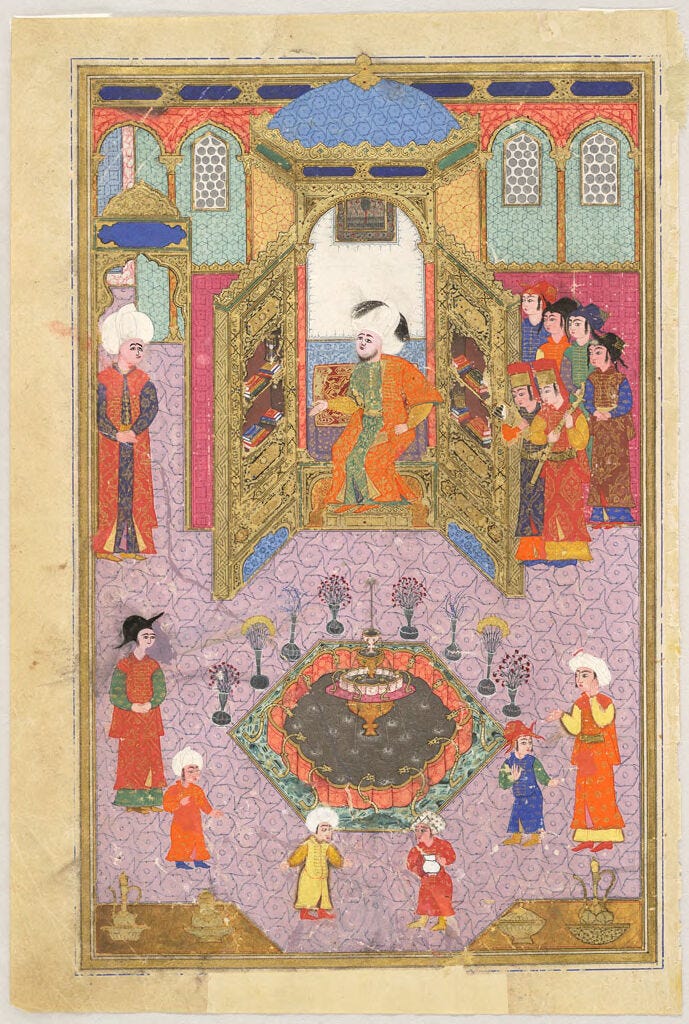
It is also important to understand how these books were produced. These manuscripts came into being through a process that involved multiple actors, including patrons, intermediaries and creators. Despite (or maybe because of) the fact that these books were aimed at a limited court audience, they were “carefully constructed to shape social hierarchies.” (p.60) The books told the current and future elite of the empire how the Ottoman state functioned and what their own position was.
Here is how the production process worked: Either a patron would commission a work from an author, or an author would compose a work to gain the favors of a privileged patron. Between the patron and the author were intermediaries, whose views seeped into and shaped the final narrative. Once a text was approved for illustration, “a team of artists, scribes, illuminators, and binders worked together to prepare the final copy.” (p.71) The patrons and intermediaries were also involved in this stage, determining which illustrations would be painted and how, and where they would be in the book. Fortunately for us, some of these manuscripts, like Shahnama-i Salim Khan, the official history of Selim II’s reign, survive in multiple draft formats in libraries around the world, which allows us to trace the multiple stages of a project and how it evolved over time following decisions and inputs from various actors (p.75-76).
The key point that Fetvacı makes is to challenge the conventional narratives and convincingly show that by the end of the sixteenth century, the sultan’s monopoly over patronage was broken and shared by other members of the Ottoman ruling elite. Members of the court as well as the bureaucracy and military could also commission books through the imperial workshop, using the same resources to which the sultan had sole access earlier. What this meant was that by the 1590s, these books emerged as dynamic objects where different visions of the state order were put forward, contested, and depicted. In short, when we look at a great Ottoman illustrated history from the late sixteenth century, we are not looking at a single message dictated from the throne. We are looking at a negotiated object (p.95-98)
One major figure who commissioned illustrated manuscripts in the late sixteenth century was the renowned Ottoman statesman Sokollu Mehmed Pasha. Sokollu served three sultans (Süleyman I, Selim II and Murad III) as grand vizier from 1565 to his assassination in 1579. Contrary to popular opinion, which only underlines the role of the sultans, Fetvacı credits the development of Ottoman historical genre to Sokollu’s patronage in the 1570s. This was especially the case after the appointment of Seyyid Lokman, a protégé of the grand vizier, to the post of official historian of the Ottoman court, which, Fetvacı argues, gave Sokollu the influence over “recording and visualization of Ottoman history” (p.101).
Sokollu was one of the earliest courtiers to harness the propaganda potential of illustrated histories in crafting his own self-image and legacy. (p.102) His patronage came at a time when a sense of troubling times was in the air for the empire, with the Ottoman intellectuals harkening to the reign of Süleyman I as a “golden age.” Sokollu, who became a grand vizier of Süleyman in 1565, was seen as a representative of that glorious period. Sokollu, in turn, used this image of himself to encourage the recording and depiction of Süleyman’s reign, with him playing a prominent role in the narrative.
The first striking example in this vein was Fütuhat-i jamila (Admirable Conquests), which was the story of the 1551 Ottoman conquests of several castles from the Habsburgs. The book depicts Sokollu, who was only a vizier at the time, as the protagonist of the whole narrative, “with his calm and controlled demeanor and military skill, representing the sultan in whose name he was waging war, conquering castles, treating defeated enemies with justice and composure.” (p.107). Kara Ahmed Pasha, under whose command Sokollu officially was, is scarcely mentioned. Even more tellingly, the re-conquest of Lipva by the Habsburgs, which took place during the same campaign, is casually omitted because it would have reflected poorly on Sokollu’s performance.
Another manuscript, produced ten years later, follows a similar pattern. Nüzhetü’l ahbar der sefer-i Sigetvar (The Joyful Chronicle of the Szigetvar Campaign) depicts Sultan Süleyman’s last campaign against the Habsburgs. The ailing sultan died before the campaign was completed and it fell to Sokollu, who had become a grand vizier and a royal son-in-law by this point, to ensure the victory and a peaceful transformation of power to Süleyman’s son Selim II.
Sokollu commissioned this book to emphasize these roles he had played. The book, for instance, depicts him on horseback going towards the castle to inspect it on the sultan’s behalf. Once Süleyman is dead, we see Sokollu making the funeral arrangements and taking the necessary precautions to prevent the soldiers from learning about the sultan’s death before Selim II is securely in place on the throne. Once Selim II enters the scene, Sokollu’s role is subordinated to him. The imperial order is secured, and it is Sokollu who secures it.
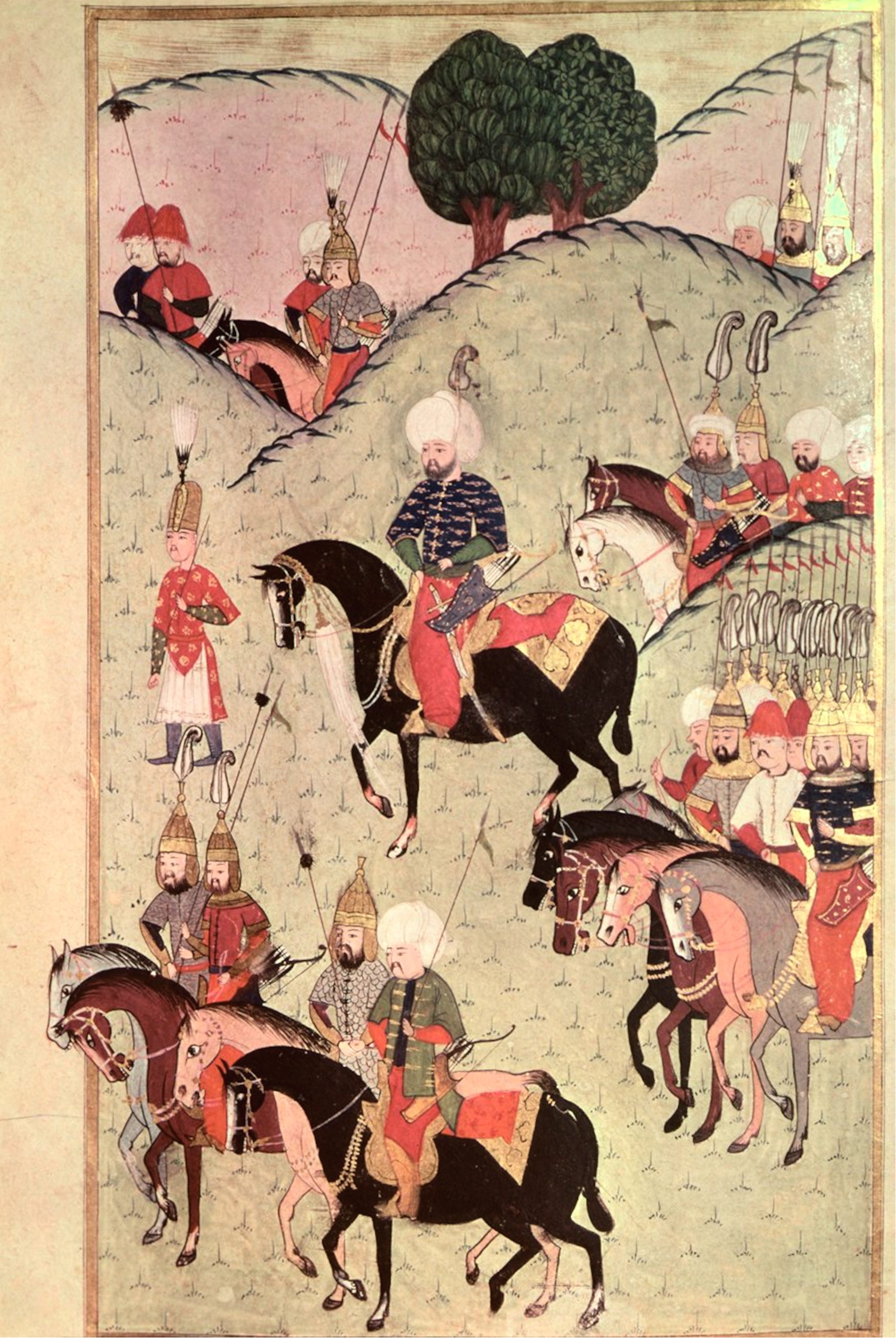
The key point that Fetvacı is making about Sokollu’s manuscripts is the idea that he did not commission works that blatantly glorified himself. Instead, Sokollu did something much more subtle, working from within the system and underlining his own position as the grand vizier within the (imagined) ideal order. These manuscripts were a strong reflection of the increasing role that the grand vizier had begun to play in the Ottoman state order in the late sixteenth century as the sultan became more of a secluded figure (p.102)
Sokollu’s program to fashion his self-image for posterity came to an abrupt end, however, when he was assassinated in 1579. What happens after that is fascinating to observe. Before his death, Sokollu commissioned a book titled Shahnama-i Salim Khan, which was the official history of Selim II’s reign. Sokollu put his protégé Seyyid Lokman on the job. The manuscript survives in multiple drafts, which allow us to trace how it evolved.
The earlier drafts, for instance, include the above mentioned account of Szigetvar Campaign, in which Sokollu played a key role (p.129). But the finished manuscript, completed in 1581, two years after Sokollu’s death, omits this narrative altogether. Instead, we see the praise redistributed more equitably among the viziers, while “the collectivity of the Ottoman court” is more heavily emphasized. In other words, the book was literally rewritten to reflect the new political reality of the 1580s. What this tells us is that these manuscripts were not static records. They were political instruments, and they could be, and often were, revised to serve whoever held power at the moment of completion.
Another indication of shifting political dynamics in the Ottoman court during this time was the emergence of new actors in Ottoman politics. This was mostly correlated to the increasing seclusion of Ottoman sultans in the Topkapı Palace. As a result, the sultan’s inner household (the individuals who were closest to him) began to gain unprecedented power and influence, including the sultan’s tutor, his spiritual advisor, and the members of the dynasty. The sultan increasingly relied on the figures closest to him to “establish his personal control over the running of the state.” (p.149)
One key figure in this group of newly powerful actors was the chief black eunuch, the highest-ranking servant of the imperial harem who supervised who went in and out of the harem quarters. Fetvacı focuses on the career and patronage of Chief Black Eunuch Mehmed Agha who held this position between 1574 and 1590. Not only was Mehmed Agha a supervisor of imperial commissions, but he was a patron of arts himself. Fetvacı demonstrates how the manuscripts that he commissioned emphasized the sultan’s piety, lineage, justice, and generosity. This was very much in line with the political theory and political developments of the time, reflecting the shift away from a sultan legitimizing his rule through fighting prowess or conquests on the battlefield.
This change in the understanding of the sultanate is clearly legible in Zübdetü’t-tevarih (The Quintessence of History). This book was a universal history written to trace the genealogy of the Ottoman dynasty back to Noah. It was produced in 1583, under the rule of Murad III, and the supervision of Mehmed Agha. In the book, Murad and the Ottoman rulers before him are portrayed as legitimate heirs to the prophets and “imbued with virtues like piety, leadership, generosity, and justice.” (p.164)
The manuscript reflects the profound shift in the discourse of legitimacy that the Ottoman Empire witnessed at the time. Especially from the mid-sixteenth century onwards, the Ottoman Empire increasingly moved from a warrior-conqueror state towards a sedentary-bureaucratic one. One key result of this change was the fact that the sultans were much more secluded in the palace, leaving the day-to-day running of the empire to the imperial household and bureaucracy. As a result, the legitimacy of the sultan came to depend not on his abilities on the battlefield, but on his inner qualities like piety and wisdom. As Fetvacı puts it, the sultan was “thus the sultan not for what he does but for who he[was]. It [was] no longer his deeds that legitimize his right to rule but rather his lineage, both dynastic and spiritual.” (p.175) By the end of the sixteenth century, the rulership became a God-given right bestowed upon the Ottoman dynasty.
The rise of these new political actors also led to proliferation of competing narratives about the ideal representation of the Ottoman state. The military-administrative elite of the empire, for instance, were not happy about the influence that figures like Mehmed Agha were acquiring. To protect his position and stake his own claims to power, Mehmed Agha turned to commissioning illustrated manuscripts that underlined his prominent role in the new court hierarchy.
In Shahanshahnama (Book of King of Kings), which narrates the story of the reign of Murad III, we see Mehmed Agha as one of the key protagonists of the narrative. As Fetvacı points out, Mehmed Agha is depicted as going to see Sokollu Mehmed Pasha on his death bed; inspecting Sokollu’s wound and giving the news of the grand vizier’s death to the sultan (p.153-154). Contrary to the conventional depiction of eunuchs in earlier Ottoman manuscripts, which portray them in subordinate positions, Mehmed Agha also takes the central stage in these scenes (p.155-156). He is acting as the sultan’s agent (supplanting the grand vizier’s role) to catch the assassins of Sokollu and “is depicted as the most senior figure in paintings that also feature a future grand vizier and the chief of the janissaries, both of which are very important positions in the court and military bureaucracy” (p.158). In short, the manuscript reflected the change in the court’s structure while also helping Mehmed Agha to secure his position within it.
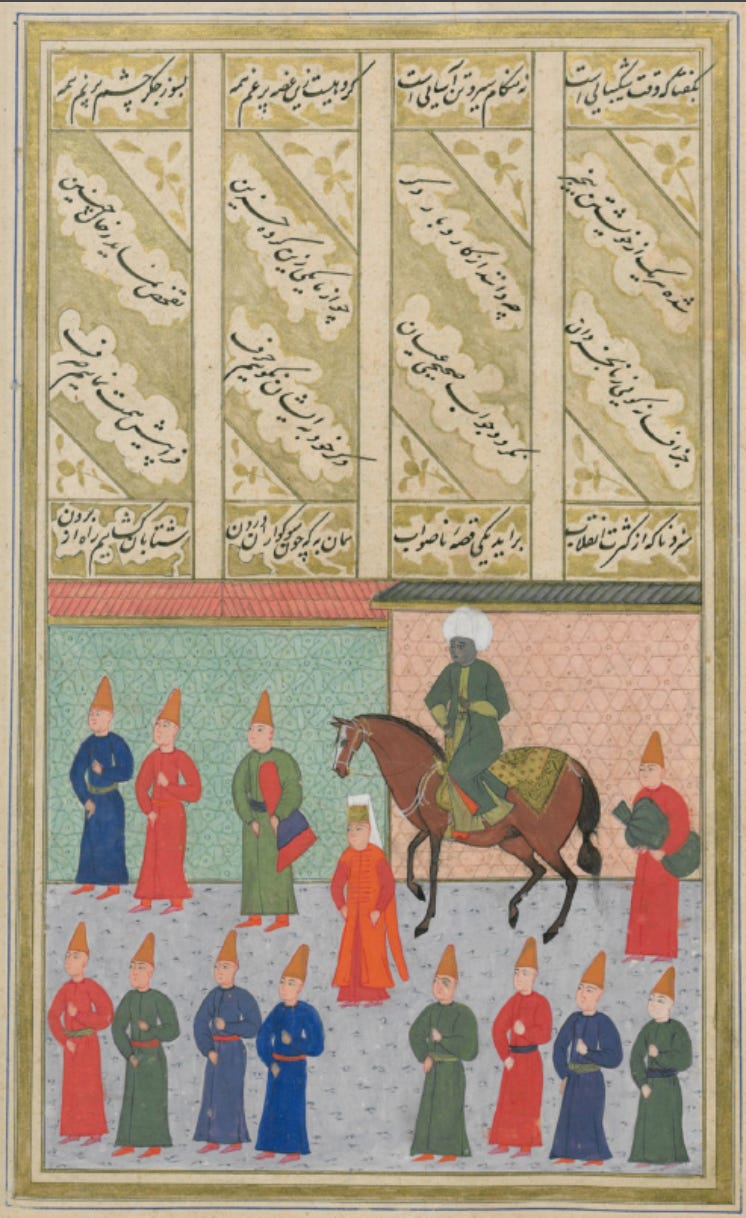
Threatened by the rise of these new political actors, the military-administrative elite responded by creating their own version of the ideal Ottoman state through illustrated histories. The end of the sixteenth century witnessed the production of many gazaname books, which were narrative accounts of a single campaign or a single, usually non-royal, commander. Prominent examples of this genre included Gencine-i feth-i Gence (Treasury of the Conquest of Ganja), Gürcistan Seferi (Georgian Campaign), Şeca’atname (Book of Valor), and Nusretname (Book of Victory), which I’ll go into in more detail below. Not surprisingly, their focus is on the members of the Ottoman military and administrative elite, and they offer a counterbalance to the narratives that privileged the sultan’s household.
Fetvacı draws attention to the fact that, unlike the other chronicles mentioned above, the gazaname manuscripts were not written by the official court historians. This led to the emergence of multiple and divergent perspectives on the history of the empire. Moreover, the production processes of these books attest to multiple patronage relationships and patterns. The language of these works, either verbal or visual, is not unified, in contrast to the unified style of the books produced by the Ottoman court.
Nusretname, which tells the story of Lala Mustafa Pasha’s campaigns against the Safavids between 1578-1580, is a case in point. The book was written by the renowned Ottoman historian Mustafa Âli, who had been Lala Mustafa Pasha’s secretary during the campaign. The manuscript was then presented to Sultan Murad III, thanks to the efforts of the Chief White Eunuch Gazanfer Agha, who made sure that it was lavishly illustrated.
Nusretname positions the military elite as “the true executors of the sultan’s will, the real extensions of his grace.” (p.209) The way Lala Mustafa Pasha and his subordinate in the campaign, Osman Pasha, are depicted in the book closely parallels the way Ottoman sultan and his lieutenants are depicted in the courtly histories such as Shahnama-i Salim Khan. “Parallels between the relationship of Lala Mustafa Pasha and Osman Pasha to Sultan Murad III and his viziers,” Fetvacı writes, “contribute to a reading of the book that implies the military elite are the true shadows of the sultan and mirror him right down to the level of his relationships.” (p.209) All these books, including Nusretname, “underscore[d] the primacy of the military elite, and attempt[ed] to redress the power balance against the ascendancy of the extended household in court politics.” (p.210)
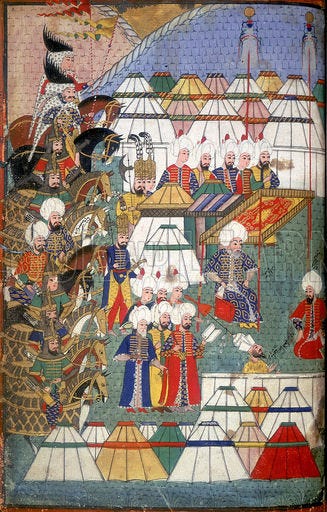
Why would Gazanfer Agha, the Chief White Eunuch and a member of the sultan’s household, patronize a book that glorified the role of the military elite? This was not as unusual as it sounds. In fact, household servants used their patronage activities to install their own candidates in influential positions within the imperial hierarchy.
Gazanfer Agha was a fascinating figure of the late sixteenth century Ottoman history. Born in Venice, he and his brother were captured by the Ottoman forces in Albania and brought to the palace to be educated there. When Selim II ascended to the throne, he asked the two brothers whether they would be willing to get castrated to enter his inner court. Both brothers agreed and while Cafer, Gazanfer’s brother, did not survive the operation, Gazanfer did. He then went on to serve as Chief White Eunuch for the next thirty years, becoming one of the most influential personages in the Ottoman court (pp.240-241).
Commissioning lavishly illustrated histories, Fetvacı claims, gave Gazanfer Agha the means to fashion himself as a true Ottoman. Through his patronage, Gazanfer Agha became “a Venetian Ottomanized.” (p.239) On the flip side of the coin, the generosity and protection that Gazanfer Agha demonstrated towards authors, poets, and artists contributed to the emergence of a distinct Ottoman court culture at the turn of the seventeenth century.
Fetvacı demonstrates how Gazanfer Agha’s patronage activities also had a very real political side to them. Nusretname, for instance, extolled the virtues of Özdemiroğlu Osman Pasha, whom the book depicts in a very favorable light and who went on to become the grand vizier, despite opposition from other members of the Ottoman court. Osman Pasha was an ally of Gazanfer Agha in the factionalized court politics, and the manuscript was a key part of Gazanfer Agha’s efforts to help him advance his position in the imperial hierarchy. Through Osman Pasha, Gazanfer Agha hoped to strengthen his position in the court, which explains why a member of the sultan’s inner household would patronize a book that underlined the military nature of the Ottoman state.
Emine Fetvacı’s Picturing History at the Ottoman Court is a truly valuable study, demonstrating how the changes that took place in Ottoman politics at the end of the sixteenth century manifested themselves in the artistic domain. Just as the sultanic authority was contested by old and new actors, the Ottoman ruler also lost his monopoly over patronage relationships, which became more and more diverse. Competing understandings of what an ideal Ottoman state was and how it should be represented existed simultaneously in the discursive field, with the patrons staking their own political claims through the lavishly illustrated manuscripts. While some did this in more subtle ways, working from inside the system, others made sure that their newfound position was depicted as being there from the very beginning. Despite having a unitary style, these Ottoman manuscripts carried different messages both for the small circle of contemporaries who could act on them and for posterity.
The main weakness of Fetvacı’s book is the dearth of analysis of the structural changes that were going on at the time. She correctly identifies, for instance, that the sultans became gradually more secluded in the imperial palace and that, by the end of the sixteenth century, members of the sultan’s inner household gained more power and influence. She does not truly explain why this was the case though, relying mostly on the changing ideological currents that gained ground in the late sixteenth century. She does not sufficiently engage with the structural explanations laid out by scholars like Leslie Peirce, who examines changes in the dynastic succession, and Baki Tezcan, who focuses on monetary and social transformations. Read together, these authors give us a fuller understanding of the shifts in the balance of power that were going on in the Ottoman court.
Other than this gap, however, Fetvacı gives us an excellent study that has already become a reference point for understanding the political nature of these illustrated histories that were produced in the Ottoman Empire in the 1580s and 1590s. It is a required reading for anyone interested in how these manuscripts were produced and how they were put to use as instruments and tools of legitimation in an increasingly fluid political environment.
Thank you very much for reading. If you’d like to learn more about Ottoman and Middle Eastern history, please consider subscribing to Ottoman Encounters. It’s a zero-cost way to support my publication.
Everything here stays free to read. If you want to go further, paid subscribers get one substantial extra piece a month, curated reading lists and deep dives into people, objects, and places that shaped Ottoman and Middle Eastern history. It’s optional, and it’s what makes the free work possible.
I don’t have a financial affiliation with the publisher. All the page numbers refer to the book.
Comments
Nothing yet. Say the first thing.
Sign in to join the conversation.