
When we think of the Ottoman Empire, we usually think of the people at the top of the imperial hierarchy. The sultans, the grand viziers, the commanders on campaigns, or the women of the imperial harem.
But almost no one who lived under Ottoman rule ever saw a sultan in their lives.
Ordinary Ottomans lived in the neighborhoods (mahalle) of Istanbul, Cairo, Aleppo, and Salonica. They worked in guilds, bargained in markets, and prayed in mosques paid for by charitable endowments (vakıf). They drank coffee and smoked tobacco in coffeehouses and argued there about everything the state would have preferred they didn’t. They married, buried their dead, told stories, and worried about the price of bread.
This is the empire I want to spend five weeks on.
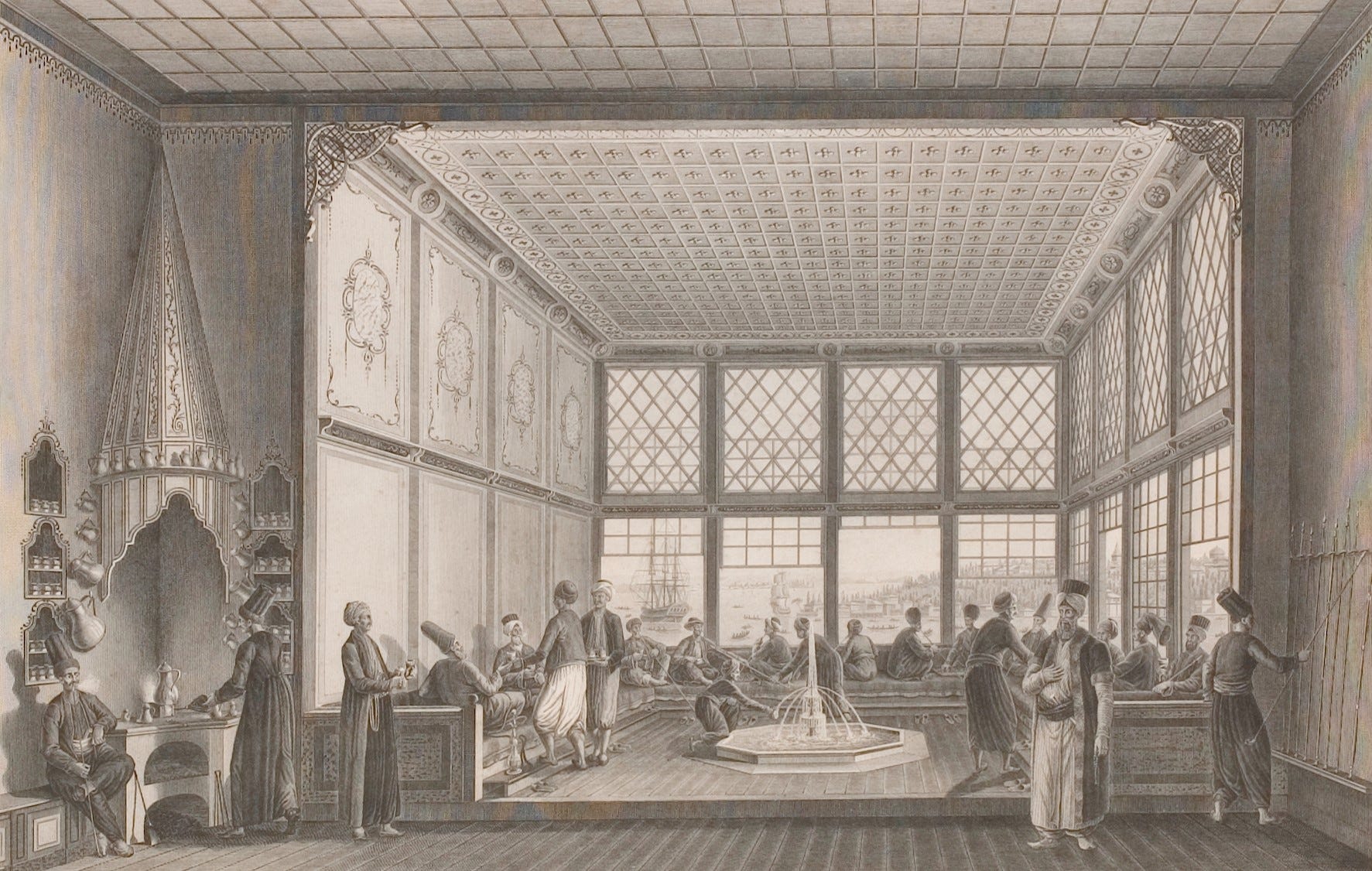
Daily life is not the soft or lesser version of “real” history. It is where you grasp how the Ottoman Empire actually worked. You cannot understand Ottoman power without understanding the household, the guild, the market, and the mosque, since those were the institutions most people actually dealt with. It is also where the clichés fall apart. The harem, to take the most obvious example, was not a den of cruelty and debauchery, as it was often depicted in European art. It was a working household with its own hierarchy, its own routes to advancement, and real political influence. Ottoman daily life was neither exotic nor timeless. It was specific, and it changed over time.
So I am teaching a five-week live mini-class on it, beginning Thursday 3 September at 7pm UK time. Each week I will lecture for about an hour on one part of ordinary life, and then we open the floor for questions and discussion. No prior knowledge is needed. There is a recommended book, Suraiya Faroqhi’s Subjects of the Sultan: Culture and Daily Life in the Ottoman Empire, but it is optional. The class stands on its own.
1. The structure of Ottoman life. How society was ordered, who owed what to whom, and where an ordinary person stood in it.
2. Women’s lives. How Ottomans understood their own world, and the legal and economic lives of Ottoman women, the harem included, on their own terms.
3. The urban environment. The neighborhood, the market, and the pious foundations that paid for much of urban life, in the age of the architect Sinan (c. 1490-1588).
4. Public festivals and crafts. Imperial festivals, guild processions, and the objects people made, sold, and used.
5. Ottoman sociability. Storytellers, coffeehouses, poetry, and the life of the table.
Five Thursdays: 3, 10, 17, 24 September and 1 October, 7pm UK time. Each session runs about 60 to 75 minutes. All sessions will be recorded on Zoom and shared with participants
Price: £85 for the full course, or £75 with code “EARLYBIRD” at checkout through 20 August.
The book (Faroqhi) is optional, not required.
Sign up here: ottomanencounters.com/seminars/daily-life
Most Ottoman history has been written from the top down. For five weeks this autumn, I want to look at it from the ground up, and examine the empire from the level of the street, the kitchen, and the coffeehouse.
I hope you will join me.
Thank you very much for reading. If you’d like to learn more about Ottoman and Middle Eastern history, please consider subscribing to Ottoman Encounters. It’s a zero-cost way to support my publication.
Everything here stays free to read. If you want to go further, paid subscribers get one substantial extra piece a month, curated reading lists and deep dives into people, objects, and places that shaped Ottoman and Middle Eastern history. It’s optional, and it’s what makes the free work possible.
Comments
Nothing yet. Say the first thing.
Sign in to join the conversation.