
A few months ago, a CISO told me something that stuck:
“We spend more time proving compliance than actually being compliant.”
That’s the modern audit struggle in one sentence.
Every company moving to AWS eventually faces the same reality: frameworks like SOC 2, ISO 27001, and HIPAA don’t just care what your environment was—they care what it is, right now.
The problem is that most audit prep still revolves around static reports. You run an assessment, export a PDF, send it to your auditor, and breathe a sigh of relief…until something changes in production the next day (which it always does in the cloud).
That’s where AWS Audit Manager steps in. It’s AWS’ attempt to move compliance beyond spreadsheets, screenshots, and last-minute evidence hunts.
Audit Manager automates evidence collection across AWS-native services like Config, CloudTrail, and Security Hub. It continuously pulls configuration data, access logs, and security findings, then maps that evidence to compliance frameworks including SOC 2, ISO 27001, PCI DSS, NIST 800-53, and HIPAA.
You get dashboards, automated control mappings, and downloadable audit reports.
But while Audit Manager collects evidence continuously, each assessment still operates within a defined scope and time window. Once an assessment period ends, the collected evidence is frozen for that report, and the next assessment starts fresh. So it automates compliance prep and monitoring inside AWS, but it doesn’t deliver a fully real-time compliance posture.
Audit Manager’s pricing can add up quickly. AWS charges based on the number of resource assessments executed, not strictly per resource or framework.
Pricing starts at $1.25 per 1,000 resource assessments in a given account and region, but because evidence is collected across multiple controls and frameworks, costs scale with the number of resources, services, and frameworks you monitor.
For larger environments—say, thousands of resources across multiple frameworks—that can still translate into tens of thousands per year before adding engineering time for setup, control mapping, and manual evidence validation. Plus, no one really knows how many resources they have or which ones count, so this is an ambiguous way to measure the cost. And because the number of resources is always changing, your costs from one audit to the next will vary.
✅ Automated evidence collection — finally, a break from the screenshot scavenger hunt.
✅ Continuous visibility — compliance posture that updates as your infrastructure changes.
✅ Cross-team collaboration — auditors, engineers, and compliance folks can actually work in the same tool.
✅ Scalable — built for multi-account environments that would otherwise drown in manual checks.
Here’s the part AWS won’t lead with.
It’s AWS-only — if you’re running hybrid workloads or SaaS integrations, you’ll need extra tooling.
Evidence customization is limited — you can define frameworks, but the data still comes from AWS sources.
No remediation — it identifies gaps but doesn’t fix them. You’ll need Config, Security Hub, or custom automation for that.
Cost escalates fast — at roughly $1.25 per 1,000 resources per framework per month, ongoing compliance at scale gets expensive.
Setup takes time — mapping controls and defining scope requires real collaboration between teams.
It’s a strong, albeit expensive service, but still not your full strategy.
A quick note on another critical compliance service: AWS Artifact. It provides static compliance reports (e.g., SOC 2, ISO) for AWS infrastructure, useful for demonstrating AWS’s security posture to customers and auditors.
Here’s the simple breakdown:
Artifact tells you whether AWS is compliant.
Audit Manager tells you whether you are compliant on AWS.
They complement each other, but only Audit Manager gets you closer to your own audit readiness.
AWS Audit Manager is a solid foundation. It automates the grunt work and gives compliance leaders a live dashboard instead of a spreadsheet.
But it’s not the full picture because it’s not ongoing. And most likely, you’re only going to run it (and pay for it) periodically. Compliance nowadays doesn’t stop at collecting evidence. It’s all about staying audit-ready continuously across teams, accounts, and frameworks.
At Stratus10, we built Kalos for our clients to close that gap. They get real-time compliance scores across multiple security frameworks, paired with prioritized risk insights, and blended with FinOps visibility. Teams manage spend, usage, and compliance in one place.
And it’s completely free for CIS monitoring and cost visibility (full disclosure: streamed usage data and additional compliance frameworks available on a paid tier).
For the engineers and managers of the world, here’s your prioritized security remediation task visual (NOT a laundry list). This security risk impact analysis graph shows your risks, filtered by severity, and how each compliance framework is affected. Need to get SOC 2, GDPR, and PCI scores up? Hone in on that risk remediation (in this example, “ensure only hardware MFA is enabled for the root account”) and you’re a step closer to compliant. By knowing exactly which risks affect compliance, you eliminate the guesswork in the remediation process, and no team member is tasked with addressing (let alone reading) that 50+ page risk resport.
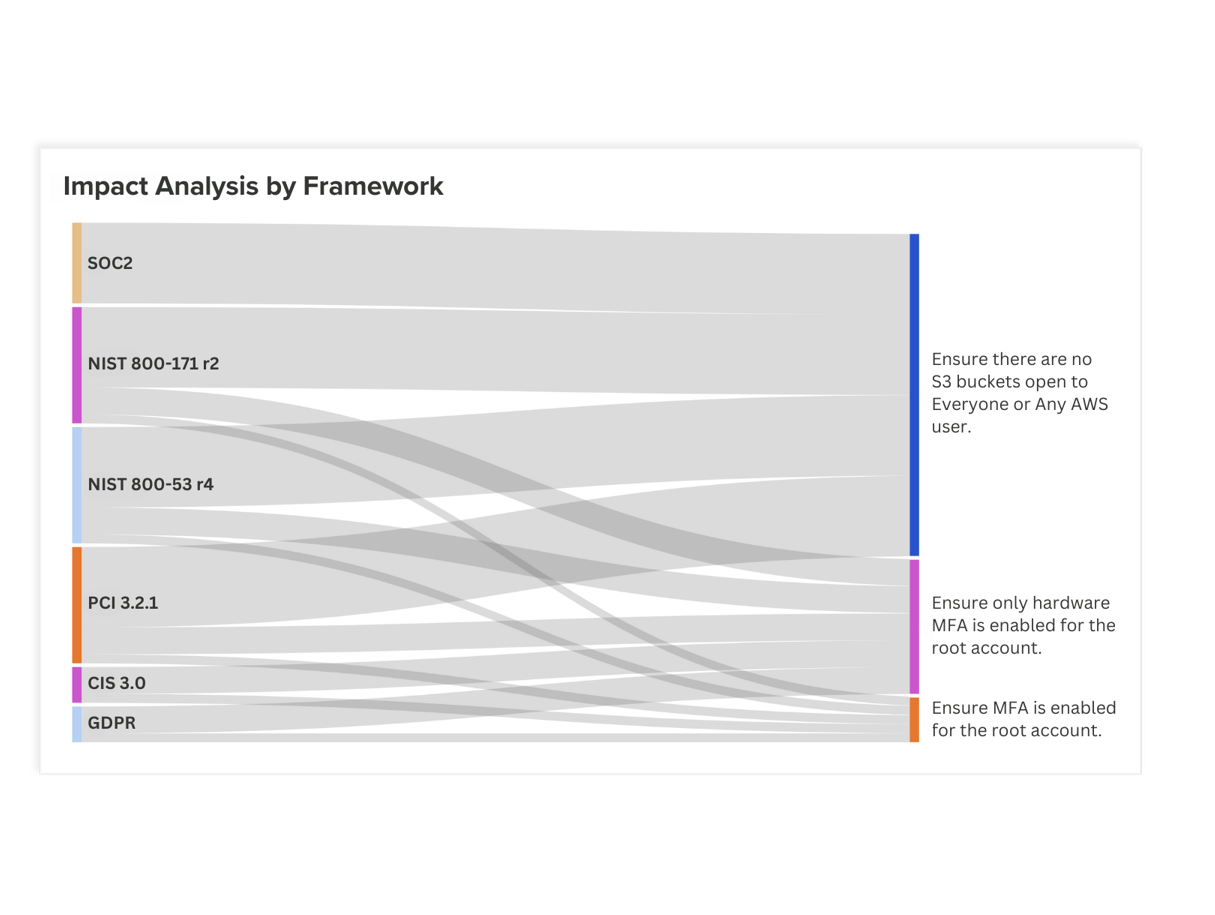
BTW, this compliance impact analysis is included in the free trial. Shoot me an email mentioning this post and I’ll extend your free trial.
AWS Audit Manager is a strong foundation for audit readiness in AWS, but it’s not a full compliance posture management platform. It helps you prove compliance faster, but staying compliant still takes ongoing visibility, remediation, and context beyond what Audit Manager can see.
For a free tool that provides continuous security compliance monitoring for your AWS environment, check out Kalos.
Comments
Nothing yet. Say the first thing.
Sign in to join the conversation.