
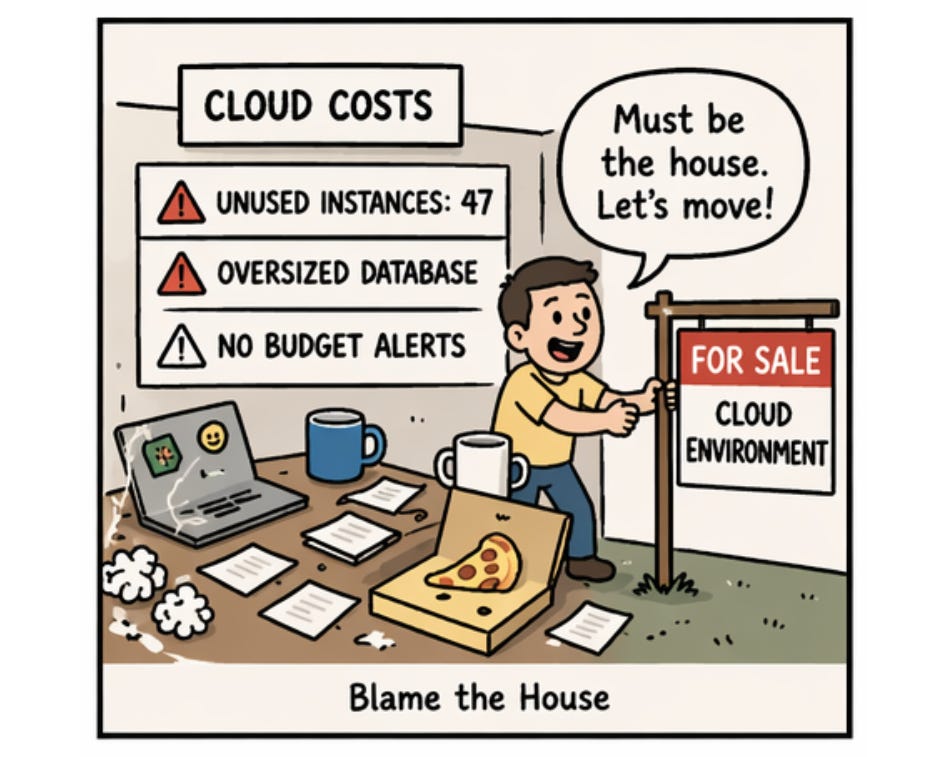
Cloud repatriation is showing up in more conversations right now, but not always for the reasons people think.
The triggers are usually the same:
Costs are climbing faster than expected
Forecasting breaks down
Finance wants answers
Engineering is under pressure to respond
At some point, someone asks: should we move out of the cloud? That question is valid. But in most cases, it is being asked too early.
Cloud repatriation, aka moving workloads from the public cloud back to on-premises or hybrid infrastructure, is often treated as a corrective action. Sometimes it is, but more often it is a signal that something upstream was misaligned or, frankly, just poorly planned.
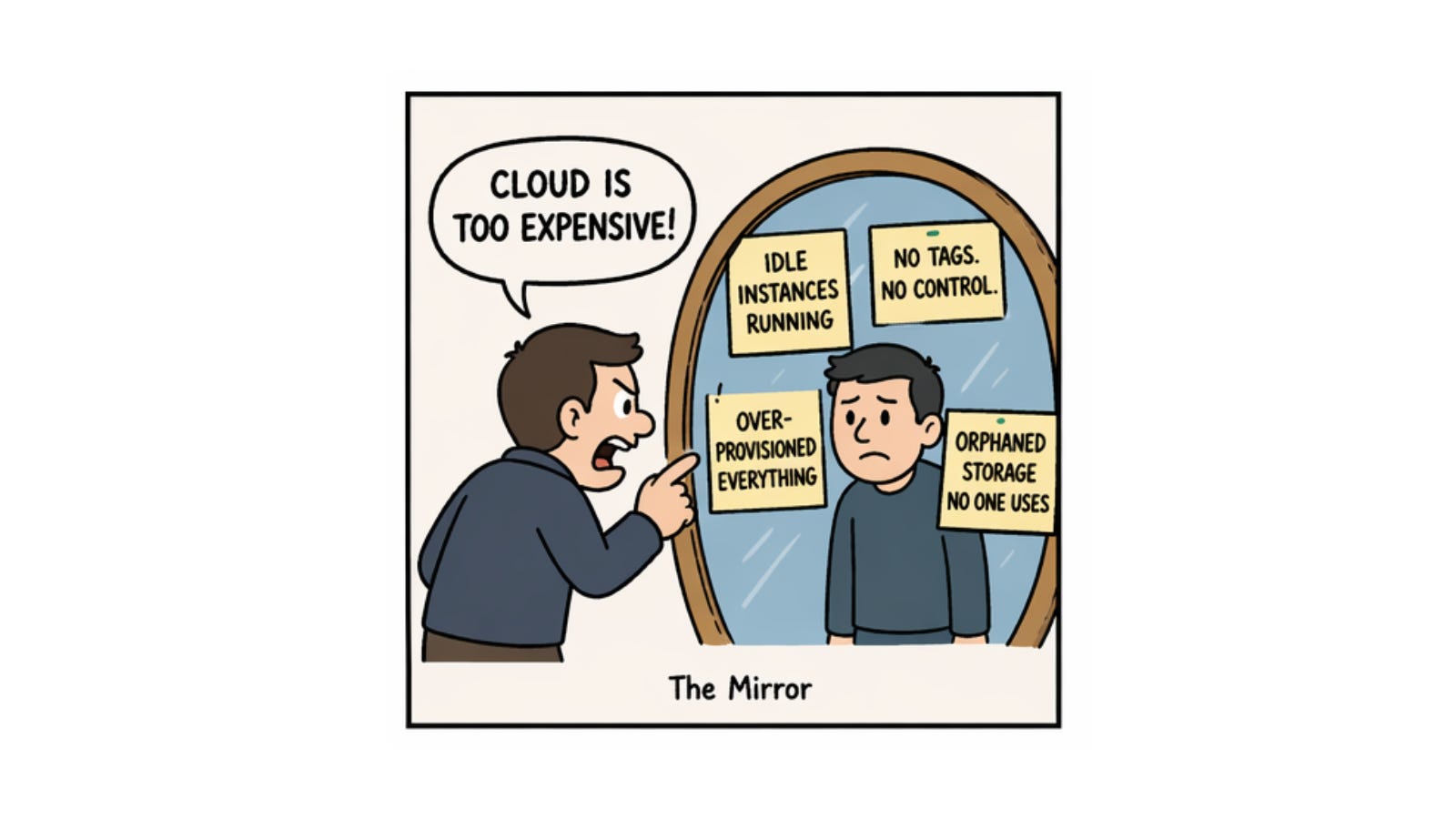
From experience working in AWS-heavy environments, the issue is rarely that the cloud itself is failing. The issue is that workloads were moved without enough scrutiny, or environments were never optimized after the fact.
That distinction determines whether repatriation is a solution or just another expensive move layered on top of the first one.
The cloud delivers what it promises early on: speed, flexibility, and reduced operational overhead. That is why adoption accelerated. What gets underestimated is how costs behave as systems scale.
Cloud pricing is consumption-based, which creates flexibility, but it also introduces variability. As environments grow, so does the surface area for inefficiency. Without strong governance, variability turns into unpredictability.
That is when organizations start looking for control again… and cloud repatriation becomes part of that conversation.
There is also a structural reality that needs to be acknowledged. Cloud providers are incentivized to keep workloads in their environments. Pricing models, service design, and ecosystem tooling all reinforce that direction. Leaving is possible, but not frictionless. That does not make repatriation wrong, but it means the decision should be made with full awareness of the system dynamics involved.
There is one more factor that shapes these conversations, and it is often the loudest one in the room. Cost growth is not the same as cost waste. Executives tend to look at the monthly bill. That is what lands on their desk and what gets questioned. What they usually do not see is why the bill changed. A team can make significant progress on optimization, decommissioning idle resources, right-sizing instances, tightening storage policies, and the bill can still go up because new workloads shipped, a new application launched, or a successful product pulled more traffic. Before repatriation gets on the whiteboard, leadership needs the visibility to tell cost growth vs. cost waste apart.
Most repatriation discussions are reactive. Rising costs seem uncontrollable and the cause is the cloud. A major cost spike triggers urgency. Leadership pushes for action. Teams look to reduce spend.
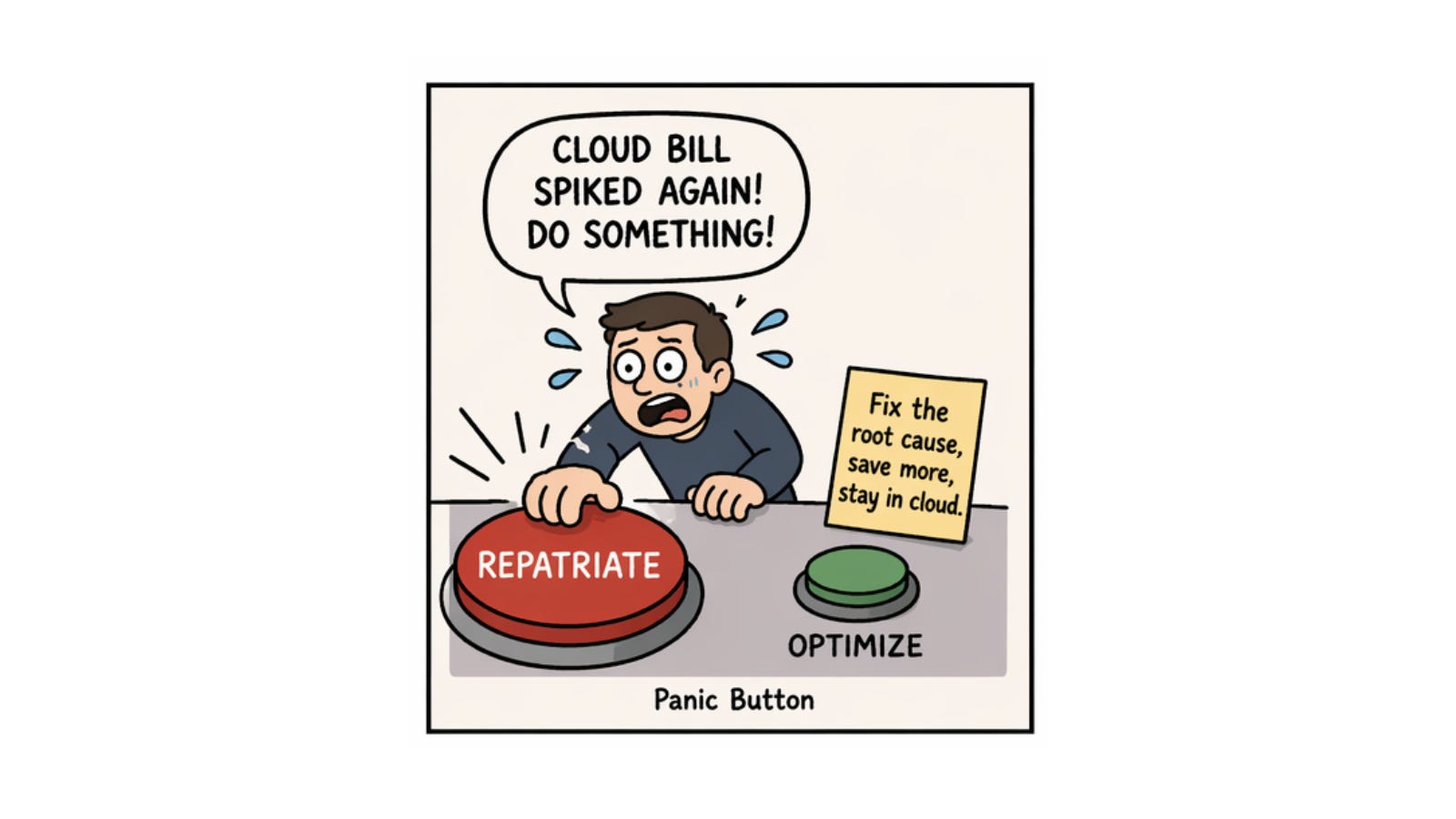
That leads to a flawed assumption: the environment is already optimized, so the cloud must be the problem.
Strategic repatriation looks quite different. It starts at the workload level, asking how each system behaves, what it costs, and what it actually needs. From there, placement decisions follow.
The objective is not to exit the cloud,but to stop misplacing workloads. It’s to uncover if workloads were moved to the cloud that never should have been migrated in the first place.
Before making any move toward cloud repatriation, you need a clear picture of your current environment. Most organizations do not have one.
You need to know what is running, how it is being used, and what is driving cost. That includes compute utilization, storage patterns, data transfer, and idle resources. It also includes how those metrics change over time.
When this analysis is done properly, the same issues tend to surface:
overprovisioned instances, unused services, misconfigured resources, and unclear ownership.
These are not edge cases. They are systemic. They are also fixable without repatriation.
One of the more consistent findings in these assessments is simple: some workloads were never good candidates for the cloud.
Workloads that run continuously at high utilization may not benefit from cloud elasticity. They incur cost without using the flexibility they are paying for.
Large datasets that are accessed frequently are a good example. Storing them in the cloud and pulling against them constantly means paying for egress over and over, and at scale that math gets ugly fast. That is a workload that is often better off on-prem. To be direct: it is also a workload that probably should not have been moved to the cloud in the first place. The cloud did not fail it; the placement decision did.
Then there are legacy applications that were lifted and shifted without being redesigned. These tend to carry all the cost characteristics of the cloud with none of the architectural benefits.
This is where cloud repatriation makes sense, but only for those specific workloads. The mistake is treating repatriation as an all-or-nothing decision instead of a targeted correction.
Before anything gets moved out of the cloud, the environment needs to be optimized because this is where most of the immediate cost reduction lives.
Right-sizing alone, aka aligning resources with actual usage, can materially reduce spend. Many environments are significantly overprovisioned.
In AWS, mechanisms like Reserved Instances, Savings Plans, and Spot pricing can further reduce cost when applied correctly. The word that matters there is correctly. These mechanisms stack, but they also overlap, and overlap is where organizations quietly pay more instead of less.
A Savings Plan applied on top of Reserved Instances that already cover the same capacity does not compound the discount; it dilutes it.
Spot used without a clear workload tolerance creates operational risk that cancels the savings.
Right-sizing after committing to a three-year Reserved Instance locks the wrong baseline in place.
Understanding the entire cost strategy as a whole — how RIs, Savings Plans, Spot, and right-sizing interact — is what separates a savings number on a slide from a savings number in the bill. This is the work we call a commitment strategy, and it is usually where the biggest near-term savings live in environments that have been on AWS for more than a year.
If you already know your environment is overprovisioned and you want a straight answer on what a properly layered cost strategy would save you, reach out. One working session is usually enough to see whether your current commitments are stacking or canceling each other out. info@stratus10.com.
Storage optimization and lifecycle policies add another layer of efficiency.
Once this work is done, the economics of the environment often look very different. In many cases, the urgency around cloud repatriation fades after optimization.
The binary framing—cloud versus on-premises—is part of the problem.
Most organizations do not need to choose one. They need to place workloads deliberately across both.
Some workloads belong in the cloud. These are typically variable, scalable, and benefit from managed services. Others are predictable and consistently utilized. These are often better suited for on-premises infrastructure.
Then there is a middle category that needs to be optimized before any decision is made. This is not a compromise, but more of an accurate alignment between workload behavior and infrastructure economics.
One cost that rarely makes it into the hybrid planning conversation is the connection itself. If workloads on either side depend on each other, you need dedicated network connectivity between your cloud environment and your data center. That is not a trivial line item. Services like AWS Direct Connect are priced by port capacity and by data transferred, and the more chatty the workloads, the more that connection costs to keep running. Teams that skip past the interconnect in their planning end up either under-provisioning and hitting performance issues, or over-provisioning and quietly adding a second recurring bill next to the one they were trying to shrink. Hybrid is usually the right answer. It is not the cheap answer by default.
Cloud repatriation is often justified as a cost-saving move, but the analysis is frequently incomplete.
Moving workloads out of the cloud introduces new costs: migration effort, engineering time, potential downtime, and capital investment in infrastructure. It also reintroduces operational overhead. Hardware does not manage itself. Capacity planning, maintenance, and lifecycle management come back into scope.
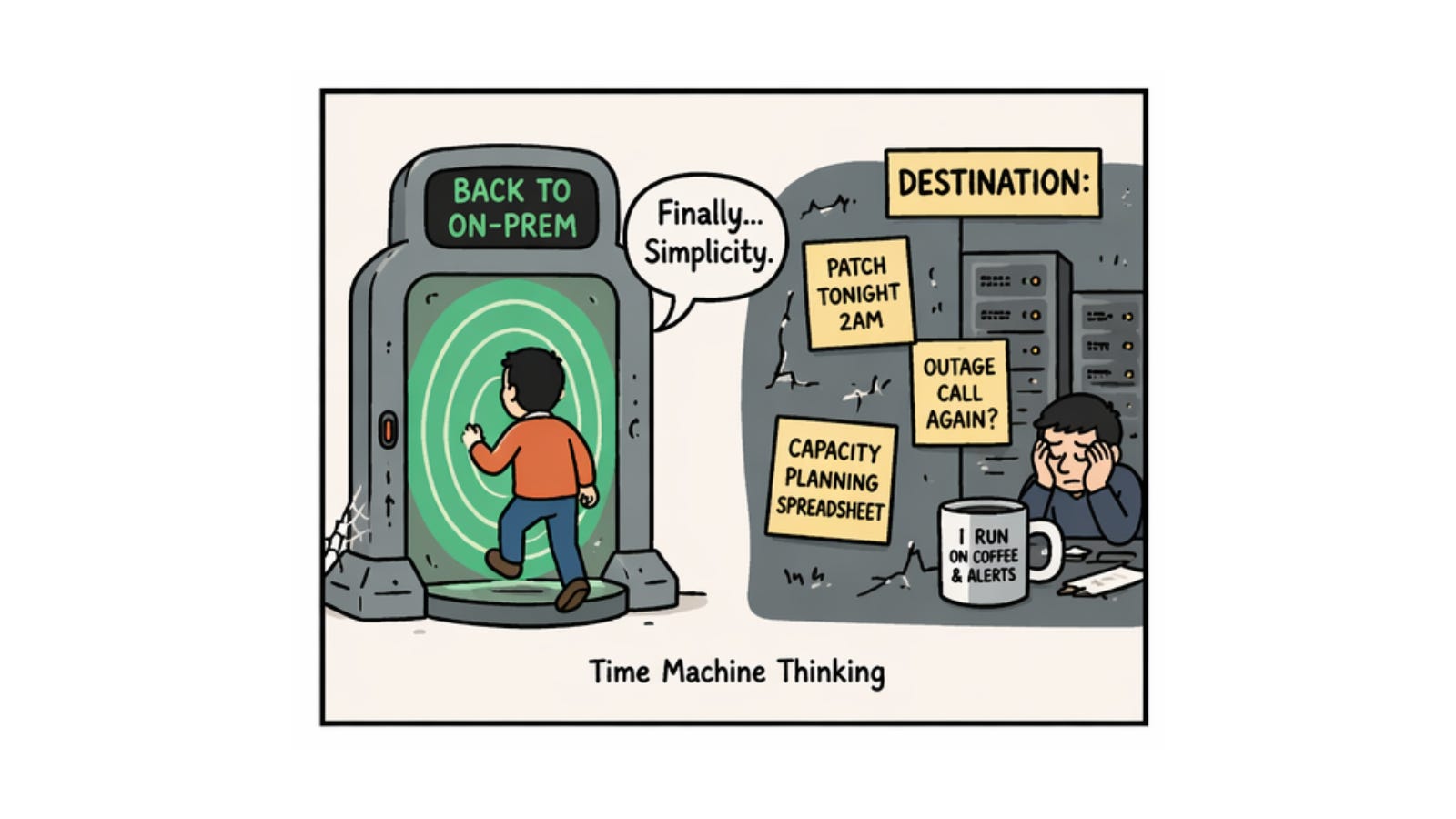
There is also an opportunity cost. Cloud environments enable speed. Repatriation can slow things down.
These factors need to be accounted for directly. Otherwise, the comparison is not accurate.
What you will have to rebuild.
Moving workloads back to on-prem is not a reverse lift-and-shift. The servers are the visible part; the iceberg underneath is everything that made those servers usable in the cloud: the network layer, backup and restore, security tooling and monitoring, data replication, automation and self-healing, the ability to scale up and down.
All of that has to be rebuilt, sourced, or licensed on the on-prem side, and none of it is optional. Teams that scope repatriation as "pull the VMs out" get blindsided six months in when the request for a replication product comes through procurement.
Cloud-native services do not have on-prem equivalents.
For any large or complex workload, repatriation also means finding an on-prem solution for every single component the cloud provider specifically supplies. Think: AWS Step Functions, API Gateway, managed queues, managed databases with point-in-time recovery, identity and access controls that integrate natively.
Each of those is either replaced with a self-hosted equivalent you now have to operate, or a commercial product you now have to license, or a custom build you now have to maintain. The substitution is almost always more expensive on a five-year view than the cloud bill it was meant to replace.
Hardware does not arrive overnight (remember?).
If repatriation means expanding your on-prem footprint, you are now on hardware lead times where orders take weeks, installation takes more, capacity planning has to anticipate demand quarters ahead instead of minutes ahead. For workloads with unpredictable growth, this is a meaningful constraint, and it is one of the specific benefits of the cloud that most repatriation business cases leave out.
Ongoing operational overhead comes back.
The people hours you reclaimed when you moved to a managed service are hours you now pay for again. Patching, hardware refreshes, vendor management, incident response on the physical layer — none of it went away, it was just someone else’s problem for a while.
Whether workloads stay in the cloud or move out, the underlying issue is usually the same: lack of cost control.
Cloud spend is not fixed. It reflects daily decisions made by engineering teams. Without visibility and accountability, costs will increase over time regardless of platform.
What is required is a system of ownership, regular review, and continuous optimization.
Call it FinOps or something else (the label is not important). Without it, any savings, whether from optimization or cloud repatriation, will not hold.
Cloud repatriation is not wrong, but the threat to repatriate due to cloud costs is overused as a first response.
For most organizations, especially outside of large enterprises, the cloud still delivers far more value than it costs when used correctly.
The issue was never about cloud adoption. It’s about misalignment:
Misaligned workloads
Misaligned architecture
Misaligned cost expectations
Fix those, and most of the pressure driving repatriation disappears.
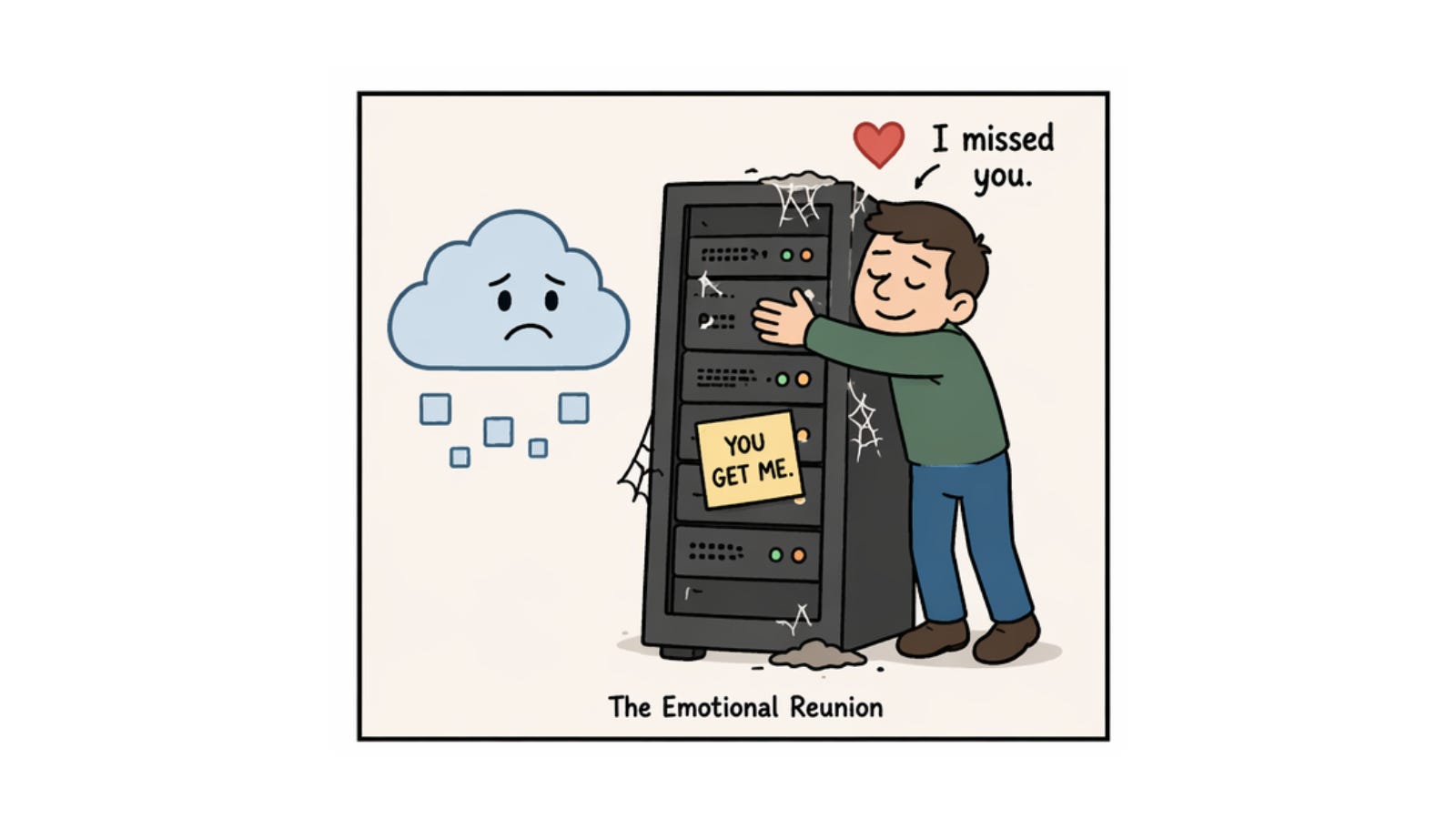
If you are seriously evaluating cloud repatriation, the highest-leverage move is not to start migrating workloads. The first move must be to understand, in detail, what you are currently running and why it costs what it does.
From there, the right actions become clearer. Some workloads may make sense to move back, but many will not. Most will need to be optimized first.
If you’re fed up with rising cloud costs and considering moving back to on-prem, I (and my team) would welcome the opportunity to help relieve your pain. There are a few ways we do this:
Immediate term: identify (and implement) quick tactics to slash cloud costs within a week as you navigate next steps. This buys time to organize your repatriation plan.
Near term: conduct an architectural assessment of your AWS environment to look for egregious cost drivers.
In a few weeks: present a full report on cloud cost drivers, security posture, performance usage, and recommendations on what to repatriate, what to keep on the cloud, what needs to be rearchitected or replatformed, and why.
Reach out to me on LinkedIn or directly at info@stratus10.com for details, whether you’re interested in #1 or all three of the above.
Cheers,
Oscar
Comments
Nothing yet. Say the first thing.
Sign in to join the conversation.