
Every year, the “Foundation for Individual Rights and Expression” (FIRE) conducts a large-scale survey of college students. Here’s how FIRE describes their latest study, from 2024: “This year’s survey includes 58,807 student respondents from 257 colleges and universities. Students who were enrolled in four-year degree programs were surveyed via the College Pulse mobile app and web portal from January 25 through June 17, 2024.” (College Pulse verifies that respondents are college students using the students’ .edu email address.)
FIRE’s focus is on assessing free speech on college campuses, but they also ask demographic questions — including questions about religion. This means that we can use FIRE’s publicly-available data to learn about Orthodox Christian students on college campuses. In this report, we will dig into the latest FIRE data.
807 of the 58,807 students surveyed by FIRE identified themselves as “Orthodox Christian.” That’s 1.37% of all students in the study — far higher than the 0.49% that we previously estimated for the general US population, based on large-scale surveys that skewed older demographically.
A different annual survey of college students, conducted by the Higher Education Research Institute at UCLA, found that 1.1% of its 2024 respondents were “Eastern Orthodox” — not far off of the FIRE number. The Orthodox share of the UCLA study has hovered around 0.9% for the past decade.
In addition, if we look only at respondents to the 2024 Cooperative Election Study who were born between 2000 and 2006 (i. e., ages 18-24), 1.0% were Orthodox.
Roughly 16 million students are enrolled as undergraduates at US colleges. If the FIRE and UCLA studies are to be believed, somewhere around 200,000 of them are Orthodox — although this number would include some non-Chalcedonians (“Oriental Orthodox”).
For comparison, only 15% of the FIRE respondents identified as Catholic. Compare that to PEW, which was 20% Catholic. Most surveys tend to estimate the Catholic share of the US population at around 19- 25%. In other words, compared to the average American, college students are notably less likely to be Catholic, but are far more likely to be Orthodox.
If we look more broadly at anyone identifying as Christian, Pew found that 62% of Americans consider themselves Christians — but in the FIRE survey, only 43% of the students did so. The message is clear: Orthodoxy is significantly bucking the trend in other Christian groups.
FIRE asked students about their race, and the results are rather surprising — only 45% of Orthodox respondents listed their race as “White”.
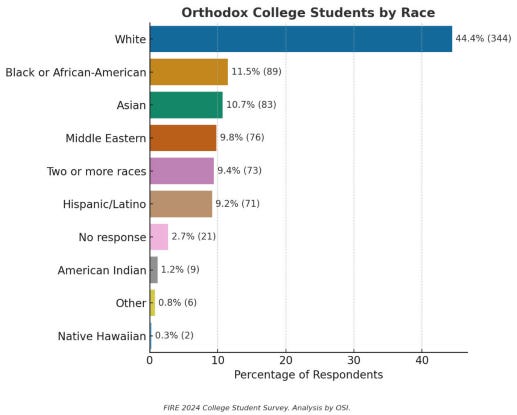
In the 2024 Pew and CES studies around 8 in 10 American Orthodox Christians were white, so 45% is very unexpected. The black percentage was relatively consistent across all three surveys: FIRE (11.5%), Pew (8.6%), and CES (10.2%).
Pew didn’t offer a Middle Eastern option, but CES did, and only 3.8% of the Orthodox chose it — far fewer than the 9.8% of Orthodox college students in FIRE’s survey. But this isn’t all that surprising: Pew and CES skew older, and older generations of Middle Eastern Orthodox in America may be more likely to identify as white, compared to their college student counterparts.
This could also affect the “two or more races” category; in CES, only 2.9% of the Orthodox chose this option, while in FIRE, 9.4% of college students did. A college student who’s half Lebanese, half miscellaneous white European, might identify as being “biracial,” while an older adult with the same ancestry may consider themselves white.
The Hispanic/Latino and Asian percentages are also very high (9.2% and 10.7%, respectively). Compare that to Pew and CES, where Hispanic was just over 2% and Asian was 2-3%. We don’t have a clear idea of what’s going on here. Anecdotally, we know of numerous parishes with high numbers of Hispanic inquirers and new converts, but whether that’s driving the high percentage of Hispanic Orthodox college students is unclear.
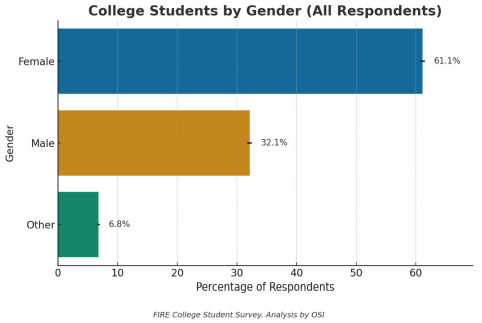
Overall, there are more women than men in American colleges and universities. It’s been that way for years, and the gap is only widening. In the full FIRE study, just 32% of all respondents were male, while 61% were female. (The remaining 6.8% were various non-binary options.)
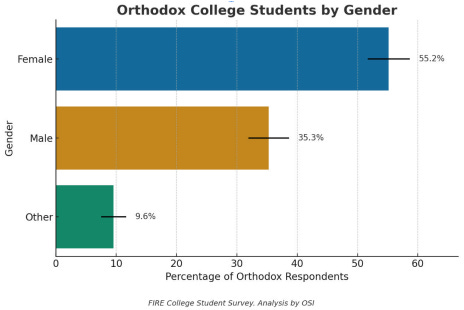
For the Orthodox students in the FIRE survey, the numbers are similar: 35% were male, 55% female, and 9.6% other.
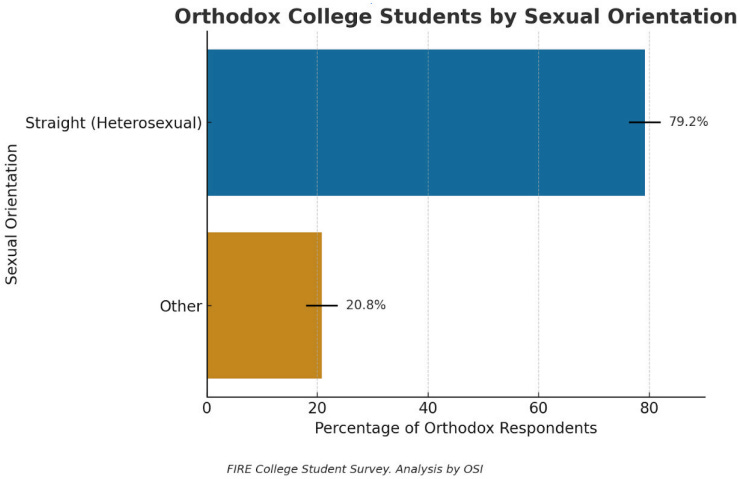
70% of all students in the FIRE survey listed their sexual orientation as straight/heterosexual. The Orthodox were notably higher, at 79.2% straight. This is consistent with other Christian groups.
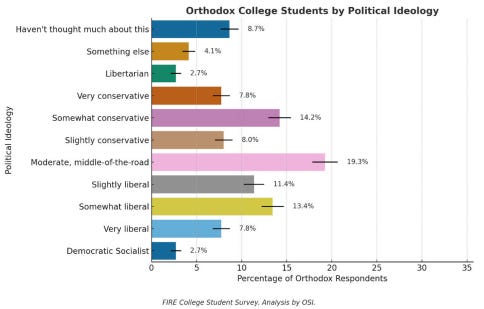
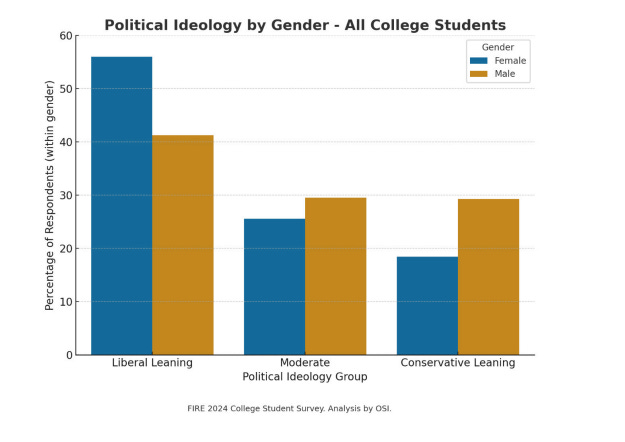
Overall, Orthodox college students were pretty evenly balanced politically, with 35.3% on the “left” and 32.7% on the “right”.
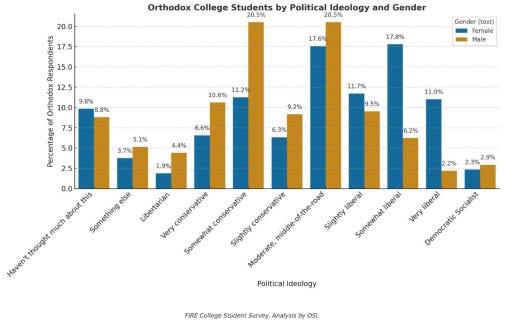
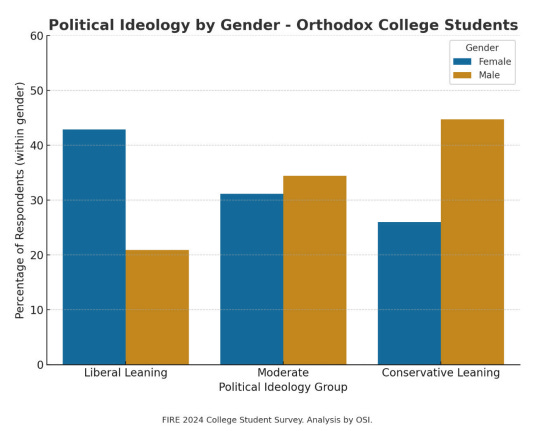
There’s a huge gap between men and women. 44.7% of male Orthodox students were conservative, 20.9% liberal. The rest were other things. For Orthodox women, 26.0% were conservative, 42.8% liberal — almost a mirror image of the men. Here, the stereotypes of conservative men and liberal women hold up.
Other than demographic questions, most of FIRE survey’s questions focused on issues related to free speech on campuses. But one very relevant question, for our purposes, was “How often do you attend church or religious services?” Here’s how the Orthodox students responded:
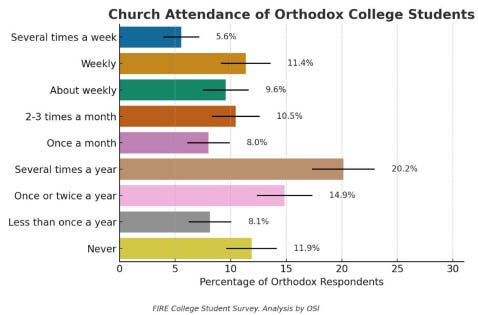
45% of Orthodox reported going to church at least once a month. For comparison, it was 42% for Catholics.
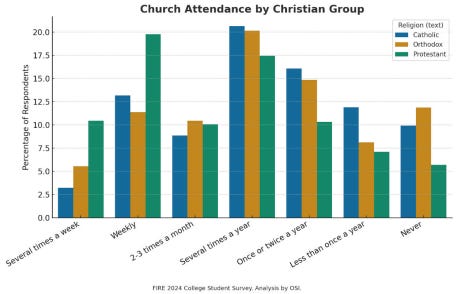
Those numbers are surprisingly high — basically in line with the Orthodox attendance numbers we found in Pew and CES. In the 2024 Pew study, 38% of Orthodox respondents reported going to church at least monthly. In CES, it was 48%.
At the other end of the spectrum, 12% of Orthodox-identifying college students said that they never go to church; it was 9% of Orthodox respondents in Pew, and 13% in CES. Again, no real difference between collegiate Orthodox and other Orthodox adults.
The reality is that people tend to overestimate their church attendance when they respond to surveys, so none of those numbers represent the reality of parish life, but we didn’t expect to find that college students were just as likely to report going to church as older adults.
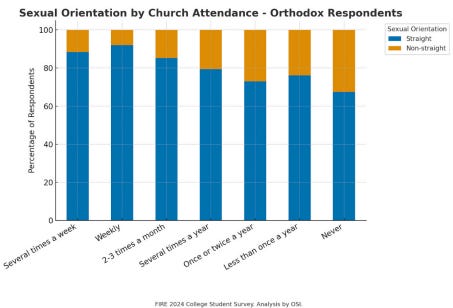
Frequent attenders were more likely to be heterosexual, compared with infrequent attenders. 88% of Orthodox students who attend church weekly are heterosexual. It’s 75% for those who attend no more than several times a year.
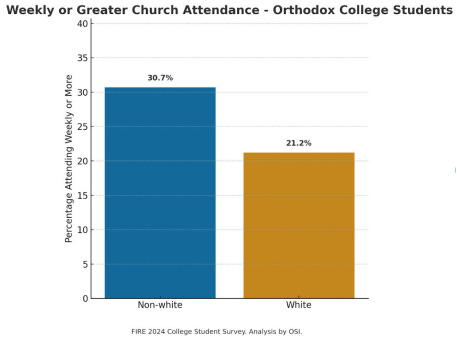
If we focus on “about weekly” or greater church attendance for Orthodox students, only 21.2% of white Orthodox students were weekly attenders — but that figure was 30.7% for non-white Orthodox students.
Finally, here are the top 10 schools in the FIRE survey based on the percentage of respondents who were Orthodox.
University of California-Irvine
Rutgers University—New Brunswick
Temple University
Iowa State University
Stevens Institute of Technology
Drexel University
University of Wisconsin—Madison
North Carolina State University at Raleigh
Cornell University
Northeastern University
For a downloadable PDF of this report please follow the link provided and select the report you would like to download.
Comments
Nothing yet. Say the first thing.
Sign in to join the conversation.