
How many people who grew up Orthodox remained Orthodox into adulthood? Put another way, what’s our retention rate for cradles? And is it changing over time? That’s what we’re going to focus on with this analysis.
It’s difficult, if not impossible, for Orthodox entities to collect our own data on this sort of thing. If we at OSI put out a survey of cradle Orthodox, we’d get a disproportionate number of responses from cradles who are still Orthodox, just because the sort of people we can reach, and the sort of people who take Orthodox surveys, are going to be active Orthodox people. So, studying the question of cradle retention isn’t easy.
Fortunately, some secular surveys of the general US adult population ask not only about current religion, but also childhood religion. We can use these surveys to examine retention.
The Data From Pew
The biggest surveys that ask about childhood religion are the Pew Religious Landscape Studies from 2014 and 2023-24. Here’s the unweighted retention data for 2024:
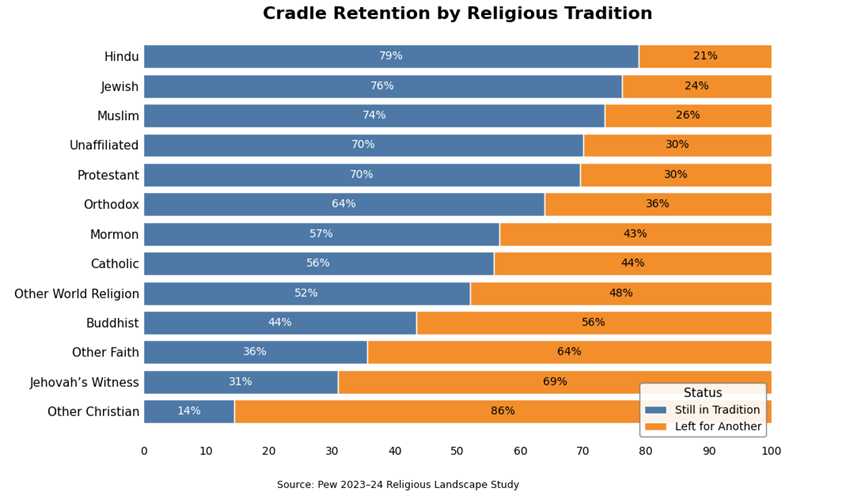
(If you look at Pew’s own report, the numbers will be slightly different. This is because we’re reporting the unweighted, actual respondent data, whereas Pew applies weights to account for biases in their respondent pool.)
What this graph means is that 64% of the 260 people in the 2024 Pew survey who grew up Orthodox are still Orthodox today. That’s a bit better than Catholics but worse than Protestants – with the caveat that Pew doesn’t show, in its publicly-available 2024 dataset, any distinction between different types of Protestants. So a cradle Presbyterian who’s now non-denominational will show up as being “Protestant” both as a child and an adult, even if the reality is that they left their childhood religious tradition.
Pew’s previous Religious Landscape Study was in 2014, and the numbers were similar: 58% retention for the 231 cradle Orthodox who were surveyed. Basically, about 6 in 10 cradle Orthodox in the Pew surveys still identified as Orthodox.
There also wasn’t a significant difference between men and women. In the combined 2014 and 2024 datasets, male retention was 63% and female retention was 60%. If we look at individual years, there are apparent differences – 2014 retention was 55% for men and 62% for women, whereas in 2024 it was 70% for men and 58% for women. But at this point, we’re dealing with small enough samples that these differences aren’t meaningful.
Where Did They Go?
The next obvious question to ask is, where did those ex-Orthodox go?
In the 2024 Pew study, there were 96 “apostate cradles,” of whom 54 (so, the majority) left religion altogether. Of these now-unaffiliated ex-Orthodox, 20 became “nothing in particular,” 17 became atheists, and 17 agnostics. Of the rest, 28 became some kind of heterodox Christian (22 Protestants, 5 Catholics, 1 other). Eight ticked the box for “Other Faith,” and five became some other non-Christian religion.
It’s a roughly similar picture if we go back to the 2014 Pew report. Of the 97 ex-Orthodox that year, 51 left religion altogether (28 nones, 14 atheists, 9 agnostics). Another 42 joined a heterodox Christian tradition (28 Protestants, 9 Catholics, 5 others), and a handful more joined a non-Christian religion.
So, in 2024, while 64% of cradle Orthodox remained faithful to the Church, 74% still identified as Christians. It’s similar if we go back to 2014: 58% remained Orthodox, but 76% continued to identify as Christian.
Other Sources
No other study with childhood and current religion data can compare to Pew when it comes to sample sizes. But we’ve tracked down numerous smaller studies that ask about childhood and current religion. Individually, these studies aren’t very helpful – for example, the 2019 PRRI American Values Survey polled 2,526 people, of whom a dozen grew up Orthodox – and of those, 5 were still Orthodox as adults. We obviously can’t draw any conclusions at all from a dozen people. But – and I know this is sort of technically irresponsible, but bear with me – if we aggregate these various little surveys, we can come up with another estimate of the cradle retention rate.
We found 10 of these smaller surveys conducted between 2014 and the present. Combined, there were 237 respondents who grew up Orthodox, 128 of whom were still Orthodox as adults. That works out to 54% – not too far off from the 2014 and 2024 Pew numbers. In those same years, the General Social Survey, which is done every couple years, had 94 cradle Orthodox respondents, of whom 49 were still Orthodox (52%).
Going back a bit earlier, we have have another 10 smaller surveys conducted between 2000 and 2012. These had, in the aggregate, 186 respondents who grew up Orthodox, of whom 117 were still Orthodox. That’s 63% – once again, roughly in the range of the Pew data. In those years, the GSS had 84 respondents who were raised Orthodox, with 71% retention.
63%, 54%, 58%, 63%... something like six in ten cradle Orthodox in America have remained Orthodox. The GSS hints that retention may have declined in recent years (from 71% in 2000-12 to 52% in 2014-24), but the sample sizes are so small that we can’t put too much stock in them — especially in light of the Pew data, which showed a slight (but statistically insignificant) increase in retention.
~60% retention isn’t terrible, in the context of American Christianity, but as the father of seven kids, I can say that it certainly isn’t acceptable, either. At OSI, we’re planning to do our own research into the question of cradle retention and engagement in the future, so that we can better understand why some kids leave the Church while others grow up to become faithful adults.
Comments
Nothing yet. Say the first thing.
Sign in to join the conversation.