
The Over Powered Game Marketing newsletter is written by game marketing strategist & co-founder of indie publisher Frostbloom, Jordan Brown, and is a regular breakdown of the tactics, data, and playbooks indie devs need to stand out in a crowded market.
We’ve had an uptick in pitch decks submitted to Frostbloom from turn based combat games and I have a personal interest in the genre so I set out to answer a simple question: “Are turn based combat games still worth making?”
I didn’t have a good answer, so I pulled every game on Steam with the tag Turn Based Combat that was released since January 2023. I then filtered out games that didn’t make at least $500, the unreleased projects, the NSFW stuff, and ended up with 1,542 games I could actually learn something from.
The average turn-based combat game made $776,940. The median made $7,744.
The most interesting part to me was trying to identify what separates the 91 games that crossed a million and how much of it comes down to decisions you can still change.
Some of it stung to look at. The most common art style in this genre is also one of the worst-performing. The most common price point is the one that makes the least money. And the single strongest predictor of a million dollar turn based game is a feature only 3.4% of them bothered to build (Co-op).
Here’s everything I found.
Before diving into the article a few updates on how things are going over at Frostbloom.
We’re heading to Gamescom! If you want to meet up, shoot me a message on LinkedIn.
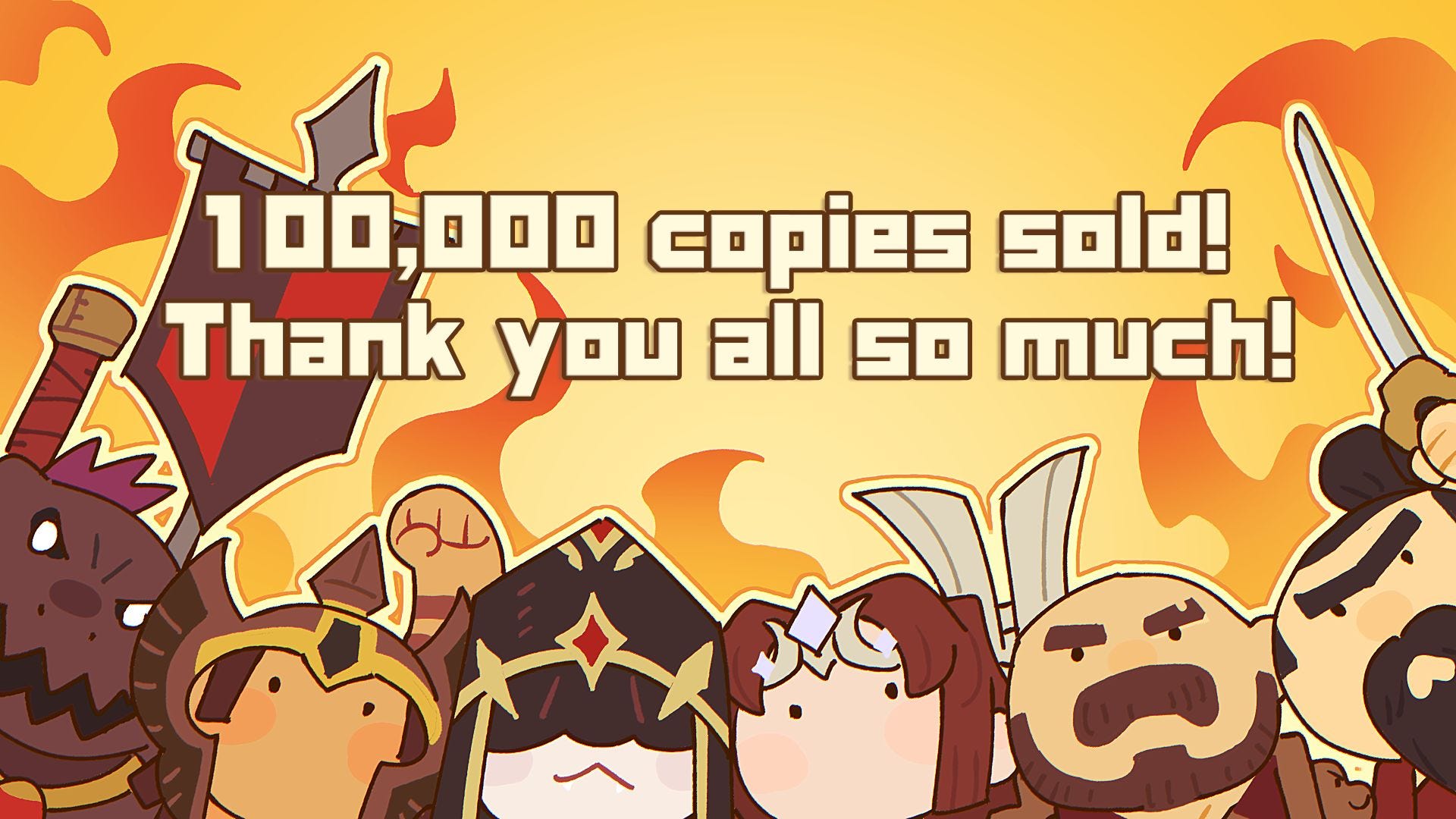
Tabletop Tavern sold 100k copies after only a few weeks! 🍻
We’re actively reviewing pitch decks, submit your pitch deck here if you’re interested in publishing!
A significant part of what we do is supporting developers going the self publishing route. Here’s a few ways we’re doing that at the moment:
Free: Press Kit Template
Waitlist: Steam Page Blueprint
Waitlist: Indie Visibility Playbook
All data was collected on August 13th 2026 from Steam and Gamalytic. Gamalytic uses third party estimates so take the data with a grain of salt.
To collect the data I applied the following filters:
Contains Turn Based Combat tag
There is a huge variety of games that feature turn based combat. Both Slay The Spire & Fire Emblem are turn based combat games with pretty different gameplay. The only way I could reliably pull a large amount of data was to focus on games that used the Turn Based Combat Tag. There are definitely relevant games out there that choose not to use this tag for whatever reason and thus are missed in this study.
Released after January 2023
I’m a big believer that the gaming industry is rapidly changing and what worked 5 years ago probably won’t work as well today so I only included games released after Jan 2023.
I first did a large data pull with only the above filters, however I noticed the numbers (especially revenue and copies old) were being heavily skewed by unreleased games, NSFW games, & games that resulted in 0 or very few copies sold (mostly asset flips, game jams, student projects, etc.). So I then applied even more filters:
Removed any games with the tags “Nudity”, “NSFW”, or “sexual content”
Unsurprising that sex sells, but not relevant for what I'm trying to study here
Removed any unreleased games.
Removed any games with less than $500 revenue.
This resulted in a total of 1542 games. You can view the full data on all 1542 games in this Google Sheet.
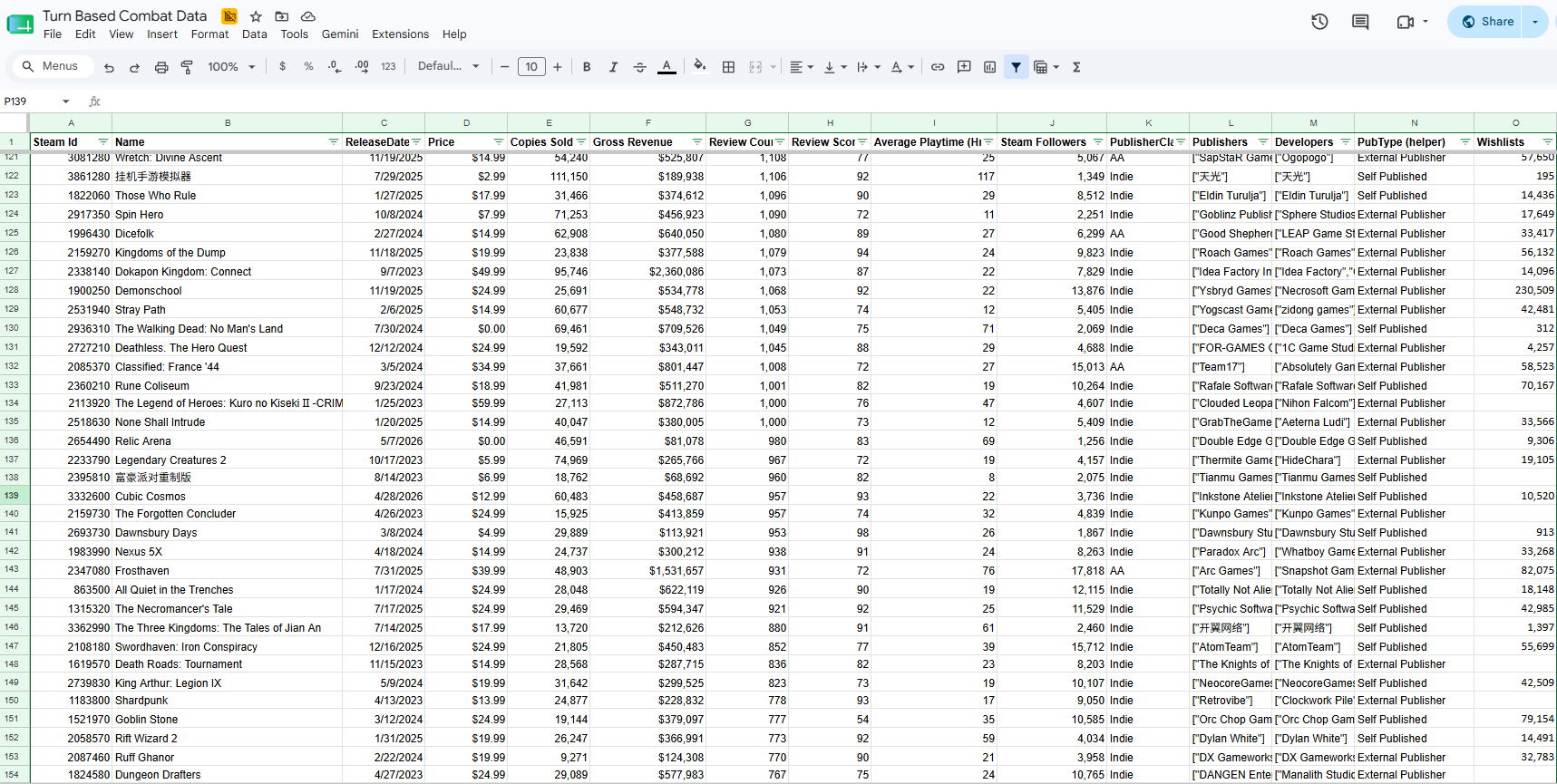
Average Revenue for Turn Based Combat Games: $776,940
Median Revenue for Turn Based Combat Games: $7,744
The average is 100x the median because 15 games out of 1,542 took 69% of the entire revenue. This reflects the winner takes all trend we’ve seen in the gaming industry for a while now.
Top 1% (15 games) = 69.4% of all revenue
Top 10% (154 games) = 95.8% of all revenue
The remaining games split ~4% of the revenue.
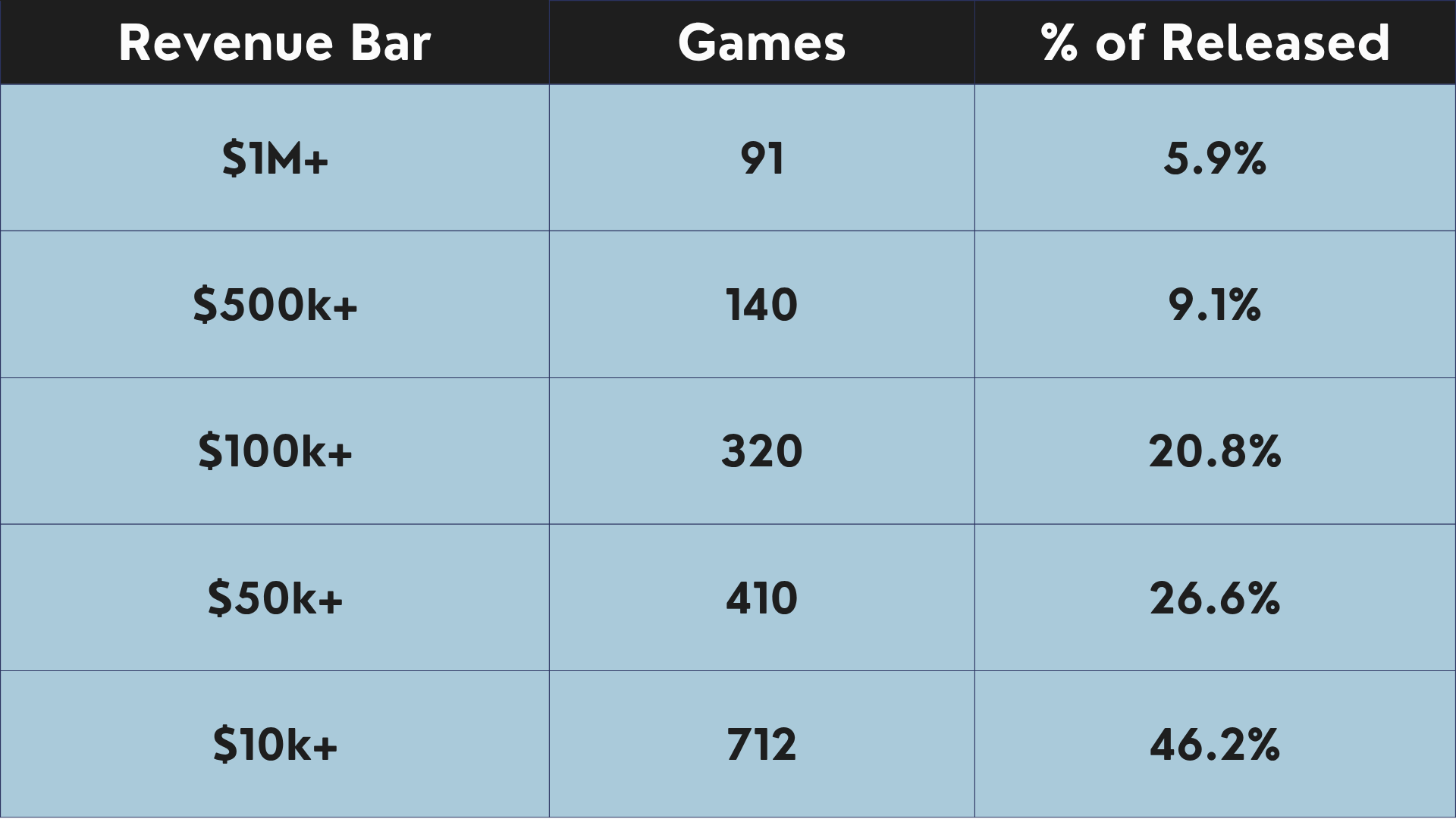
On the slightly depressing side nearly half of released turn based combat games since 2023 never made $10,000 gross revenue. It would be way more than half if I didn’t apply the $500 minimum filter. However on the plus side 20% making over $100k is definitely a good sign.
Looking at how the various tags performed can help us determines what genres, art styles, and features players prefer.
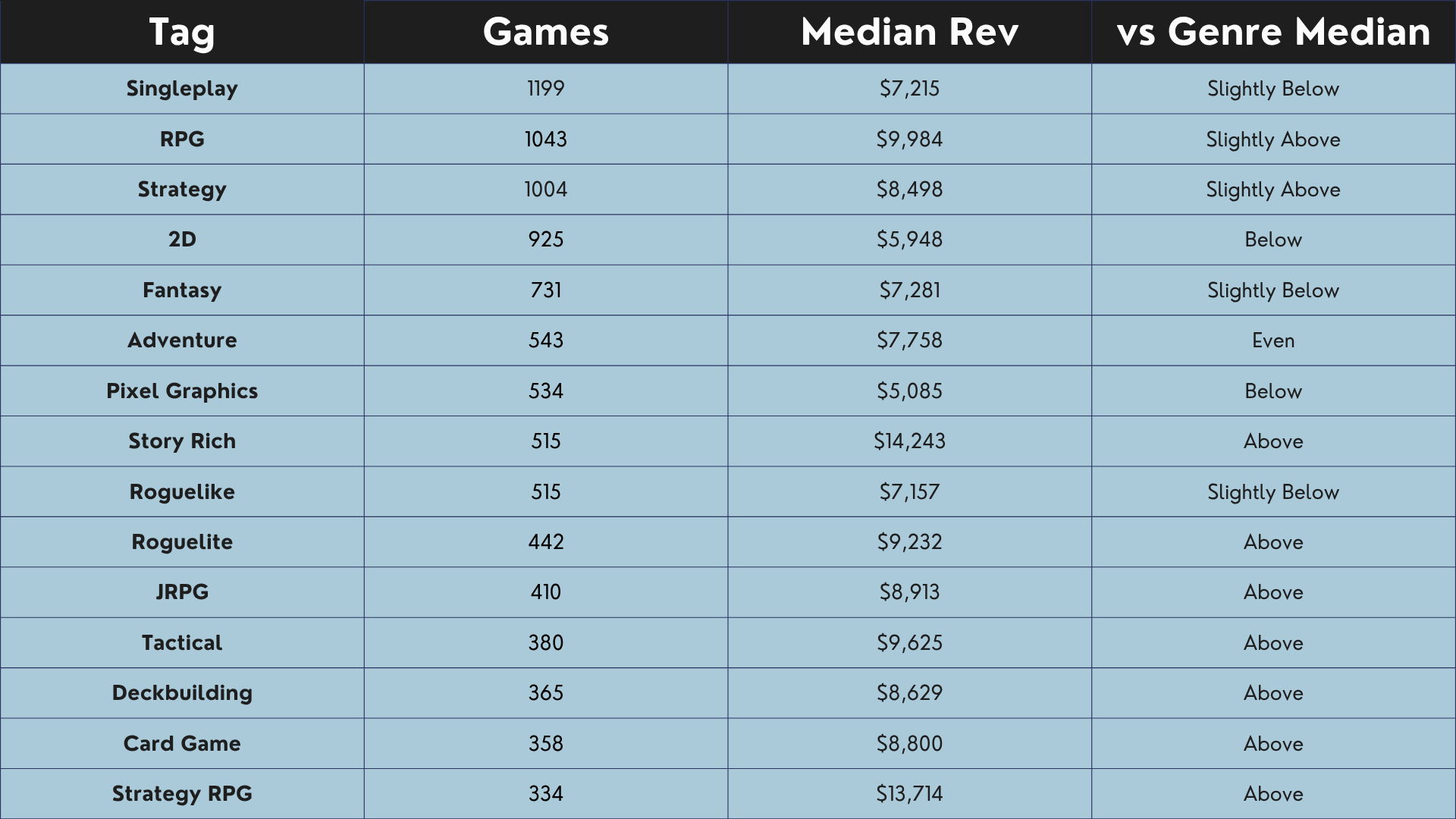
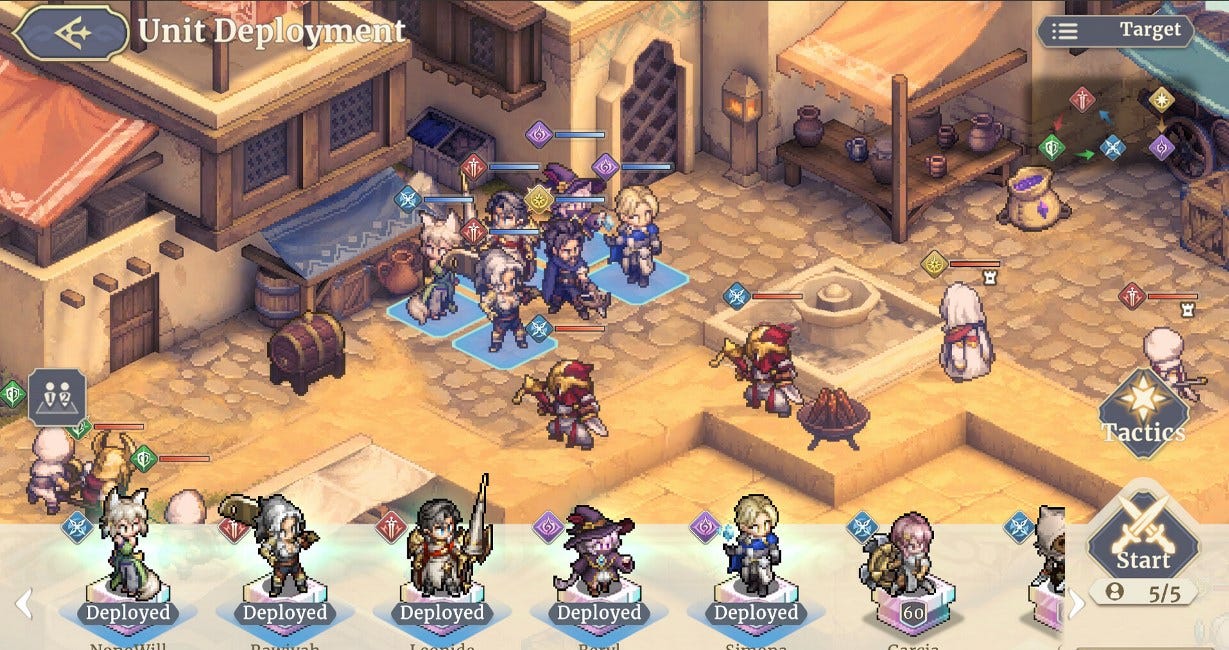
I think it makes a lot of sense that the 2D & Pixel Graphics tags are very popular but both below the genre median. This is the most approachable and affordable art style for indies so it stands to reason it would have a higher amount of inexperienced devs working with it. I also think the quality of pixel art for this kind of game is now very high to stand out. Take Threads of Time with an estimated 500k wishlists for example. I talked about this in one of my recent articles:
So You’re Making a Pixel Art Game?
·
September 5, 2025
I’ve always loved pixel art and I know its an extremely common art style for indies. The other night I found myself randomly wondering how the art style performs on Steam, so I decided to find out.
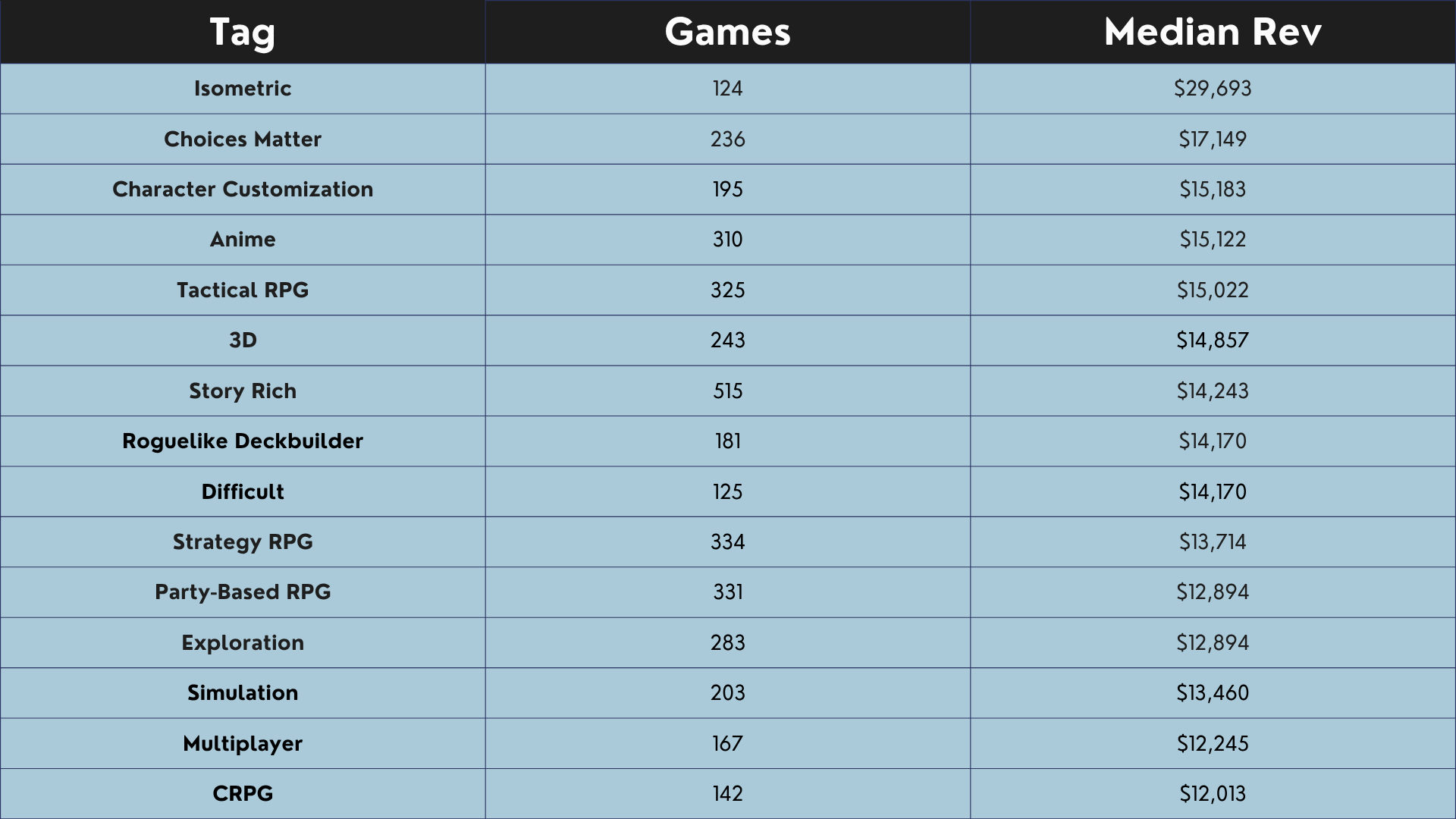
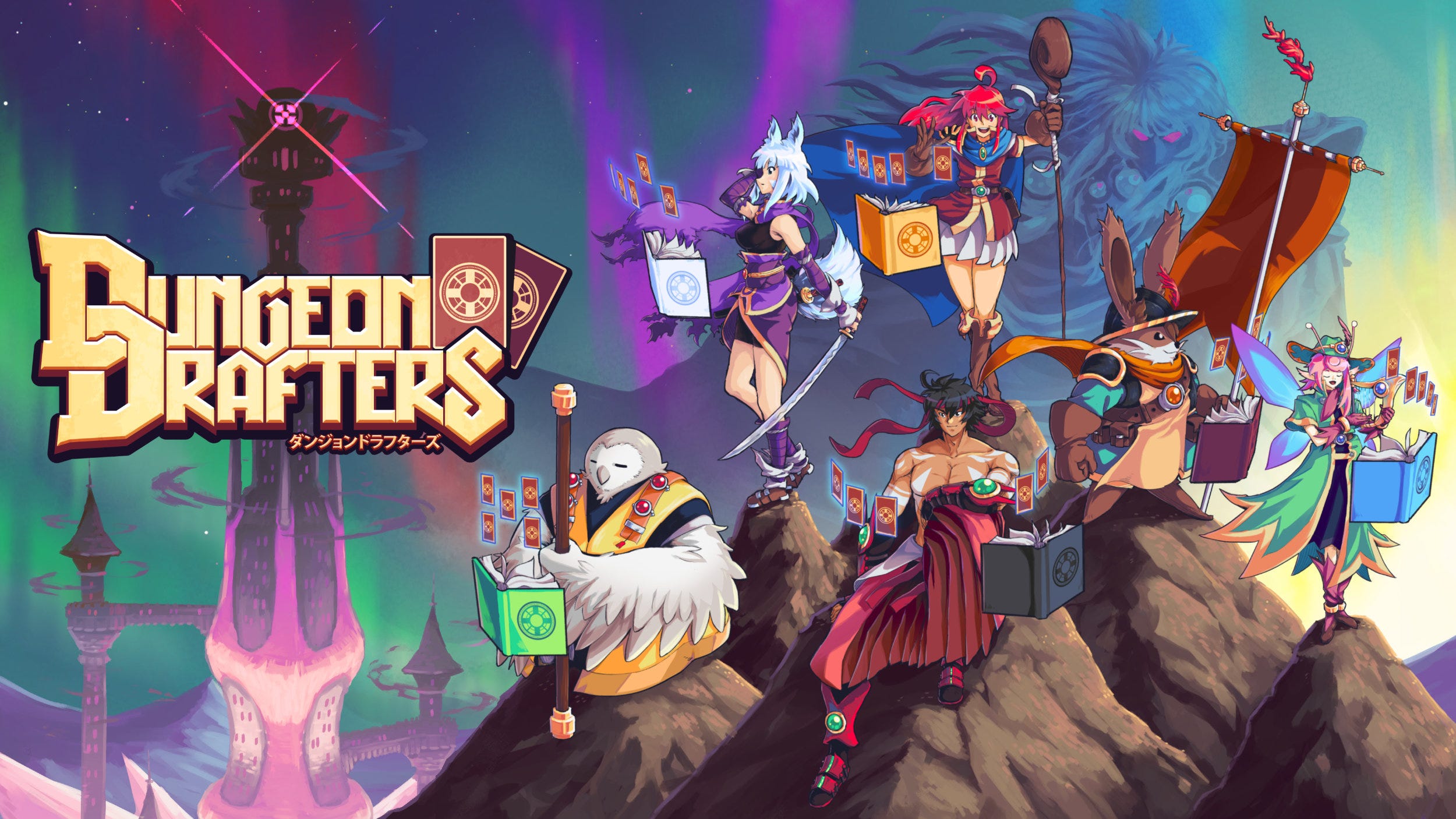
These tags tell me that players prefer a good story they can immerse themselves in, challenging gameplay, and they want to play with friends. Contrary to the pixel art performing poorly, 3D performs quite well. Anime (mostly JRPGs) & Roguelike Deckbuilders performing well was probably the most surprising. In case your wondering what an anime roguelike deckbuilder looks like, here ya go.
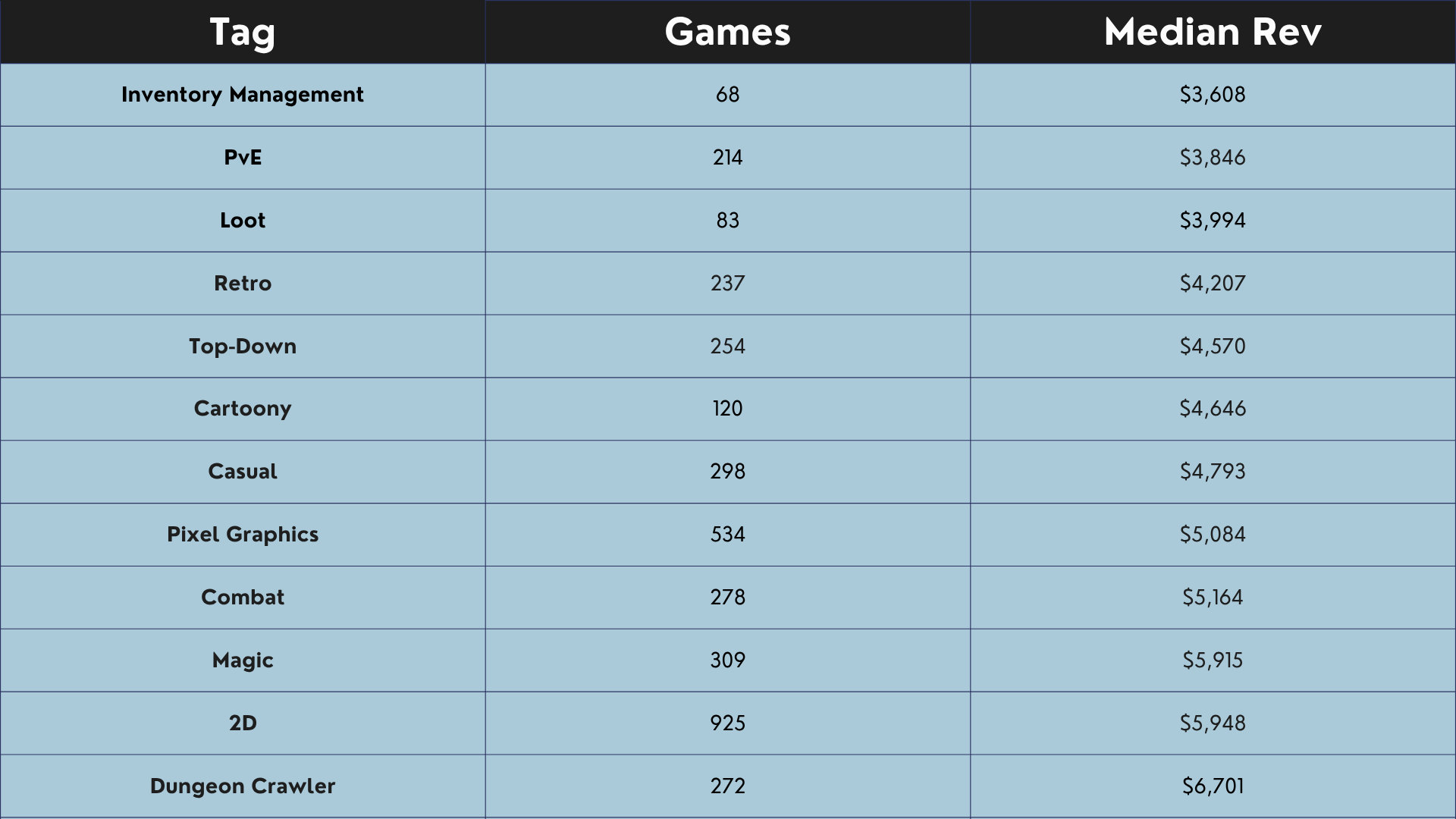
Not too much to say here. Many of these are just the opposites of the ones we saw doing well above. Seeing tags like Combat, Magic, and Inventory Management, makes me wonder if the more successful games are just better at tagging their games. I suspect many turn based combat games have these elements but since these are such broad tags I would personally include them at the very bottom of the list if at all when tagging my game.
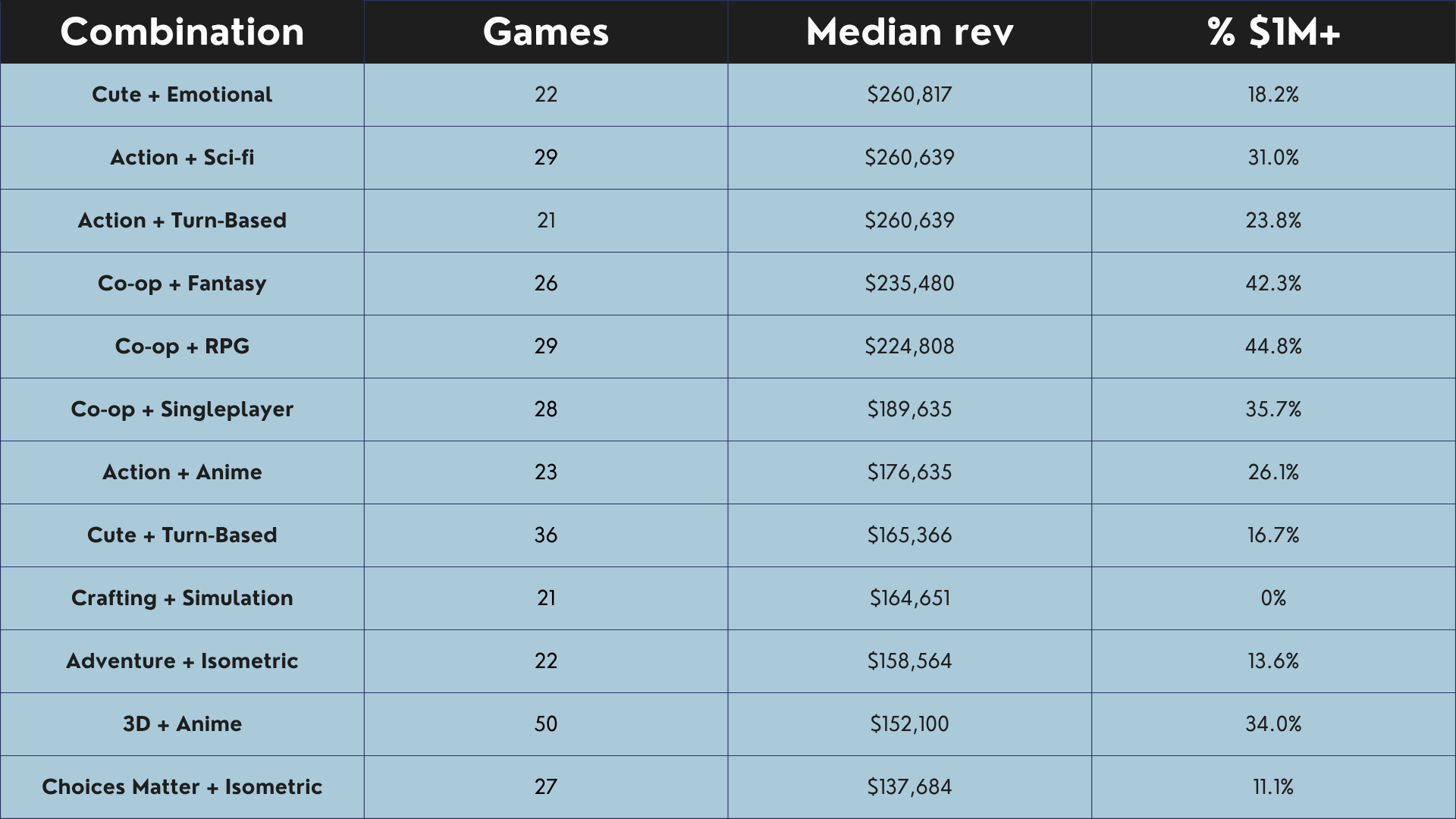
The cute + emotional / 3D + Anime / Cute + Turn Based are almost certainly JRPGS. I personally think western takes on the JRPG formula will increase thanks to the success of Clair Obscur. Fantasy RPGs are hallmarks of many turn based combat games but its interesting to see that Sci-fi is also doing well.
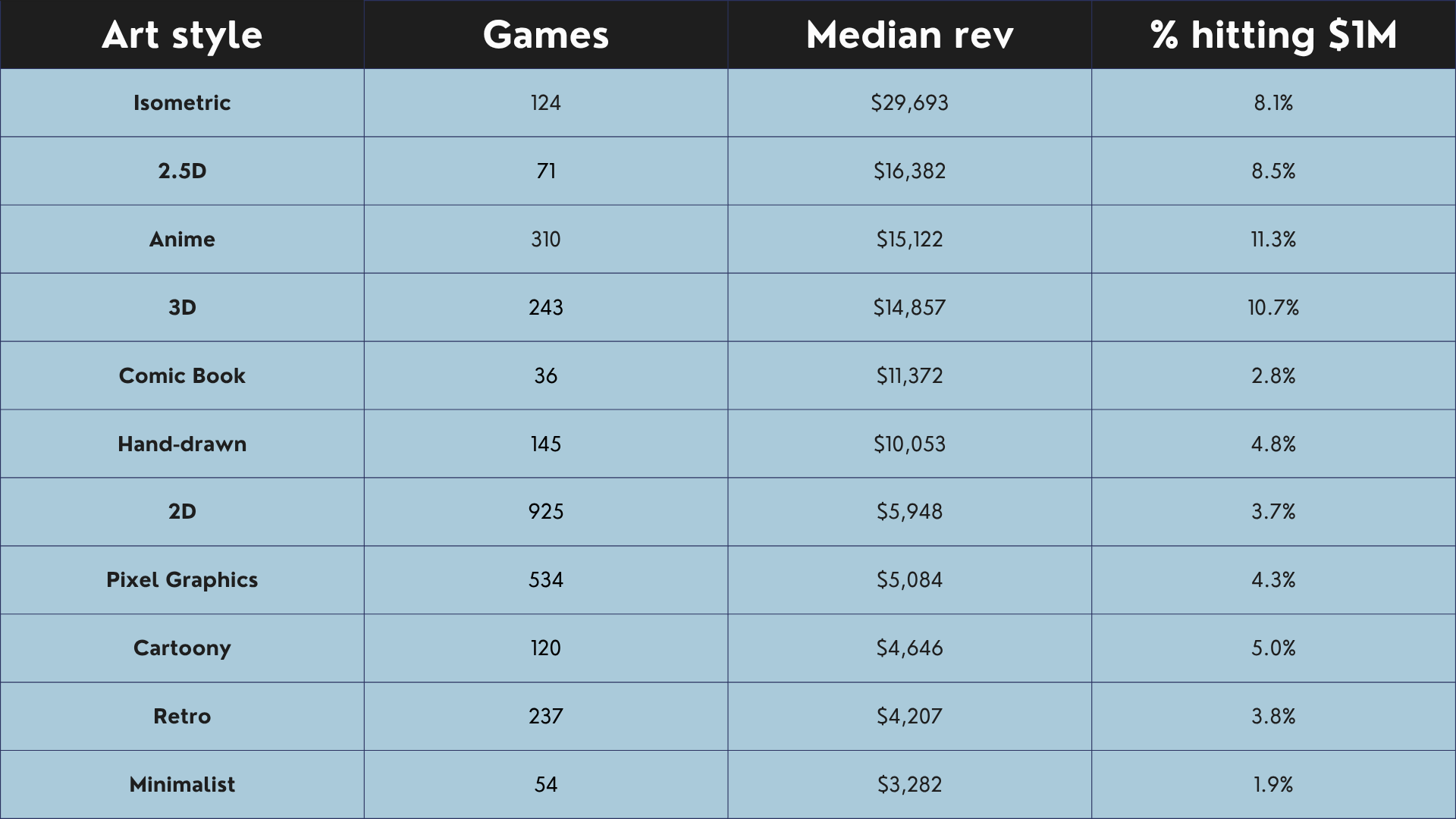
3D games earn a median 2.9x what pixel art games earn. Pixel Graphics is on 34.6% of all games in the genre and sits near the bottom of the performance table. This is not "pixel art is bad." It's just supply and demand. Pixel art is the default aesthetic for solo devs & small teams in this genre, so the pixel bucket is where nearly every under resourced project lands. The takeaway isn’t "go 3D", but your art style is a positioning decision and the most common one is unfortunately the most competitive one.
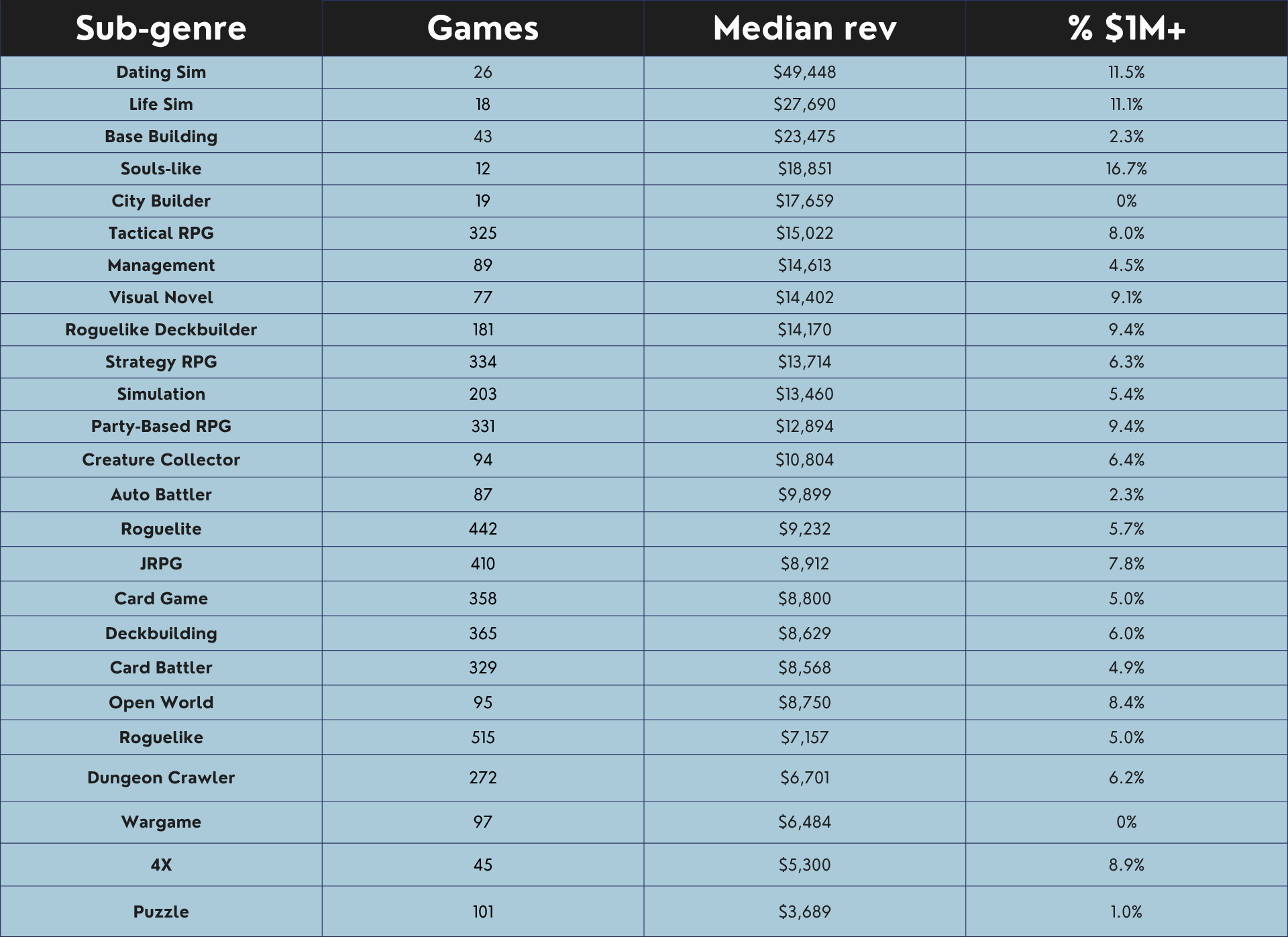
The best performers are turn-based combat crossed with something else. Dating Sim, Life Sim, Base Building, Management, Visual Novel. These are all genres that found a clever way to weave in turn based combat resulting in innovative gameplay. Pure combat sub-genres (dungeon crawler, wargame, 4X, puzzle) sit at the bottom, with Tactical RPG being an arguable exception. Turn based combat works best as a system inside a larger loop, rather than the appeal for the entire game. I suspect simply having a great turn based combat used to be enough for these games, but with so many now in the market it’s the innovators that win.
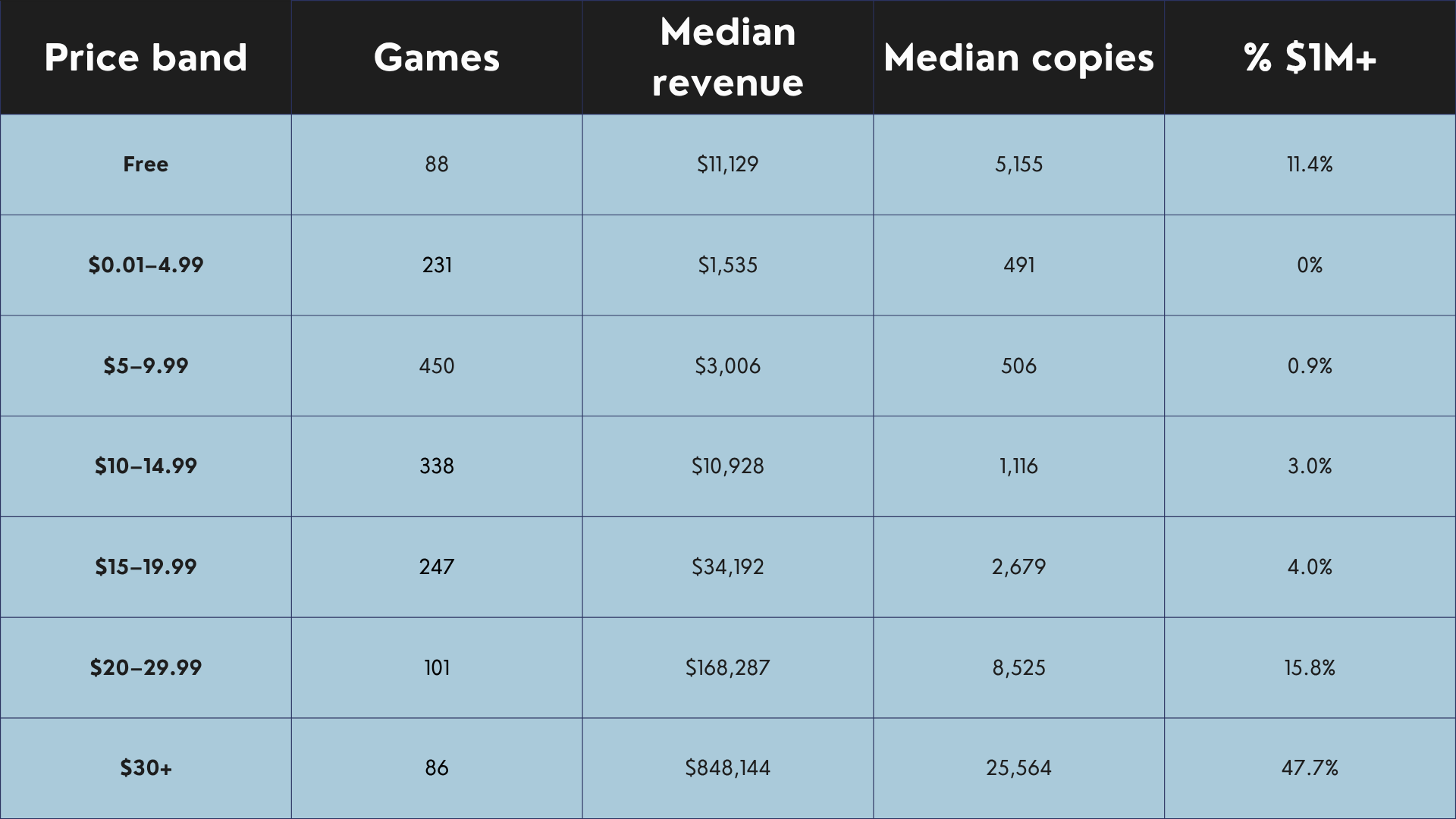
I generally think that indies tend to underprice their games so it made me a bit sad to see the largest cluster of games at the below $10 range. 44% of the dataset (681 games) is priced under $10. Turn based combat games, especially RPGs, tend to have pretty long playtimes so I personally would hover around $15-$20 on average unless you have some solid logic to go above or below.
Pro Tip: Since Steam has trained us to wait for discounts and offers them frequently, I tend to recommend setting the price of your game a bit higher than the price you actually think it will convert. So for Tabletop Tavern we priced it at $20 while we thought $15 was the real price most players would convert. This allowed us to capture fans of the game willing to pay $20 and also convert well when on sale at a 20% discount ($16), which also so happens to be the minimum discount needed for Steam to notify wishlisters. You can always lower the price of your game if you think you overpriced but its much harder to raise the price once you realize you left money on the table.
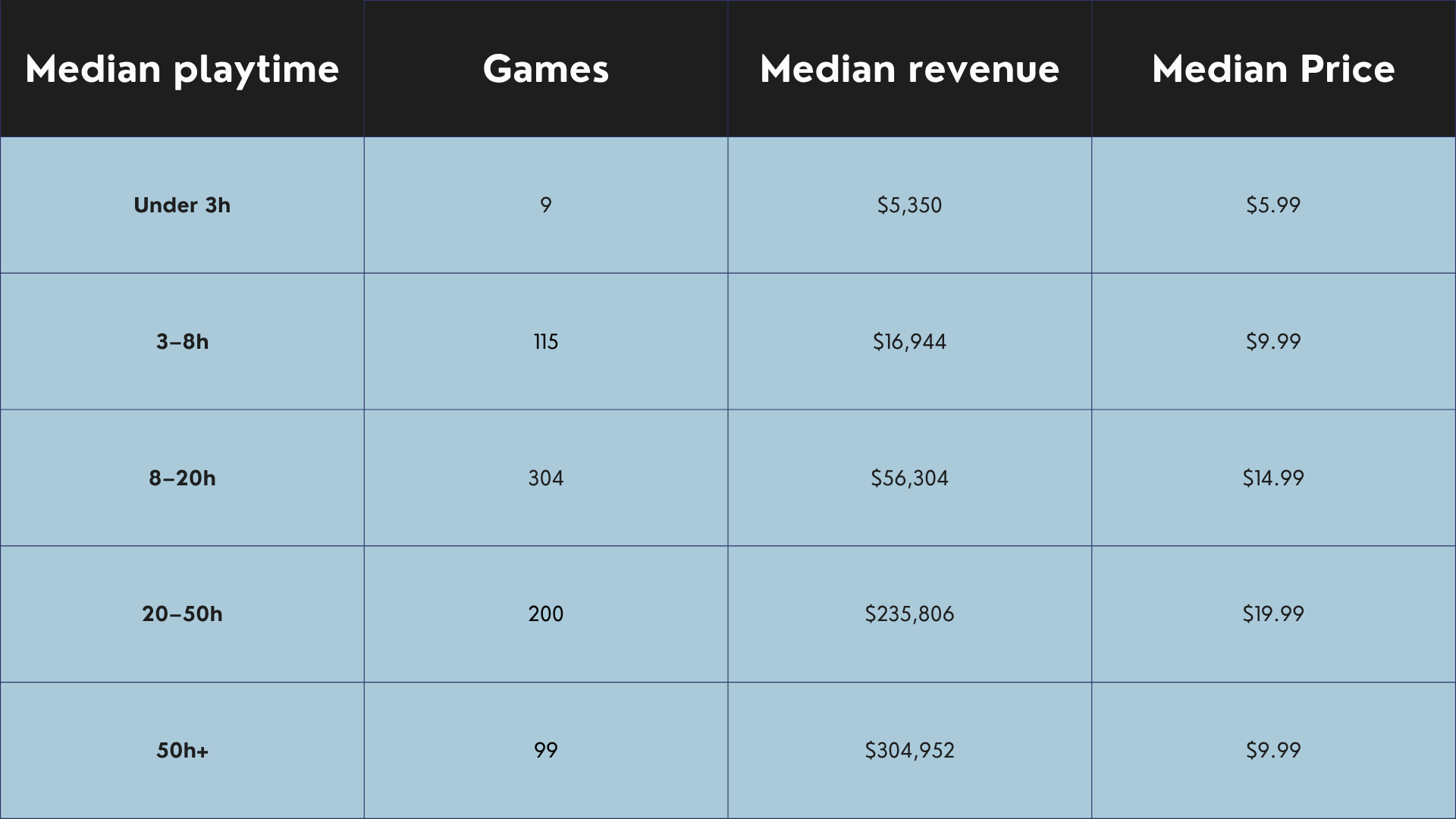
As predicted above it looks like $15 - $20 is the sweet spot for the average indie in this space that has near 20 hours of core gameplay. The Median Price for the 50h+ games is brought down by 32 of those games being free to play so I wouldn’t consider that data point too much.
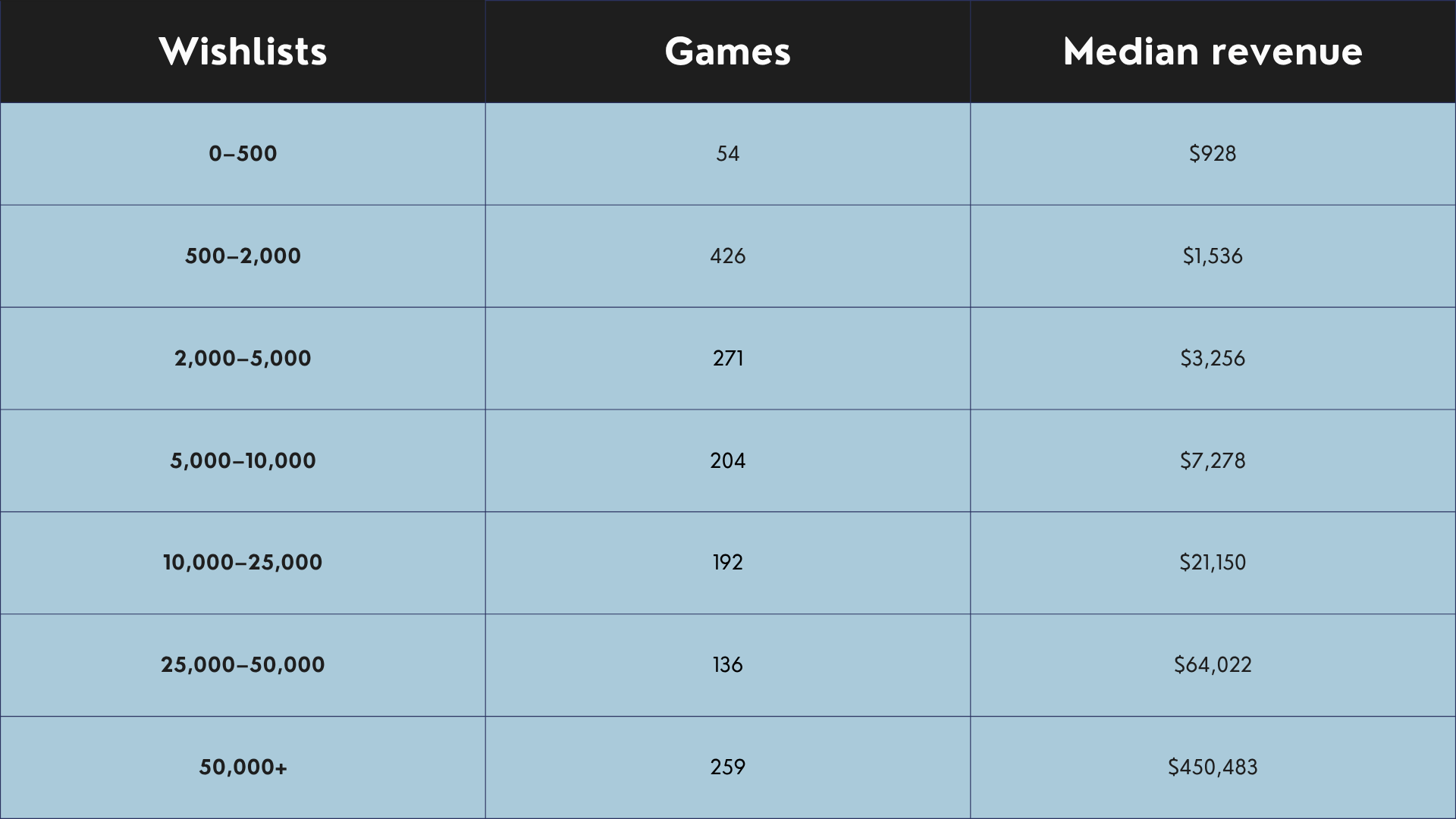
Median wishlists at release for a $1M+ game: 111,026
Median wishlists at release for a sub-$10k game: 662
This doesn’t change that the goal is always to get more wishlists, but this is useful information to show what kind of revenue you can expect based off the wishlists your able to accumulate. Keep in mind this chart only applies to this data set, so take it with a grain of salt and maybe don’t apply it if your game is a completely different genre than the games I looked at here.
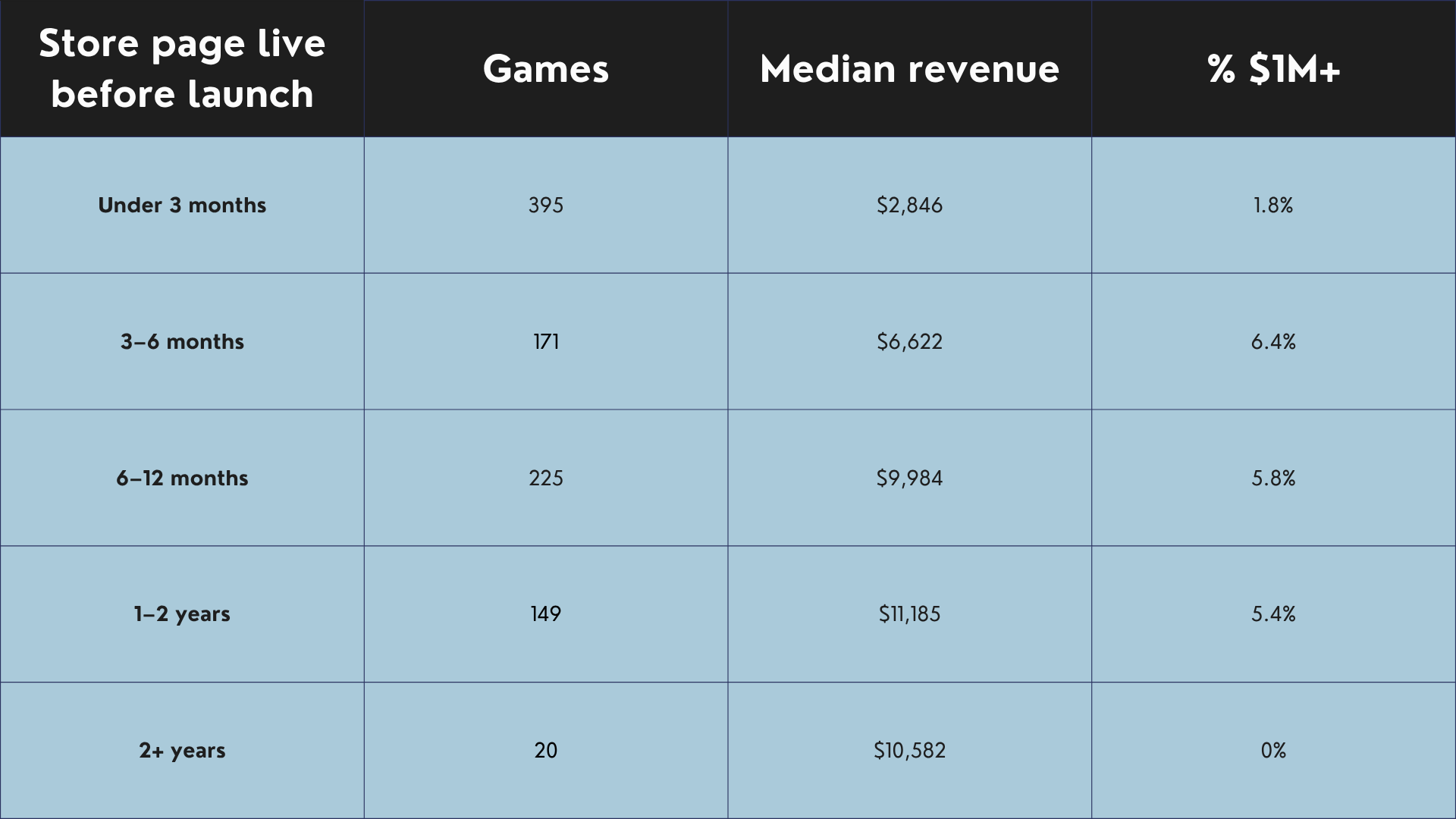
Devs who put the store page up under 3 months before launch made a median $2,846. Those who gave themselves 6–12 months made 3.5x that. I was kind of surprised under 3 months had the largest amount of games as it feels rather obvious it’s usually a bad idea to think you can gather enough traction in 3 months unless you have a very experienced marketing team behind you and a healthy marketing budget. Publishers can get away with this but if your self publishing I would definitely recommend at least 6 months but more ideally a year if its your first game so you have some time to make mistakes and learn what works.
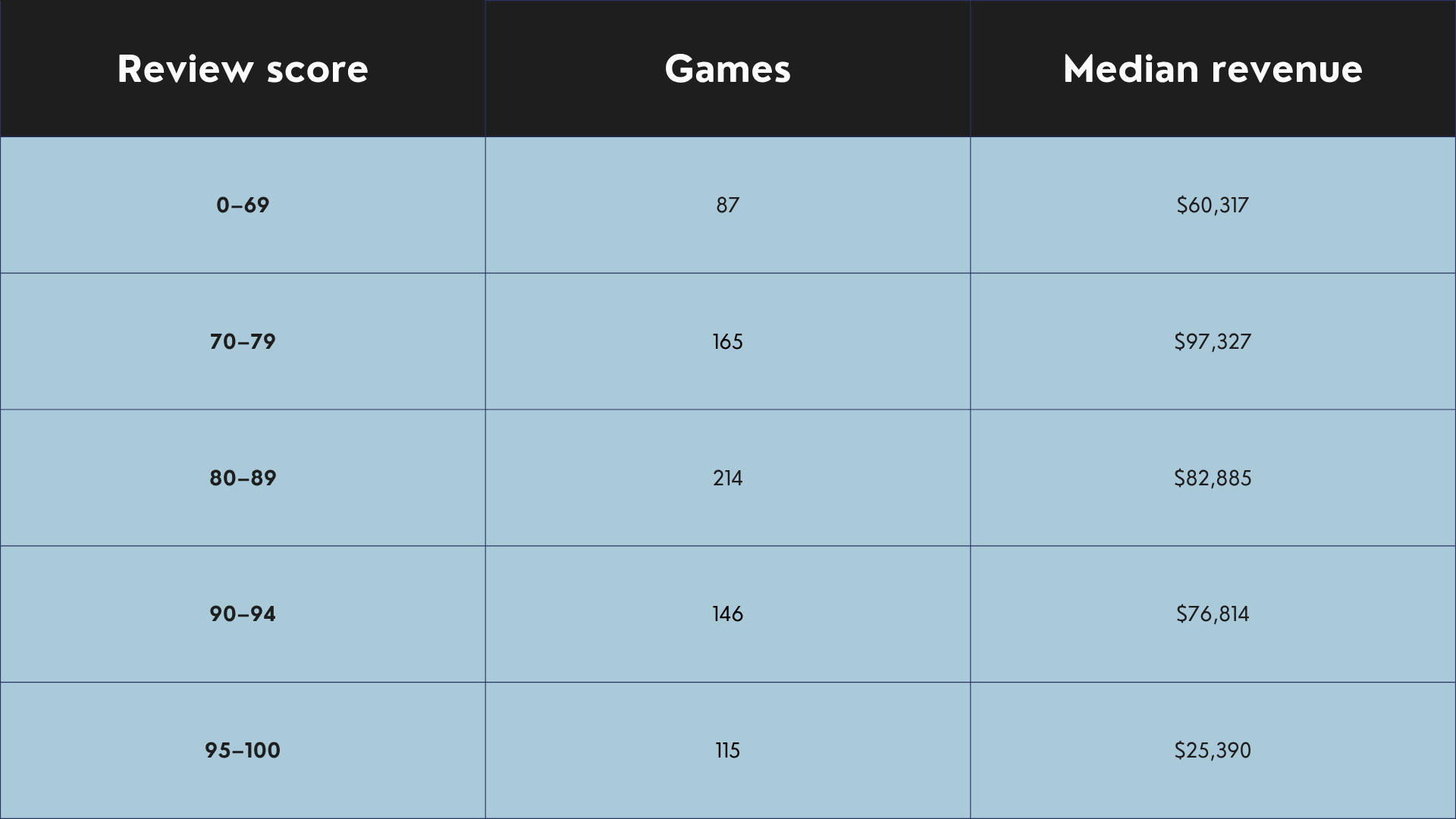
Games rated 95–100% made a lower median than games rated 70–79%. Chasing a 98% rating by narrowing your game to please a small audience may win awards but it could be a commercial mistake. Higher review score does not always correlate with higher revenue. Review count does.
0–9 reviews ($951)
10–49 reviews ($2,794)
50–99 reviews ($13,586)
100–499 reviews ($66,522)
500+ reviews ($709,526)
It’s worth noting that the 70-89 range had the highest collection of AA & AAA games. I suspect these games have a higher likelihood of negative reviews due to various cultural and social factors like players not giving as much leeway as they would to indie devs, bandwagon review bombing due to something a large community dislikes, etc. Small, cheap, beloved niche games earn near perfect scores from a tiny devoted audience, while big commercial games attract more critical buyers.
Synthesizing everything above, the profile of a turn-based combat game that clears $1M:
~111,000 wishlists at launch.
Priced $20+. 47.7% of $30+ games cross $1M vs 0.9% of $5–9.99 games.
6–12 months of marketing. Median for $1M+ games is 6.4 months vs 3 months for the bottom.
20+ hours of median playtime. Depth, replayability, and systems that keep giving.
A differentiated visual identity. Isometric, 3D, anime, or 2.5D rather than the pixel/top-down/retro default that 1 in 3 games in the genre shares.
Turn-based combat wrapped around a second loop. Life sim, base building, management, dating, exploration, etc. Rather than combat as the entire game.
Co-op, if you can build it. 44.8% of Co-op+RPG games crossed $1M. Nothing else comes close.
A great story. Games in this data set with three narrative tags were 3.4x the median of one with none, and roughly three times as likely to cross a million. Simply having at least one narrative tag lifts the median from $5,750 to $11,112.
Narrative Tags: Story Rich, Choices Matter, Multiple Endings, Lore-Rich, Great Soundtrack, Atmospheric, Emotional, Mystery, Narrative
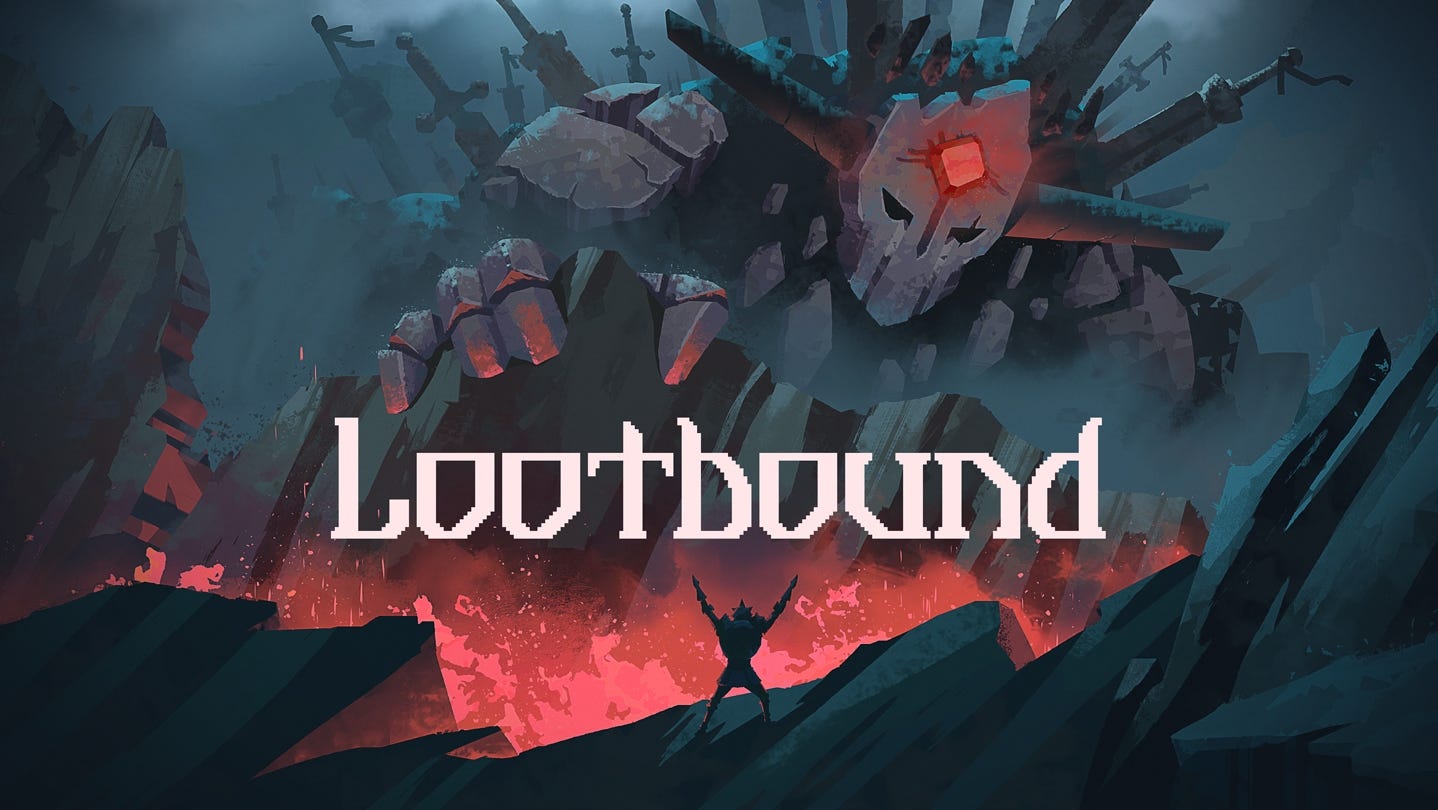
Lootbound is a tactical roguelite with turn-based combat, loot management and D&D elements set in a dark fantasy world. Fight dangerous enemies, collect epic loot, recruit allies and lead them on a path of adventure.
I choose this game because it releases today (Aug 14th) and has a very strong performance for an upcoming game in this genre (200k+ wishlists). I think Lootbound is a great example of a Turn Based Combat wrapped around a second loop that we highlighted above.
Lootbound is also a perfect example of why you shouldn’t let data by itself guide all your decisions. Lootbound has a ton of the tags that regularly have low performance like Pixel Graphics, Dungeon Crawler, Inventory Management, Loot, and Casual. It's also probably the highest wishlisted indie turn-based game on Steam.
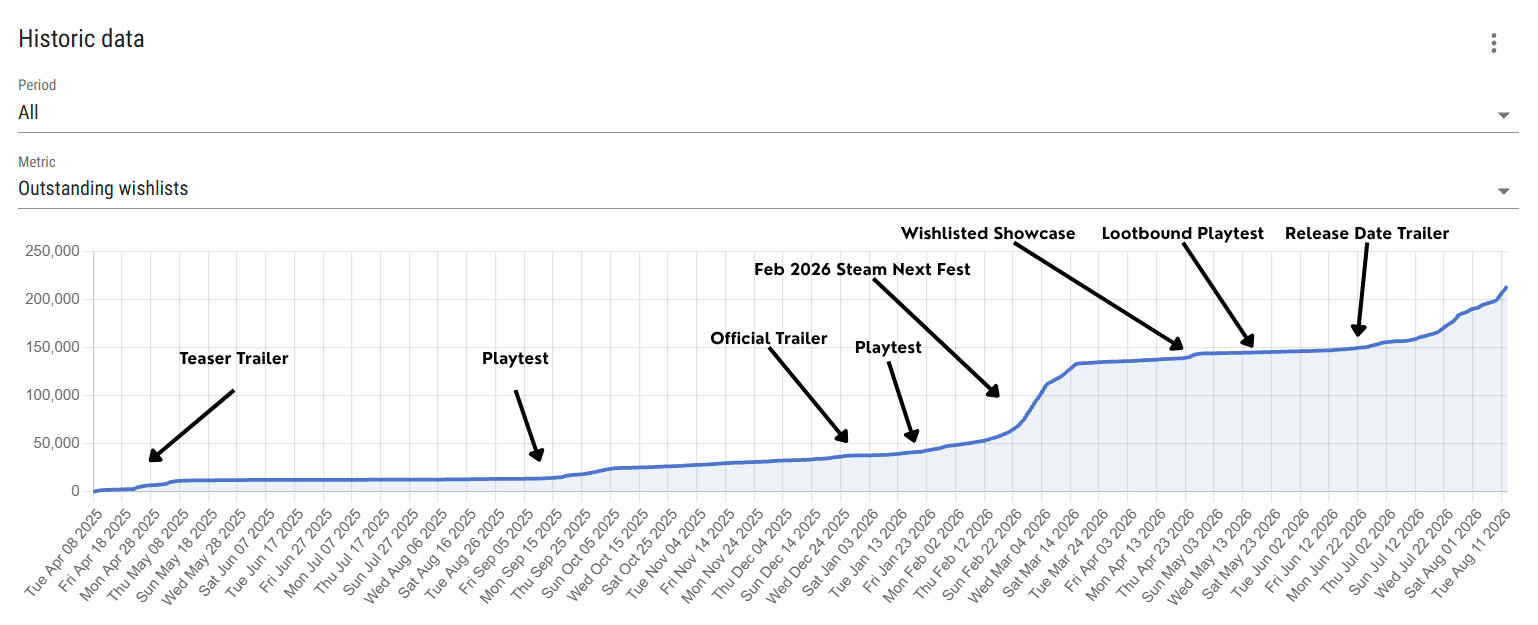
Below is a quick snapshot of Lootbound’s marketing efforts.
Participated in many festivals, showcases, and in person events.
Wishlisted Indie Game Showcase
Nordic Game
Tokyo Game Show
Gamescom
Trailers were regularly shared by the big trailer channels like IGN, Game Trailers, etc.
Great influencer coverage
Very strong Feb 2026 Steam Next Fest performance.
Went up 29k wishlists during Steam Next Fest.
Did some cool collaborations with other games during this.
Social Media didn’t seem to be a significant source of their wishlists.
Great custom art for marketing beats.
Great use of playtesting before and after demo.
Seems likely they utilized playtests to test both their demo build and aspects of the final game.
Failed Kickstarter but still went on to have great success!
Two great selling games I highly recommend doing a case study on is Tactical Breach Wizards (300K+ copies sold) & Shogun Showdown (350k+ copies sold). Luckily for you i’ve already done a deep dive on both these games.
If you skimmed, here’s what I’d want you to walk away with.
The market is brutal, but it’s brutal in predictable ways. The games making real money aren’t doing anything mysterious. They started marketing early, priced with confidence, built something with depth, and gave players a reason to care beyond the combat itself.
Three things you can fix before launch:
Your price. 44% of this genre is priced under $10, and those games sold roughly the same number of copies as games priced under $5. Meanwhile 47.7% of $30+ games crossed $1M. The sweet spot is around $20
Your runway. 395 games, the single largest group in the dataset, put their store page up less than three months before launch and made a median $2,846. Games with a store page up six to twelve months triples that. A store page is free :). This should go without saying but when I talk about runway and putting up a store page I really mean marketing. Simply putting up your store page and doing nothing else will likely not change much. So when you read into this data you should interpret it as how long these games focused on marketing ahead of launch.
Your tags. If your game is Pixel Graphics, Top-Down, Retro, Casual, and Dungeon Crawler, you’ve described roughly a third of your competition. Make sure you have Turn Based Combat wrapped around a second loop if you hope to stand out with these tags.
And one thing that isn’t easy to add but might be worth it: co-op. 44.8% of Co-op + RPG games in this dataset crossed $1M. Nothing else in the data comes close. Only 52 games out of 1,542 built it.
Data tells you where the crowd is. It doesn’t tell you that you can’t beat them there. Lootbound has pixel art. It’s a dungeon crawler. It’s got Inventory Management, Loot, and Casual tags, five of the exact tags sitting at the bottom of my performance tables. And it’s launching today with over 200,000 wishlists. Lootbound didn’t win by avoiding the crowded lane, it won by having a very unique premise/identity and executing on a great marketing plan.
If your making a turn based combat game hopefully you learned some useful stuff! And if you’re interested in a publisher that loves these types of games feel free to pitch your game to us.
See you next time 🍻
No posts
Comments
Nothing yet. Say the first thing.
Sign in to join the conversation.