
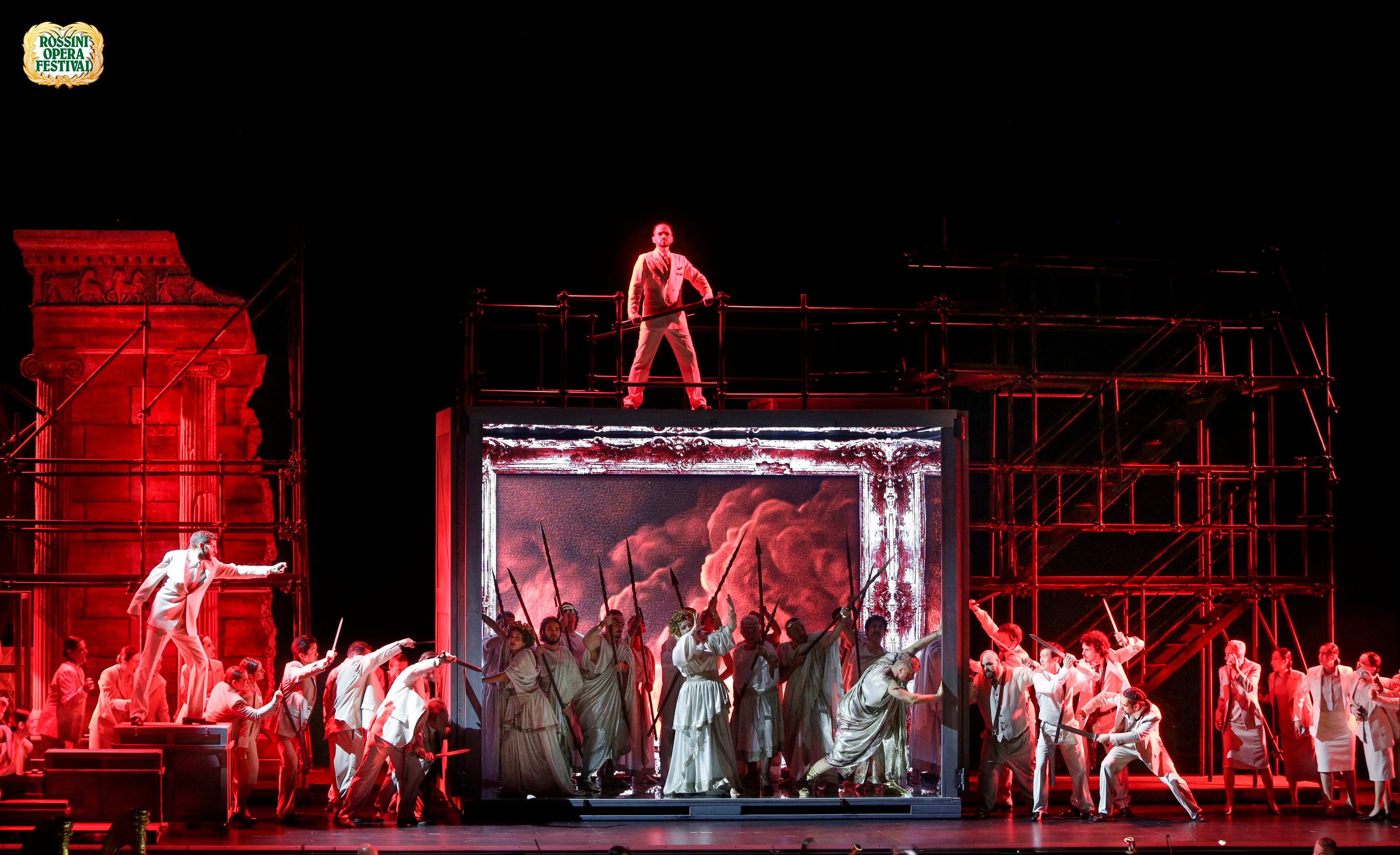
The Ruins of Corinth: Adrian Sâmpetrean (Mahomet II) atop D-Wok’s video-box Picture © Amati Bacciardi
Few Rossini operas have a more complex history than Le Siège de Corinthe, which the annual opera festival at Pesaro, the composer’s birthplace, has just treated to a fascinating, albeit irritating production.
In its original incarnation Le Siège de Corinthe was a melodramma with the title Maometto II: it first saw the light of day at the Teatro San Carlo in Naples in 1820. Rossini then reworked the music for a new grand-operatic version in French, Le Siège de Corinthe, premiered at Paris in 1826. This was quickly popularised across Europe in Italian translation, as L’assedio di Corinto - a version championed in the second half of the 20th century by Renata Tebaldi and Beverly Sills.
The significance of Le Siège de Corinthe is the way it reveals Rossini’s development as an opera composer. A year previously, his ‘scenic cantata’ for the coronation of Charles X, Il viaggio a Reims, effectively summed up his genius as a composer of Italian comic opera. Simultaneously he was adapting two of his serious Neopolitan operas, Maometto II and Mosè in Egitto, as grand-operatic blueprints for his ultimate masterpiece, Guillaume Tell, his final original work for the stage. Le Siège was the first step on that path - a path that saw Rossini revolutionising the French tragédie lyrique and transforming it into the operatic spectacle that his successors, Meyerbeer and Halévy (with less distinguished music), would make their own.
Comments
Nothing yet. Say the first thing.
Sign in to join the conversation.