This page provides a record of edits and changes made to this book since its initial publication in the BC Open Textbook Collection. Whenever edits or updates are made, we make the required changes in the text and provide a record and description of those changes here. If the change is minor, the version number Read more »
Dr. John Douglas Belshaw is an Open Learning faculty member at Thompson Rivers University, a consultant to the post-secondary sector, and a writer. He has authored, co-authored, and edited several books and articles on the history of British Columbia. Contributing Historians Frank Abbott, Ph.D. (Simon Fraser University) Dr. Abbott is an accomplished Canadian History instructor Read more »
This glossary is a summary of all key terms that appear at the end of each chapter. Glossary abolition (ch 7): Refers to the abolition of the institution of slavery. In Britain a single piece of legislation resulted in the abolition of slavery in 1834. Abolition in Upper Canada was initiated by John Graves Simcoe in 1793.aboriginal Read more »
History is a complex dance between continuity and change. Both, however, are deceptive. What appears to be continuity can, from time to time, be the reappearance of a practice or belief, one that had been suspended for a time. A single element of material design might be perpetuated for centuries for reasons that no one recalls Read more »
Confederation enabled the creation of a changed investment environment. Like all such environments, it had more to do with subjective confidence than with any objective reality. Nevertheless, the years after 1867 were marked by heavy investment in railroads, the growth and maturation of the banking system, and the rise of an urban-industrial Canada that was only Read more »
George Brown entered into a coalition government with John A. Macdonald and George-Étienne Cartier with a grocery-list of conditions. One of these was that Canada — in whatever form it was to take — would annex Rupert’s Land. There was no talk in 1867 — no serious talk at least — about adding the newly Read more »
Confederation was, very clearly, an idea arising in Canada as a solution to Canadian problems and it was meant to give advantage to Canada first and foremost. It did not derive from the ambitions of Prince Edward Islanders, nor was it an expression of the dreams of Newfoundlanders. Nor too was it a scheme hatched in Read more »
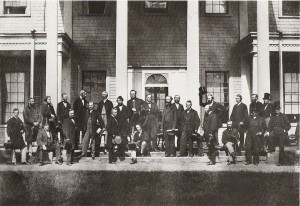
The Charlottetown Conference Two dozen delegates attended the first meeting in Charlottetown to discuss the possibility of a federal union. The fact that the idea of federalism was put on the table at the outset is important. The United States was a federation and its example was obvious and important to consider. But Britain was Read more »
The late 19th century saw the rise of the patent medicine industry in North America. Backed by anecdote and perhaps some folk-remedy pedigree, the patent medicines promised to cure anything and everything. At best they might have a benign placebo effect. Confederation was a bit like these cure-all medicines. It promised to address everything that was wrong Read more »
As we saw in Chapter 11, political life in the united Province of Canada in the 1850s was marked by frustration and stalemate. No single party commanded enough seats to enjoy a majority in the assembly. There were divisions along ideological lines, principally between liberal urban professionals and the wealthy merchant class in the Reform, Grit, Read more »