
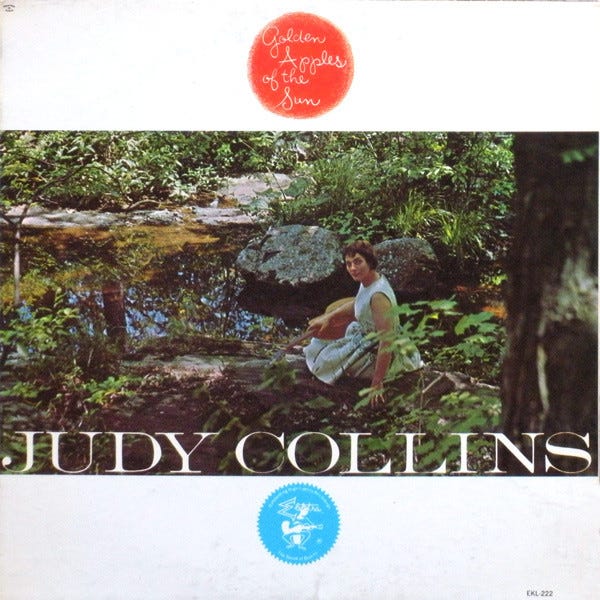
Tracks: 1) Golden Apples Of The Sun; 2) Bonnie Ship The Diamond; 3) Little Brown Dog; 4) Twelve Gates To The City; 5) Christ Child Lullaby; 6) Great Selchie Of Shule Skerry; 7) Tell Me Who I’ll Marry; 8) Fannerio; 9) Crow On The Cradle; 10) Lark In The Morning; 11) Sing Hallelujah; 12) Shule Aroon.
REVIEW
By the time Judy’s second album came out, it was still 1962, and the Greenwich Village singers were still on their way to becoming songwriters, so, unsurprisingly, the track list here still mostly consists of traditional numbers, and the record’s commercial fortunes were just as thin as its predecessor’s. There are, however, a few subtle differences, which may or may not be significant, but at least indicate a bit of curiosity and soul-searching on the part of the artist (yes, in a rough sense all Judy Collins albums sound the same, but this is the kind of music where you either buckle up and go hunting for nuances or just make the resolution to die of boredom straight away, right?).
First, there’s a slight change in the sound: Judy is still backed by a second guitarist (Walter Raim replacing Fred Hellerman), but the banjo is gone, and in its place is Bill Lee on bass — the same Bill Lee who was very much responsible for the dark and brooding atmosphere on Odetta’s earlier albums. In the case of Judy, he adopts a different strategy, playing very lightly and tenderly to suit her lighter, chirpier style, but the difference is still there — mainly on a handful of faster songs like ‘Fannerio’, which the addition of bass makes toe-tap-worthy or even danceable, or spiritual covers like ‘Twelve Gates To The City’, to which the bass adds an air of certainty and defiance. Nothing ground-shaking, but a small step away from the «just-one-girl-and-her-guitar» mood of the debut.
Second, there are some equally tiny steps to broaden the horizons. A Maid Of Constant Sorrow was almost completely dominated by the Irish folk song, with just a few spills over into the Appalachians. Irish folk still makes up the bulk of this record as well, but there are attempts to toy with other traditions as well — the above-mentioned ‘Twelve Gates To The City’ is a spiritual most commonly associated with the Rev. Gary Davis (and was also quite popular with Judy’s peers in the Village, like Dave Van Ronk), while Mike Settle’s contemporary classic ‘Sing Hallelujah’ is a mix of gospel and country-western, perfectly tailored for American TV watchers. I am not too sure that Judy could pass for a great gospel singer, but she certainly has the pipes to carry those songs, so they at least provide welcome distractions from the otherwise non-stop barrage of Irish folk ballads.
I suppose that the best remembered performance from here is still the title track, a stately musical arrangement of Yeats’ ‘Song Of Wandering Aengus’. Investigation shows that the very first reimagining of Yeats’ famous fusing of Hellenic and Celtic mythology as a song may have been captured on Burl Ives’ Songs Of Ireland (1957) as a tender a cappella piece (titled ‘The Wandering Of Old Angus’), but the original liner notes to Judy’s album state that she learned the song from listening to live performances (and later, a demo made specially for her) by Greenwich Village resident Will Holt, and that the melody may have come from the famous minstrel Richard Dyer-Bennet. To make matters more confusing, some digital sources like Wikipedia still quote the Bud & Travis’ recording on their Naturally: Folk Songs For The Present LP as the first and most famous one, dating it to 1960, but in fact that album came out in 1963, and the Bud & Travis version is clearly a cover of Judy’s song, not the other way around. (Technically, the Bud & Travis version is quite superior to Judy’s: they have a fairly complex and perfectly disciplined twin guitar melody rolling on, and the vocal harmonies are intelligently sophisticated — but it still puts me to sleep much quicker than Collins).
Whoever and however did it first, though, there is no denying that Yeats’ already somewhat old-fashioned (by the standards of 1897) romanticism and Judy-Blue-Eyes are a match made in the Irish heavens — both may be somewhat corny and embarrassing, but sometimes the conjunction of two pretentiously starry-eyed artistic minds helps to override the individual skepticism you might feel toward either of them separately, because love is always nice, and there’s clearly some serious love here between the interpreter and the original material. The only possible complaint is that, like just about every other Judy Collins song, this one’s fairly static: each verse sounds exactly like its predecessor, with the small exception of the last two lines (”the silver apples of the moon, the golden apples of the sun“) which Judy stretches out just to let us properly experience their linguistic flavor. The poem itself is less static — its actual mood changes from hopeful and merry in the beginning to gloomy and rather hopeless by the end, and a penetrative musical arrangement or a nuanced vocal performance should have somehow tried to recognize that. Yet even the way it is, ‘Golden Apples Of The Sun’ feels like quite a huge potential influence on folk-based acoustic songwriters all around — from Donovan to Nick Drake — because, come to think of it, where would all those future lyricists get their inspiration from, if not from the likes of W. B. Yeats?
Two more titles are credited to specific contemporary writers. The aforementioned ‘Sing Hallelujah’ is a neo-gospel tune that Judy lifted from the then-recent album Folk Sing Hallelujah by Mike Settle and the Settlers — just one of those fairly generic fire-and-brimstone sermons carefully molded into the shape of a catchy pop song, you know, so that the Lord’s message could slide in real easy. Bill Lee sets up a nice bass groove for this one, but I don’t feel that Judy really has it in her to throw all the sinners out of the Temple with just the power of her voice: she has to seriously strain to introduce a streak of menace, and she doesn’t even have that bit of mischievous tomboy-next-door youthful ardor that we get from the likes of Mary Travers — it’s a bit of a schoolmarm vibe instead, and that’s not very convincing.
Much better is ‘Crow On The Cradle’, which was the first known attempt to set to music a famous pacificist poem by Sydney Carter — later tried on for size by lots of people, from Joni Mitchell to Jackson Browne and far beyond. It’s a terrific lyrical piece, brilliantly marrying Christmas carols and Mother Goose to modern day realities (”rings on her fingers, bells on her toes, a bomber above her wherever she goes“), and Judy has found an appropriately morbid, dirgey arrangement for it; in this case, her stately ice-queen voice works perfectly, conveying the song’s incurable Weltschmerz more perfectly than any of the later covers I’ve listened to for comparison.
The rest of the material is still largely drawn from the same inexhaustible pool of Irish tradition as her debut album, and pretty much everything is more or less predictable, so it really only makes sense to discuss this stuff in comparison. For instance, here you shall encounter the song performed as ‘Silkie’ on Joan Baez’ second LP, but here presented under its less user-friendly, more complex Celticized title of ‘Great Selchie Of Shule Skerry’ — and the impression is that Judy is actually trying to outperform Joan on this tragic tale of magic seals, throwing on a far more intricate guitar arrangement, slowing down the tempo, and going for a downright regal mood. Likewise, it is amusing to compare Judy’s ‘Fannerio’ with Bob Dylan’s ‘Pretty Peggy-O’, released the exact same year (for accuracy, the original title is ‘The Bonnie Lass O’ Fyvie’, and Ewan McCall sang it as a bona fide sea shanty a decade earlier) — lightness and humor dominate Bob’s version, seriousness and tragedy are all over Collins’. (”When I return, the city I will burn / And destroy all the ladies in the country-o“ is somehow not one of the lines that would end up in Bob’s take on the story of the tragically infatuated captain).
Out of sheer historical interest, the final track is a bit of a mess: ‘Shule Aroon’, a «user-friendly» way of transcribing the correct Irish spelling (‘Siúil a Rúin’, commonly translated as something like ‘Go My Love’, but more literally ‘walk, my treasure!’), mixes together elements of the traditional Irish delivery, going all the way back to at least the 16th century, and elements of the song’s American off-shoot (‘Johnny Has Gone For A Soldier’, allegedly quite popular in the Revolutionary War). Today, it’s one of the most common and popular Celtic tunes, with miriads of recordings, but only a handful existed prior to 1962, and I think it’s Judy who must have popularized it around the Village circuit at least, in this mixed Irish-American identity.
Another bit of mystery concerns the fairly lovely ‘Tell Me Who I’ll Marry’, a slightly humorous courting song that opens Side B. The lyrics — “tell me who I’ll marry, tell me who I’ll be, while the Vistula is flowing by the green oak tree“ — naturally suggest a Polish origin, but I have been unable to track down any Polish songs like this one (at least, not in the digital world). The liner notes credit the arrangement to Judy’s second guitarist Walter Raim, whose born name was apparently Walter Yudomin and whose ancestors may have been Jewish immigrants from Poland, so this may have been something he’d learned from his folks... or, who knows, it may have been an original composition of his that he decided, out of shyness, to pass for a traditional Polish folk song (this sometimes happens). Liner notes again: “I know little of the song’s background”, Judy explained, “but it is quite apparent from its very sophisticated contraction that it is probably a composed rather than traditional song”. In any case, it was she who popularized this one.
Overall, Golden Apples Of The Sun is a bit more romantic and less on the militant side than its predecessor — only two of its numbers are straight-ahead anti-war songs — which is neither good nor bad, but at least it does not turn the album into a faithful clone of Maid Of Constant Sorrow, and for a generally formulaic artist like Judy that’s already a good sign. Yet it still precedes the «Great Dylan Revolution» in folk, taking the usual baby steps, common for 1962, to modernize the genre, and generally being more interesting to those who like to look back rather than forward... not that there’s anything inherently wrong with that, of course.
Only Solitaire reviews: Judy Collins
Comments
Nothing yet. Say the first thing.
Sign in to join the conversation.