
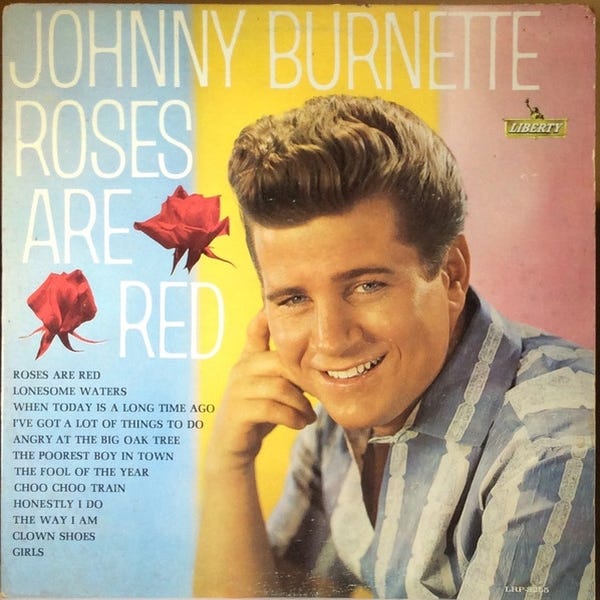
Tracks: 1) Roses Are Red (My Love); 2) Lonesome Waters; 3) Clown Shoes; 4) The Fool Of The Year; 5) The Poorest Boy In Town; 6) I’ve Got A Lot Of Things To Do; 7) Girls; 8) Honestly I Do; 9) Choo Choo Train; 10) Angry At The Big Oak Tree; 11) When Today Is A Long Time Ago; 12) The Way I Am.
REVIEW
By the time Johnny’s last LP for Liberty Records — and, as nobody could foresee at the time, his last ever LP — appeared on the market, his career was pretty much over. For most of 1962 and 1963, preserved data shows that he actually played far more shows in England than he did in his native country, which, at the time, was a fairly secure sign of losing any relevance: in the future, the practice of groundbreaking artists rejected in their own country but finding success abroad — from Hendrix to Sparks — would become fairly common, but in 1962, moving (even symbolically) from the US to the UK (or from the UK to, say, Scandinavia, for that matter) usually meant that you really weren’t good enough. And in the UK, with a bit of a time lag, people were still ready to accept him as the hero of ‘You’re Sixteen’ and ‘Dreamin’ — let alone the rockers who probably still cherished their exclusive memories of the Trio.
But this does not mean that Johnny’s records would continue to sell, on either side of the Atlantic. His first single for 1962, recorded in December of the previous year, was a rather odd song called ‘Clown Shoes’, credited to a mysterious «James Marcus Smith» which, as it soon turned out, was actually the real birthname of the artist known as P. J. Proby — at the time, still trying his luck in his native country, before finding a bit more of it in the UK (wink wink nudge nudge again). Maybe he wrote it under the influence of the Everly Brothers’ ‘Cathy’s Clown’ — who can really tell? — but in any case, the song is a goofy-maudlin pop ballad that carefully walks the line between tragic and humorous without properly setting foot in either side. It’s really novelty vaudeville, something straight off the cheap cabaret line, and I honestly have no idea how even Snuff Garrett let that past his controlling eye, unless he just didn’t give a damn any more. It did go all the way to No. 35 on the UK charts — probably triggered by Johnny’s touring of the country at the exact same time — but that was the last time that even Johnny’s British fans were willing to cut him any slack.
For some reason, though, Johnny did take a serious liking to songs in which the protagonist is openly humiliated by his girl (perhaps a psychologist’s advice would not be out of place here): the next single was ‘The Fool Of The Year’, which was his third song with a similar title (after ‘The Fool’ and ‘Fools Like Me’) in less than two years. This one, incidentally, was commissioned from David Gates, a prolific corporate songwriter at the time and the future frontman of Bread — far from a reassuring recommendation in retrospect, but at least the song was moderately less embarrassing than ‘Clown Shoes’: upbeat, catchy, a little on the Drifters side of things, and making better use of the art of irony than its predecessor. Alas, it was a complete flop, and for the rest of his life Johnny Burnette never had a single hit anywhere.
Still, at least he recorded enough material in Hollywood during those last months of 1961 and first months of 1962 for the bosses at Liberty Records to leave it all just sitting on the shelf, and in late summer of 1962, both of the above-mentioned singles, along with their B-sides and eight other recordings, came out as Roses Are Red — not a particularly exciting title, but it was most likely offered for pragmatic reasons. The title track, a sentimental country-pop ballad by Al Byron and Paul Evans, was recorded by Johnny in January 1962 and temporarily shelved, along with everything else; meanwhile, the song was also picked up in February by the struggling young artist Bobby Vinton, released as a single in April and turned into his first smash hit. So, naturally, when it was discovered that Burnette had recorded his version even earlier, a last-ditch effort was made — but, of course, it did not help album sales (and releasing it as another single was probably deemed risky).
Listening to the two versions back to back is quite instructive in understanding what was perceived as commercially viable and what was not back in mid-1962. Johnny still sings like a former rocker — a little husky, a little low, not enough «teen» for the youthful market but also not nearly as «adult» as somebody like Elvis. Vinton, coming out of the Ricky Nelson school of singing, delivers it with an almost unhealthy overdose of melancholic teenage romance, just the right stuff for all those young couples at drive-in theaters. The song itself is fairly trite — there were literally hundreds of these country shuffles on the market at the time, and this one, in particular, seems like an inferior variation on ‘I Can’t Stop Loving You’ — but there was definitely something to be said about the brutal simplicity of its chorus: “Roses are red, violets are blue, sugar is sweet, but not as sweet as you“. (Something tells me the 10-year old Joey Ramone might have appreciated that.) Perhaps if Liberty Records had had the foresight to release Johnny’s version as a single before Bobby’s, that simplicity would have helped — but as it is, Vinton’s tender youthfulness completely overrode Burnette’s rowdy masculinity, though, ironically, Vinton himself was only one year younger than Johnny.
Most of the other songs deserve, at best, a brief mention. Of note is ‘Choo Choo Train’, one of the few songs in Johnny’s Liberty catalog that he actually wrote himself: it ain’t no ‘Train Kept A-Rollin’, of course, but it is the closest this record comes to recapturing a tiny whiff of his rockabilly past, with the rollickin’ ‘Mystery Train’ rhythm used as a foundation for a pop melody — I think the song would have worked much better without the distracting strings, but wishful thinking has no real place in 1962. Meanwhile, brother Dorsey contributes ‘Honestly I Do’ (not to be confused with Jimmy Reed’s superior and entirely different ‘Honest I Do’!), a sweet, upbeat mandolin-led country ballad that’s even further away from the brothers’ glory days of so long ago. Not awful, but quickly forgettable.
Several of the songs are strictly in the contemporary Elvis vein, the only difference being Burnette’s obviously inferior (but sometimes a bit sleazier and/or more playful) voice and Snuff Garrett’s «Technicolor-enhanced», in-yer-face string swoops. ‘Girls’, written by Barry De Vorzon, one of the co-authors of ‘Dreamin’, is one such number, very typical of the «timid sleaze à la 1962» catchy, toe-tappable pop style of contemporary Elvis — slight, but fun enough with lowered expectations. ‘Lonesome Waters’, with its slower, bluesier tempo, is another Elvis clone, with Johnny trying to copy every single inflection, diving low and soaring high at the appropriate spots, but naturally amounting to just a shadow of the real thing. There’s even a Carl Perkins composition, ‘When Today Is A Long Time Ago’, which does sound like every slow Carl Perkins country-rock ballad ever written, and is appropriately spoiled by all the springs and gospel back vocals.
In the end, this is maybe only just one tiny notch below Johnny Burnette Sings, in that this time around, there ain’t a single song like ‘The Fool’ that I’d want to preserve under my pillow — but only ‘Clown Shoes’ felt like it was quite piercingly embarrassing (for some reason, I can’t get rid of visions of Johnny in drag, with fake tears painted on his face, performing this before a mob of drunken sailors or something). Up to the very end, he was clearly battling the efforts to market him as a «teen idol», but, just like Elvis, the only thing that could have saved him from this ordeal would be developing his own songwriting skills, which he was either unwilling to do or incapable of doing. Dependent on corporate songwriting, he could but follow the industry’s default trajectory.
But he still tried — as proven by his very last single for Liberty Records, apparently written under the influence of having watched the contemporary UK naval blockbuster Damn The Defiant! I guess it made such an impression on Johnny that he took great care to retell the plot of a fictitious mutiny on board a British war frigate in just so many verses, setting it to an appropriately martial beat (a little too happy for such dark content, but whatever — he mostly stole it from Johnny Horton’s ‘Battle Of New Orleans’ anyway). Maybe he believed it’d make a splash in the UK, but it never even dented the charts on either side of the Atlantic, even though the movie itself was reasonably popular at the time. But, you know, it’s one thing to go see Alec Guinness and Anthony Quayle take out bad guy Dirk Bogarde on the silver screen, and quite another to hear a washed-up rockabilly hero of five years ago retell it to you against a generic martial beat.
Supposedly that was the last straw, with the label refusing to renew Johnny’s contract after it expired in the fall of 1962. It did not mean the end: over the next two years, Johnny would be able to find a common language with no fewer than three different labels — Chancellor, Reprise, and, most significantly, Capitol — meaning that somebody still saw commercial potential in the guy, and entertained tiny hopes of his capacity of producing another ‘Dreamin’ or ‘You’re Sixteen’. But it did mean the end of his partnership with Snuff Garrett, and however slight or irritating we may find all those records, it is at least undeniable that Johnny and Snuff had a thing goin’ on: that combination of Johnny’s «post-rockabilly» spirit and Garrett’s hyper-happy string arrangements was its own style that nobody else had, and if only they could beef it up with first-rate melodies, who knows how things would have turned out.
Only Solitaire reviews: Johnny Burnette
Comments
Nothing yet. Say the first thing.
Sign in to join the conversation.