
During the Summer, my life revolves around the tide charts. It is the time of year that us Washingtonians get full week-long stretches of daytime negative lows. Dock fouling becomes something you do in-between those lows and may not get as much energy or attention. I’m also less willing to travel as far to a dock this time of year because I’m already driving hundreds of miles bee-bopping around the coast. Most of my dock observations become closer to home.
Summer dock fouling can be downright obnoxious, too. Quiet marinas with empty parking lots and zero foot traffic become overrun with waves of fisherpeople as various permit windows open and close. How dare they use the docks for their intended purpose! Going early doesn’t help either as they are equally as interested in their catch as I am in my observation.
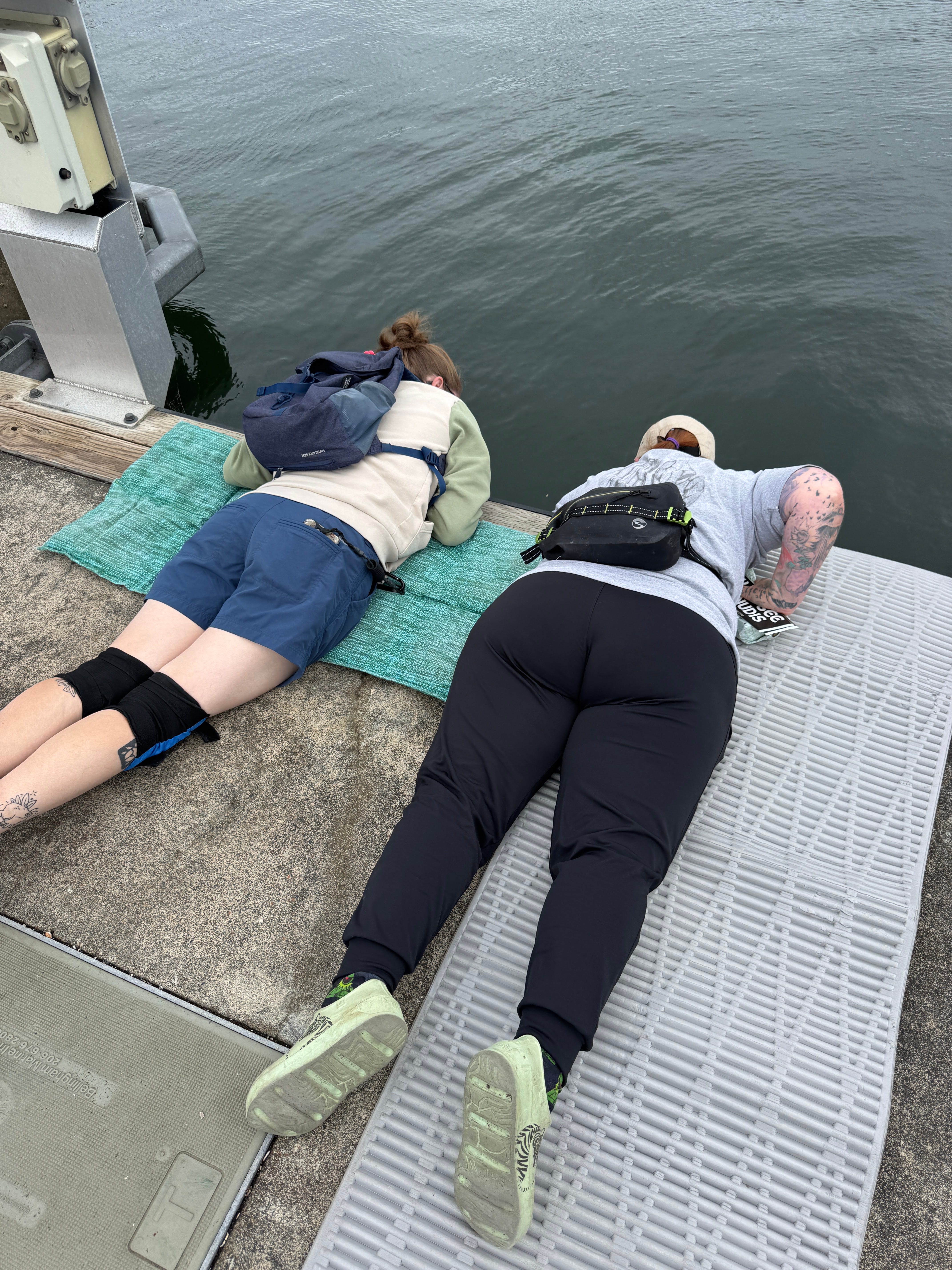
With this increase in activity, the water can get gross. Debris, dead bits of jellies, fuel and that scuzzy stuff that coats your camera in a brown film all accumulate along the dock wall. Mother seals and their pups might show up, effectively shutting down that portion of the dock.
It might sound nice to be laying on a dock on a sunny day. In reality, the glare from the sun can obscure your view entirely and burn your face as it reflects back at you from the water. As a small mercy, the water temperature is at least bearable.
Despite all this, dock fouling during the summer can yield some marvelous observations and even some surprises that make it totally worthwhile. Here’s what’s been going on this summer around Puget Sound.
If you want to spend an entire day dock fouling, Kitsap County makes it easy for you. It includes the highest concentration of public docks with large marinas in Port Orchard, Bremerton, Brownsville and Poulsbo. There are many other smaller public ones tucked in around there if you are feeling ambitious.
Throughout this summer, most of these docks have been presenting the classic Puget Sound nudibranch varieties. The Giant Nudibranch, Dendronotus iris, has been the most ubiquitous slug this season. Both teeny tiny juveniles and large flamboyant adults can be found either in the bushy hydroids or swimming in the water column. Hermissenda crassicornis has also been observed at all of the major docks in this area, because of course it has. This time of year its population can wax and wane. Sometimes there are giant blooms of Hermissenda, then you can return to the docks the next day and only see a couple of them.
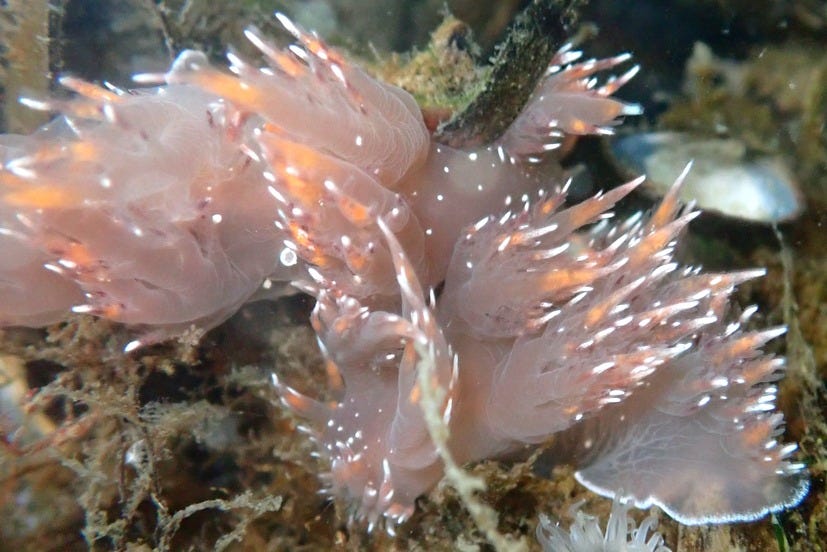
Rocky aeolids, Eubranchulus rupium, are also present throughout this area though they seem to be buried deeper in the hydroid in smaller clusters. Tenellia albocrusta has been popping up here and there; distribution seems to only cover a few of the docks. You might catch a barnacle eating dorid or two, just don’t expect to see any huge aggregations of them in this area. The branched dendronotid population that was popping in the spring appears to have dwindled down to only a handful of individuals.
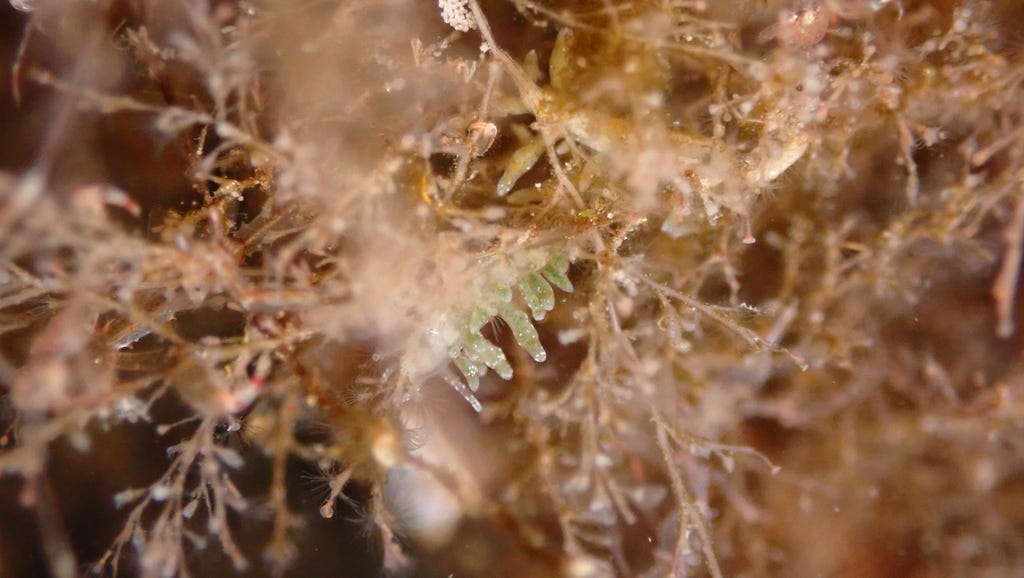
The Hedgepth’s Sapsucker seemed to be the only sacoglossan with a robust presence in this area, though it was patchy dock to dock.
Surprises are possible in Kitsap County this time of year, so don’t make assumptions about what species you are seeing until you get a better look.
The public docks in King County include Vashon Island and Shilshole Marina. There is only one public dock that I know of in Snohomish County and that is at Edmonds Marina. Even though there is a marina in Des Moines I rarely visit it as I have seen little sign that it is capable of hosting nudibranchs.
The docks in these counties are few but have been especially interesting this time of year. Vashon Island is host to a year-round doto population that has exploded this summer. The whole dock, including the newly installed fingers, has enormous bushy hydroid tufts that each host dozens of doto. As the doto population has been increasing, other visible species at this dock have mostly vanished. If you want to see LOTS of one species and that species is a doto, Vashon has a dock for you.
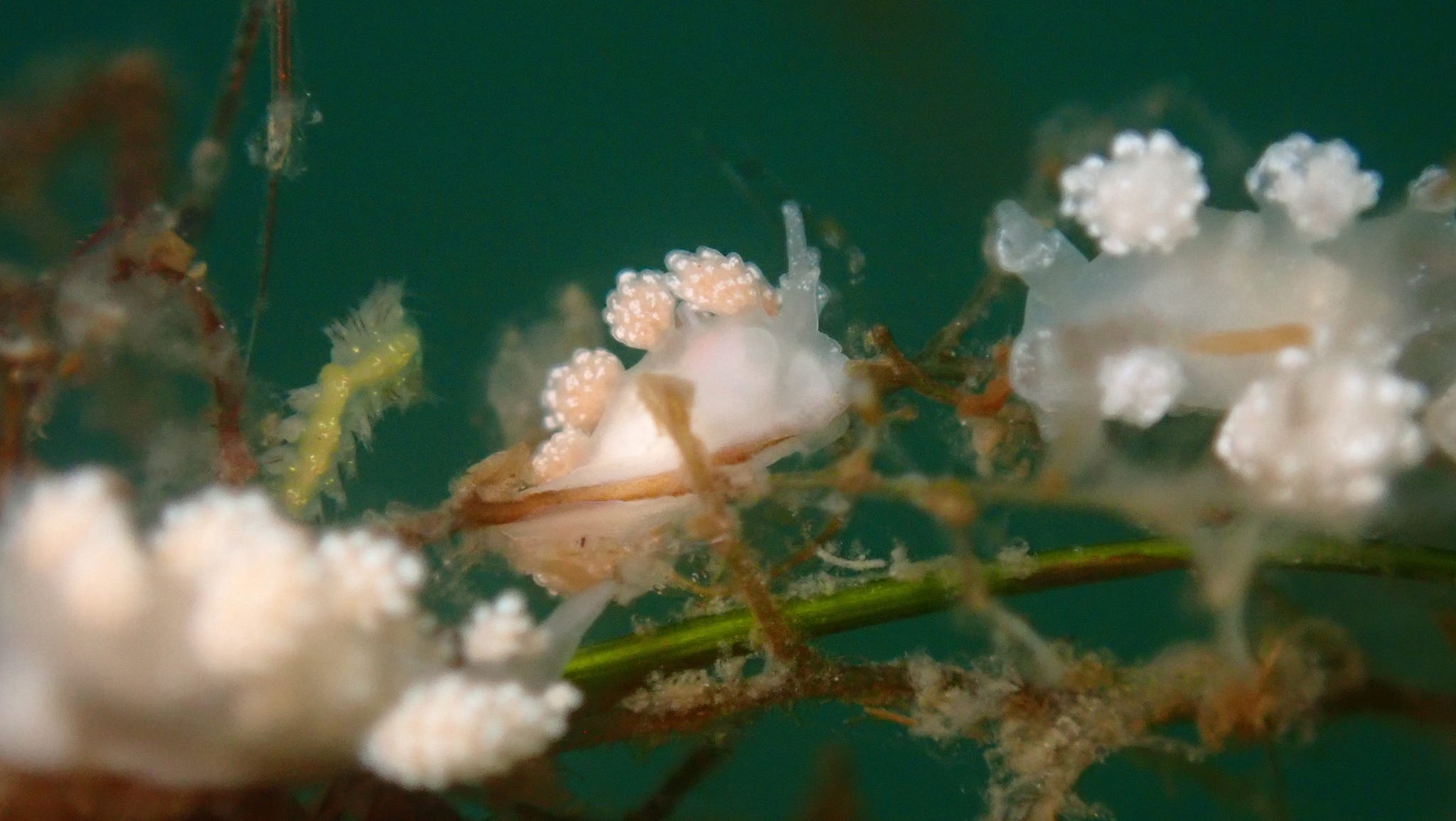
Shilshole Marina can be quite temperamental. It can be difficult to access due to sea lion presence or ongoing projects. Even when it is accessible it may only reveal a couple of slugs. As of late July, Shilshole seems to be having a moment. Access has been clear and the slugs have been slugging. Though I doubt you’ll ever see a high abundance of individuals at this dock, you’ll have a decent chance of seeing a variety of species. My last visit yielded a small quantity of six different nudibranch species and one sapsucker. Not bad for a dock that I usually snub!
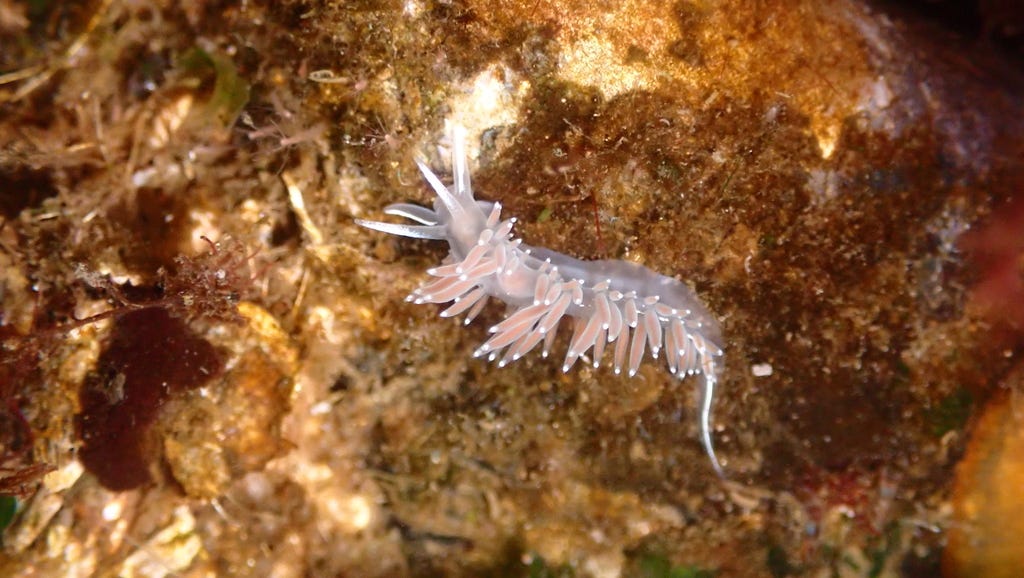
Edmonds Marina typically gets neglected by me in the summer due to it being on the opposite side of Seattle from where I live. None of my friends appear to be observing much there either. This dock doesn’t often host many nudibranchs and I would expect summer to be the exception to that. If you happen to be there at a lower tide, it might be a different story. Nudibranchs can often be spotted in the rocks below the docks here, though they can be impossible to photograph.
The one public dock in Pierce County is at Point Defiance Marina. Technically there is a collection of a few docks at this location. During this time of year, the boat ramp style docks are almost inaccessible due to the amount of boat traffic. You are mostly confined to the “L” shaped dock, though that can get busy too. This time of year the little floats below the boathouse open up. These are incredibly tricky to dock foul but have different algae and hydroids to the marina.
Horned nudibranchs, Hermissenda crassicornis, dominate here in the summer. Second to that are the Tenellia albocrusta that can be reliably found on crusty blades of kelp hanging from the docks. That kelp is worth examining slowly and carefully. It appears to be a nursery this time of year with tiny baby Hermissenda, Orienthella and Tenellia all inhabiting the same blade.
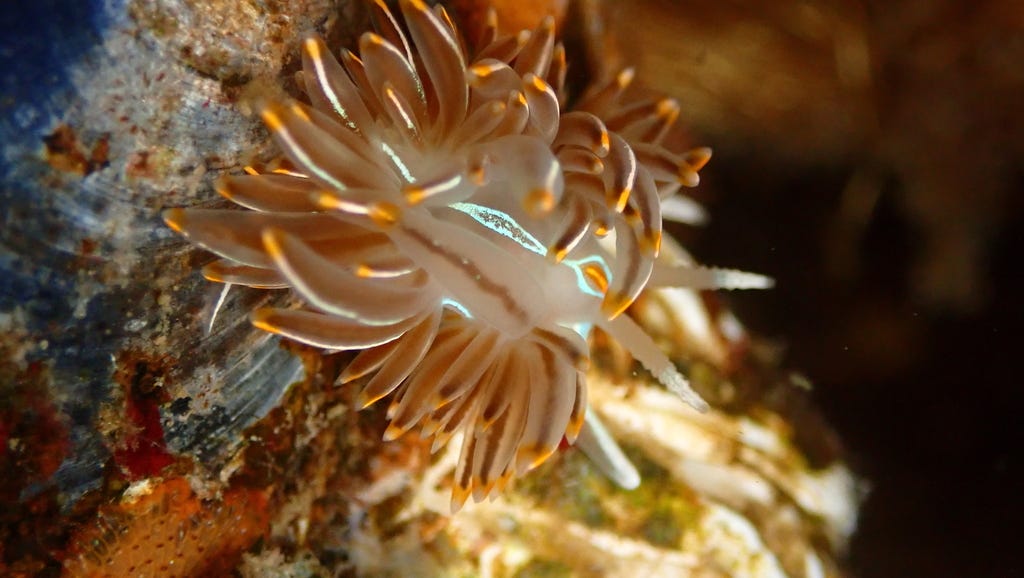
On the dock sides I have consistently seen tiny white dorids, either Fuzzy or Jannas, in the patches of encrusting bryozoa. Tucked in there you can usually also find some baby aeolidia that are so young they almost look like an entirely different species. Towards the end of the summer, white lined dirona start popping up. You can also find small numbers of Dendronotus venustus and Eubranchus rupium, both species that seem to have large blooms at other times of the year.
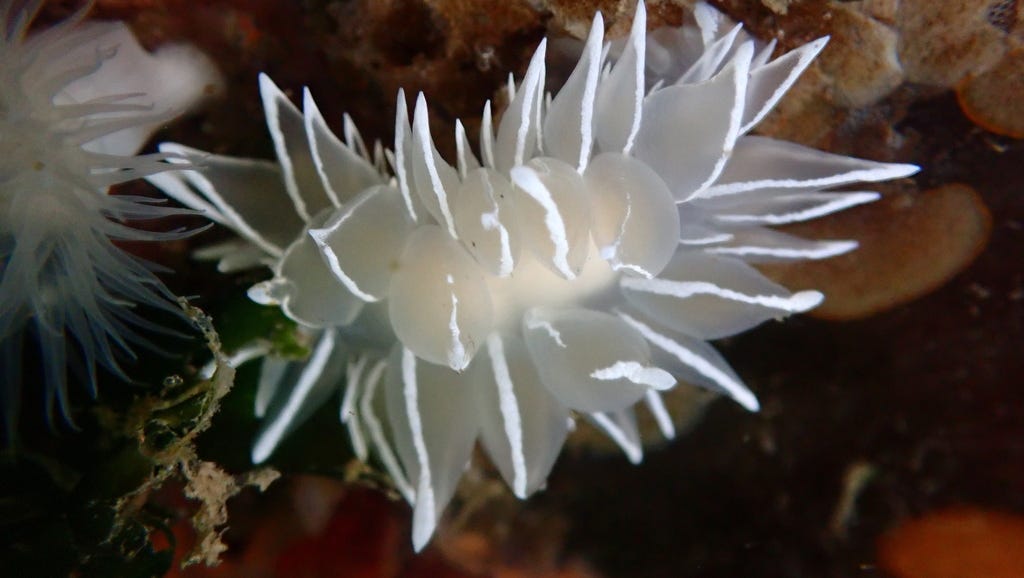
Notably absent this summer are the pink mouth hydroids and the species that come along with them. No sightings of Tenellia columbiana or Orienthella trilineata. I don’t think the presence or absence of the pink mouth hydroid is linked directly our terrestrial seasons. These docks can get particularly gross with human pollutants and decaying debris. Pink mouth hydroid seems to prefer cool, flowing water rather than the little pockets of filth that accumulate here in the summer.
I am not sure if I would quite consider this area a part of Puget Sound, it is more of a threshold. Despite it being a bit further than I’d like to drive in the summer, Deception Pass docks are a completely worthwhile summer diversion. I had been eager to see how the Cornet Bay docks would recover after the storms last winter that wiped them clean of all slug activity. Around May they started to show slug signs again and have just been getting more exciting from there.
Pink mouth hydroids are going strong at Deception Pass, and so are the Tenellia columbiana that you typically see with them. Their presence at this dock is what leads me to believe that the absence of pink mouth hydroid at Tacoma is beyond something as simple as seasonality. Dendronotus venustus that were conspicuously absent from other docks around the Sound have also been going strong here. This dock is a clear example of how population patterns follow unseen factors that don’t cleanly line up with our land based expectations.
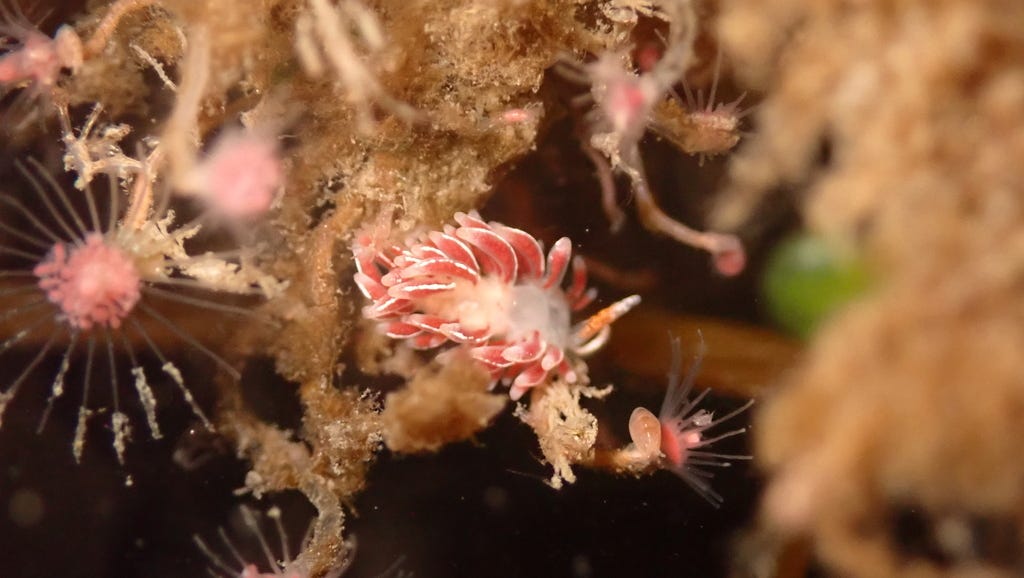
These docks can be lively this time of year, but there is plenty of space to spread out and it is worth taking your time to check different zones. Long blades of kelp have already rooted to the dock. Along with them are kelp lace bryozoa and their predator Corambe. Kelp does seem to have true seasonal patterns and as it ages on the dock it will play host to different species as the seasons progress. It is always worth a delicate check.
Close to the walls of the docks you are likely to find Coryphella longuadata, Tenellia albocrusta and possibly Diaphodoris lirulatocauda.
It is worth noting that there are a few public docks in this area, at La Conner and Anacortes. I typically don’t visit these docks but that doesn’t mean they aren’t worthwhile.
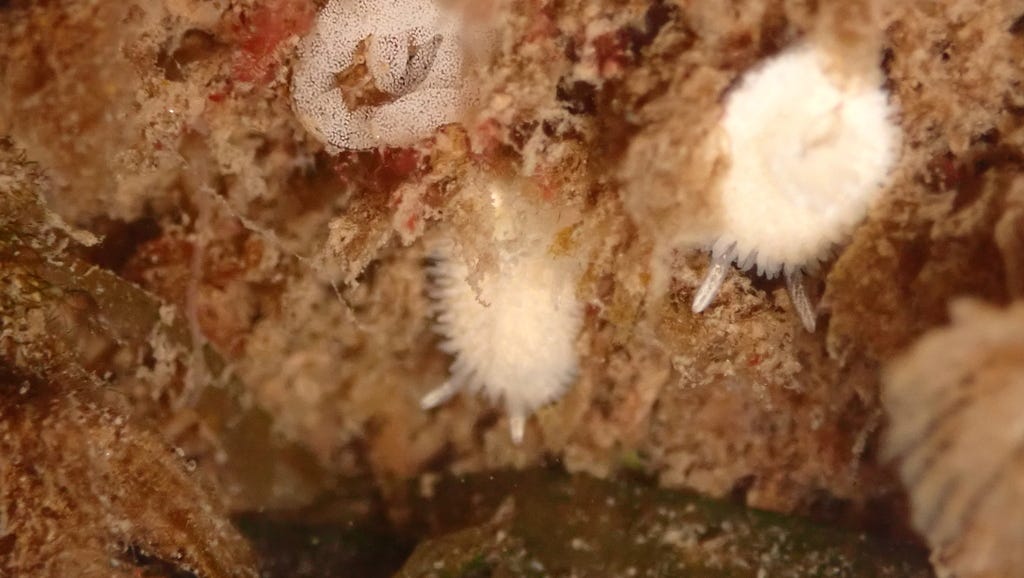
Come September our low tides will have vanished and the docks will start to look even more appealing.
If you are new to dock fouling, I hope this helps orient you to what you might see as we head into fall. If you are a seasoned dock fouler, I hope you see all the opportunity there is to learn more. Whole populations of nudibranch could bloom and collapse in-between when I am able to get out there and observe them. Different eyes will focus on different parts of each dock. You might have easy access to a dock I can only reach twice a year.
Whatever your situation may be, you are capable of making unique contributions to our understanding of sea slugs in Puget Sound.
Comments
Nothing yet. Say the first thing.
Sign in to join the conversation.