

As I write this, the market is back at all-time highs. The first week of August handed us a jobs report that did not just miss but went negative, with the US economy shedding 23k jobs in July against expectations for a gain of around 80k, and the 2 prior months revised sharply lower on top of that. A weak labour market would normally worry equities, but the read this time was simple, that the Fed is not hiking in September and possibly not at all. Treasury yields fell, and the S&P 500 closed at a fresh record to cap its best week since April. The sharpest move of the lot came from the semiconductors that had only just crashed, with the chip index up more than 7% on the week as the capitulation reversed.
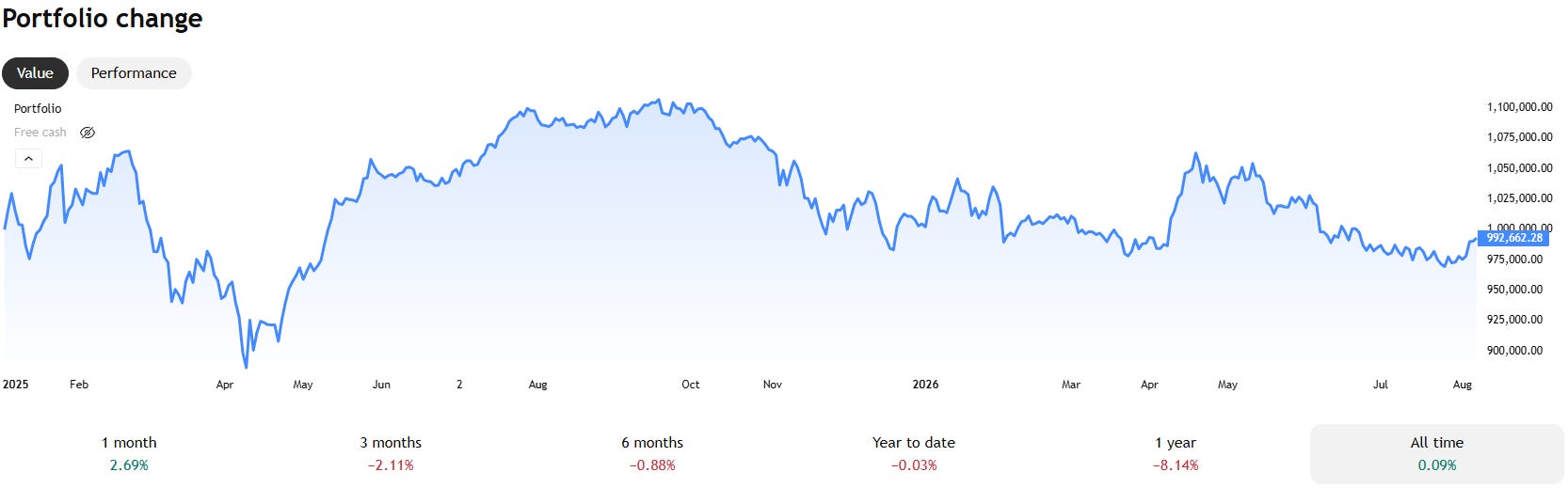
That backdrop is the vindication of a call I will come to, but the month I am actually reporting on, July, was not kind to my book. The portfolio returned -1.16% for July, which brings the YTD to -2.65%. The number is disappointing, and the lesson behind it is one about process. My rebalance falls on the first of the month, and this time the calendar worked against me. It had me cut oil right at its low, just as the war premium came out, and then the same rigid cadence kept me on the sidelines while the thesis turned back and oil rallied through the rest of the month. I ended up recapturing that move as a separate tactical trade rather than holding it in the book, which is a clumsy way to run a position I still believed in. So the thing I am changing is not a view but a mechanism. I am building in room for time-sensitive tactical adjustments (made known to paid subscribers) between rebalance dates, so that a thesis which flips mid-month is no longer held hostage by the date on the calendar.
The reason the record highs matter is that they are the tape catching up to the one signal I changed my mind on. Global liquidity has turned back up, with M2 breaking to new highs, and that was the very pillar of my caution when it was rolling over. So through late July I put the dry powder I had been hoarding to work, into cheap emerging markets, commodities and, most contrarian of all, the semiconductors everyone else was selling. One good week is not a victory lap, and stretched valuations and the Middle East can both still bite. But the balance of risk had shifted, and I would rather ride with the tape than go against it.
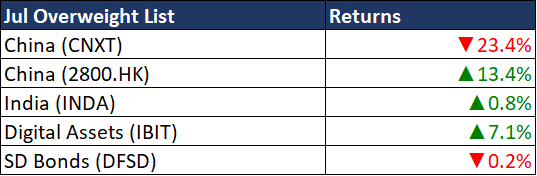
China (2800.HK): +13.4%. My best holding of the month and the clearest proof that cheap Hong Kong value can work on its own terms. I have kept it and made it the core of my China exposure going forward.
China (CNXT): -23.4%. The mainland growth side, and the mirror image of the same trade. It was hit hard by the very rotation that lifted value everywhere else, and the gap between it and 2800.HK was almost forty points in a single month.
Digital Assets (IBIT): +7.1%. The debasement hedge did its job, and I have banked it after a good run rather than overstay.
India (INDA): +0.8%. Roughly flat, and I am keeping the India exposure but switching the vehicle for August.
Short Duration Bonds (DFSD): -0.2%. The stable core that let the rest of the book take risk, and the 55% dry powder I built up while I waited for better entry points. Those entry points are what I think July handed me.
For August I have put that bond pile to work and built a book that leans into cheap emerging markets and commodities, more offensive than last month by design.
China (2800.HK): 20%. Consolidated into the Hong Kong value market alone, so there is no more onshore-versus-offshore style risk to trip over.
India (EPI): 15%. The same domestic-demand thesis, expressed through an earnings-weighted vehicle rather than a cap-weighted one.
Copper Miners (COPX): 15%. A structural supply deficit meeting a market that is still under-positioned for it.
Semiconductors (SMHX): 15%. The contrarian call. I am buying the capitulation after July’s crash, not chasing momentum.
Oil (USO): 15%. Back in the book as my Middle East hedge while the Hormuz truce talk stays unconfirmed.
Mexico (EWW): 10% and Malaysia (EWM): 10%. Cheap, commodity-linked and nearshoring-geared emerging markets to round out the tilt.
The cash that was my caution last month is now my ammunition. If the melt up has given way to a liquidity-fuelled rotation into cheap assets, this is the book I want to be holding.
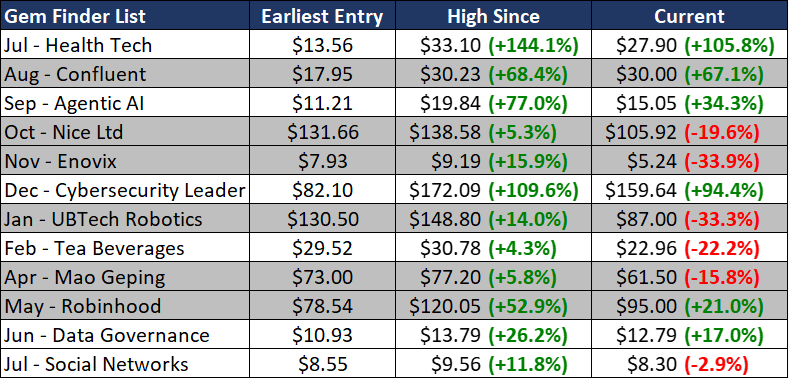
Closed this month: Brokerage, which I can now name as Robinhood (HOOD), booked at +21%. It ran to +53% at the high before the momentum rotation caught up with it, and I rang the register at $95 rather than hand the gain back.
The open book, by theme, with the latest on each.
Health Tech: +105.8%, Oscar Health (OSCR). Our very first Gem Finder call has still more than doubled, and it earned that this quarter with record first-half profitability, a sharply better medical loss ratio and a raised full-year profit guide. The stock actually handed back a chunk of its peak on results day, not on the numbers but on a warning that its Affordable Care Act membership will churn lower in the second half, which I read as a sensible reset rather than a crack in the thesis.
Cybersecurity Leader: +94.4%, Fortinet (FTNT). Another multi-bagger. The quarter was a stunner, with revenue up 26%, product sales up 52% as the firewall refresh cycle roars, record operating margins and raised full-year guidance. The shares have slipped just off their high as the market argues over whether that product surge is durable or pulled forward from the AI build-out, which is a quality problem to have.
Agentic AI (Sep): +34.3%. The one that has woken up. It had round-tripped all the way from a +77% high back to barely above entry last month, and this month it surged as management said its agentic products are moving from pilot into production and the company turned profitable for the first time, with the full-year outlook lifted on top. The risk-on tape did the rest.
Data Governance (Jun): +17.0%. Quietly excellent again. Recurring revenue grew 27% to a record, net new additions set their own record up 35%, it booked an eighth straight profitable quarter, and a brand-new product for governing AI agents is already pulling in much larger deals. Management raised the full-year recurring-revenue outlook. The thesis is doing exactly what I bought it for.
Social Networks (Jul): -2.9%. The newest pick, a social-entertainment platform in fast-growing frontier markets, roughly flat since entry and still early in its story. Nothing to do but let it develop.
Tea Beverages (Feb): -22.2%. The honest laggard. It is a mass-market Chinese tea chain that keeps executing, with revenue and profit both up sharply and the founder buying his own stock, yet the share price has been dragged down by fierce price competition in the tea space on top. The business compounds while the multiple derates, so I am holding it on watch against its stop rather than adding.
Paid subscribers also get real-time positioning updates and trade alerts as I take them.
Disclaimer
This publication is for informational and educational purposes only. There is no consideration given to the specific investment needs, objectives, or risk tolerances of any of the recipients. The information or opinions provided are personal views and do not constitute investment advice, a recommendation, an offer, or solicitation to subscribe for, purchase, or sell the investment product(s) mentioned herein.
No posts
Comments
Nothing yet. Say the first thing.
Sign in to join the conversation.