
Last month I told you the tide was going out, and that I had pulled both feet out the door even though the market was still near its highs. My caution was running ahead of the tape, and I said so plainly. In July the tape caught up. The leadership that carried this whole rally broke, the rotation I have been describing for weeks played out over a full month rather than a single afternoon, and the Fed poured oil (pun intended) on it. This is starting to look less like a wobble and more like the regime change I have been warning about. And yet, right as the crowd turned fearful, the single most important signal I track quietly flipped, which is why this month I am doing something that may surprise you. I am putting my cash back to work.
July split the market in two. The old-economy, cyclical and defensive names held up, with the Dow grinding out a fourth straight monthly gain, while the momentum leadership that ran the first half was taken apart. The S&P finished roughly flat and the Nasdaq-100 dropped almost 7% in its worst month since early 2025. The epicentre was semiconductors, where the memory and chip names that had tripled handed back enormous gains as investors finally asked the awkward question of whether all this AI spending will ever earn its keep. Money did not leave the market. It rotated, out of expensive hype and into cheaper, cash-generative businesses, which is exactly what a regime change looks like when it starts.
The Fed was the turning point, and not in a good way for the bulls. At the end of the month it held rates steady, but three officials wanted to hike, and the Chair’s blunt line that inflation is a choice told you everything about how reluctant this Fed is to ease. The market took it as a central bank falling behind, and it sold off hard, with the Dow suffering its worst day since April 2025 on the decision itself.
The bond market delivered the real verdict. Long-term yields spiked, with the thirty-year hitting its highest level since 2007 and the ten-year the highest since the start of 2025. When long rates jump on a day the Fed holds, the market is telling you it no longer trusts the central bank to control inflation. That is the single clearest signal of the month, and it sits right at the heart of the stagflation call.
And the calm in oil did not last. The Gulf re-escalated through July, the ceasefire fractured, strikes resumed, and the Houthis declared a blockade of the Bab al-Mandab, a second chokepoint alongside the Strait of Hormuz. The war premium I thought had drained away in June came roaring back, which matters for the whole inflation picture.
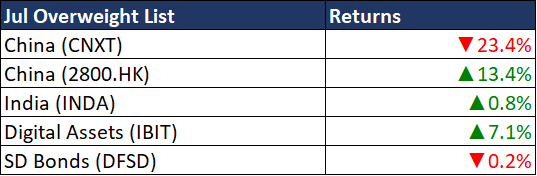
July was a month of extremes in the book. The Hang Seng position (2800.HK) was the star and gained 13.4%, digital assets (IBIT) added 7.1%, and India (INDA) was quietly positive. Short-duration bonds (DFSD) did their steady job. The mainland China growth position (CNXT) fell 23.4% and was by far the biggest drag on the month.
Here is the uncomfortable and instructive part. Both my China positions express the same view, that China is the cheapest major market in the world and the one most sheltered from the US unwind, yet they went in opposite directions by almost forty points. The reason is style. The mainland growth complex got caught in the very same de-rating of momentum and technology that savaged the Nasdaq, while the Hong Kong market, packed with value and dividend payers, caught the rotation that was lifting exactly those names. The thesis was right. The way I expressed one leg of it carried more style risk than the idea itself needed, and that is a lesson I am taking forward.
The mistake I want to own: my rebalancing rule cost me
I rebalance this book once a month, on the first. That discipline usually protects me, since it stops me chasing noise and forces me to act on considered views rather than headlines. At the end of June I judged that the oil thesis had weakened, because the Strait of Hormuz had reopened and the war premium had drained, so I removed the position at the first-of-month rebalance. Within days the ceasefire fractured, the strikes resumed, the Houthis moved on the Bab al-Mandab, and oil ran straight to the level I had originally been targeting. I had the right view a month early and the calendar took me out at the worst possible moment.
I did still capture that oil move, but I had to do it as a separate tactical trade on my Telegram channel rather than in this core book, precisely because the monthly rule had already forced me out. So here is what I am changing. I am keeping the monthly rebalance as the backbone, because the discipline is worth more than the occasional miss, but I am building in a defined rule for time-sensitive tactical positions between rebalancing dates for premium subscribers, so that a fast-moving catalyst like a war re-escalation does not get handcuffed by the calendar. A good process should let a correct view breathe, not kill it on a technicality.
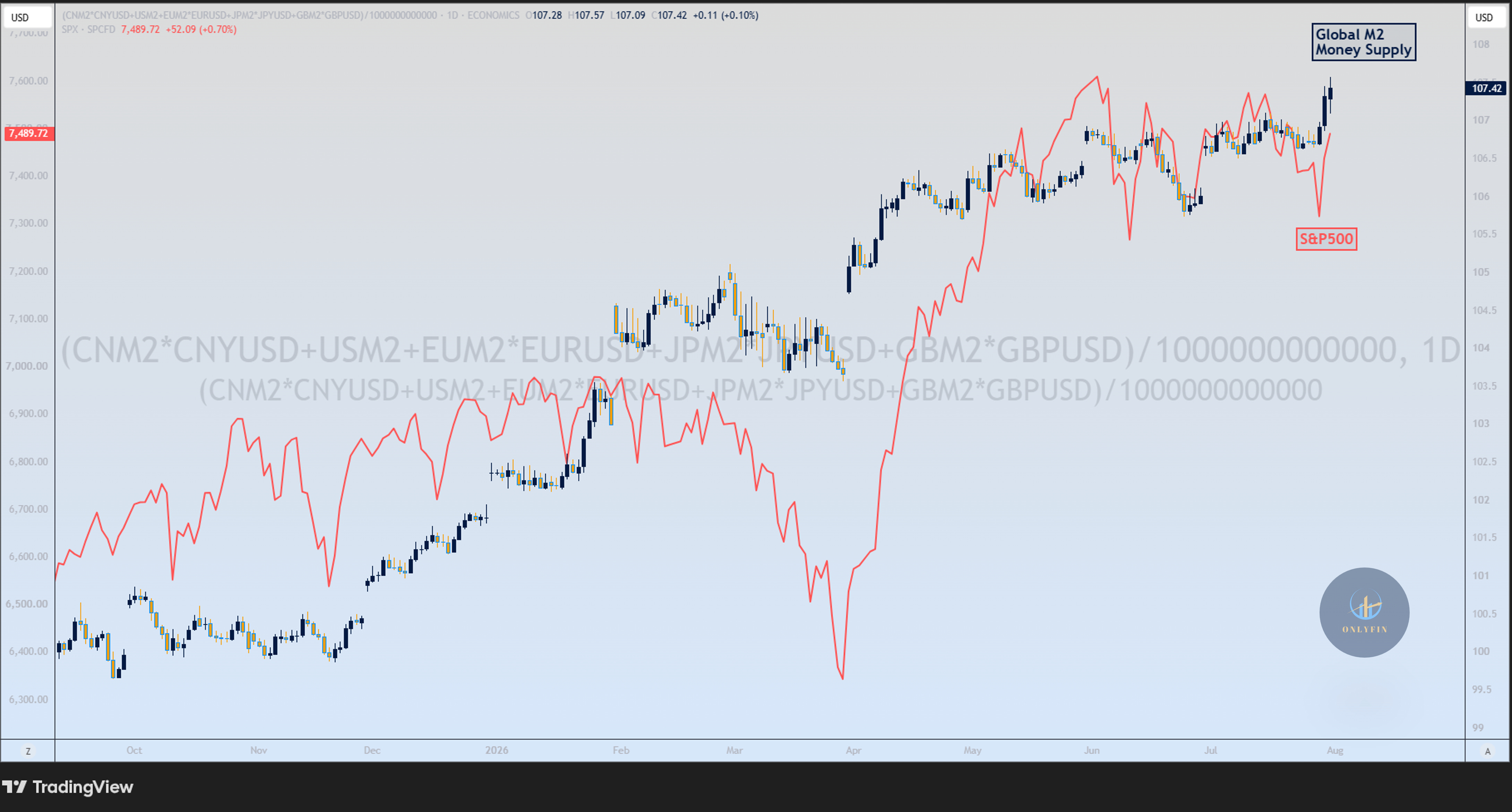
This is the single most important chart I am watching, and it is the reason I am turning a little more bullish rather than hunkering down further. The candlesticks are global M2, the total money supply across the major economies, and the orange line is the S&P 500. Money supply leads equities. It is the tide, and stocks are the boats that ride it.
Through July, as stocks wobbled and the Nasdaq fell apart, global M2 quietly broke out to a new high. When I turned defensive earlier in the summer, the single biggest reason was that this line had rolled over. It has now turned decisively back up. I follow this signal in both directions, and right now it is telling me the tide is coming back in, which has historically been a bullish setup for equities over the weeks that follow.
The twist is what a rising tide of money does when inflation is sticky. It does not lift everything evenly. It rushes into the assets that hold their value, hard commodities and cheap real markets, and away from the expensive growth names that need cheap money to justify their price. That is exactly why I am deploying mainly into emerging markets and commodities.
Ray Dalio’s Big Cycle
Last month I flagged that global liquidity had rolled from an uptrend into a downtrend, and July showed you what that does, because the most expensive and most crowded assets were exactly the ones left exposed when the tide went out. But as the Chart of the Month shows, that tide has now turned back up, and this is the piece that has shifted my stance. Rising liquidity set against Dalio’s late-cycle backdrop of a superpower stretched by debt, war and division does not send me back into US growth. It sends me further into real assets and cheap emerging markets, the places money flows to when the currency it is printed in is quietly being debased.
Howard Marks’ Pendulum
The pendulum is swinging back from greed, and it is doing it the way it always does, fastest where the crowd was most one-sided. The names everyone owned took the hardest hits in July. That is the pendulum in motion, and it is why I have been taking chips off the table rather than adding to consensus trades.
Peter Lynch’s PEG Bands
The US remains the most expensive major market in the world even after July’s fall, while China sits near the cheapest it has been against its own history. Nothing in the sell-off changed that relationship. If anything, the rotation is the market slowly starting to agree with a valuation gap that has been screaming for months, which is the backbone of my tilt away from the US and towards Asia.
Elliott Wave
This is where I felt most vindicated. Last month I said the S&P, the Nasdaq and the FTSE All-World looked like they were starting a third wave down, the powerful trending leg of a decline. July’s break in the Nasdaq is consistent with that count getting underway. I said I was watching long yields and the dollar for confirmation, and long yields spiking to multi-year highs is exactly the risk-off, inflation-fear signal the count implied. I could still be wrong, and a clean break back to new highs would tell me so, but so far the structure is behaving.
Put the four lenses together and they tell a more interesting story than last month. The rotation has arrived and the US momentum trade is broken, so I am still nowhere near the expensive growth names. But the one lens that turned me defensive in the first place, liquidity, has flipped back up, and that is the cross-current that changes what I do with my cash. Sentiment is fearful, valuations still favour Asia over America, the wave structure is playing out, and now the tide of money is rising again into all of it. The difference this month is that I am no longer just early and defensive. I am deploying, carefully, into the cheap corners a rising tide reaches first.
Comments
Nothing yet. Say the first thing.
Sign in to join the conversation.