
A couple of months ago the Oxford academic Carl Benedikt Frey wrote an opinion piece in the New York Times arguing that, as the application of AI becomes increasingly ubiquitous, more tasks that were once handled by professionals or businesses will shift onto consumers. This, noted Frey, is not a new phenomenon. The washing machine may have replaced laundresses, but it also moved laundry into the home. Online banking replaced the bank teller but it also led to banking becoming largely self-service. This pattern repeats through history as successive new technologies simultaneously democratise access to services but also shift the burden for interacting with those services onto the consumers using them. AI will repeat this but on a much larger scale.
This gives us a very different spin on the AI-will-take-our-jobs debate which is raging right now. What this debate tends to overlook is that the work doesn’t disappear, it often relocates. Frey makes the point that the shift in burden is easy to miss because it’s not accounted for in labour statistics and no single act of self-service feels too costly for us as consumers. We might notice the fee that we’ve saved but we rarely notice the additional time we’ve spent taking the task on ourselves - an example of what behavioural scientists would call opportunity cost neglect. But I’d go further. Frey treats the transfer as a consequence of efficiency, or something that happens downstream of a genuine productivity gain. In a good number of contexts however, I’d argue that we might look at it the other way round - the transfer is less what the efficiency produces and more how the efficiency is actually produced.
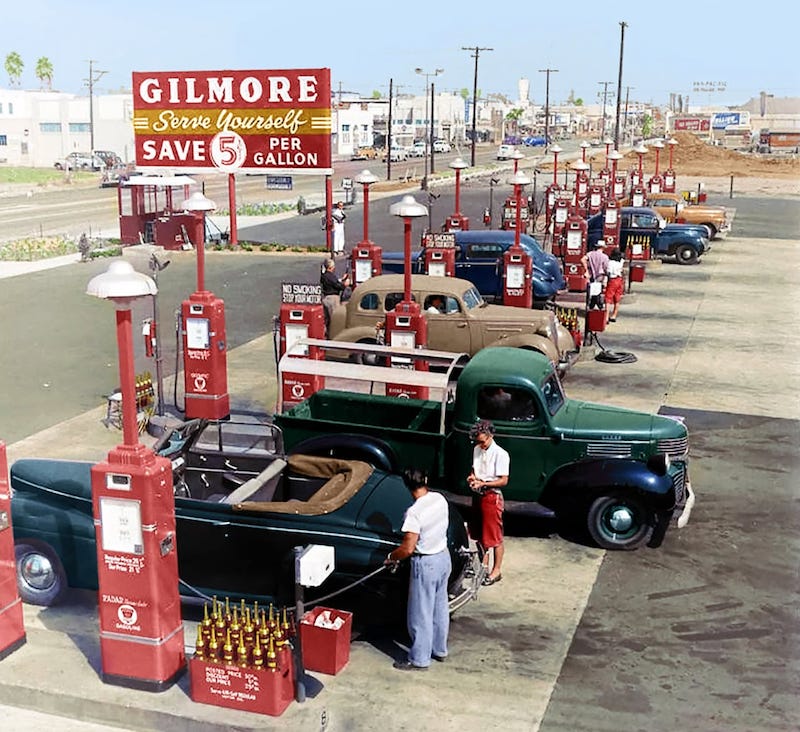
We have some history with this. In 1947 Frank Urich opened a petrol station at the corner of Jilson and Atlantic in Los Angeles. The station was unlike almost every other filling station in America which were typically staffed by attendants who would fill your tank for you. It was unbranded, and it had a singular proposition that was promoted on a big sign above the petrol pumps - save 5 cents, serve yourself, why pay more? In the first month, Urich sold more than half a million gallons of fuel. But what’s perhaps most interesting about this example of the shift towards self-service is that Urich had explicitly priced the trade. Customers could see exactly what the ask was, and see what they’d get in return. Very little in the seventy-odd years since this happened has been offered in quite such explicit terms. Consumers have taken on the burden of the checkout, the bagging, the check-in, the balance transfer, the insurance claim without being told what the going rate was for these things. As AI moves self-serve into more complex areas like law, medicine, accountancy, that trade off is likely to stay implicit.
You would think that given the success of Urich’s innovation and the obvious efficiencies involved, filling stations would switch rapidly to a self-serve model but it took decades for this to happen at scale. A 1950 survey found that out of 81,000 petrol stations in the US only around two hundred of them were self-service. As late as the 1970s, the total was still under 3,000. Scaling was slow for a number of reasons, including the fact that many states legislated against the idea, customers often showed loyalty to branded stations, and the technology took time to finesse. Self-service was actively resisted rather than passively ignored. When it finally took off in the late 70s, it took a two-tier forecourt with self-serve and fully serviced islands at different posted prices to make it happen. But the exchange in price and effort was clear for everyone to see.
Yet almost nothing since has worked in this way. In 1950, the economist K. William Kapp, in his book ‘The Social Costs of Private Enterprise’, argued that when businesses cause damage (through pollution, industrial injury or exhausted soil) this was in effect corporations transferring costs from their books to someone else who is not keeping accounts. These costs arrive, sometimes unnoticed and uncompensated. Conventional economics treated such losses as marginal exceptions, but Kapp argued they were systematic, a reliable way of manufacturing the appearance of efficiency. With petrol stations the transferred costs stayed visible. Where the trade goes unstated, it simply reappears on the balance sheet as a gain.
Household work is a good example of how hidden costs go unaccounted for. The System of National Accounts framework produced jointly by the UN, IMF, OECD, World Bank and the European Commission has what it calls a ‘production boundary’ - the line separating activity that counts as economic output from activity that does not. The convention is not to include household production in national accounts because it is difficult to measure and supposedly might overwhelm the figures. So for decades, valuable work that has mostly been conducted by women, has not been visible in how we account for production at a national level (sidenote: it was not until 2025 that the latest version of the SNA recommended that countries compile extended accounts to include household service work but it remains a recommendation).
The consequence is that this work has been undervalued for years. But for corporations it also means that when a task moves from a paid professional to an unpaid household member, it moves off the books. The task is, by definition, no longer seen as work, and the business is congratulating itself on its efficiency. Frey references Ruth Schwartz Cowan who showed in ‘More Work for Mother’ that the industrialisation of the home did not reduce the hours that women spent on housework. Individual advances and machines may act to save labour and time but standards rose to absorb it. On this logic we might make the prediction that over the next few years with AI, measured productivity in professional services will look strong at exactly the same time as the people who rely on those services report doing more work. AI will shift the burden of work that was once outsourced to paid professionals back on to the people that once commissioned that work.
Author and philosopher Ivan Illich (who I’ve referenced before) once did the maths on this in the context of cars. He added up everything that the American motorist gave to his vehicle in a year. The time spent driving it, parking it, and working to save up the money to buy it, tax it, insure it and fuel it. An average of 1,600 hours was committed to being able to drive 7,500 miles in a year, meaning that the American car was effectively moving at less than five miles an hour, or about walking pace. The car might have been fast, but motoring was not. His principle of ‘counterproductivity’ was the idea that once it passed a certain threshold a tool started producing the opposite of its intended effect whilst continuing to look as though it works. This is because we judge it by its moment of use rather than by everything that the use requires.
With AI, productivity shows up through faster processes and quicker task completion but counterproductivity might show up in the time it takes to frame the request and read the output well enough to judge its quality, or in the tasks that were once outsourced but are now taken in-house, or in the time it takes to correct outputs or work that is not quite correct or good enough. We’re already seeing this show up inside the organisation with the emergence of ‘workslop’, or how AI is intensifying work rather than reducing it, or how using AI can lead to ‘brain fry’. Similarly when a service is redesigned around self-help that output and the saving stay with the organisation whilst the hours go to the customer. The effective speed may look great from inside the company but that’s because half the work is now being done by someone else. In each of these examples, the efficiency gains may well be measured but the transfer of cost is not.
These hidden costs of AI often appear in areas where no-one is counting. In the time and effort that customers are contributing to access a service. Or in the additional cognitive load that AI lands on employees. If work and costs transfer rather than disappear, we should pay more attention to where the cost ends up and what we ourselves are absorbing. AI will give us access to expertise that was previously beyond many people’s reach but there will always be a trade-off. Urich put his sign above the pumps - five cents and you do the work yourself. The unasked question in AI application is whether you can say what your five cents is.
Rewind and catch up…
The age of the expert generalist
AI, Constraints and Bottlenecks
This video, an account of a study done by Anthropic into how AI models think and reason is quite mind-blowing. The company gave Claude a simple task (copying the sentence) whilst also asking it to think about something else (the Golden Gate bridge) and then looked at where the model was active. They discovered that their AI model has developed a kind of latent space (they called J-space) where it holds thoughts that are not surfaced or seen by the human using the tool. In other words AI models have internal thoughts.
What’s remarkable about this is that none of this shows up in the chain of thought reasoning that it shows us, but also that AI models have ended up replicating the way humans think without this being deliberately designed in. Humans too combine accessible thoughts with unconscious reasoning. This could mean that humans can get better at understanding when an AI model is misbehaving or misleading, but it also is a demonstration of how little we understand about how these models actually work.
LinkedIn is awash with AI generated posts so they’ve now introduced a ‘seems like AI slop’ button. Related - a couple of weeks ago Subsatck introduced a feature (which you can access when you read posts in the app) which enables you to see whether a post is AI generated or written by a human (in partnership with Pangram)
Substacker Jasmine Sun has been touring states in the U.S. where data centres are being built to try and get a fix on how people feel about AI. She argues that people are not necessarily anti-AI by default, but they are against losing agency in a situation where tech billionaires are forcing a technology upon them. Jasmine did an account of what she found on Ezra Klein’s podcast. (HT Pete Marcus)
Jasmine also recently wrote a great post (written for younger generations but useful for everyone) on having a career in the age of AI
An interesting study looking at how LLMs are changing human spoken communication and how words favoured by AI engines are cropping up more often in places like podcasts
A useful, deceptively simple one page campaign strategy template from Alex Mason
An interesting HBR piece from Sangeet Paul Choudray on AI transformation and the implications of going beyond task automation and further into reorganising how work actually gets done, including the need to redefine the unit of work and the coordination simultaneously, changing knowledge work to be more about a continuous flow of small steps shared dynamically between humans and machines rather then single experts and fixed stages, and how organisational structure starts to mirror decision architecture rather than process architecture
‘At the gym, it makes no sense for that robot to lift weights for you. The point of weightlifting isn’t to move heavy things across the room; it’s to actually lift those heavy things.’ I liked this metaphorical perspective on when to use AI and when not to. This was a more practical but simple framework on the same topic
Date for the diary - next year’s Interesting conference (always one of the quirkiest but best) will be on May 19th in London. This was also a good related idea from Russell Davies - Interesting Assemble
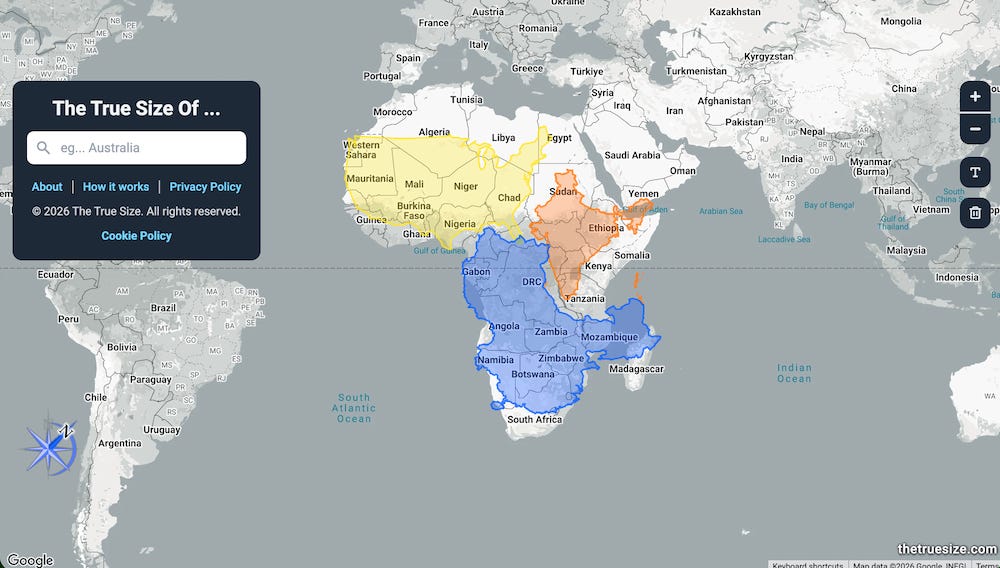
Drag any country across the map to see its true size (kind of blows my mind that you can fit China, US and India inside Africa).
This week was another WFH week (I’m actually loving the rhythm of this work period) but I’m off on the road again on Monday, travelling to Oman for eight days work with my Omantel client, and also doing some work with one of the large banks out there. Muscat is one of my favourite work destinations but this time it will be pretty full on whilst I’m out there.
Thanks for subscribing to and reading Only Dead Fish. It means a lot. This newsletter is 100% free to read so if you liked this edition please do like, share and pass it on.
If you’d like more from me my blog is over here and my personal site is here, and do get in touch if you’d like me to give a talk to your team or talk about working together.
My favourite quote is from the renowned Creative Director Paul Arden: ‘Do not covet your ideas. Give away all you know, and more will come back to you’. This captures what I try to do every day.
Only dead fish swim with the stream.
Neil
No posts
Comments
Nothing yet. Say the first thing.
Sign in to join the conversation.