
One of the qualities photography can have, according to Walker Evans (1903-1975), is playfulness. He put it this way:
“Photography seems to be the most literary of the graphic arts. It will have, on occasion and in effect, qualities of eloquence, wit, grace, and economy; style, of course; structure and coherence; paradox and play and oxymoron.”
Evans was not only a great photographer, but also a great editor. He played with combinations of images and meanings in the editing process. Evans photographed letters and billboards, shop windows, façades, posters, cars, people, interiors and everyday objects. He placed images one after another in such a way that they reacted to each other. A word on a billboard can suddenly take on a different meaning because of the photograph that follows it. A similarity in form can connect two completely different subjects.
The order of the photographs he chose for his book American Photographs was not set in stone. For the exhibition of the same name at MoMA in 1938, Evans used different combinations from those in the book. He played with groups of photographs and clusters, allowing new relationships to emerge between them.
Lucas Samaras (1936–2024) played with the technique of the Polaroid. In his Photo-Transformations, Samaras manipulated the still-wet emulsion, scratching and rubbing the surface after the photograph had been taken. As a result, the images acquire characteristics of etchings, drawings or paintings. The series consists largely of self-portraits made in the kitchen of his New York apartment. Coloured light, props and the way he poses give the images a theatrical quality. The Polaroid Corporation apparently saw potential in Samaras’s experiments: the company provided him with a camera and film so that he could continue experimenting with the medium.
Peter Fischli (1952) and David Weiss (1946–2012) played too. But they did so with everyday objects. In their series Equilibres (A Quiet Afternoon), ordinary utensils and household objects are stacked and balanced in improbable constructions. The subtitle A Quiet Afternoon refers to their working method: they consciously sought out boredom, with the idea that creativity might then begin to flow naturally. “To celebrate boredom,” Fischli and Weiss explained, “was also to go against the whole idea of the ‘inspired artist.’”
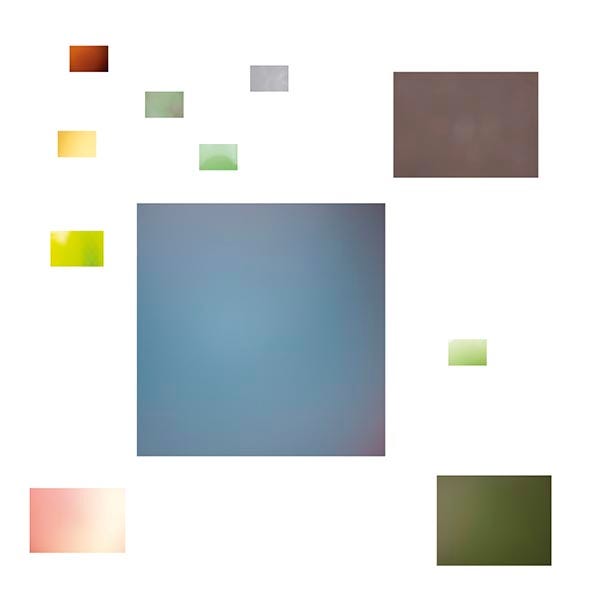
In 2013, I made the series One Week, a diary consisting of coloured squares and rectangles. The coloured areas represent daily activities that are completely unimportant, such as driving my car, crying over red onions, sitting in the garden, eating chocolate cake.
The photograph in this post is Thursday, 10 April. The activities are: Closing the door; Checking the weather; Checking the garden; Pulling out a dandelion; Riding my bike; Riding my bike, passed a green car; Riding my bike, over a yellow bridge; Stopping at a traffic light; Passing another green car; Doing the shopping; Unpacking; Hugging and a good night kiss.
Thanks for reading one photo! This post is public so feel free to share it.
Comments
Nothing yet. Say the first thing.
Sign in to join the conversation.