
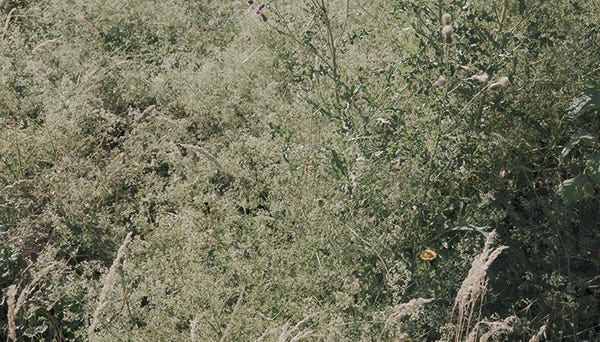
Three photographs of green foliage. None of them is about botany.
In 1998, Thomas Struth began photographing forests and rainforests around the world. At first, he says, the decision was intuitive. Later he realized what had drawn him there. “The idea I initially generated was to make pictures of extremely dense information, so that you could in fact not read every detail in them.”
Only after exhibiting the works did he discover another quality. The photographs seemed to slow people down. Viewers entered a meditative state, almost as if they were looking into something beyond the visible.
He titled the series Paradise, deliberately provoking expectations. “It was meant somewhat to irritate the spectator. By choosing that title I wanted to ensure from the beginning that no one mistook it to be about botany, for example. That is not my interest.”
For Struth, these forests are not landscapes to be identified. They are unreadable texts. They can be compared to shorthand: a language that cannot be read unless you know the signs.
Thomas Demand approaches foliage from a completely different direction. His photograph Clearing (2003) was made in his Berlin studio. The image shows a forest clearing where sunlight breaks through the trees, yet nothing in the picture is real. It is a reconstruction, built from approximately 270,000 sheets of coloured paper in around eighty different shades. Thirty assistants helped construct the model.
The work is based on a corner of the Giardini della Biennale in Venice, but Demand was not interested in copying nature. Instead, he created a carefully constructed image that refers to the romantic tradition of landscape painting. What fascinated him was the fleeting instant when light suddenly appears. “It is an emotional moment,” he said, “a glimpse of a second when the light breaks through. Of course that is a very romantic idea.”
To photograph the work he used a 10,000-watt artificial sun developed for the film industry. The heat was so intense that the paper could easily catch fire, leaving only a short moment to make the photograph.
My own photograph also depicts an impenetrable field of green. It was taken just around the corner from my house. Yet, like Struth and Demand, I am not interested in the plants themselves. What draws me is the texture. The repetition. The surface.
In The Beauty of Everyday Things, Soetsu Yanagi (1889-1961) writes that patterns in nature are governed by symmetry and mathematical order. He describes the structure of a single leaf as an example of this hidden logic.
But that is not what I see. I don’t see order. I see chaos. Christian Dior found inspiration in that same apparent chaos. In the early years of his career, he studied the forms of flowers and gardens, not to reproduce them literally, but to transform them into patterns, embroidery, and silhouettes. This inspiration is clearly visible in some of his
Thanks for reading one photo! This post is public so feel free to share it.
Comments
Nothing yet. Say the first thing.
Sign in to join the conversation.