
Good morning from Lisbon! For those new here, I’m Connor - a father, facilitator, educator, and occasional writer. This newsletter is where I explore new ideas that help you lead a more intentional life.
By the way, if you’re craving a reset to start the year and want to reclaim your focus, presence, and energy, why not consider joining the final live cohort of The Inner Operating System. We start Tuesday January 20th. Applications close tomorrow. Learn more and apply here.
Hey hey,
I’ve had a very slow start to 2026.
I caught a bug over Christmas that lingered until late last week, and I’m only now feeling like myself again. I usually love the fresh start energy of January. It’s when I reflect, write my annual review, and sketch out plans for the year ahead.
But the start of this year has been a struggle.
Last Monday was the first day down at a cafe, opened up my laptop, and tried to get things moving. About halfway through my cappuccino, I realized I could hardly focus, my energy was flatlined, and my brain felt like mush.
I wish I could say that I calmly recognized the state I was in and gave myself permission to take it easy. After all, this is what I teach to my clients. Instead, I found myself in a self-critical, judgmental, negative headspace.
Luckily, my wife Claire showed up as I was spiraling and provided a voice of reason. I was sick, exhausted, and needed rest. She helped me triage our work, and I went home and promptly passed out for a two-hour nap.
She was right. I spent the next few days resting, and as the fog lifted, I started to realize something else beneath the fatigue.
Looking back at the final months of 2025, I could see how much I'd been crowding out my own thinking with other people's content.
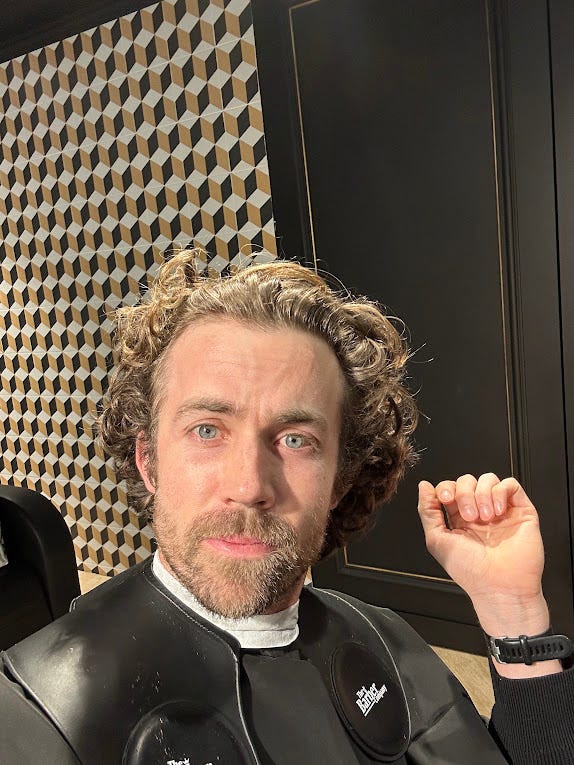
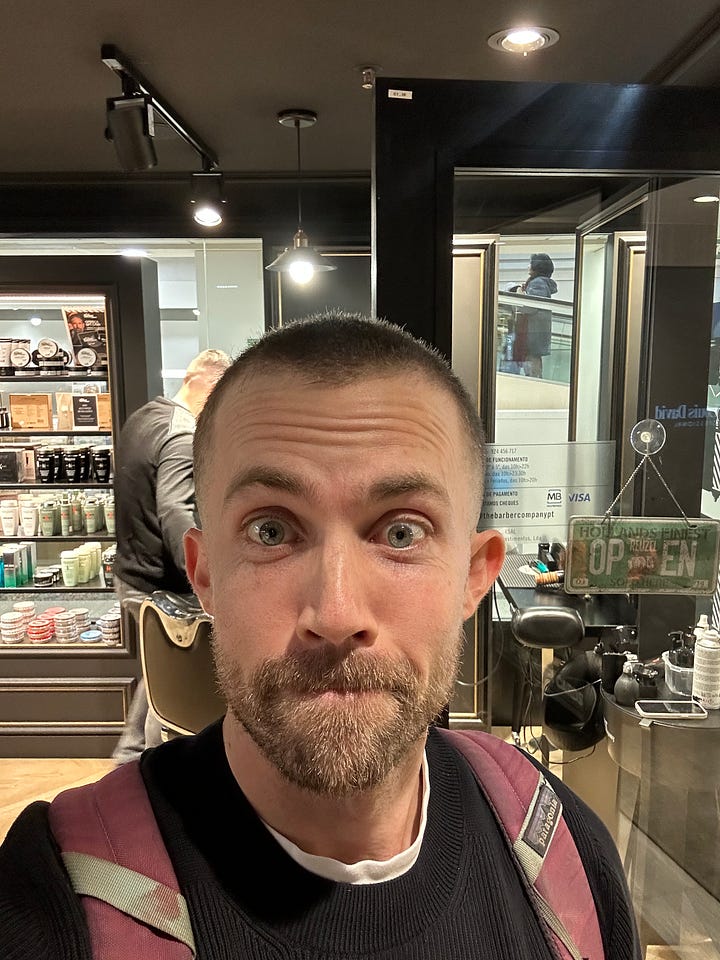
Over the weekend, as I finally felt back to normal, I decided I would create my own “New Year’s Day.” I got a buzz cut to mark the occasion and committed to a hard reset of my information diet.
Why the reset? It comes down to a core belief of mine:
Your life is what you pay attention to.
There are 8 billion people on Earth. Countless events happening every second. Yet if you imagine you’re 80, looking back on your life, what you’ll actually remember is only the tiny sliver you noticed.
We each live inside a subjective reality, and attention is the lens that shapes it. What you pay attention to isn’t just part of your life. It is your life.
In today’s world, there is an endless supply of content competing for that attention. News. Social Media. Podcasts. It’s easy to drift into information overload without realizing it.
Despite years of working on this, I’ve noticed the pattern is cyclical. Every so often, the noise creeps back in. Looking at the final months of 2025, I can see how much I was crowding out my own thinking with other people’s content.
To be fair to myself, life with a toddler is tiring. When my energy is low, it’s hard to be intentional. I’ve found myself always putting a podcast in the background while picking up the house, or cheekily checking the news during a spare thirty seconds in the bathroom.
The problem is that this kind of overconsumption doesn’t restore me, it actually drains me further. When I’m fatigued, my nervous system wants calm and quiet, not more Tweets.
But there’s something more concerning that tiredness at play here. Overconsumption displaces my own mind.
Quiet, uninterrupted time where the mind can wander freely is essential. This is where we make sense of who we are and what we want to do. It’s where intuition, creativity, and self-understanding reside.
When we constantly host other people’s thoughts and opinions in that sacred space, we crowd ourselves out.
When we do not fully pay attention to what matters, the quality of our time suffers. The fidelity of our experiences degrades.
There is something vital to the human experience about being able to drop deeply into a moment — whether that’s in creative work or being present with a friend. These moments feel good on a deeper level. And yet we are making them increasingly rare with our constant urge to consume, connect, and “just check” something.
To reclaim that space, I set myself a 14-day experiment to turn down the noise.
My rules were simple: no social media, no news, and no podcasts for two weeks.
In the first 48 hours, I found myself struggling.
The itch to check the news on my phone or turn on a podcast was constant. It created this low-grade irritation that I couldn’t shake. I kept reaching for my phone, only to remember the sites were blocked and there was nothing to scroll.
I felt like I was fighting myself.
That’s when I realized I had fallen into the trap of setting an Avoidance Goal.
In psychology, there are two distinct styles of goal-setting that drive how we change our behavior:
Avoidance Goals focus on moving away from an undesirable, negative outcome. (“e.g. I need to stop scrolling”)
Approach Goals focus on bringing you towards a desired, positive outcome. (e.g. “I’ll read 20 pages of a book tonight.”)
I’ve noticed this distinction mostly clearly with healthy eating.
It’s far easier to focus on an approach goal like “eating 100g of protein a day” then it is to adopt an avoidance goal like “quitting sugar.” When you focus on more protein, you benefit from a “crowding out” effect: the protein makes you feel fuller for longer, which makes the sugar less appetizing as a byproduct.
Additionally, you’re not trying to fight cravings with willpower. You’re taking a proactive choice to fill up on something better, and the craving fades on its own.
In general, approach goals feel more motivating, and research suggests they are more effective. I think this is because it’s easier for most people to move towards a want, rather than trying to suppress or resist something.
In the first couple days of my experiment, I was focused entirely on the “No.” I was trying to resist and restrict.
When I noticed the irritation creeping in, I remembered to ask myself a different question: What am I actually trying to move towards?
I landed on three things I wanted more of in my life right now:
Boredom: I want more time with my own thoughts. More walks without listening to a podcast. More mornings without a phone in sight.
Creativity: I want to recommit to a consistent, creative practice of writing.
Nutrient-Rich Information: I want to increase my intake of higher-quality sources. Books instead of tweets. Research papers instead of breaking news.
As I got clarity on what I was actually wanting, something shifted inside me. The experiment stopped feeling like restraint and started feeling like choice.
It’s a subtle thing that I noticed in my body first. Tightness in my chest softened. The irritation that was hummingin the background slowly faded. I realized I didn’t have to white-knuckle my way through this experiment. I could choose to actively move towards something positive.
I’m not restricting myself from checking my phone in the morning. I’m choosing to be present with Claire and Kaia and enjoy the moment.
I’m not depriving myself when I walk home from the office without a podcast. I’m choosing to allow myself to be bored and to be with my own thoughts.
When you decide what you want to add to your your life, the positive thing can displace the negative thing. This “crowding out” effect works, and not just for appetite. The same principle can be applied to attention, relationships, fitness, really anything.
Right away I started to see how these positive intentions I had created started to crowd out the noise on their own, just like protein crowding out a sugar craving.
The urge to scroll X when I open my laptop in the morning is softer, because I have a real desire to use that time for writing. And the same thing is happening in the evenings. Instead of scrolling the news, I’m excited to pick up a book because I’ve connected to my deeper want.
It’s amazing how a simple reframe can make such a difference. When behavior change becomes a proactive choice to bring something positive in, you can stop fighting your impulses and instead, use that energy to move towards a clearer vision of who you want to be.
This shift is something I’ve experienced many times in my own life, and I’m writing this as a note-to-self because it’s easy to forget.
If this resonated, perhaps you want to give it a go. Here’s how
Think in experiments, not goals. Instead of all-or-nothing traditional goal-setting where you try to make a permanent change, consider running a personal experiment instead. Goals can feel heavy, whereas experiments can feel light. Goals are fixed and pass-fail. Experiments are focused on learning and iteration.
Focus on approach, not avoidance. It’s usually easier to move towards something rather than restricting yourself through willpower. If you want to do less of something, think about what you want to more of, and try to substitute that.
Share it and make yourself accountable: Accountability is the real secret to behavior change. By telling someone what you’re doing, you’re making an intention real.
I’m doing #3 with all of you here. I’m currently on Day 5 of my 14-day challenge. I’ve not checked the news, opened X, or listened to a podcast. But more importantly, I’ve made time to write every day for the past 4 days, I’ve been reading books instead of breaking news, and I’ve been walking home from my office with my phone in my backpack.
If you’re feeling like you want to make a change this year, I’d encourage you to try your own experiment this week. Start small, focus on what you want more of, and tell someone in your life what you’re hoping to shift (you can email me back if you’d like!).
I’ll check back in with you in a couple weeks to let you know how the rest of the experiment went.
Thanks for reading,
Connor
Comments
Nothing yet. Say the first thing.
Sign in to join the conversation.