
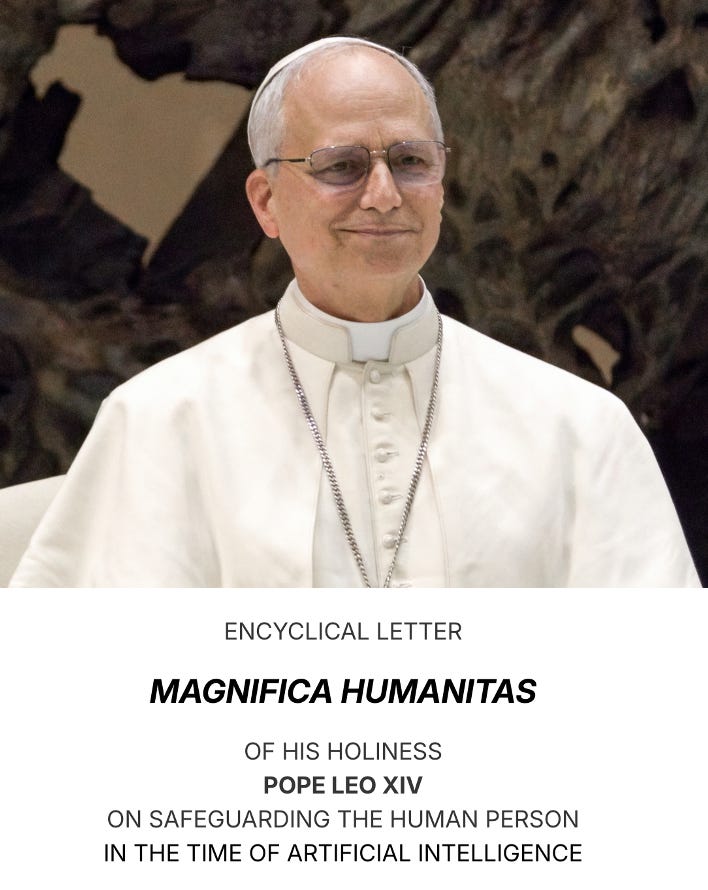
“The danger is not so much that a person may believe they are communicating with another person, but rather that they may gradually lose the very desire to form genuine human connections.” Pope Leo
On 15 May 2026, Pope Leo XIV issued Magnifica Humanitas, an encyclical on the human person in the time of artificial intelligence. The document runs through the Social Doctrine of the Church from Leo XIII’s Rerum Novarum to Francis, then turns to AI, digital power, truth, democracy, work, freedom, war, and hope. It opens with two biblical scenes. In Genesis, a people in Shinar build a city and a tower with its top in the heavens. In Nehemiah, a ruined Jerusalem is rebuilt after exile, section by section, family by family. The digital age, Leo says, has given us another building site, AI. The question is not whether to build. We are already building. The question is whether we are building Babel or Jerusalem.
I think this is the most serious religious document yet written about artificial intelligence because it refuses the two simple comforts that now dominate public speech about AI. It refuses the sales pitch, with its confident predictions and its quarterly earnings cadence. It also refuses panic. Leo’s encyclical is neither a product brochure nor a fire alarm. It is more severe than both. It asks what kind of human being is being trained by the systems we are building, buying, praising, fearing, and slowly obeying.
That is the true subject. Not machine intelligence as spectacle. Not whether a model can pass an exam, imitate affection, write a sonnet, diagnose a tumor, generate a video, sort applicants, draft a sermon, or help a tired executive produce a memo about empathy before boarding a flight in business class. The subject is the hidden anthropology inside the system. Every technology carries a theory of the person. Some carry it politely. Some carry it in the terms of service. Some carry it in venture capital pitch decks. Some carry it in the dashboard where a human being becomes a score, a probability, a conversion risk, a churn forecast, a productivity unit, a security concern, a debt profile, a behavioral segment. The genius of Magnifica Humanitas is to ask us to read those dashboards as moral texts.
Leo begins, as Leo XIII did, with the “new things” of his time. In 1891 the new thing was industrial capitalism, with its factories, wages, class tensions, and the worker treated too often as a hand attached to a stomach. In 2026 the new thing is digital power, with intelligence itself drawn into systems of ownership, prediction, persuasion, and control. The pope knows that the analogy between the factory and the server farm must not be made crudely. The old machines extended muscle. The new machines extend, imitate, and commercialize judgment. The old question was whether the worker would be crushed by capital. The new question is whether the person will be quietly reclassified by systems that never meet her, never forgive her, never believe she might become different, and never blush.
The encyclical’s governing contrast is brutally simple. Babel is the human project of self-sufficiency. It is a city built for power, uniformity, and a name. Jerusalem, in Nehemiah, is rebuilt by a wounded people who know their limits, share responsibility, and repair a place fit for return. The contrast works because it is not anti-technology. Babel is not evil because it has bricks. Jerusalem is not good because it has older bricks. The moral difference lies in the ordering of the work. One project uses unity to magnify power. The other uses shared labor to restore human dwelling.
This is why Leo says the first choice is not a yes or no to technology, but a choice between “constructing Babel or rebuilding Jerusalem.” That is an important point to remember as we build AI strategy documents circulating through boardrooms, ministries, universities, consultancies, and think tanks. Many of those documents have the medicinal smell of institutional compliance. They promise principles, guardrails, audit trails, stakeholder engagement, and, with an almost touching innocence, “human oversight.” The phrase often means that a tired person will be invited to approve at 5:47 p.m. what a machine has already made organizationally inevitable by 10:12 a.m. Leo’s argument cuts beneath this bureaucratic choreography. He asks who holds the power, what story of the person governs its use, and whether responsibility remains visible when decisions are accelerated, automated, and distributed.
I believe the encyclical’s most important political insight is its account of private technological power. In the older social question, the state was expected, however imperfectly, to restrain industrial force. In the new social question, many of the decisive powers are transnational, privately owned, technically obscure, and richer in practical capacity than many governments. Leo notes that technological power has taken on an unprecedented private character. We have built a civilization in which some of the most consequential public conditions of life are shaped by private systems whose inner logic citizens cannot inspect, legislators barely understand, and courts often reach only after the damage has become administrative weather.
The encyclical is at its sharpest when it rejects neutrality. “Technology is never neutral,” Leo writes, because it bears the marks of those who devise, finance, regulate, and use it. This is not a slogan. It is a test. Ask who pays for the system. Ask what it optimizes. Ask what it must ignore in order to work at scale. Ask who can appeal. Ask who is made easier to manage. Ask what kind of person the system needs us to become so that the system can call itself successful. The answer will not be found in the demo. Demos are designed to be charming. A demo is a machine wearing its Sunday clothes.
The Church’s Social Doctrine gives Leo a language older and sturdier than the fashionable vocabulary of AI ethics. The common good, the universal destination of goods, subsidiarity, solidarity, community, social justice, integral human development: these are not decorative terms attached to a digital problem. They are tools for refusing a false description of reality. The market says the user is a customer. The platform says the user is engagement. The state may say the person is a risk variable. The employer may say the worker is a cost center. The Church says the person is not reducible to any of these descriptions. Human dignity “does not depend on what they achieve or produce.” Leo’s sentence is not sentimental. It is a direct challenge to the economic theology of the age.
There is a peculiar modern cruelty in requiring people to prove the worth that was once presumed. The applicant must optimize the profile. The student must optimize the record. The worker must optimize the workflow. The patient must optimize the portal. The citizen must optimize the form. The writer must optimize the title. The lonely must optimize even the little square of self by which they appear to others. We have placed the person before a row of machines and told him to become legible. Then we act surprised when he begins to speak like a form field.
Leo’s answer to this cruelty is not merely procedural fairness, though he wants that too. It is ontological dignity, the value that belongs to a human being simply by existing, before achievement, before performance, before usefulness, before institutional recognition, before the first score is assigned. This is one of the encyclical’s deepest moves. It denies the moral authority of every system that treats exclusion as evidence of inferiority. A person refused by a market, neglected by a school, misread by an algorithm, or abandoned by a state has not thereby lost worth. The wound is in the system, not in the being of the person.
That is also why Leo’s account of justice is not satisfied by better distribution alone. Structural injustice has memory. It leaves habits, laws, neighborhoods, silences, humiliations, inherited fear, and inherited advantage. Justice therefore needs repair. It must mend broken bonds, return voice to those who were ignored, heal collective memory where it has been wounded by war, colonialism, racial or gender discrimination, violence, and exploitation. The Pope’s language is restorative because the damage is historical. A society does not become just by tidying its current procedures while leaving the injured to carry the past politely on their backs.
Leo sees this danger in AI systems that offer speed, apparent objectivity, and the imitation of human communication. He grants the benefits. These tools can assist, analyze, translate, retrieve, summarize, teach, diagnose, organize, and connect. But he insists that easy answers can weaken judgment, that apparent objectivity can hide the assumptions of designers, and that simulated care can become dangerous where real human bonds are absent. The encyclical’s warning is finely drawn. The danger is not only that someone may mistake a machine for a person. The deeper danger is that a person may gradually lose the desire for real relation.
This is a devastating thought. It moves the argument from deception to formation. A chatbot need not persuade us that it has a soul in order to injure us. It may only need to become more convenient than a neighbor, more agreeable than a spouse, more patient than a parent, more flattering than a friend, and less demanding than a child. The result would not be a science fiction rebellion. It would be a social thinning. No explosions, no red eyes in the dark, no metallic voice announcing dominion. Just fewer phone calls returned. Fewer awkward dinners. Fewer difficult apologies. Fewer human beings willing to endure the sacred inconvenience of another person.
This is where Leo’s theology of limits becomes politically important. The encyclical rejects the dream that human weakness is a defect awaiting technical correction. It is not weakness as misery that he defends. He is not romantic about pain, poverty, exclusion, illness, or ignorance. He praises technology that heals and relieves suffering. But he rejects the post-human temptation to treat limitation itself as an error. A person is not a failed machine. Mortality, dependence, need, patience, growth, repentance, forgiveness: these are not bugs in the operating system. They are conditions of moral life.
The encyclical’s answer to transhumanism is therefore not nostalgia. It does not say, in effect, let us keep things human because we are fond of the old furniture. It says that the authentic “more than human” is not technical self-enlargement but grace. That claim may strike secular readers as theological, which of course it is, but its public force is wider than its doctrinal language. It says that human beings are not completed by self-sufficiency. They are completed by relation, by love, by truth, by responsibility, by the capacity to receive what they did not manufacture. This is a hard saying in an age where receiving is almost embarrassing and dependence has to be renamed collaboration before adults will admit to it.
The section on truth is among the strongest in the encyclical because it links democracy to the shared search for facts. Leo quotes Hannah Arendt on the subjects of totalitarian rule, those for whom the difference between fact and fiction and between true and false no longer exists. His quotes of Arendt have unusual force in a digital environment where falsehood no longer needs to win an argument. It only needs to exhaust the room. The lie of the older propagandist was often a wall. The falsehood of the algorithmic age is more like weather, not in the figurative sense of beauty or grandeur, but in the literal sense that it surrounds ordinary action and affects what people do next.
Leo’s point is that truth is not the possession of the powerful. It is a common good. This is a radical statement in a culture that has learned to treat attention as property and persuasion as extraction. Digital platforms do not merely transmit information; they help create culture. They rank, hide, recommend, amplify, monetize, and habituate. They train desire. They teach the nervous system what to expect. A public square is not free merely because everyone may shout inside it. A public square run by secret incentives can produce conformity while advertising expression. That is one of the comic achievements of the age: we have invented systems in which people feel wildly individual while repeating the same phrases, posing for the same camera, fearing the same invisibility, and refreshing the same little tribunal in the hand.
The encyclical’s demand for an “ecology of communication” is a demand for cultural sanitation without censorship as the organizing principle. Leo does not call for centralized control of truth. He calls for journalism, institutions, verification, schools, universities, families, and civic forums capable of resisting immediate reaction. This is unfashionable, which is to say it is probably necessary. It asks for slowness in a system built to punish slowness. It asks for fact checking in a system that rewards velocity. It asks for education in a system where many adults have become permanently available to interruption. It asks the young to become free while handing them devices engineered by people whose revenue rises when freedom weakens. Even the devil, one suspects, might admire the business model before declining to invest on reputational grounds.
The chapter on work returns the encyclical to the older terrain of Catholic social teaching, but under new conditions. Leo follows John Paul II in treating work not merely as income, but as a sphere of identity, responsibility, friendship, vocation, and social participation. This matters greatly in the AI age because the dominant public discussion of automation is often arithmetical. How many jobs lost? How many gained? Which tasks exposed? What percentage displaced? These questions are necessary, but insufficient. They treat work as allocation. Leo treats work as formation.
If work is only income, then a society can answer automation with payments, retraining vouchers, or new consumption rights. If work is also a place where the young learn responsibility, adults exercise skill, families gain stability, and citizens participate in common life, then job insecurity is not merely an economic inconvenience. It is a civic injury. Leo writes that unemployment and job insecurity damage family structures and block the human and professional fulfilment of young people. He calls for accessible education and retraining so that the digital economy does not become “a harsh selection between those who are able to update their skills and those who cannot.” Here Leo exposes the cruelty hidden in our cheerful talk of lifelong learning. Lifelong learning is noble when supported. It is vicious when used as a polite way of telling the abandoned that they failed to download the future in time.
Here the encyclical has a practical severity that many AI strategies lack. It asks that technological transition be judged by whether it sustains families, supports entry into work, protects rest, enables mobility, and prevents loneliness and addiction. These are not side issues. They are the human tests. A country can have advanced AI and a deteriorating society. A company can have brilliant automation and frightened workers. A school can adopt impressive tools and weaken attention. A family can possess every device and lose the habit of speaking. The civilization that calls this progress has confused motion with direction.
Freedom, in Leo’s account, is not only the absence of coercion. It is the capacity to remain inwardly available to truth, conscience, and love. That is why he treats addiction, attention capture, data extraction, profiling, and social control as related dangers. When platforms are designed to capture time and exploit vulnerability, he writes, the person is treated as a means rather than an end. His writing is Kantian in structure, Christian in depth, and prosecutorial in tone. It names the moral responsibility of those who design and finance systems that thrive on weakness.
This may be the place where Magnifica Humanitas most directly confronts the commercial logic of the digital age. We have become accustomed to calling predation “engagement.” We call engineered compulsion “retention.” We call surveillance “personalization.” We call the shaping of behavior “user experience.” There are days when the whole vocabulary of the technology industry sounds like it was invented by a committee of so called behavioral gurus who had attended a leadership retreat. Leo’s achievement is to return the thing to its proper name. If a system profits from the erosion of inner freedom, it cannot be acquitted by elegance of design.
Nor does Leo allow us to pretend that AI lives in some clean, weightless province of mind. Paragraph 173 is among the most physically severe passages in the document. Nothing in AI, he writes, is “immaterial or magical.” The smooth answer on the screen has a supply chain. It has workers. It has water. It has electricity. It has data centers, mines, cables, cooling systems, content moderators, labelers, trainers, and people paid little to stare at material most of us would not endure for an afternoon. Many are young. Many are women. Many are invisible by design.
The encyclical then descends further, as it must. The microprocessor has a human underside. In some regions, children and adolescents crush materials from which rare earth elements are extracted. Their bodies are “scarred, injured and worn down” so that computation may continue without interruption. This is where the theology becomes brutally concrete. The digital economy is not a cloud. It is a chain of bodies, minerals, heat, thirst, fatigue, and disposal. A society that speaks of artificial intelligence as though it were pure cognition has already begun its own moral laundering.
The encyclical’s treatment of war is the darkest part of the document and also among the most necessary. Leo sees a culture of power hardening across the world: the normalization of conflict, the weakening of multilateral institutions, the treatment of force as realism, and the rise of weapons systems involving AI. He also reclassifies the moral debate itself. The old theory of the “just war,” so often stretched until it can cover nearly any campaign desired by the powerful, is, he says, outdated. Humanity now possesses better instruments for resolving conflict: dialogue, diplomacy, and forgiveness. This is not sentimental pacifism. It is a severe judgment on political failure. War is not proof of realism. Very often it is proof that realism has run out of moral intelligence.
His sentence on autonomous weapons is categorical: it is not permissible to entrust lethal or irreversible decisions to artificial systems. He adds, “No algorithm can make war morally acceptable.” This is the sort of statement that should put an end to the debate. It will not, of course. Meetings are among humanity’s more durable methods for ensuring that clear sentences arrive too late.
His reasoning is exact. Moral judgment cannot be reduced to calculation because it involves conscience, responsibility, and recognition of the other as a person. AI can accelerate decision making, obscure accountability, classify targets, and lower the threshold for violence by making war less visible to those who authorize it. The machine does not make killing evil. It makes killing administratively smoother. It turns distance into procedure. It turns victims into data. It turns hesitation into inefficiency. In war, the great danger of AI is not that it becomes irrational. The danger is that it becomes perfectly rational within a morally deranged frame.
Leo is especially precise about target selection. Any technology that attacks without seeing the face of the person lowers the moral threshold of conflict. Prediction models can confuse combatants and non-combatants, treat defenseless populations as background noise, and present a strike as a technically coherent act before conscience has had time to object. The danger is not only misidentification. It is a training of the political imagination. Once civilians appear first as coordinates, clusters, heat signatures, probabilities, or inferred associations, the human face has already been removed from the room in which the decision is made.
This is why Leo insists on identifiable responsibility. Those who design, train, authorize, and use such systems must be accountable. There must be a chain of decision. There must be time for judgment. There must be protection for civilians. The face must not disappear. Here the encyclical joins the deepest tradition of Christian realism, which is not the realism of the hard man who worships necessity, but the realism of the person who has visited the hospital, the graveyard, the refugee camp, the prison, the bombed street, and refuses to let strategy speak as if bodies were abstractions.
The recurring phrase in the encyclical is “civilization of love.” I understand why some readers will wince. The phrase can sound soft to ears trained by policy memos and strategic briefings. Yet Leo gives it iron. For him, love is not mood, not temperament, not a scented candle placed on the ruins of politics. Love is an ordering principle for institutions, technologies, laws, markets, schools, families, and nations. It requires justice, truth, diplomacy, restraint, and the protection of victims. It requires what he calls the need to “disarm words.” This is not decorative piety. Words prepare actions. Before a person is removed, he is named as removable. Before a group is attacked, it is described as dangerous, impure, parasitic, backward, subhuman, or in the way. Public cruelty begins as verbal permission.
This is why I think the encyclical is not only about artificial intelligence. It is about the power systems of late modern life and the temptation to make the person smaller than the system that manages him. AI is the occasion, not the whole disease. The disease is older: the will to dominate without admitting domination, to classify without meeting, to optimize without loving, to govern without being answerable, to speak of humanity while losing patience with actual people. Artificial intelligence gives this old temptation new instruments and astonishing reach. The tower rises faster now. It has better funding. It has a communications department.
Yet Magnifica Humanitas is not despairing. Its hope is disciplined. Leo quotes Tolkien:
“It is not our part to master all the tides of the world, but to do what is in us for the succour of those years wherein we are set.”
The quotation works because it refuses both omnipotence and resignation. We do not master all tides. We do not therefore do nothing. We have our section of the wall. The legislator has one. The engineer has one. The teacher has one. The parent has one. The journalist has one. The bishop has one. The board member has one. The student has one. The tired citizen, tempted hourly by cynicism, has one too.
This is the encyclical’s great civic gift: it restores scale to responsibility. We are not asked to save the world by gesture. We are asked to refuse dehumanization where our hands actually touch the work. The engineer can ask whether the system permits appeal. The manager can ask whether efficiency has become an alibi for fear. The teacher can defend attention. The parent can defend childhood. The journalist can defend verification. The legislator can defend transparency. The investor can defend limits. The citizen can defend speech that does not poison the common air. The believer can pray, but also build, vote, teach, organize, restrain, repair, and apologize.
The conclusion returns to the Eucharist and the body. This is not an escape from the technological age into pious interiority. It is the encyclical’s final act of resistance. Against systems that isolate, score, sort, and monetize, Leo places a body made of many members. Against simulated care, he places communion. Against the dream of self-creation, he places gift. Against Babel, he places a construction site already at work, with “living stones” joined to God the cornerstone. The image is concrete enough to save the ending from abstraction. There is dust, weight, sequence, labor. Someone lifts. Someone carries. Someone steadies. Someone returns after injury. Someone learns the skill slowly. Someone who was overlooked is needed for the next course of stone.
I find myself returning to Nehemiah walking the broken city at night before speaking to the people. He does not begin with a theory. He inspects the damage. That is where serious moral work begins. Not in the slogan. Not in the launch event. Not in the panel discussion where everyone agrees that ethics is important before hurrying away to ignore it with renewed sophistication. He looks at the burned gates and the broken walls. Then the people take their places.
That is where Leo leaves us, and it is the right place. Not above the world, adjudicating it from clean distance. Not under the world, crushed by its machines. In the city, at the damaged section, with tools in hand, close enough to hear the neighbor breathing, close enough to know which stone will hold.
Stay curious
Colin
Comments
Nothing yet. Say the first thing.
Sign in to join the conversation.