
I’m no fanatic, but having been socialized in Germany, there’s no way around Fussball—soccer, fútbol, calcio, the beautiful game. This year’s World Cup, hosted across North America and billed as the biggest tournament yet, was congested with geopolitical chaos before it even kicked off.
It is, for a start, the most expensive World Cup in history. Through FIFA’s “dynamic pricing” the same demand-based model airlines use, ticket prices on the official platform have ranged from a theoretical $60 floor to nearly $11,000.
Then there are the people kept out entirely. Under two proclamations issued by the Trump administration, citizens of 39 countries face full or partial bans on entering the U.S., including fans from four nations whose teams qualified: Haiti and Iran under full bans, Côte d’Ivoire and Senegal under partial ones. A separate Visa Bond Program requires citizens of some 50 countries to post a bond of up to $15,000 simply to enter.
The capricious exclusions, and the instrumental power behind them, sit uncomfortably close to the roots of FIFA itself. Founded in Zurich in 1904 to oversee competition among a handful of European nations (every founding member but Switzerland a colonial power at the time), the institution was built on a Eurocentric order that still tilts the field today. For most of its history, and in many ways still, it has been a male-only world. And then there is the close, well-documented friendship between FIFA president Gianni Infantino and Donald Trump himself.
In short: I understand anyone who chooses not to participate, support, or engage in any of it.
I do, still.
I remember watching the World Cup with my classmates many years ago, and later on with friends in overcrowded beer gardens. Recently I even fell into a YouTube rabbit hole, rewatching Brazilian footballer Ronaldinho’s magical tricks (I was a true fangirl back in 2006). Also, I enjoy watching others watch the game in public, together.
Because underneath the money and the machinery, it also still is a game.
One that was always meant for people, and whose roots run far deeper than any nation-state. The oldest ancestor is cuju (蹴鞠), “kick-ball,” played in China during the Han dynasty more than two thousand years ago. What moves me is a detail from its history: cuju societies came to see themselves as a force for social harmony, bringing together young men of many backgrounds into something close to a communal life, sharing clothes, money, and food. The Greeks had episkyros, the Romans harpastum, the Maya their own ballgame played with the hips.
The World Cup lives inside our current framework of nationalism. Benedict Anderson’s classic study argues that nations are “imagined communities” — far too vast for any citizen to ever know every fellow member, and yet bound by a set of shared beliefs and behaviors that construct the feeling of being in community even with people we will never meet. In a world of collapsing systems, of violence and war and a felt sense of fragmentation and othering, the longing to feel part of a greater whole persists.
There is a shared loneliness among those who long for a shared sense of meaning, a shared reality, even when the conditions for that longing look vastly different from one another. This is what makes the World Cup such a potent imagined community. Fans may not know each other, may not know what or whom the others vote for, what might divide them — but following the same game, at the same time, rooting and aching together, for a moment, is enough. As the historian Eric Hobsbawm wrote, “The imagined community of millions seems more real as a team of eleven named people.”
Within that imagined community, the very real machinery of colonization and migration becomes visible, and we ask: who gets to play for whom?
A research team from the University of Zurich and the University of Konstanz recently simulated this year’s World Cup nearly 1,500 times, using Football Manager 2026, to test what colonial ties still do to the game.
The eight major former European colonizers, England, Portugal, Spain, France, Belgium, the Netherlands, Germany, and Italy, consistently field some of the world’s strongest squads, often built on players with roots in former colonies: Kylian Mbappé (France/Cameroon), Lamine Yamal (Spain/Equatorial Guinea), Marcus Rashford (England/Jamaica). The researchers asked what would happen if those players instead represented their families’ countries of origin.
The results were striking.
Under current conditions, France wins 34.5% of the simulations. If players like Mbappé played for their ancestral countries, that probability would be nearly halved while formerly colonized nations would win far more often, with countries like Brazil and Nigeria seeing their chances climb. The competitive advantage of the former colonial powers, it turns out, is partly inherited from the same extraction that built their wealth.
And yet the movement runs both ways.
This is the most foreign-born World Cup in history: nearly a quarter of the 1,248 players selected were born in a country different from the one they represent. Morocco named 14 foreign-born players in its team; 85% of the Democratic Republic of the Congo’s were born abroad. Many of them are the sons of diasporas, reclaiming the countries their families came from.
What’s fascinating is that diversity doesn’t only complicate national identity, it seems to strengthen the teams themselves. A study of European national teams competing between 1970 and 2018 found that more diverse teams tended to perform better on average. The same has long been argued in the business world.
A similar logic runs through the living world. Diversity is what makes a system resilient: more species, more synergies, more ways to survive a shock. Permaculture works with this directly. The Three Sisters of Indigenous American agriculture: maize, beans, and squash grown together are the clearest image of it: the maize gives the beans a stalk to climb, the beans fix nitrogen in the soil that feeds all three, the squash spreads low to hold moisture and keep the weeds down. None of them thrives alone. Grown together, they feed each other and the ground itself.
They thrive in oneliness, alone and in relationship, interdependent.
But the part of the World Cup that moves me is the power of shared feelings, from joy, dissapointment, sadness, and celebration.
Colombian fans cheering up an Uzbek child mid-match, the flourishing friendship between Koreans and Mexicans that started in 1962, a Japanese fan being thrown in the air by Dutch fans, thousands upon thousands of people singing and dancing, or rowing, like the Norwegian fans.
I don’t have one country I root for; I have a few, with a slight bias toward the underdogs and whoever’s spirit moves me. What I find beautiful is the sheer colorfulness of people gathered around something shared. Émile Durkheim coined it collective effervescence: the charge that moves through a crowd swept up in the same feeling at the same moment.
My friend, the social-impact strategist Laura François, calls it Systems Feeling — a way of processing our crises together rather than reaching, again, for the same solutionist frameworks that delivered us here. The stadium becomes a threshold where ordinary hierarchies and identities are briefly suspended, giving way to what the anthropologist Victor Turner referred to as communitas: a direct, unmediated, powerfully equal experience of shared humanity.
As a side note, it is also one of the few places we have collectively decided it’s acceptable for men, or those socialized as men, to feel everything. A place where men weep openly, hold each other, press their faces together in grief and elation. I don’t want to romanticize it, but I find it genuinely moving to witness.
In Latin America, fútbol/futebol is, arguably sacred:
“Soccer deeply moves Brazilians because it creates a sense of belonging, identity and hope,” said Jeferson Mengali, a Catholic priest and lifelong Corinthians fan. “People suffer, work hard and face difficulties, and soccer becomes a space for collective joy.”
I see a smaller version of it on my own street in Berlin. People perched on stools outside the Spätis, watching whatever match is on. Kneipen, the neighborhood bars, putting up huge screens so anyone who wants to can come and watch together, rather than alone at home, as we so often are.
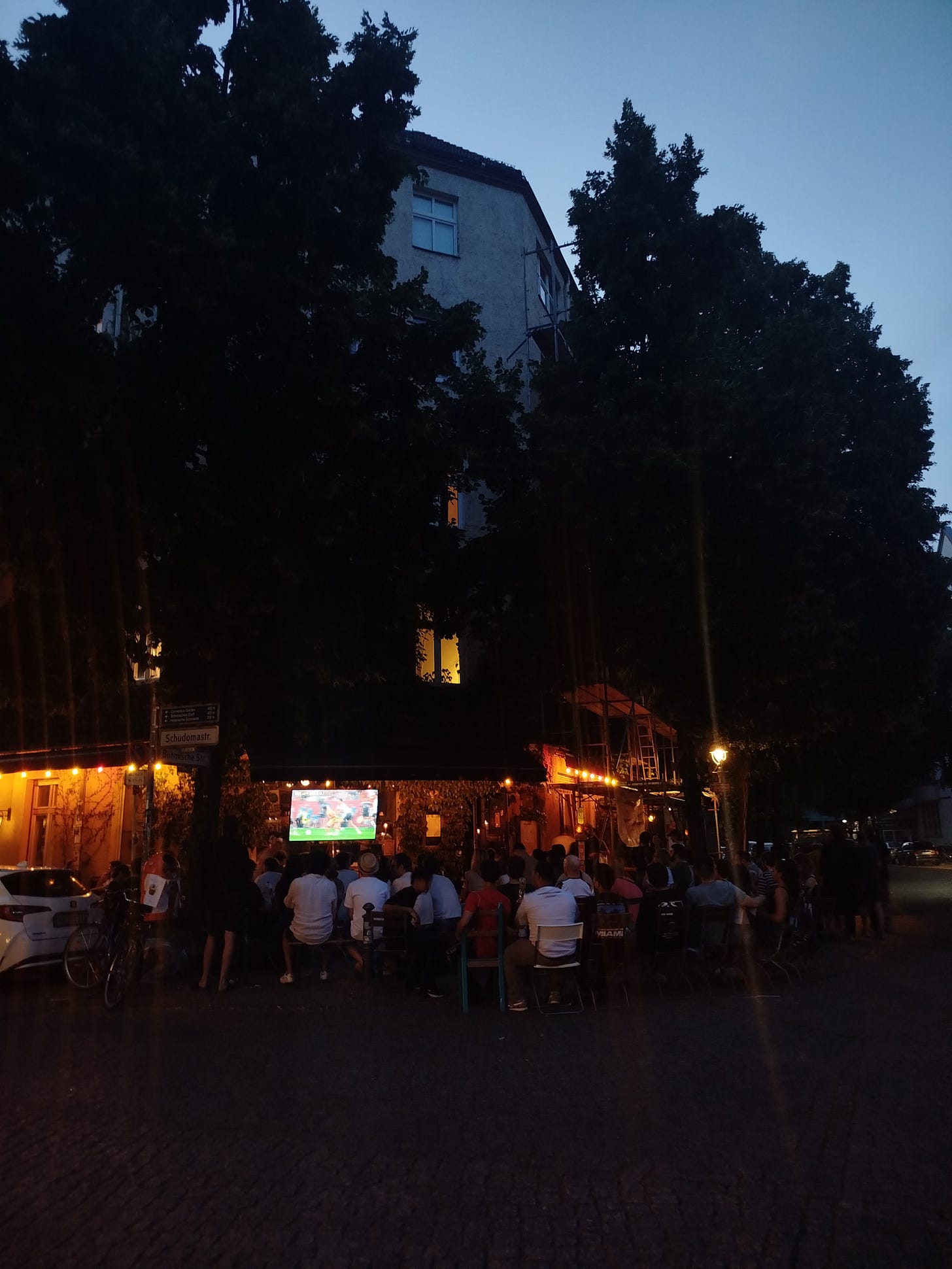
In an age of lifemaxxing and within “the cult of the enhanced self” as Derek Thompson writes—health and longevity sold to us as an isolating, obsessive, individual project that only makes us lonelier, the best medicine we still have is each other.
It doesn’t mean we all have to become fans or friends, or agree on anything. But it offers a moment to wonder: when was the last time I felt that? To be in awe with others, to laugh and cry and sit in silence and move together, to celebrate and to mourn, and in doing so, to loosen our grip on the all-encompassing self, the idea of purity, of monolithic identity, of the clean line between colonized and colonizer.
This is the collective feeling we might need more than we think. Not a denial of the injustice and ugliness of the game, but a refusal to let it have the last word, staying with it, showing up anyway, for the beautiful parts, for the sense of being in something shared that is, ultimately, just a (very, very expensive) game.
To not succumb to the cynicism in us that says, so what.
To be infected instead, in the most positive way, by a spirit and a spiritedness that feels light and uplifting, that lets us be for and against something at once, and that puts us back in touch with the almost foreign, estranged feeling of being in something together, for the sake of it.
Thank you for reading. Are you following the World Cup? How is your relationship to it? Feel free to share.
I’m Monika Jiang, a writer and community builder exploring loneliness and oneliness: the state the word loneliness derives from, and the capacity to be with ourselves, each other, and the world.
If this resonated, the best way to support the work is to subscribe and share it. For speaking, hosting, or bringing Daily Connect to your team, find me and The Oneliness Project on Instagram, LinkedIn and monikajiang.org
Comments
Nothing yet. Say the first thing.
Sign in to join the conversation.