
Men don’t care — or they only care about what they want, where they get something in return. Maybe they never received care, and so never learned how to give it.
There are many myths about men and what it means to be one in modern society. I catch myself in them too: the judgmental thought, the presumptuous one, the generalizing from repeated patterns. The countless small examples that could prove the point: not all men, but most men.
I’m not oblivious to the ways men have harmed and continue to harm — physically, emotionally — or to how patriarchal masculinity is perpetuated, reinforced, and rewarded. There’s no excuse for any of it. And there is also the possibility of caring, nonetheless. Of asking how we, and here I’m speaking to all feminists, whatever your gender or sexual identity, might be in solidarity with the men who care, too.
Early in my research and my first gatherings on loneliness, I was missing men. You may have noticed it yourself: in community workshops, creative spaces, anything to do with wellness or mindfulness, retreats and the like, men are usually the minority. And there’s research showing how women and men are developing in opposite directions. A widely cited analysis by the Financial Times described “a new global gender divide“ — young women becoming rapidly more liberal across the developed world, while young men become more conservative or stall, to the point where the FT called Gen Z “two generations, not one.” Many boys and men feel left behind, and, under certain conditions, become more susceptible to things like right-wing extremism.
So I started gathering men. Like this past Sunday, at our first Shared Table Picnic for men*, co-hosted with Jindy Mann and Jack Becher — both community organizers and leaders in men’s work, and two people who have helped me understand more deeply the loneliness, the complicity, and the ambiguity of how boys become men, and what it means to be a man today.
*persons socialized as boys or men.
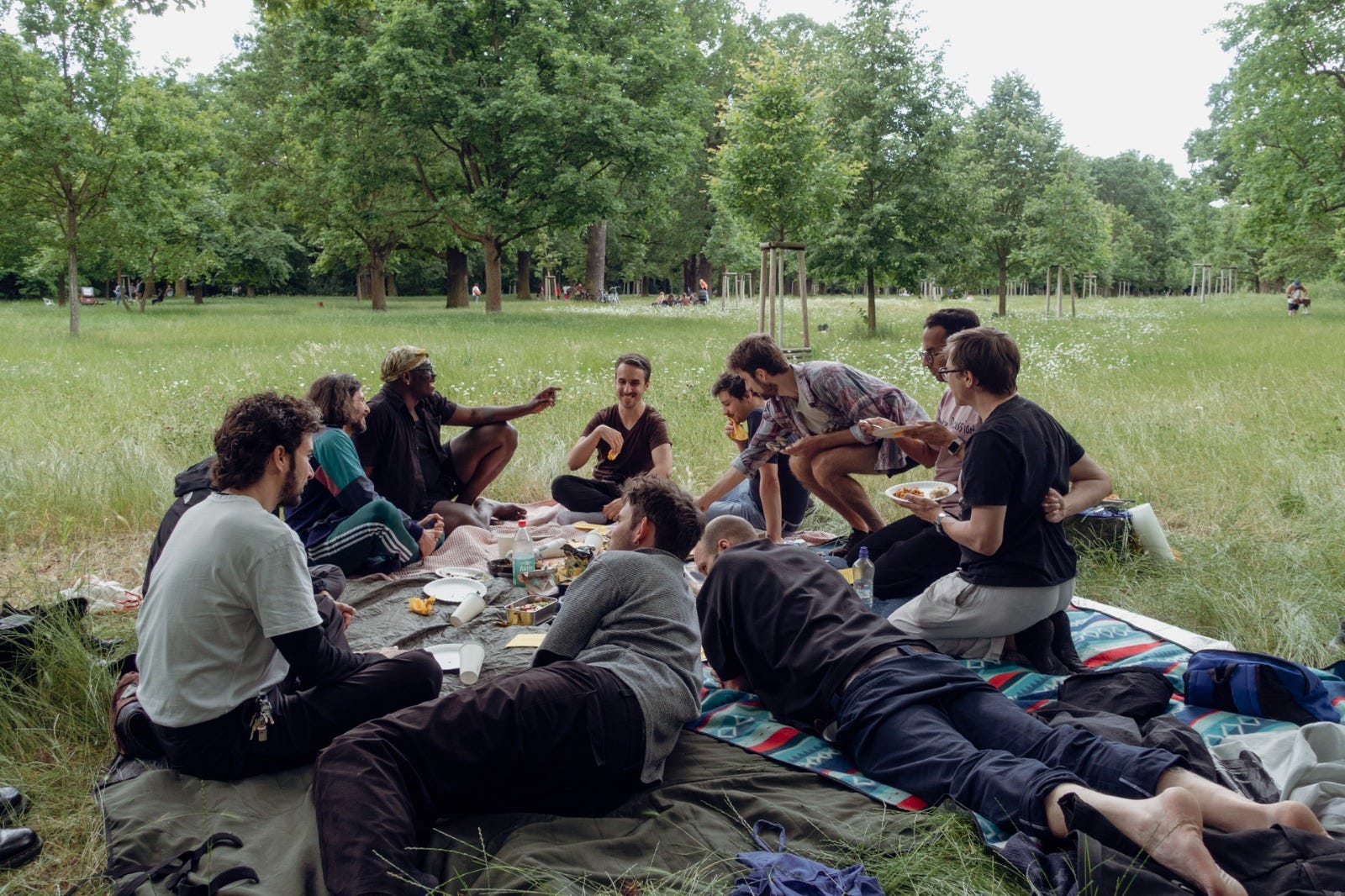
That afternoon, men of different ages and backgrounds arrived, some cycling, some on foot, all carrying something to share. A Persian dish from a kitchen calendar. A go-to of chickpeas and courgette. A rhubarb crumble. A backpack full of cold drinks for everyone.
I remember wondering, before the first edition a few months back, whether we’d have good-enough food given that we’d “only have men” bringing it. My own stereotyping was proven wrong the moment they walked in. And on Sunday, again. Of course men can cook. Of course they care. Of course they’re more than happy to share, and try, and stay open to it all.
And of course, there is also hesitation, doubt, and fear.
As Jindy put it in our podcast episode, he sees many men carrying a fear of other men — from past experiences of being judged, misunderstood, or excluded. In the clickbait dialogues about men, we forget that boys and men have also been harmed by patriarchy.
Hurt people hurt people, as the saying goes. And yet there’s more to all of it than the binary of victim and perpetrator, blame and punishment. That binary is comfortable precisely because it asks nothing further of us. Staying with the ambiguity is harder, and it’s the only place anything actually shifts.
Our picnic moved through movement and somatic attunement, an opening micro-podcast I’d recorded and shared, after which everyone wandered off to find a spot to sit or lie down and listen.
Then sharing in pairs. Open potluck conversations around prompts: the most caring person in your life, and what you learn from them. Overcaring, and the overburdening and feminizing of care as a political form. The simple practice of care in friendship. Care as shared and collective. Care extended toward the earth and the more-than-human.
It drew out stories of the different ways we give and receive care — who our role models are, what we learn from them, how care is seen or unseen in society, and how care also means carrying these conversations out beyond where we happen to be sitting.
I had the privilege of witnessing men in their tenderness. In their embodied ways of caring, for themselves and each other. My role as co-host is to hold a space that’s fluid and structured enough, clear and open, and above all warm. If I act from a place of love and care, it spills over into the container we share.
During the conversations, I retreat and give space. It isn’t only about relinquishing control — it’s about offering spaciousness and trust to the group, held also by Jindy and Jack, and by the confidentiality we keep for everything shared, which is not to be attributed afterward.
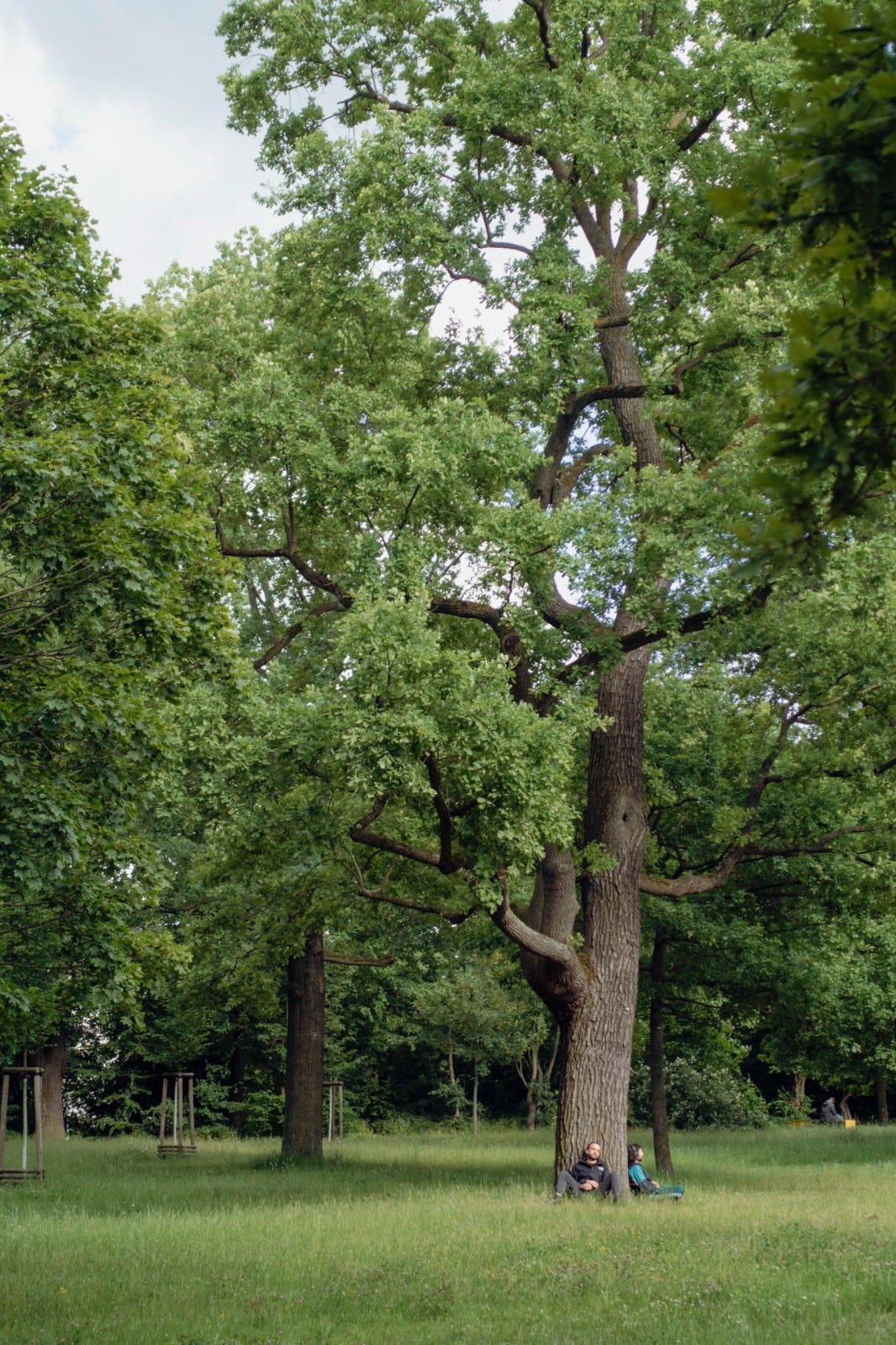
I sat against a tree across from the group. Far enough not to overhear. Close enough to feel the shifts in energy, to catch the occasional laughter.
Toward the end, I gathered everyone to stand together in the high grass, facing the sun that had finally found its way through the clouds. To plant our feet in the earth and, for a moment, simply receive, care by being held and carried by the ground and the light.
We stood in silence for a few minutes.
Then we closed the circle, each offering something back to the collective. A gesture of gratitude. A line someone repeated from another. A commitment to carry these conversations beyond the circle. And the simple, recurring surprise that several of them had felt so at ease in the company of men they didn’t know — that this, too, had helped them reframe their own biases, doubts, and fears.


Care is not a female capacity that men need to borrow.
It’s a human one that was taken.
In hearing the stories of men I love and have loved, of those who have opened up to me, of those dedicated to men’s work, it strikes me again and again how lonely it must feel to be, or to become, a man. Not only lonely for lack of meaningful relationships, but lonely in a deeper way — what Kierkegaard called the despair of being alienated from oneself, which goes unnamed because it feels normal. Because it has always felt normal. As Barbara Deming wrote, men are “homesick for the truth.” A loneliness for feeling yourself, and feeling at all.
What becomes possible when men begin to come home to themselves — not through self-improvement as a private project, but through genuine care for one another? Through the kind of friendship that doesn’t need a reason. The kind of presence that says: I am moved by what moves you. I am here for the grief of it, not only the triumph.
adrienne maree brown writes that care is the antidote to violence — that where genuine care exists, reciprocal, relational, communal, violence has less ground to take root in. What that points to is something our modern Western framing lost: that care is not individual, not gendered, not optional. It’s the relational fabric without which community doesn’t exist. Not what some people do for others, but what makes us, together, possible.
So I want to leave you with more of what I witnessed. Men bringing extra blankets so everyone could sit. Trying a new recipe and offering it around. Forgetting their phones long enough to be fully present. Remembering each other’s names. Inviting others to speak. Listening deeply. Sharing from the heart about their insecurities, their fear of being judged by other men. Affirming with their bodies: I’m in this too. I’ve felt this before.
Men who see how much the women in their lives carry, how care is feminized and undervalued, and want to help shift it. Men who care about their friendships, their relationships, the environment, life itself. Men who seek out spaces like these because care, for them, is a practice they keep cultivating.
And my part — as a woman, a feminist, the one holding the space — is to keep showing up for that. To stay in relationship. To care for the men who care, too.
Comments
Nothing yet. Say the first thing.
Sign in to join the conversation.