
Heard of loneliness influencers?
It’s a somewhat recent trend of a persona that romanticizes the life of “living alone, single, no kids, with no friends,” and choosing it this way. They take us through their weekends and after-work routines, emphasizing the narrative that being alone can bring happiness, too.
There are dramafreediaries or zazainchina whose choices and “ordinary lives” seem deeply relatable to those following and eagerly commenting on the videos. Perhaps it’s an effort to tilt the so-far loud and flashy lifestyle choices that have dominated the internet, resulting in distorted ideas about how to live life, exacerbating an overreliance on friend groups, romantic partners, or a certain normative social life.
Where, however, does aloneness tilt over to isolation, where does loneliness become a harmful lifestyle as much as over-socializing has?
I think they get something right: destigmatizing aloneness (and through that, challenging the myth that alone means lonely), showing that a life lived alone isn’t a failed one, pushing back on the idea that a packed calendar is proof of a life well lived. Plus, voicing the many ways in which people are healing and ultimately finding resonance and community through it. That matters.
But I think they also miss something: the difference between choosing aloneness and performing it. Once aloneness becomes content, it can stop being a practice and start being a persona to maintain, even on the nights you don’t feel like being alone at all.
What I want to write about isn’t that performance. It’s the messier, less Instagrammable version, the past summer weeks I spent turning inward and with myself.
A few weeks ago, I felt empty and full at the same time. I’ve felt like this before, but this time it was different. “You sound depleted,” a friend of mine diagnosed by merely listening to my voice note. I was.
They said that this Year of the Fire Horse will keep us up and running, catching momentum, and that it can easily keep us in it while forgetting our need to decelerate. As someone who’s been creating and building on Oneliness largely alone (the joke’s on me!), I meet myself at the edges of my resources regularly. There’s an emotional, mental, bodily, spiritual exhaustion over initiating, holding, and caring for spaces where groups can come together to fall apart a little.
Given the nature of the work I’ve chosen, it’s never the same group or type of people. Sometimes, it’s standing in front of a highly diverse group of practitioners of civil society organizations; sometimes it’s a mix of creators, entrepreneurs, and corporate leaders; other times it’s a group of facilitators and social change leaders, or a men’s-only group in their thirties and forties. They speak different languages in a metaphorical and literal sense, and I’m met with skepticism and apprehension wherever I go. It takes sensitivity and understanding as a practice, a muscle I’m strengthening with each encounter. It’s how I stay committed to this work as a sacred work.
The shadow side is the impermanence of it. There’s beauty, even awe, in a brief moment of resonance, coming together through a shared space or experience, whether it’s an overflowing Zoom chat or the synchronicity of sharing a meal together. There’s beauty, too, in witnessing and guiding people into a space, safe enough to open the darker, less-seen parts of themselves. But it will never last.
And underneath that, there’s loneliness in holding spaces for others.
Ask any facilitator, community builder, organizer, or teacher that people naturally flock to; we feel it, whether we admit it or not. It’s a loneliness of a spiritual kind: a longing to feel less alone in work that has often chosen us, rather than work we pursue for our own benefit.
I know, rationally, that I’m far from alone in this; there are plenty of people building toward the same kind of shared, reimagined life, and I’m in touch with many of them, inspired by their work. That’s the comfort of facts and figures, the knowing that my contribution is ultimately no more than a blip in the ocean. Emotionally and spiritually, though, this rarely translates. I still feel lonely in it. Rather than fighting that or succumbing to it, I’ve been learning to care for and befriend it, to consider that some loneliness is simply part of this work, in this moment, in this time of transition.
I’ve jokingly called it my midlife crisis, aware of the immense privilege to question meaning and existence at a time when many around the world have no such choice, as they search for loved ones under earthquake rubble, march to overturn their governments, or simply struggle to survive.
I don’t want to keep doing what I do only because it’s easier to continue. There’s comfort in repeating a pattern, in matching everyone else’s pace and busyness, in doing what feels good rather than what feels right.
So I stopped: to turn inward, to give myself the grace of doing nothing. Nothing to fight or rub against the loneliness, or the desire for security and permanence. Summer in Berlin is built for the opposite: meeting new people, learning new skills, partying and partying a little longer, trying new restaurants, going to every event. I felt tempted.
But more than that, I felt the pull toward myself. Choosing aloneness, in a world that mistakes socializing for connection, is almost a small act of rebellion.
The same tension applies to the loneliness influencers I mentioned.
Once your “brand” becomes tied to a life lived quietly and alone, where’s the line between staying true to that and being able to shift — to be both alone and in relationship with people who bring you joy, too?
The internet loves extremes; it rarely holds the in-between well. So instead of shunning this trend, or the need behind it, I’d rather ask a plainer question: how comfortable are we, honestly, spending a Friday night with just ourselves?
What needs to happen for us, as a society, to shift our perception of what that entails: a life well lived, outside of the path carved out to keep us as productive and willing to comply as possible?
Part of it might be learning to tell apart two things we currently conflate: There’s chosen aloneness that can restore you, that you can step in and out of by choice. And there’s unchosen isolation: the lack of access to people, care, or public life that no one would pick for themselves willfully. We treat them as the same issue, to be solved in the same manner. One is for us to respond to individually, and the other needs to be addressed structurally.
South Korea’s honjok culture gets at this distinction in a way I find useful. Honjok means “tribe of one,” people choosing to eat alone (honbap), drink alone (honsul), travel alone (honhaeng), stepping outside the conventional social script on purpose. What’s interesting isn’t the aloneness itself, but that they kept the word for tribe. It’s aloneness that doesn’t require giving up on belonging altogether.
Maybe that’s the actual shift we need: not more community for community’s sake, and not more aloneness turned into a brand, but the cultural permission to move between both without either one being read as a failure of the other.
Julia Cameron, in The Artist’s Way, suggests taking ourselves on a creative date, putting ourselves in relation to something that inspires us, that lets us see the world differently. It doesn’t need to be elaborate: a long walk, a coffee with a book, a bike ride, pulling tarot cards, visiting an exhibition, gathering flowers for yourself.
Being alone isn’t staying home, and it isn’t consuming your way out of that aloneness either. It’s easy to scroll our way out of the discomfort of being with our own thoughts; even watching educational YouTube is a form of consuming, however much I love it, and I’ve been trying to reduce my intake, especially when I’m alone.
The phone has become the companion we reach for fastest, because it promises connection to other people’s lives, even people we barely know beyond the reels they post.
So being with ourselves means finding our own rhythm, carving out time to attune.
For me, that’s mornings: listening inward before hyping myself up with coffee, moving my body before sitting at a desk for hours, reading a page or two before the phone takes over. Watching the leaves change color, looking up at the sky, before checking the weather app.
The point of being alone, to me, is to hear myself. In a world this loud: online, on the street, in the news, hearing your own inner voice is rare, and honestly, a little scary. It’s easier to follow the advice and blueprints of others than to trust your own. It’s scary to show yourself fully, to admit to the mistakes you’ll make, and to know that at the end of the day there’s no one left to “blame“but yourself.
A few weeks ago, I posted a call for support on LinkedIn. In a conversation with someone who kindly responded, I realized it hadn’t really been a cry for help for others; it was a cry for myself. The outburst of comforting words and resonance that followed left me relieved, and yet unresolved: the offers of a mentor or someone to point me in the right direction were generous, but what I actually longed for was to hear myself again.
Looking for answers outside ourselves, for something that’ll hand us a magic formula, is what we default to, but it is rarely what we need.
“You are the only one who can give you the answer you’re looking for.”
Staying with it doesn’t mean staying stuck.
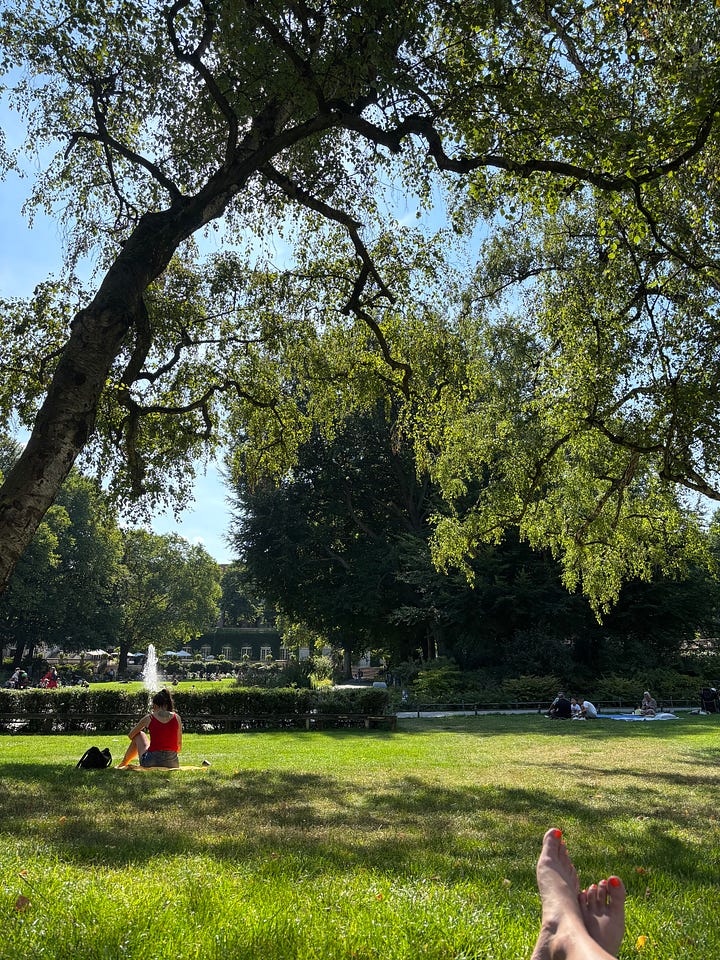
So I started, again, releasing, letting go of a story that had held me in paralysis, untying myself, letting in air and space and an opening of peripheral vision, to see again what’s possible. That meant saying no to invitations, yes to critical ignorance and to selective presence with others, while not (fully) feeling guilty about it. It meant lying in the grass on hot afternoons and floating in the lakes around the city. As well as re-reading words of wisdom and practicing mindfulness regularly.
With the letting go came respite, and from there, a newfound clarity for pouring out what I carry through the encounters and groups I hold together in Oneliness.
How will we find friendships that nurture us if we don’t want ourselves as a friend? How will we love others if we can’t be excited about a life with ourselves?
The two aren’t separate — oneliness recognizes our individuality and our commonality, sees ourselves as living beings in relationality. In oneliness, there’d be no need for loneliness influencers at all — we’d move past the binary of alone and together, introvert or extrovert, and know the practice lives in the in-between, the capacity for both at once.
For now, I’d love to hear what has been moving you this summer, in aloneness, in relationships with others, in oneliness?
Thank you for reading!
I’m Monika Jiang, reimagining loneliness into oneliness as a way to love, work, and live. If this resonated, the best way to support the work is to subscribe and share it. For my offerings for organizations and individuals, learn more at monikajiang.org and follow The Oneliness Project on Instagram or LinkedIn.

Comments
Nothing yet. Say the first thing.
Sign in to join the conversation.