
The second annual online Women of Cacao Summit spanned four days and welcomed dozens of speakers on topics ranging from farming at origin to marketing high-end chocolate. I am still catching up with all the talks through the recordings, but I wanted to give you this quick report of some big ideas that made me grab my pen to scrawl notes.
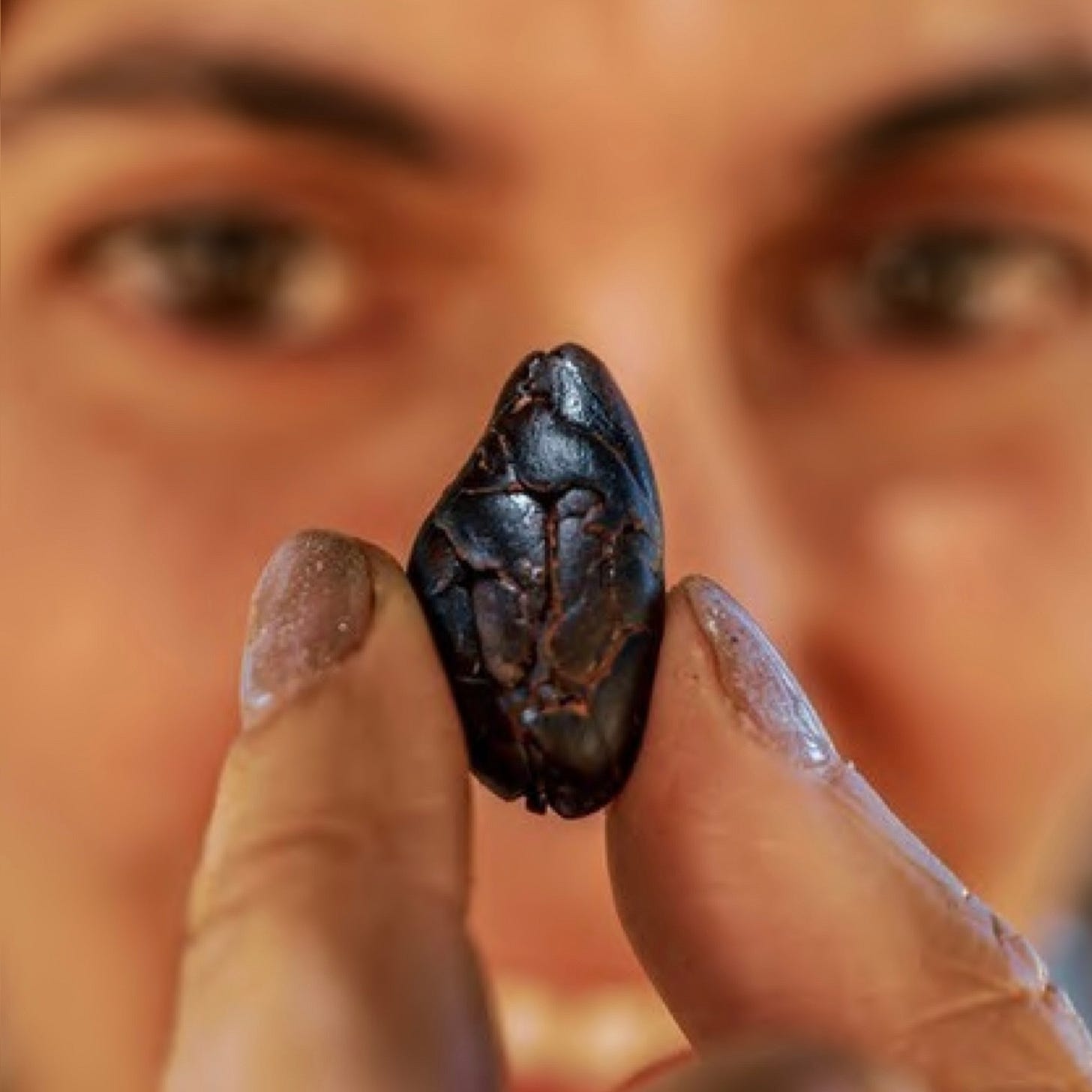
At least three talks shared ways in which cacao and chocolate allow us to explore our own brains and perceptions. I love to consider chocolate as a gateway (drug) to neuroscience! To learn about the way your brain interprets the signals from the world, try rubbing textures, listening to diverse music, or plugging then unplugging your nose while tasting chocolate. Comparing your impressions with others’ lets us glimpse into the different ways people perceive. (This synopsis was painfully brief but there is too much to cover. More soon!)
What stood out to me this time was an exercise I’ve never tried before from Nathalia Awki (from Akwi Chocolate in Ecuador) in her presentation called Neuroscience, Cacao, & the Brain. She asked us to think of a pink elephant then smell chocolate. I found, like most people, the pink elephant completely disappeared as I focused on inhaling. Then the image could come back. What is going on? Interpreting odors is so primal and important that our brains cut out all unnecessary cognitive load. Smelling something intently pulls you out of your thoughts. It anchors you in the moment and primes your memory. It connects you to scents of the past.
I wonder if this tendency to push out thought as we smell deeply is part of the block that seems to exist for humans forming concrete words that describe smells. Instead of being able to call something analogous to blue or rectangular, we are caught in a web of associations and memories: like hay in the morning, reminds me of my grandmother’s cherry pie. I guess that is striking and beautiful? I mean it is, but it is also frustrating as I smell so many scents shafting through our yard and attempt to force my brain to parse them in a non-relational way.
Sophia Rea of Projet Chocolat was not shy to admit her unease at some aspects of cacao ceremony culture. In her talk about current and likely future trends in cacao and chocolate, she paused to reflect on the difference between ceremony versus ritual. She defined ceremony as being formal, performed, often with an audience, and mark and honor specific moments or events. Ceremonies include weddings, graduations, and baptisms. By contrast rituals are repeated actions with deeper meaning, practiced by individuals or groups. Much of the cacao ceremony culture might be better described as cacao ritual. (I like the word ritual better, too, and used that term for the title of a chapter in my book.)
Sophia highlighted a research experiment showing that people value chocolate rituals. She notices more marketing around ritual in chocolate, too, like daily chocolate kits. I love this trend, and I plan to offer something along this line. I imagine that a world full of people who practice a daily chocolate ritual would be a happier more harmonious world.
Sarah Bharath, cacao ecology expert, talked about soil and cacao, but at a deeper level invited us to view all agriculture from a different perspective. The complexity of plant nutritional systems makes it hard for humans to replicate. So why not support biological systems (looking at above and below ground ecosystems here) instead of floundering with synthetic chemical systems? We know polycrop systems are more resilient than monocrops. What was new to me is that it is important to have many different plant families growing together. Cacao (mallow), bananas, citrus, herbs… just not grasses, which prefer a bacterial rather than fungal dominated soil. I’m going to count plant families in our cacao groves, and add more!
I’ve learned much about the Mayan relationship with cacao, but I’m embarrassed to say that somehow I have totally missed hearing from and about the Bribri, who have a distinct and profound cacao relationship. While the Maya are People of Corn, the endemic people of Costa Rica are the People with Cacao Blood. (Cacao is called T’sïru, in Bribri language and is revered as a living spirit.)
India Mayorga spun the tale of the origin of the world, their cosmovision, in which cacao plays an important role, so different from any other origin story I have heard. I won’t try to sum up or retell the story. I do want to communicate that this was eye-opening to me as an example of how much I still do not know about cacao and the human-cacao relationship. I was rapt by India’s story, which I listened to while working in a cacao grove. Awe-inspiring, indeed.
Coming from a a certain path, I have gleaned that craft chocolate people are often suspicious of ceremonial cacao claims, and not without good reason. These chocolate makers are good people with integrity, doing their best to be transparent and honest in their products. “Ceremonial grade” cacao is meaningless as a term and they want customers to understand that. Yet I know people who make ceremonial chocolate and offer cacao ceremonies who also are good people with integrity. While I have seen some dishonest practices in ceremonial cacao, that happens in craft chocolate, too, e.g. the infamous Mast Brothers scandal.
Craft vs ceremonial seems like an unnecessary schism. So I’m grateful and relieved that the Women of Cacao Summit brought people of both and all sides together. It was refreshing and real to hear craft chocolate people talk about the spiritual side of chocolate and ceremonial cacao people talk about scientific studies. Categories blurred, and everyone agreed on their appreciation for the precious tree.
Cacao brings people together.
Thank you to Ava J Holmes, Fiorella Richter, Charlotte Nieuwenhais, and Roza Shifrin for a well-organized and inclusive summit. I look forward to next year!
No posts
Comments
Nothing yet. Say the first thing.
Sign in to join the conversation.