
The chocolate that dazzled people across the world during the colonial period was not chocolate bars but chocolate drinks. Not only was the form different from our common chocolate experiences today but so was the chocolate itself: from Mesoamerican not the African cacao. Fashionable flavors were also different. Peppermint, caramel, and marshmallow were not familiar to chocolate drinkers of the 17th and 18th century. What was this drink like, that enamored Europeans hundreds of years ago? The chocolate experience that inspired people to sail cacao trees to new homes across tropical lands? Here’s my first attempt to find out.
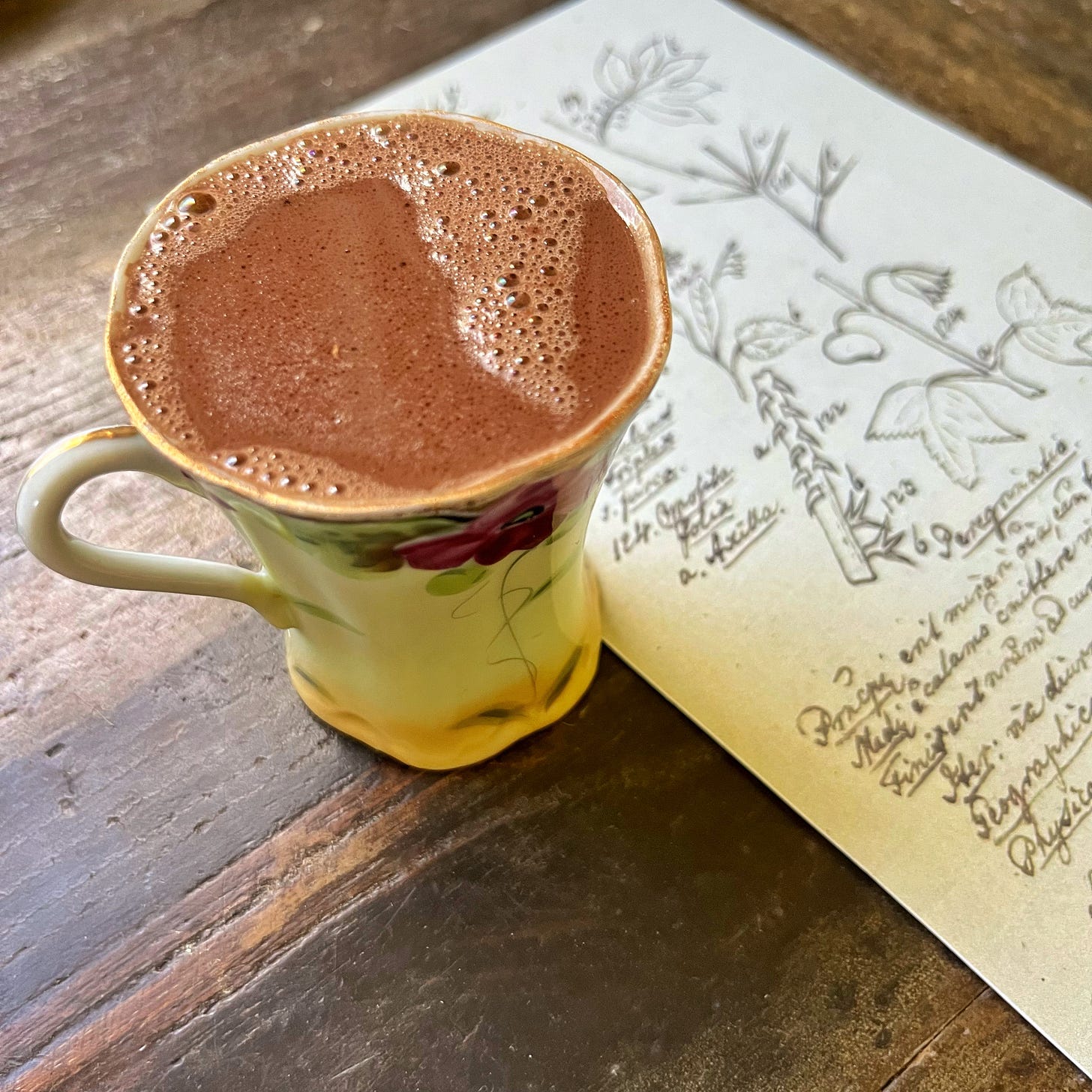
If you are interested in historic accounts of chocolate, download the reprint of the Walter Baker & Company’s 1886 pamphlet entitled “Cocoa and Chocolate.” There I found this entertaining and excellent quote of Jean Anthelme Brillat-Savarin, author of “Physiologie du Goût” published in 1826.
“Let every man, then, who has drunk too deep of the cup of pleasure; every man who has spent in work the time which should be devoted to sleep; every man of wit who feels himself temporarily growing stupid; every man who finds the air damp, the time long, and the atmosphere difficult to endure; every man who is tormented with a fixed idea which takes away from him the liberty of thought, - let all these, I say, administer to themselves a good half-litre of amber chocolate, in the proportion of sixty or seventy grains of amber to the pound, and they will see wonders.”
Why, yes, I have experienced temporary stupidity and lack of thought liberty! Sign me up to experience the wonders of amber chocolate! (I’ll take the deluxe version, if it allows me to write in style like Brillat-Savarin.) But, oh dear, how much exactly is a grain of amber? And what does he mean by amber? It’s like the lost recipe of kykeon.
Another wonderful resource for old chocolate recipes is the book “Chocolate: History, Culture, and Heritage” edited by Louis E. Grivetti and Howard-Yana Shapiro. In these pages Carl von Linné (Linnaeus), the man who gave the cacao tree a scientific name meaning “food of the gods” in 1753 and said chocolate cured his hemorrhoids, is quoted for his three chocolate recipes written in “Om Chokladdryken” in 1778. One of these includes amber.
“17 pounds roasted cocoa beans; 10 pounds sugar; 28 units (?) vanilla; 1 dracma amber; 6 pounds cinnamon.”
Doesn’t that seem like a lot of cinnamon? He must mean cinnamon sticks and not powdered. But still. This recipe makes 33+ pounds, impressive and noteworthy, but we can scale down. More of a problem is what is missing. No one seems to know what a unit of vanilla means. A dracma may mean a dram, which could mean 1/16 of an ounce? How much water? Or is it milk? How long to simmer?
Am I going to make this recipe? Of course, but given the haziness of the instructions I’m moving the goalpost to “inspired by” rather than complete accuracy. Faithfully recreating drinks of a few hundred years ago is not realistic, anyway, given changes in ingredients and tools.
In case you don’t want to follow the nib trail detailed below, here’s the spoiler: Linnaeus’s recipe smells like cinnamon stored in an incense factory. It is bitter and thick. It isn’t bad, in fact it is good. You would never experience these flavors in a pouch of Swiss Miss.
What did I learn? As someone who wants to try everything, I am gleeful for this culinary window to what Linnaeus and other 18th century Europeans knew as chocolate. I’m also intrigued about the value of what we left behind. Would I be surprised to see heavily scented cacao coming back as a trend or a tonic? Not at all, and I hope it does!
After the Brillat-Savarin sales pitch and the Linnaeus endorsement, I’m ready to try amber with chocolate, but what ingredient is amber? I know amber as the resin of trees, like the kind in which you see prehistoric insects entombed. I don’t think that is what it meant. Amber is a popular fragrance but more of a profile than a specific ingredient. Alternatively, amber might also be a shortened word for ambergris, a precious and popular flavoring in those days, which I don’t currently have.
My friend Sara - author of the wonderful Incense Apprentice - tells me that the ingredient amber in these old recipes likely refers to labdanum, a resin collected from the leaves of a beautiful flowering plant, Cistus ladanifer. Labdanum is a favorite ingredient for perfumes, due to its complex and robust scent as well as its durable properties.
Whatever exactly he meant, Linnaeus’s amber was likely a material with complex aromatic qualities of floral and musky scents. Given the preference for Mesoamerican people to use flowers to scent chocolate, that Europeans thought to try their favorite flowery scents is not surprising.
First of all, don’t confuse labdanum with laudanum, the opium tincture. Similar names, but unrelated substances.
A sticky plant resin, labdanum is aromatic, the complex scent described by experts as woody, floral, and musky. The descriptor “amber” comes up quite a bit. It is commonly used as a substitute for ambergris, since the scent profiles overlap somewhat. Ambergris has more sea and labdanum more earth.
When I smell labdanum, I think “incense cone.” It is complex, resinous, spicy, dry. The amount of scent wafting off a tiny bit of resin is astonishing.
I read that labdanum had culinary roles in the past and is currently used as a food flavoring for smoky or meaty nuances. The only modern food product I found that proudly featured labdanum was this fancy cordial from a French company.
As a reminder, Linnaeus’s recipe (quoted above) calls for cacao, sugar, cinnamon, vanilla, and amber. In my first try, I used Wildland Chocolate’s Mexican lavado drinking chocolate, which is whole bean cacao with about the right ratio of cane sugar and a bit of cinnamon. I chose this thinking that the flavor of the cacao may be similar to what Linnaeus might have been familiar with.
How to use labdanum? At room temperature, it’s a sticky resin. (Sara gave me a sample and instructed me to keep it in the freezer. Thank you, Sara!) I see three options:
Simmer a chunk in with the chocolate.
Make an alcohol extract, and put a few drops in.
Scent the chocolate through enfleurage.
Linnaeus probably chose option 1. I chose option 3, partially because I am not certain about any risks of consuming labdanum and mostly because, as you know if you’ve been reading my updates, I love this technique! In a small mason jar, I combined 25 grams of Wildland’s drinking chocolate powder, a half inch piece of vanilla bean, and a tiny drop of labdanum stuck to the side of the jar. My hope was that the cocoa butter in the chocolate would absorb the scents of vanilla and labdanum.
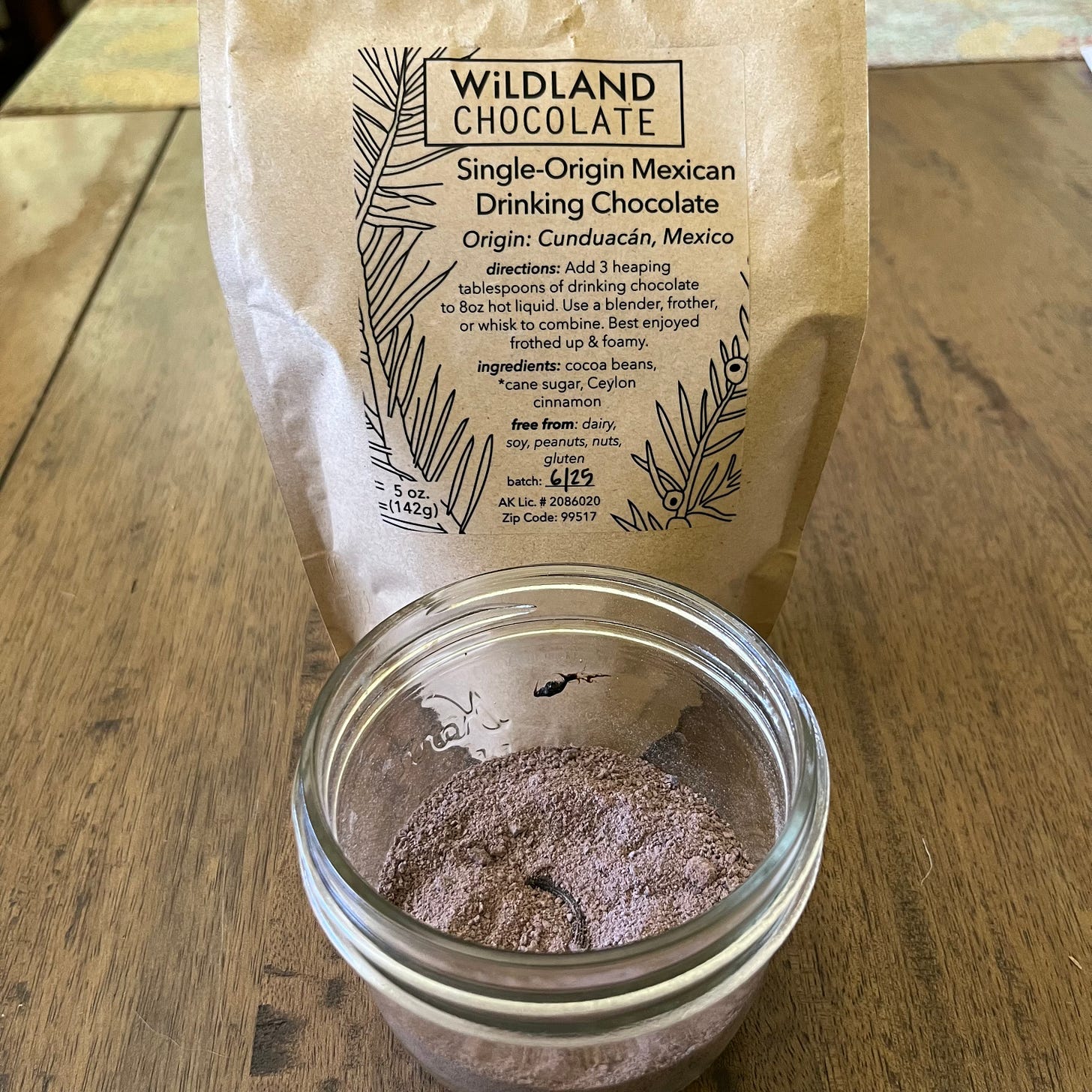
After about 20 hours, I whisked a spoonful of the powder into hot water. The labdanum scent is unmissable. I get floral and musk. Also some warming spice, but that could be the cinnamon. A difference in flavor is not as pronounced, but the drink seems heavier somehow, with a more rounded aftertaste.
For my second experiment, I used 100% chocolate I made from Mexican lavado beans. I scaled down the recipe for 1 cup:
34 grams of labdanum-infused chocolate
20 grams sugar (panela)
6 grams Ceylon cinnamon sticks
1/2 inch piece of vanilla bean
I simmered the ingredients in 1 cup water for about 10 minutes. After removing the cinnamon and vanilla, I whisked with molinillo.
The drink is thick and bitter. It doesn’t foam well. As expected, the cinnamon flavor is strong. The floral notes characteristic of Ceylon cinnamon blend with the sweet depth of vanilla and the spicy-smoky-resinous labdanum. I might feel like I licked an incense cone, but not in a bad way. This chocolate was intended to be medicinal as well as delightful.
Before embarking on this exercise, I searched for blogs or videos where someone recreated any historic chocolate amber (labdanum or ambergris) drink. I was surprised to not find anything, except Casanova’s aphrodisiac pudding. What am I missing? I did find some delightful recreations of spiced colonial hot chocolate, complete with period clothing, cookware, and cooking fire. Check out this one and beware the rabbit hole.
September 13 2025 2025 Hilo Cacao & Chocolate Workshop with talks on tree-to-bar, tourism, and chocolate tasting businesses. I’m sad I can’t go, but you should!
September 19-21 2025 Women of Cacao Online Summit featuring some of my favorite chocolate friends. I’m speaking on Sunday.
No posts
Comments
Nothing yet. Say the first thing.
Sign in to join the conversation.