
I recently became interested in the game theory and came across a very intriguing 1982 paper written by game theorist Alan Blinder, discussing struggles between Reagan’s administration and the FED.
It occurred to me that Blinder’s framework could be applied to the 2026 midterm election objectives and contemporary conflict between President Trump and FED Chairman Powell, ideally compressing his 32-page paper into a short post.
In this post, I assume readers already have basic understanding of the game theory, dominant strategies and the Prisoner’s Dilemma.
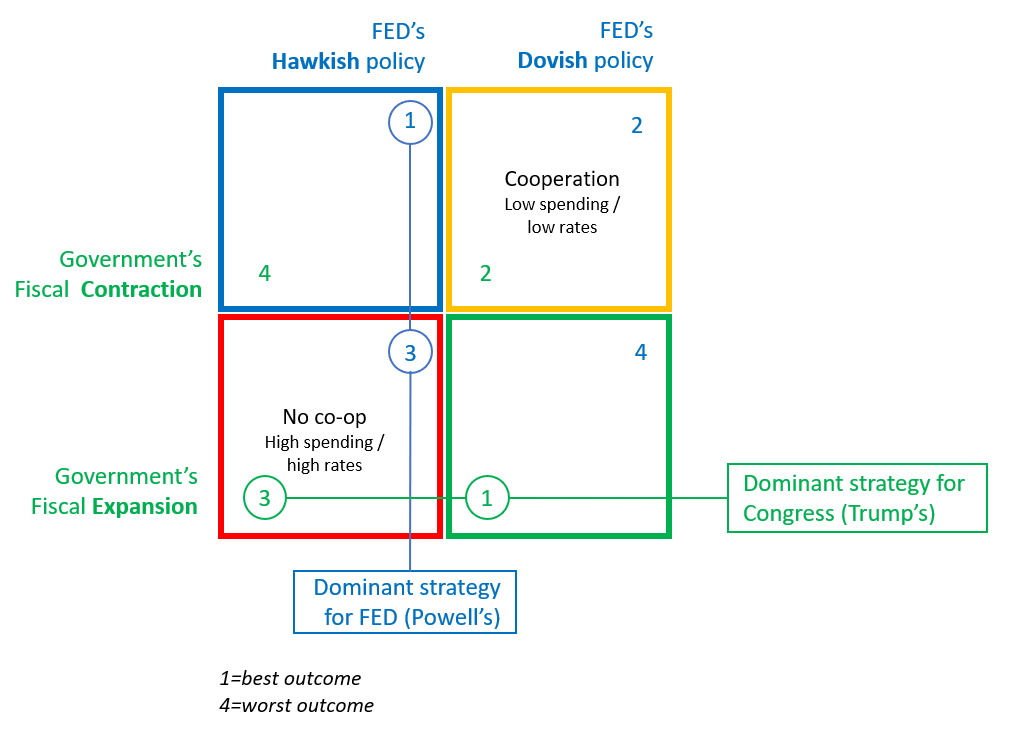
The attached diagram shows stylized outcomes for Mr Trump and Mr Powell (1 = best, 4 = worst) under different circumstances.
US GOVERNMENT POSITION
Fiscal policy is the government’s domain. Republicans’ economic program is based on supply-side economics, promoting large tax cuts, domestic production, and deregulation of the energy and financial sectors. The result is fiscal expansion and large budget deficits. Mr Trump’s primary concern for low interest rates and manageable debt payments is understandable. Given their relatively short-term mandate (6 years for senators and 2 years for representatives), long-term inflation can be seen as only a secondary concern.
Therefore, the dominant strategy for Trump’s administration is fiscal expansion, regardless of the FED’s action. This is because fiscal expansion always delivers a short-term boost to the economy (red🟥 and green🟩quadrants).
FED POSITION
FED governors, by contrast, serve much longer terms (14 years). Free from short election cycles, their primary concern is long-term inflation control, often leaning towards hawkish policy when supported by strong job reports.
Mr Powell’s dominant strategy is cautionary monetary policy, aimed at minimizing the risk of persistent inflation (red🟥 and blue🟦 quadrants)
PRISONER’S DILEMMA
Anyone familiar with game theory knows the Prisoner’s Dilemma: two players would be better off cooperating, but each has an incentive to defect if cooperation cannot be guaranteed. The game ultimately settles into a Nash equilibrium, where neither side can improve its outcome unilaterally.
Congress and the FED each pursue their dominant strategies, leaving the game stuck in the red🟥 quadrant.
A better outcome for the country’s national debt would be to pursue fiscal contraction paired with a low interest rate environment. This would also achieve the FED’s goal of lowering persistent inflation and Trump’s goal of boosting the economy via lower interest rates (yellow🟨 quadrant).
RESOLVING THE DILEMMA
The Prisoner’s Dilemma can be resolved via collaboration, enforced by a strategic move (like a threat, promise, or commitment).
For Trump’s strategic move to work, one critical condition must be met - the payoff structure must change so Powell’s best response shifts. Otherwise, the move is just talk which won’t influence the other player’s behavior.
In our example, the only viable option to force Powell into lowering rates is to move the game from red🟥 into the yellow🟨 quadrant by committing to fiscal contraction, so the payoff improves from 3 to 2 for both parties. Game theory outlines a multitude of credible commitments which can achieve this goal.
WHAT ACTUALLY HAPPENED
Mr President tried to push the FED from 🟥red into the green🟩 quadrant (dovish monetary policy in line with the 2026 Midterm election objectives), while maintaining expansionary fiscal policy. But this shift would significantly worsen Chairman Powell’s payoff from 1 to 4 by sacrifising long-term inflation prospects.
Despite numerous attempts (FED building renovation project, attempted firing of Lisa Cook, and others), pursuing Mr Powell to move the game from red into the green quadrant didn’t work, because it violates fundamental rules outlined by the game theory.
⚠️Regulatory disclaimer: This is a personal post which is stemming from my interest in game theory, rather than US politics. Views expressed here are my own and do not reflect those of my employer.
🔗Link to the original article: Alan Blinder: On Issues in the Coordination of Monetary and Fiscal Policy (1982)
No posts
Comments
Nothing yet. Say the first thing.
Sign in to join the conversation.