
Have you ever considered shorting German bonds while buying Spanish or Portuguese to capture the yield difference?
If so, you're not alone. Today, more than half of so-called "€ peripherals" bond trading is done by macro and multi-strat hedge funds, for speculative purposes. This trend has been on the rise since the pandemic and is closely linked to the comeback of voice trading, which I discussed in my previous post (link below).
1️⃣ Why do hedge funds love this strategy?
Peripheral trades resemble carry trades. They capture rate differentials, but without FX risks. Instead, the focus is event and sovereign risks. These trades can deliver market-neutral returns and attractive Sharpe ratios, largely because much of the risk is hidden in the fat tails rather than in day-to-day volatility.
2️⃣ Why is this strategy risky ?
Fat tails. The strategy has similar risk profile as selling vols or carry strategies. Fat tail risk means that there potential losses are low in probability but high in magnitude.
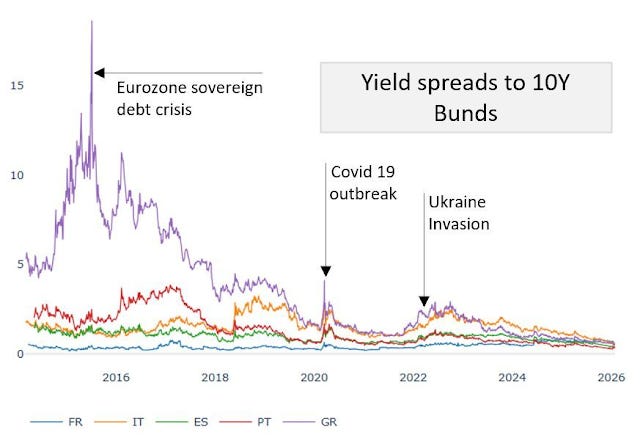
Managing liquidity and political events are the main factors which differentiate winners from losers. For example, during the heights of Greek sovereign crisis in 2012 and 2015, the main questions to ask were:
* What will be result of Greek election?
* What austerity measures will the new government commit to?
* What haircut will be applied to my bonds as part of the bailout negotiations?
3️⃣ What are institutional barriers ?
Profiting from peripheral spreads requires significant leverage. Access to the repo market and cheap funding is therefore essential. A typical German/Spanish peripheral trade is structured as follows:
1) Borrow cash from a bank via a repo transaction to buy peripheral bonds.
2) Borrow core bonds via a reverse-repos to sell them in cash market.
Transacting illiquid bonds in large quantities often requires over-the-voice negotiation. Borrowing them is even more challenging, since your bank must first hold them on its balance sheet. That balance sheet is a limited resource, carefully allocated to the most valuable clients.
4️⃣ Factors which drive peripheral spreads
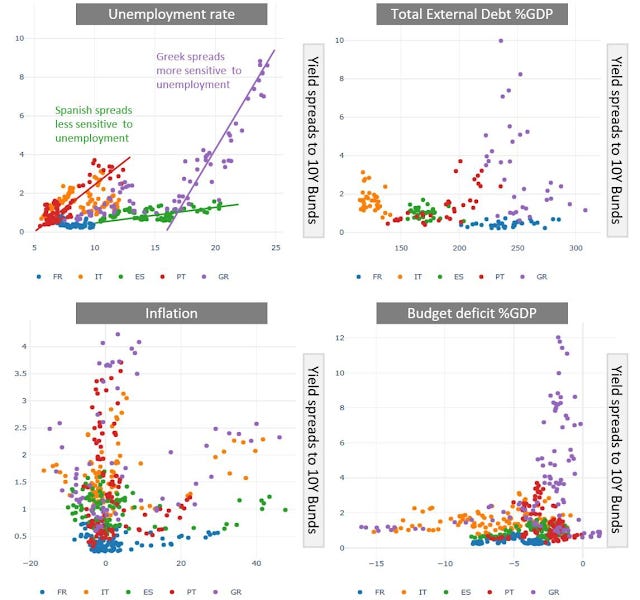
As of 2026, peripheral spreads are at record lows (Fig. 1). The key macroeconomic factors to monitor are tied to a country's ability to meet its obligations, such as the debt/GDP ratio, budget deficit, inflation, unemployment rate, and balance of trade (Fig. 2).
Quantitatively minded traders may be tempted to rely on multi-factor models to guide their decisions. However, this can do more harm than good for two reasons:
1) Macroeconomic shifts make factor loadings unstable, rendering models ineffective at critical moments.
2) Instead of serving as a supplement, quantitative models can distract from the true nature of peripheral bond trading, which revolves around navigating idiosyncratic events and managing liquidity.
No posts
Comments
Nothing yet. Say the first thing.
Sign in to join the conversation.