

Everybody wants to be a unicorn.
By that, I mean that every entrepreneur wants to be that one company on the cover of Forbes that becomes famous for going from $0 to $100 million (or whatever) in a year.
But, speaking from experience, those cases should be rare and for good reason.
…for your own good even.
And I have learned this the hard way—twice.
Allow me to explain:
Why are you an entrepreneur?
…no, I mean really?
For money alone? Doubtful.
The reason why I doubt that is because it’s statistically proven that once you achieve a personal income past $70,000 per year (or whatever the equivalent amount would be for a comfortable quality of life in a way contextually correct for you)—the principle of diminishing returns applied to happiness goes into full effect the more money you make.
So, what would drive you past the point of meeting your Maslowian needs? To go beyond them?
And why the rush?
Why be in such a hurry to make more money than you will ever need in no time flat?
There’s got to be something else there, within you. A different reason. A void or trauma of some sort—even if generational.
Something else you may not even entirely be consciously aware of that would drive your obsession and ambition.
My marketing firm, OMI Firm, the very company hosting this article that you’re reading…has collapsed due to the weight of its own clientele…more than once.
And this was due to me wanting to reach a certain level of viable, annual income beyond that which was necessary for a generally comfortable life in a way that was difficult to ethically scale.
The marketing world is filled with key areas that marketers repeatedly fail to fulfill and deliver. Beyond merely results, marketers often fail to be honest and moral.
Many are in the business of lying.
Not simply as conmen (though, those do exist and I’m sure we’ve all seen them—the type that will film advertising videos while standing in front of Lamborghinis they can’t actually afford), but as those who would unethically push products and services they don’t really believe in, or may believe in but know are significantly flawed in some way…but still use Wolf of Wallstreet-style high-pressure sales tactics to make money.
Example: I could have guided Wolven Industries, as its CEO, to do this with the uRay after COVID-generated market demand died down, but I did not.
But remember what I’ve written before: A good company is a good person.
You don’t have to lie to market yourself, your product, or service.
All that is required for success is that you meet or generate market demand for your solution to a given problem. That is all.
If you can do that for one customer, you can do it for a thousand—the question is merely how you scale.
And that’s when we get into why you don’t necessarily want to be that company that explodes overnight—if you care at all about your wellbeing and the wellbeing of others around you, including your own customers’.
I repeatedly deliver what the marketing industry wants: honesty and results.
You’ll notice on my Upwork profile, the very first sentence is no-nonsense and cuts straight to the point: Put simply, you hire me to make your company more money.
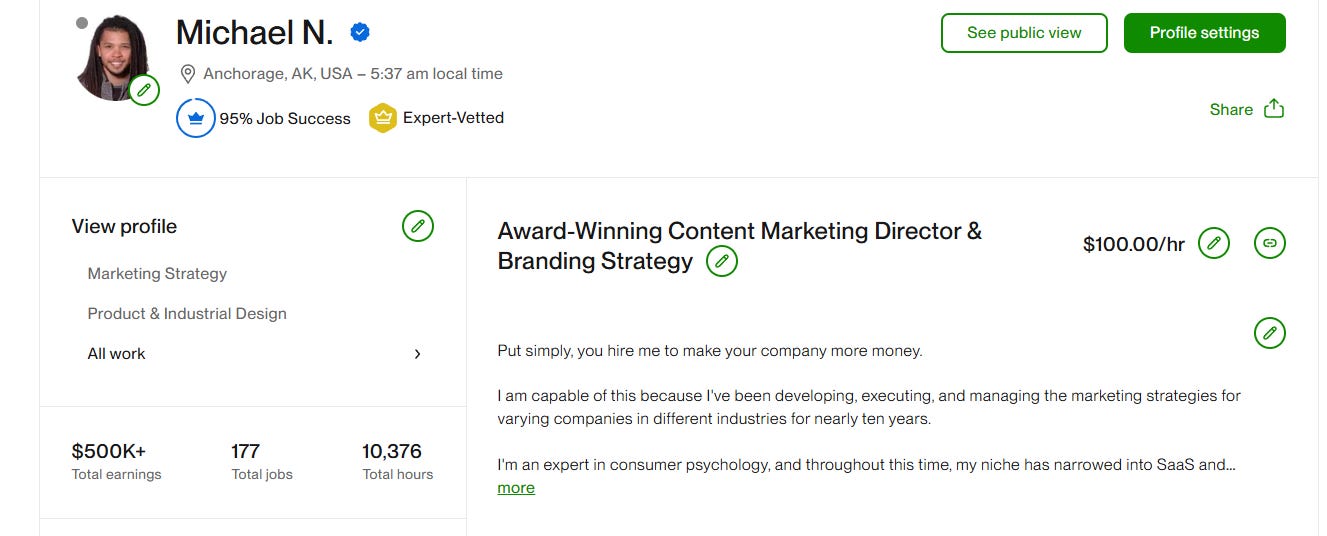
This is exactly what the industry wants to hear, what entrepreneurs want to hear when they contract someone like me.
And because I said exactly what the industry wanted to hear (with the credibility to back up that claim, considering my education, experience, and portfolio)—you can understand why I had no problem receiving job offers.
You can understand why I still have no problem receiving job offers.
And, at one point, I took on way too many contracts than I could handle at one time. There were points in my career as a marketing strategist at which I was taking on 3-4 new companies at a time, as I bounced from one interview call to another.
NOTE: I am not simply saying that I had 3-4 clients or that I should have handled one client at a time; I am saying that I, as a sole proprietor, onboarded 3-4 clients at a time, when I should only onboard 1 (maximum 2) at a time.
If, due to the length of a contract, I end up with a gross total of 5+ clients that’s fine…that’s just higher and higher levels of success—so long as they were all onboarded at a rate that didn’t detract from my ability to give 5-star service to each of them without collapse.
And collapse is exactly what I experienced.
As OMI Firm is a family business, my wife is my executive assistant. She often helps with middle-management, graphic design, and other miscellaneous things.
So, whenever I have taken on more clients than I could thoroughly learn and acclimate to, I have ended up splitting my attention among each client throughout the process of multitasking beyond my personal ability to fairly deliver my services to any of them.
All the while, I was overstressing my family members with the weight of both the clients’ work demands and my ambition.
And that was all my fault. No one else’s.
Every single company (like yours) requires genuine, personal attention and expertise that befits you and you only.
There is a point, for each client, at which I have comfortably internalized their company, its culture, workload, etc.
When I reach that point, able to efficiently deliver quality work and results sustainably in an energy-efficient way, then it is correct to consider taking on another client…
…but not before.
Transferring this wisdom over to Wolven Industries, we have ventured into developing home security products.
To compete with the services of ADT and other top dogs, Wolven Industries (which is, right now…again…my family and I) need to provide not only high quality technology to our customers, but round-the-clock support to start off with—until we can hire more people to scale with.
If we take on only a handful of customers in the beginning (deliberately capping our willingness to take on more too soon), my family will be fine as we deliver 5-star service to those few customers that we can handle well—especially if we automate some aspects of the customer onboarding process.
If, however, we invest a ton of money into marketing the otherwise solid offer and thereby attract far more customers than we can handle…we might indeed check the “unicorn” box for Forbes within a year…
…but at what personal cost? And that’s assuming we wouldn’t go out of business due to the permanent, self-inflicted reputational damage from bad reviews written by customers dissatisfied with our inability to fulfill the demand we generate by over-marketing ourselves too early.
As both the leader of the company and the head of my family…would I destroy my family for the sake of my ambitions and over-the-top work ethic likely stemming from the traumas of my childhood? Allowing the Jungian shadow of my entrepreneurial personality to possess me into becoming an abusive husband and father?
Or would I sacrifice what could be the “unicorn” status of our company for the overall collective success of our family and legacy?
So, leading by example with my work here, I ask myself the same question I ask you:
Why am I an entrepreneur?
I am an entrepreneur because I have a unique personality that makes it hard to fit into other business cultures while I retain the ambition of rebuilding a family legacy from scratch. One of the key factors that drives me is pain, the trauma involved with my father’s murder, which led to the destruction and collapse of my original family of origin.
If I valued money over family like Steve Jobs did, yeah—we might become the next Apple of homeland defense products, but I’d contradict myself and fail my deeper spiritual and metaphysical mission of family.
…while the family is the core of our civilization, which pertains to the collective mission of my companies in the first place.
…and ultimately end up alone in the end, which was Steve Jobs’ core regret and final message to the world—not to become like him.
The money will come. Don’t worry about that.
Do not allow the thought of it to corrupt your spirit, and why the people that matter most to you…love you.
Don’t just be a good entrepreneur—be a good person.
You don’t want to explode overnight.
What you really want (and need) as an entrepreneur is to scale at a rate in direct proportion to your ability to provide 10/10 customer service.
I have...
Helped to build nearly 200 businesses over the past ten years as an award-winning marketing strategist.
Multiple business certifications, collegiate awards won, and a college degree in business. Click here to view them.
Back-to-back 5-star reviews on Upwork while also "expert-vetted" and verified by Upwork with a +90% business success rate.
A public, digital portfolio of some of the work I've performed for other businesses that you can click here to view.
You have but to check me out on LinkedIn and view my Upwork profile to verify. Click the links to do so; I have provided them in the sentence before this one to make it easy for you.
And, if you're a college student, I provide limited business mentoring for absolutely free to help you get on your feet.
You have but to reply directly to this e-mail to explain to me what your entrepreneurial situation is.
We can work something out that is unique to you.
Click here to schedule a free appointment with me.
...please show your support by signing up to my Substack.
Your $7/month support matters more than you think, as it enables me to continually produce this kind of content and further develop my ideas, which are intended to help you think differently and see more clearly about your business and its customers.
You can also consider the price as a kind of limited consulting retainer, as you’ll also be granted my direct and personal attention to talk about your actual business in either comments, e-mails, or direct messaging.
No posts
Comments
Nothing yet. Say the first thing.
Sign in to join the conversation.