

American Eagle released an ad campaign featuring actress Sydney Sweeney—an ad that, on the surface, seems innocuous: it compliments her appearance, celebrates her genetic gifts, and sells clothing.
Yet somehow, this simple gesture sparked a cultural firestorm. Accusations flew. Think pieces were written. Social media lit up with debates ranging from beauty standards to political ideology, and even “crisis experts” were called to weigh in on the alleged social damage inflicted by the campaign.
For those unfamiliar with Sydney Sweeney, she’s a rising star in Hollywood—blonde, feminine, and strikingly attractive in a way that feels almost politically incorrect in today’s climate. The ad didn’t shame other women. It didn’t denigrate any particular group. It simply praised one woman for having “great genes.”
And that, apparently, was enough to set off the outrage machine.
But here is what I’d like to discuss about today, pertaining to this ad: the virtue of sticking with a target audience, no matter who lashes out at you for it.
It’s about business—and the increasingly dangerous temptation to appease people who were never your customer to begin with.
It’s about having the courage necessary to demonstrate that you know your audience and understand what they value as you stand firm in that identity—especially as the mob starts screaming—all while speaking in the language that your ideal target audience can relate to, trust, and understand.
What follows is a post I originally published on Facebook—a raw, unapologetic breakdown of why American Eagle’s ad worked, what Victoria's Secret got wrong, and what every brand needs to understand about marketing, masculinity, and the power of choosing a side.
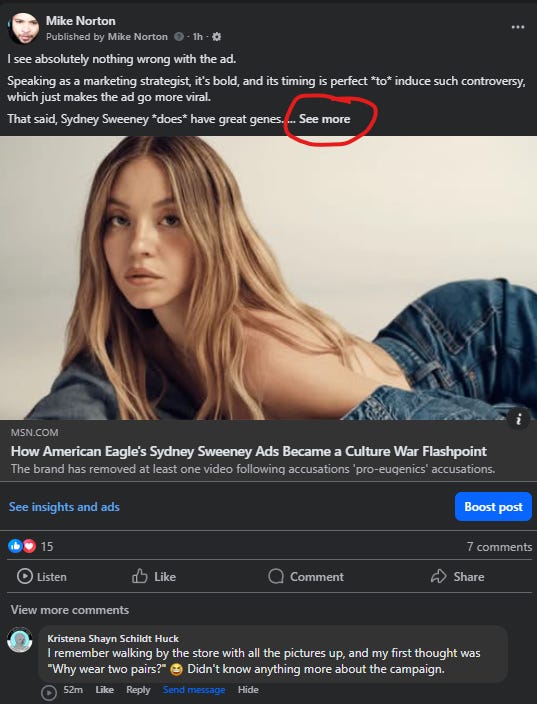
I see absolutely nothing wrong with the ad.
Speaking as a marketing strategist, it's bold, and its timing is perfect *to* induce such controversy, which just makes the ad go more viral.
That said, Sydney Sweeney *does* have great genes.
Notice how the ad does not say that other phenotypes lack great genes, or that they are inferior—it merely says that she has great genes. To lift someone up is not to put others down.
...and watch how various psychographic groups respond to truth.
It is *supposed* to perturb certain people's insecurities; that's what gives the brand exclusivity and thus higher market value to its target audience.
This is a subtle, pre-emptive retaking of rationality—a shift back to reason from woke.
Bravo American Eagle. 👌
Victoria Secret tried something like this once—talking about the genetics of people like Heidi Klum and others. The blowback was so severe from such a wide amount of people that the brand got distracted by the fact that few of those millions of people were even really customers.
They weren't customers. They weren't the target audience of the brand. They were just passersby who couldn't afford Victoria Secret anyway.
Victoria Secret then began to decline when they started changing their advertising to oblige those complainers...
...but those complainers aren't the real target audience who buys the most over the longest period of time.
The *real* target audience of Victoria Secret isn't people like some random Muslim chick in South America, or some random overweight college student who doesn't know what gender she is.
The *real* target audience of Victoria Secret (and brands like American Eagle) aren't even white women.
...It's men like me.
My wife won't buy herself Victoria Secret; I buy it for her.
*I* make that purchase decision. She wears it *for* me.
These brands choose the women that *I* like to look at, that *I* would have sex with, that get *me* excited, that *I* relate to my wife being like in order to make the purchase decision.
What they subcommunicate is: "Your wife is but one purchase away from looking like this..."
And, as a representative of that target audience segment: Yes, I am not offended by the notion that my wife has fantastic genes, because she *does* have fantastic genes...
...and the clothing accentuates that. 👍
The clothing is sexual. Sex implies the proliferation of genes.
Men like me want to (and enjoy) fusing blood and proliferating offspring with women who have great genes.
That is *exactly* what our thought-process is.
Period. 🤷♂️
Yes, wear these clothes. Display your enticingly wonderful genes for me...
...and let's breed! That's the *entire point* of the purchase!
Now, I'm about to reconsider purchasing American Eagle. And trust that I will be a customer with a far higher "customer lifetime value" (which is the amount of money someone spends with a customer over a lifetime) than the people complaining.
Yes, Victoria Secret, American Eagle, et al...
...please keep speaking to people like me in *our* language. 👍
In business—as in life—clarity of identity is everything.
Brands that try to be all things to all people end up belonging to no one. The real power lies in having the spine to say: “This is who we are. This is who we’re for.” Not in apologizing for it.
American Eagle didn’t just feature Sydney Sweeney—they made a quiet, calculated stand for a particular kind of beauty, desire, and consumer. They reminded us that not every ad has to coddle to every corner of public opinion.
Some are meant to polarize, because the sharper your stance, the clearer your signal to the people who actually buy—winning their loyalty, and thus the war for lifetime customer value.
Whatever audience you may choose, classify them as your intended loyalists. Your lifelong brand evangelists who will be there for your company in times of need, with a credit card in hand, waiting for someone to speak their language again.
So if you're building a brand—ask yourself: Are you trying to win over the crowd in the cheap seats, or are you signaling to the people who’ll actually invest in what you offer?
Are you a coward in your marketing strategy?
Because at the end of the day, general backlash from people who wouldn’t reliably purchase from you anyway isn't the threat.
The consequences of losing your most devoted fans are.
And American Eagle seems to know better.
I have...
Helped to build nearly 200 businesses over the past ten years as an award-winning marketing strategist.
Multiple business certifications, collegiate awards won, and a college degree in business. Click here to view them.
Back-to-back 5-star reviews on Upwork while also "expert-vetted" and verified by Upwork with a +90% business success rate.
A public, digital portfolio of some of the work I've performed for other businesses that you can click here to view.
You have but to check me out on LinkedIn and view my Upwork profile to verify. Click the links to do so; I have provided them in the sentence before this one to make it easy for you.
And, if you're a college student, I provide limited business mentoring for absolutely free to help you get on your feet.
You have but to reply directly to this e-mail to explain to me what your entrepreneurial situation is.
We can work something out that is unique to you.
Click here to schedule a free appointment with me.
...please show your support by signing up to my Substack.
Your $7/month support matters more than you think, as it enables me to continually produce this kind of content and further develop my ideas, which are intended to help you think differently and see more clearly about your business and its customers.
You can also consider the price as a kind of limited consulting retainer, as you’ll also be granted my direct and personal attention to talk about your actual business in either comments, e-mails, or direct messaging.
No posts
Comments
Nothing yet. Say the first thing.
Sign in to join the conversation.