
If Texas Republicans spent more time reading history, they might remember the story of Icarus. He was given wings of wax and feathers and warned not to fly too high. But exhilarated by the view, he rose anyway until the sun melted the wax and sent him falling. The lesson was never about flight itself. It was about the danger of believing it could never end.

In August 2025, I wrote an article for this publication called “How Texas Republicans Drew Seats for Trump’s Loyalists.” It analyzed the pro-Republican maps adopted for the 2026 elections and made a prediction that now bears revisiting:
“Texas Republicans operate with impunity, comfortable in their gerrymandered strongholds, confident no one can touch them.
But comfort breeds vulnerability. Gerrymandering may hand them districts, but it cannot hand them invincibility.”
For three decades, Republicans in Texas governed with the certainty that their power could not fail. Their coalition lifted them through election after election, reinforcing the illusion of permanence. Texas came to stand for Republican rule. But political coalitions, like wings, are built from fragile materials. They hold only as long as their pieces remain intact.
This weekend, the warning became impossible to ignore. Democrat Taylor Rehmet won a special election in Texas Senate District 9, a North Texas seat running through Tarrant County and the Fort Worth suburbs. This is territory long dominated by Republicans. In 2024, Donald Trump carried the district by 17 points. Rehmet won it by 14, taking 57 percent of the vote.
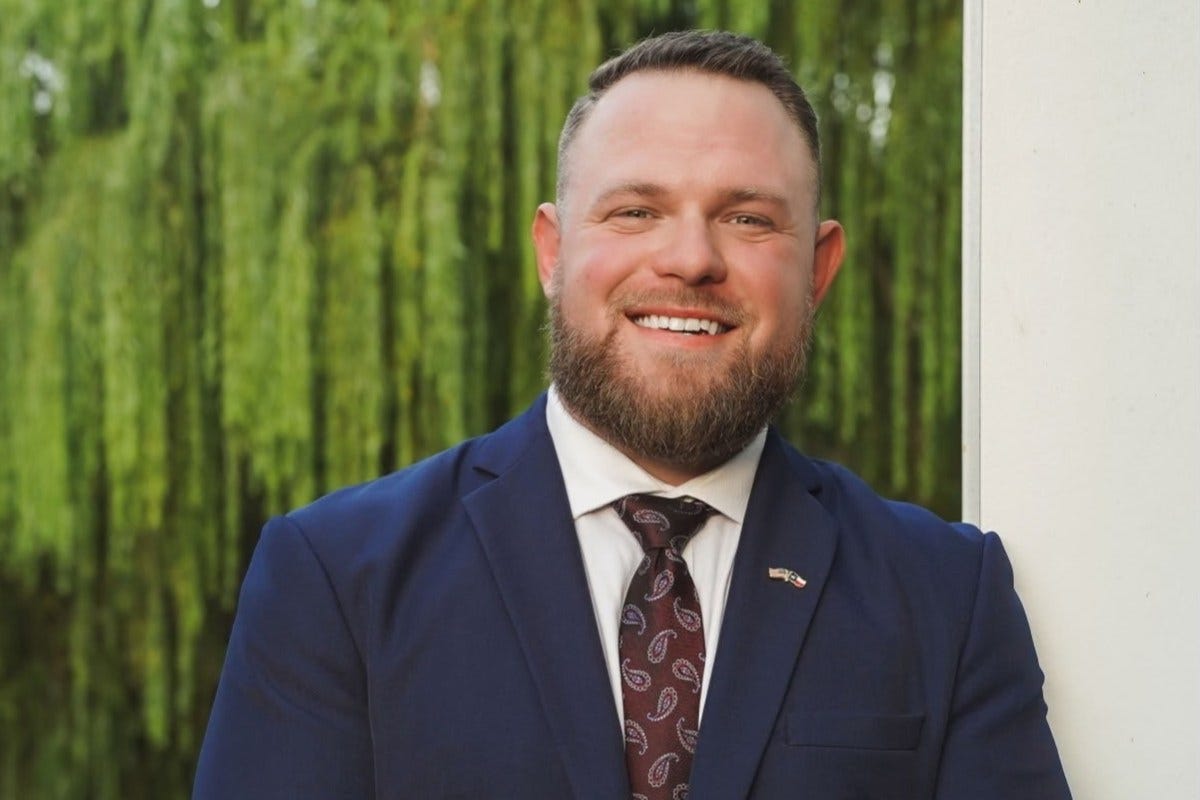
The race began when Republican Senator Kelly Hancock vacated the seat to join the comptroller’s office, triggering a costly GOP fight between Leigh Wambsganss and John Huffman centered on gambling policy and casino money. Republicans spent more than $2.5 million after the primary, while Rehmet raised about $380,000 from mostly small donors, aided by outside support. He still won decisively, turning what was supposed to be a test of money and muscle into a lesson about coalition and turnout that has sent shockwaves throughout the Texas Republican party.
Rehmet’s victory makes him the first Democrat elected to the Texas Senate from north Tarrant County since 1978. It was not the product of a single cause but of a visible pattern.
In heavily Latino Fort Worth precincts, the change was stark. In 2024, Democrats won these precincts. In the special election, Rehmet did more than win them. He ran up the score, nearly doubling Democratic support in some places and expanding margins by as much as 15 to 50 points.
At the same time, Republicans collapsed in suburban precincts that had backed Trump by 10 to 20 points, where Rehmet ran competitively or won outright. GOP turnout lagged while Democratic turnout held steady. Latino precincts supplied the margin. Suburbs failed to provide the cushion. Together, they flipped a district Trump had carried by 17 points into a Democratic win of 14.
That danger is structural as well as electoral. Republicans’ 2025 redistricting gamble assumed that 2024’s Hispanic margins reflected a lasting realignment rather than a turnout-driven anomaly.
Districts were drawn around the belief that Latino voters had tilted right for good. But SD-9 shows how brittle that logic was. When Latino margins rebound and suburban cushions thin, the very lines meant to lock in control become fault lines instead. A map built on a moment becomes a trap when the moment passes.
This is more than a political risk. It suggests structural damage. Districts engineered to withstand narrow Democratic performance fail when turnout returns to normal levels. The problem is not a bad candidate or a bad cycle. It is that the architecture of the map no longer matches the behavior of the voters who live inside it.
Midterm electorates skew older, more consistent in participation, and more suburban than presidential ones. This pattern has historically weakened Republican coalitions built on irregular turnout and cultural mobilization. That is the coalition Donald Trump relied on in 2024. The problem is that it turns out reliably for Trump but not for other Republican candidates, as seen in 2018, 2022, and again in the 2025 off-year elections. Setting up what could be a similar defeat in 2026.
With a fractured coalition and lower baseline turnout, the Republican nominee will also face the burden of persuasion. That task will not become easier after a bruising primary between John Cornyn, Wesley Hunt, and Ken Paxton, which is already straining party unity.
Ross Hunt, principal at Hunt Research, points to the composition of the SD-9 runoff electorate. Many voters had participated in the Republican primary, suggesting the outcome cannot be explained simply by low GOP turnout. Instead, the electorate included substantial numbers of independents and habitual Republican voters who crossed over to support the Democrat.
The November electorate is expected to mirror Republican turnout levels from the runoff, but with a larger bloc of independents. Those independents are now the party’s central vulnerability.
Pew Research’s validated voter data from 2024 underscores the problem. Trump’s victory rested more on turnout than on persuasion. His 2020 supporters returned to the polls in greater numbers than Biden’s, but he added relatively few new voters to his coalition.
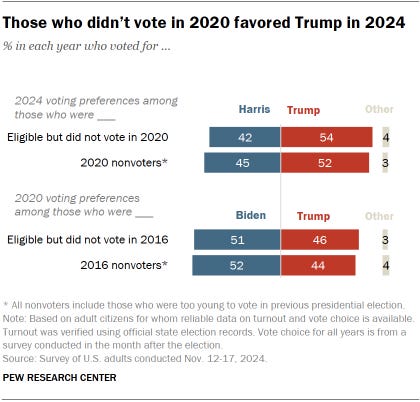
If Republican morale weakens and turnout softens, while independents shift left— margins narrow quickly. And if Latino margins continue to move against Republicans, those voters could provide the decisive blow.
The Latino shift seen in SD-9 goes well beyond what Democrats achieved in 2018. When Beto O’Rourke ran against Ted Cruz, heavily Latino precincts in Fort Worth and north Tarrant County usually gave Democrats about 60 to 70 percent of the vote. In the SD-9 runoff, many of those same precincts moved into the 80 to 90 percent range.
This is why the Texas gerrymander may prove brittle. By redrawing districts from the Rio Grande Valley to the Dallas–Fort Worth suburbs, Republicans aimed to secure as many as five additional House seats in 2026. That strategy depends on fragile assumptions about turnout and loyalty. If Latino participation rebounds and suburban margins continue to slip, districts drawn as fortresses could instead become fault lines.
Trump’s coalition was never permanent. It was built from low-propensity and swing voters who trusted him on inflation and the economy. A midterm electorate changes not only who turns out but what voters judge most harshly.
In 2024, Trump ran against an unsettled economy shaped by pandemic disruptions. Now he governs with unified control in a state already ruled by his party. Attention shifts from possibility of change to present kitchen table issues. Rising property taxes, climbing insurance premiums and ever-so-increasing grocery prices. Elections become judgments on whether life feels better than it did before, and for many voters, it does not. For some, it feels worse.
The enthusiasm gap is not confined to voters. It is visible among officeholders as well. Nearly one third of Texas’s Republican congressional delegation has chosen to retire rather than seek reelection, a quiet signal of fatigue inside a party that once prized longevity and security.
A swing like the one seen in SD-9 would not stop at the top of the ballot. It would travel downward, reshaping contests for the Texas Legislature, the courts, and county offices. What begins as a shift in turnout becomes a shift in who governs schools, writes the laws, and draws the next maps.
Icarus was warned not to fly too high. But he rose anyway. For decades, Republicans in Texas have flown just as confidently above the political landscape. When a Democrat flipped a district Trump had carried by 17 points, it revealed the cost of ignoring warning signs. Texas is not falling from attack. It is descending from overconfidence, its dominance melting away one election at a time.
Rehmet and Wambsganss will meet again in November, with Republicans already declaring victory. That certainty seems premature. If I were advising the GOP, I’d focus less on SD-9 and more on the weight Wambsganss adds to Tarrant County Judge Tim O’Hare’s re-election fight. Political gravity is unforgiving.
Mythology, after all, is not subtle about how this ends.
Comments
Nothing yet. Say the first thing.
Sign in to join the conversation.