
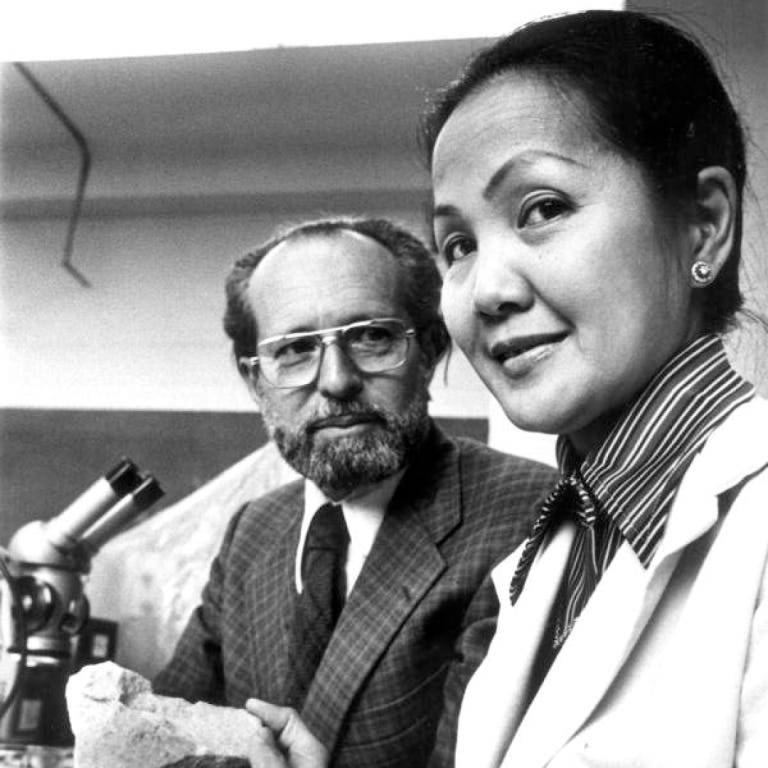
The rocks that arrived at Roseli Ocampo-Friedmann and her husband E. Imre Friedmann’s Florida State University microbiology lab in 1974 had been on a long journey. They’d been wrested from the ice-free cold desert of the dry valley region of southern Victoria Land, Antarctica by Wolf Vishniac, who’d actually lost his life collecting the samples.
Now, the rocks were nearly 10,000 miles away under an electron microscope, ready to give up their secrets. One 2-inch rock in particular, a “small but perfect specimen of Beacon sandstone” would debunk the idea that life couldn’t possibly exist in extreme polar desert conditions. Few rocks can boast enjoying such scrutiny and distinction.
“The ice-free cold desert of the dry valley region in southern Victoria Land, Antarctica (77°30’S, 161°00’E) can be regarded as the most extreme and inhospitable environment on Earth,” the scientific power couple noted in their subsequent 1976 paper. “This area attracted the interest of microbiologists not only because the combination of extreme drought and cold poses utmost demands on the adaptive capacity of microorganisms, but also because the dry valleys are regarded as the closest terrestrial analog to Martian or other extraterrestrial planetary environments.”
Using a visible-light optical microscope, Roseli and Imre captured a light micrograph (or photomicrograph), aided by a Leitz Ultropak illumination system and water immersion. They tilted the specimen stage to create stereoscopic pairs of micrographs of the rock (to be viewed with a stereoscopic hand viewer) . The sample was then coated with gold-palladium and viewed in the scanning electron microscope.
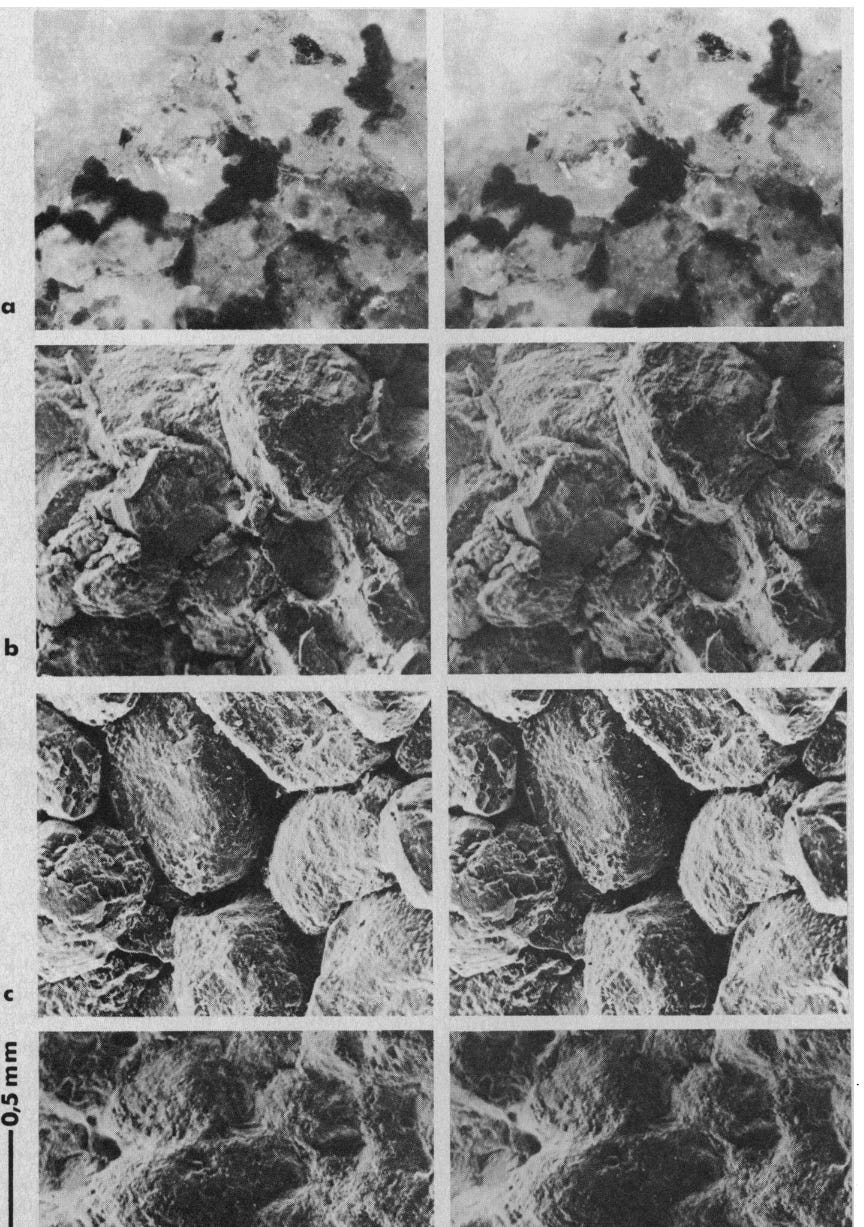
There it was: life in the most inhospitable of places. They discovered several colonies of algae visible behind the transparent crystalline particles. “Examination of the orthoquartzite rocks revealed the presence of endolithic algae,” they reported. The rock is porous, which allows the algae to grow in the air spaces between the rock particles, while the rock’s transparency lets in light.
“The finding of endolithic blue-green algae in the dry valley region provides direct visual evidence of the presence of indigenous microbial life in this area and, so far as we can determine, also constitutes the first record of primary producers in the Antarctic cold desert ecosystem,” the pair announced. “We suggest that, beyond the relevance of our finding to terrestrial biology, scientists making future efforts to detect life in extreme planetary (for example, Martian) environments, which have so far centered exclusively on soft soils, should also consider the interiors of exposed rocks as possible substrates for pioneer life forms.”
At the time of the paper’s publication, Roseli and Imre had only been married for two years. Roseli was born in Manila, Philippines on November 23, 1937. She earned a degree in botany from the University of the Philippines in 1958, and a master’s degree in biology at Hebrew University in Jerusalem in 1966. Upon returning to the Philippines, she was hired by the National Institute of Science and Technology in Manila as a researcher. In 1968, she began pursuing her PhD at Florida State University under Imre, whom she’d met at Hebrew University. In his lab, days were spent cracking open rocks from deserts, looking for life where it was assumed none could possibly exist. Roseli and Imre were married in 1974, a year after she completed her degree.
The following year, NASA asked the Friedmanns to issue a press release on their landmark findings, then anchorman Walter Cronkite highlighted their work in his report on the progress of Viking 1 spacecraft’s experiments searching for life on Mars.
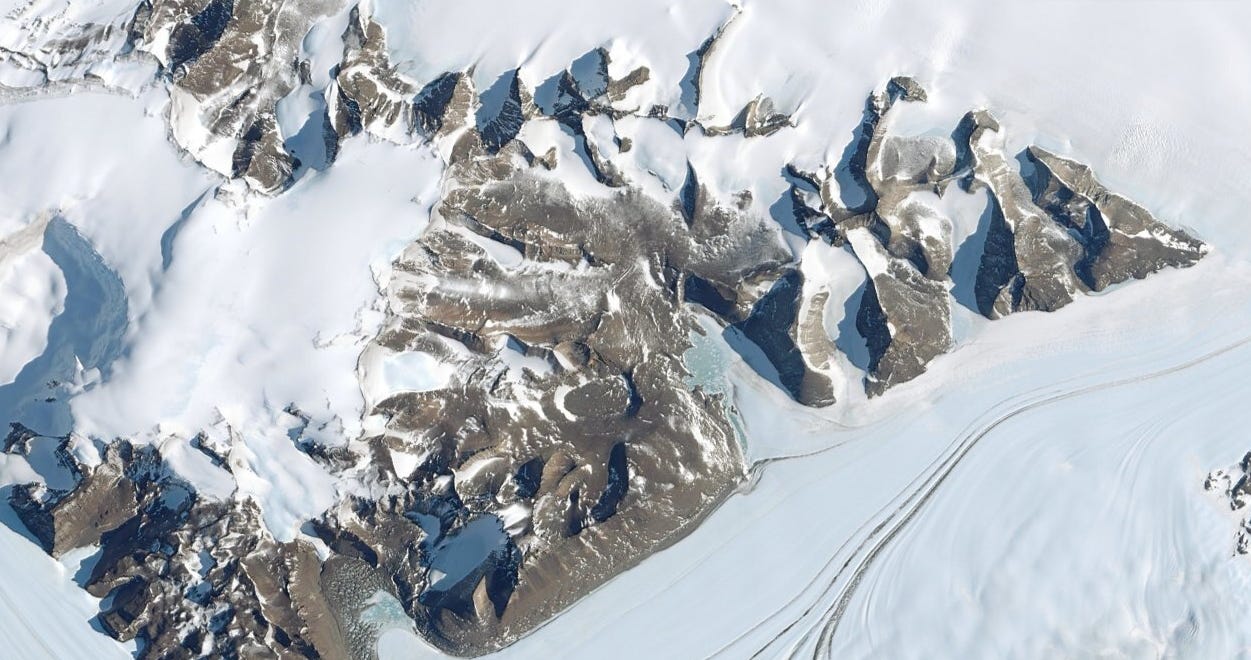
But what Roseli and Imre were really excited about was that the strength of their algae findings meant the Friedmanns could finally get funding for Antarctic expeditions of their own. Once a year, they’d head to McMurdo research station in Antarctica, then would be taken by helicopter into the icy wilderness, where they’d set up a simple campsite of tents and cooking stoves. Over several weeks, the team would make observations and set up data-recording sensors every few millimeters in a sandstone boulder. Their instruments log features like light intensity, moisture, humidity, and temperature.
It was as treacherous for instruments as it was for bodies: “In the intense cold, plastic often breaks, and metal parts freeze. If you set up an instrument to record data, come back the next year, and find that something went wrong, you’ve lost two years of research,” Imre relayed to Discover Magazine in 1997.
At first, they relied on expensive, cumbersome solar-powered instruments that transmitted data to a polar-orbiting satellite. Soon, they welcomed data loggers, shoebox-sized devices that were much cheaper, could house incredible amounts of data, and had batteries that lasted seven years. The Friedmanns’ team also set up data loggers in the Gobi, Atacama, and Negev deserts. “Thanks to these data loggers, we have continuous recordings of climates in the millimeter range,” Discover noted.
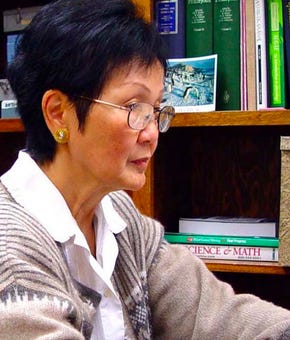
In 1981, the National Science Foundation awarded Roseli the Antarctic Service Medal. She then took a role as a professor at Florida A&M University, but still spent the summer in her husband’s lab at Florida State. She also served as a consultant for the SETI Institute, a nonprofit research center. Roseli collected over 1,000 different microorganisms from extreme environments throughout her career. The area of the Antarctic mountains where the rock they discovered algae in was found is named after them: Friedmann Peak.
“Looking for Life in All the Wrong Places” by Will Hively, Discover Magazine, May 1, 1997.
Olivia Campbell is a New York Times bestselling author interested in the intersection of women and science. Her latest book, Sisters in Science: How Four Women Physicists Escaped Nazi Germany and Made Scientific History, tells the story of four women who fought sexism to become brilliant physicists, only to be fired by the Nazis, and how they helped each other flee the country.
A seasoned science journalist and essayist, Campbell is a regular contributor at National Geographic; her work has also appeared in The Atlantic, Vanity Fair, The Guardian, Washington Post, New York Magazine, People, Smithsonian Magazine, Scientific American, Boston Globe, The Wall Street Journal, Aeon, and History.com, among others. Find out more on her website.
No posts
Comments
Nothing yet. Say the first thing.
Sign in to join the conversation.