
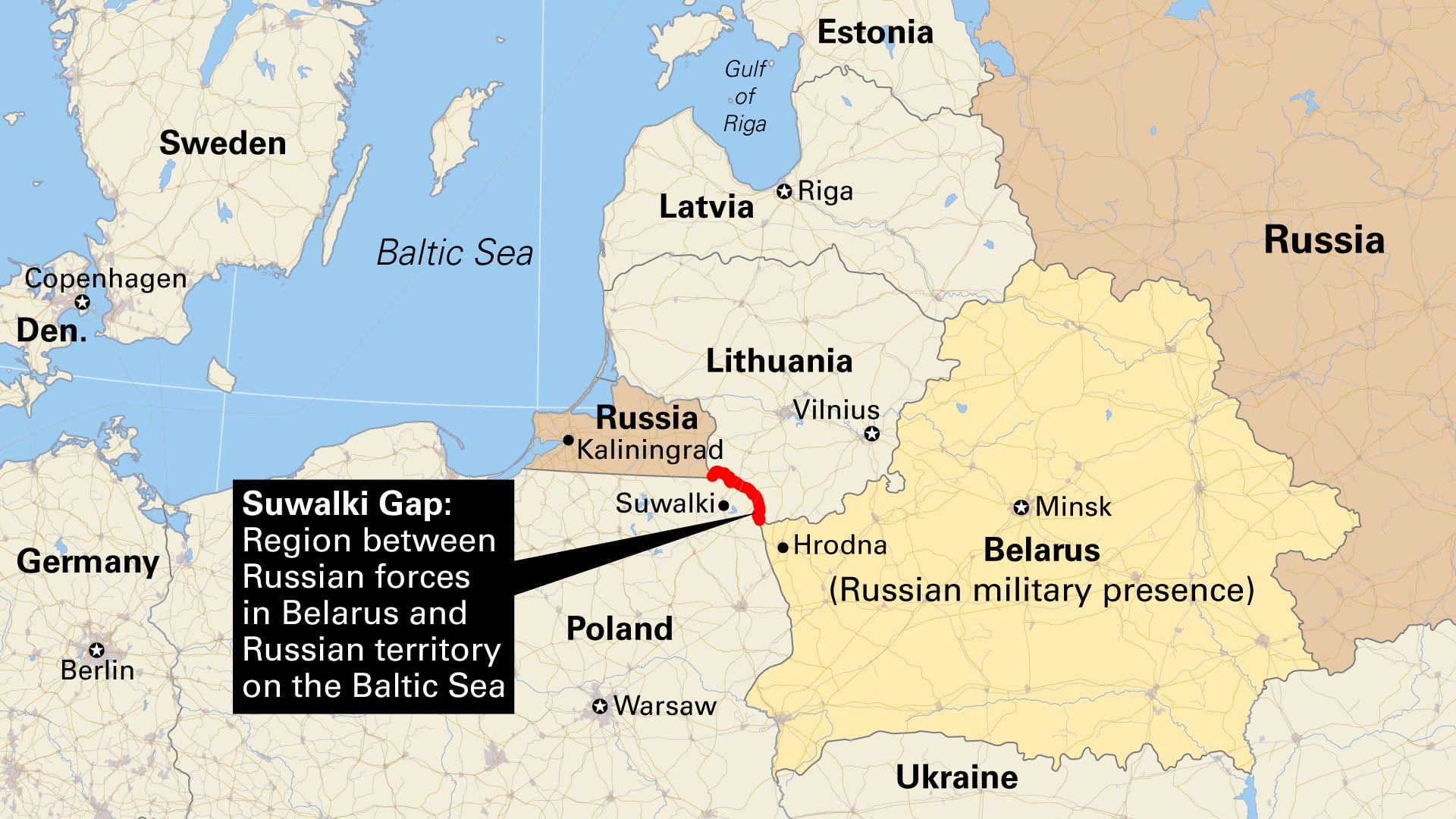
For several weeks, U.S. and European officials have been sounding the alarm over intelligence that Russia could be preparing to test Article 5 with a military attack against a NATO country, possibly even a ground incursion from Belarus or Kaliningrad. These warnings have me particularly worried about the Suwałki Corridor, which I have been warning about for years. The narrow stretch of NATO territory between Belarus and Kaliningrad connects Poland to Lithuania and the Baltic states and has long been considered one of NATO’s most vulnerable points.
Against that backdrop, today’s flurry of NATO activity was hard to miss. U.S. F-35s, surveillance aircraft, and multiple aerial refueling tankers were spotted operating across Poland and the Baltic. Among them, one aircraft that stood out was the U.S. Air Force’s EA-37B Compass Call.
The EA-37B is fairly new and designed to disrupt communications, radar, and navigation systems, capabilities that would be crucial in any confrontation with Russia. Its participation around Kaliningrad was notable, especially given the number of NATO aircraft operating across the region today. Polish defense analyst Jarosław Wolski estimated that more than 50 NATO aircraft were “simultaneously in the air,” although that figure has not been officially confirmed.
All of this comes as Russia has been making some unusual naval movements through the Baltic. On Monday, one of Russia’s most advanced warships, the Admiral Kasatonov, was spotted passing the German island of Fehmarn as it made its way out of the Baltic. The frigate is capable of carrying Zircon hypersonic missiles, which can be armed with conventional or nuclear warheads and are extremely difficult to intercept.
And Kasatonov is not the only Northern Fleet warship we have seen in the Baltic recently. At the end of July, the Admiral Levchenko was also spotted near Fehmarn after coming down from the Barents Sea, meaning two major Russian warships normally based much farther north have passed through the Baltic within a matter of weeks.
Russia’s increased naval activity is not limited to the Baltic. Russian warships and intelligence vessels have also been showing up more frequently around Britain, including in the English Channel and North Sea.
There is no evidence that today’s NATO activity was in response to Russia’s naval movements, as NATO routinely conducts surveillance and training exercises across the region. But it is worth paying attention to as warnings about Russia continue to grow louder and more frequent.
Separately, Moscow’s threats against European shipping have also become more aggressive. Last week, Putin warned that Russia could retaliate against British and European vessels if European countries continue intercepting ships belonging to Russia’s illegal shadow fleet, calling the seizures “piracy and robbery.” Former Russian president and current Security Council deputy chairman Dmitry Medvedev went even further, claiming Russia has the right to attack merchant ships belonging to countries supporting Ukraine.
None of this means Russia is preparing to attack NATO tomorrow, although some of the intelligence warnings have raised the possibility of a Russian attack as early as this fall. Moscow has spent decades probing the alliance, testing red lines, and watching carefully for weakness before escalating. And from Putin’s perspective, there may be no better time to test NATO than now. Trump has repeatedly attacked the alliance, questioned whether the U.S. would defend its allies, and shown fealty to Putin while betraying the countries America is obligated to defend.
We don’t know whether today’s NATO operation was routine or something more, what Moscow is planning, or what Western intelligence agencies are picking up. But we do see that NATO is preparing for the possibility that Russia may be willing to go further, and that its next attack will not remain in the shadows.
Comments
Nothing yet. Say the first thing.
Sign in to join the conversation.