
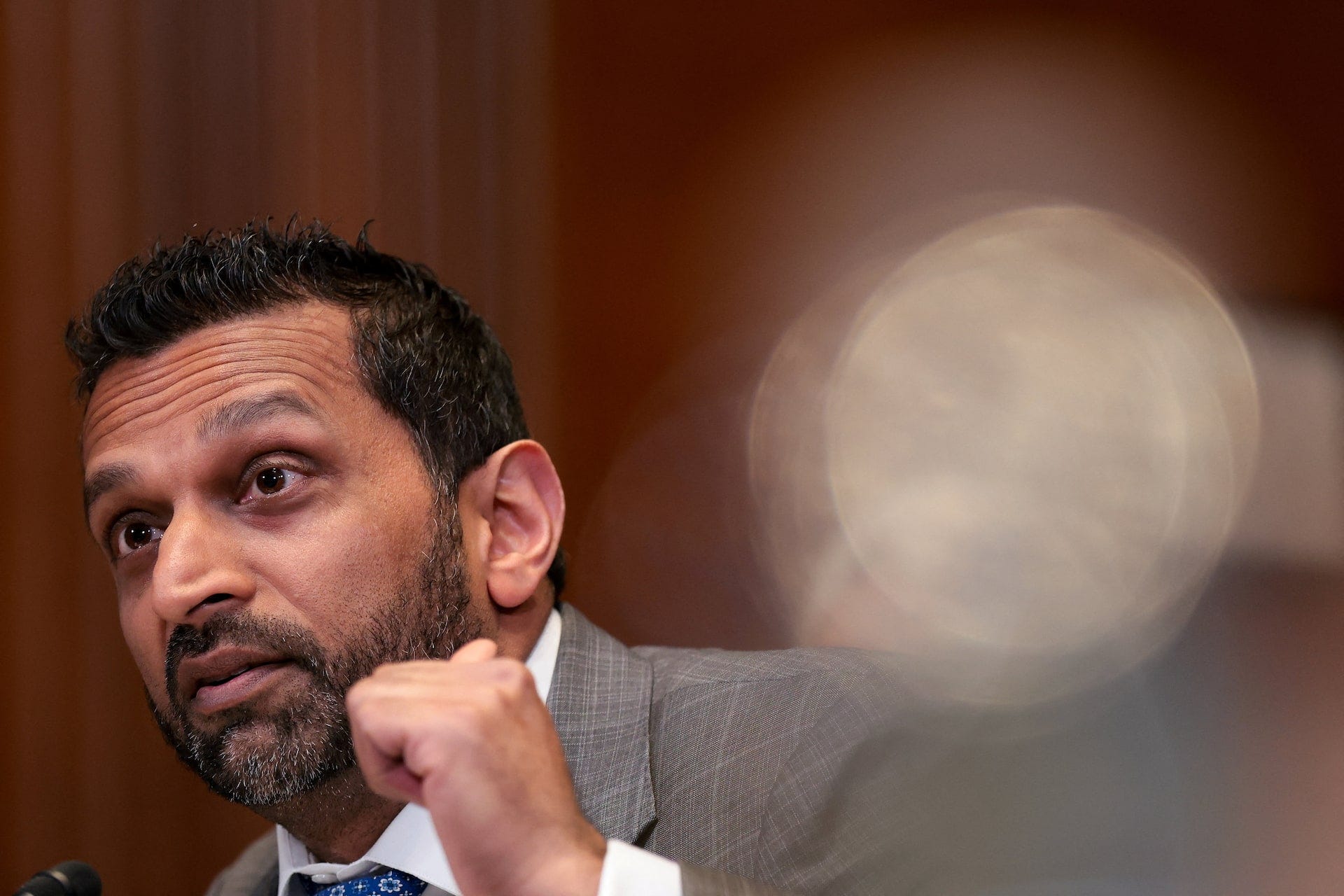
A few weeks ago, I wrote about Patel’s reported upcoming trip to Moscow and St. Petersburg on October 14–15 and the serious implications of such a trip. I asked why the FBI director needs to travel to Russia, what he planned to discuss with Russia’s security services, and why the trip was taking place just weeks before the midterms.
If the reported trip isn’t disturbing enough, yesterday Moskovsky Komsomolets, known as MK, a Russian outlet with a long history of publishing information and propaganda from the FSB, Russia’s Federal Security Service, ran an article speculating about Patel’s relationship with Russia and what could come from his upcoming visit. It discussed everything from Russia providing kompromat on Democrats and what Moscow could get in return, to Patel serving as a backchannel to Putin and secret FBI-FSB contacts that may already be taking place in third countries.
I included an English translation of the MK article at the end…
Normally, I wouldn’t amplify propaganda coming from the Kremlin or Russian security services. But given Patel’s history, his absurd upcoming trip, and what he recently revealed about the FBI’s relationship with Russia, this one unfortunately deserves attention.
Last week, Patel told Reuters that the FBI has spent the past 15 months quietly building what he described as “new and dynamic relationships” with Russian and Chinese security and law enforcement agencies, including the exchange of intelligence and investigative information. Patel insisted the cooperation is limited to specific types of transnational crime and that the risks can be managed.
It took only a few days for Moscow to respond to Patel’s Reuters interview.
MK raised the possibility that the recent reporting about Patel could be “signs and messages to someone,” then asked longtime political analyst Vladimir Vasiliev to weigh in. Vasiliev, a senior researcher at the Russian Academy of Sciences’ Institute for U.S. and Canadian Studies, suggested that the White House may want something from Moscow that would leave Democrats “in a pretty big panic.”
“It is assumed that Russia has some kind of kompromat on the Democrats, and it could be provided by us, in one form or another, to the American side,” he said, adding that Americans could share something in return because Moscow might naturally ask, “What will we get in return?”
He went even further, suggesting Patel could serve as an intermediary between the U.S. and Russia and asked, “What, then, would prevent the FBI director from acting as an intermediary or, say, a liaison officer?” He suggested that because Putin came from the KGB, the U.S. may see intelligence channels as a more effective way to deal with the Kremlin than traditional diplomacy.
The most disturbing part, and what warrants an investigation, is Vasiliev’s suggestion that contacts may already be taking place in secret. “Contacts between the FBI and FSB most likely already exist and are ongoing. They are not publicized, nobody knows about them,” he said, before suggesting that people may be meeting in Turkey, the Balkans, or Switzerland.
Now the FSB doesn’t need Moskovsky Komsomolets to communicate with Patel. He has already acknowledged that the FBI is exchanging information with its Russian counterparts. If Russia has information it wants to give Patel or the FBI, it can do so quietly.
So why put any of this out in the open? Why publicly discuss providing kompromat on Democrats and what Moscow could demand in return? Why float Patel as a “liaison officer” to Putin? And why raise the possibility of FBI-FSB meetings in Turkey, the Balkans, or Switzerland while simultaneously talking about the “secrecy and anonymity”?
Russia does not need to say any of this, which is why this is all so disturbing. Moscow could be floating an offer, preparing the information space for something that could emerge before the midterms, or sending a message with those oddly specific references to third countries.
Russia could also be trying to dirty Patel, and its longtime adversary, the FBI, although that seems less likely considering Patel has plenty of baggage and embarrassing headlines all on his own. Or maybe Russia is enjoying the spectacle of publicly discussing an FBI director as a potential channel to Putin while making clear that Russia may have something politically useful to offer. Whatever is happening, it feels a lot like 2015.
As I wrote a few weeks ago, there is also Patel’s history with Igor Lopatonok. Before becoming FBI director, Patel disclosed receiving $25,000 from Lopatonok’s company to participate in a documentary portraying Trump and his cronies as victims of a “deep state” conspiracy. Lopatonok has spent more than a decade running influence operations for the Kremlin, working closely with Putin ally Viktor Medvedchuk, whose daughter Putin is godfather to, and developing projects that reportedly reached Kremlin spokesman Dmitry Peskov’s office for approval.
There is no evidence that Patel knew he was participating in a Russian influence operation. But we are still talking about the current FBI director accepting $25,000 from someone who spent years working with the Kremlin and advancing its interests. And now, Patel is building closer relations with Russia while preparing for a reported trip to Moscow. That should raise questions about his judgment and why none of this has received more scrutiny from the media or Congress.
And some of what Russia is floating is very familiar. In 2016, Russian intelligence stole and weaponized Democratic emails while flooding the information space with disinformation and fabricated material to damage Hillary Clinton and help install Trump. A decade later, a Russian outlet with ties to the FSB is openly discussing the possibility of providing kompromat on Democrats weeks before another election.
And this time, the person at the center of the discussion runs the FBI.
Normally, this is where we would expect federal law enforcement and counterintelligence officials to investigate. Sadly, we don’t have a functioning government, and the person responsible for protecting the country from Russian intelligence operations is the person Moscow is publicly discussing as becoming a potential backchannel to Putin.
So that leaves Congress, I guess?
Congress needs to investigate why Patel believes closer relations with Russia are necessary, what information the FBI has received from Russia and provided in return, what meetings FBI officials have held with Russian security officers, including any that took place in third countries, and whether Russia has provided or offered information involving Democrats, political campaigns, journalists, or the upcoming election.
Congress also needs to establish if any FBI investigations have been opened using information supplied by Russia. Regardless of what we learn, Patel should not be traveling to Moscow weeks before an election—or, for that matter, ever.
Original publication: Moskovsky Komsomolets, August 8, 2026
Russian title: Тайный канал Кэша: директор ФБР Патель то ли пугает, то ли интригует
A note: I’m providing the English translation below because I do not want to put a link to an FSB-connected site, in case of trackers.
Kash Patel has far more connections to Russia than previously thought
In a candid interview, excerpts of which were published by Reuters, FBI Director Kash Patel spoke about fairly close cooperation between his agency and its counterparts in Russia and China, dating back almost to the first days of Donald Trump’s administration. Patel also acknowledged that specialized and even intelligence information had been exchanged with the security and law-enforcement agencies of those countries, although strictly to the extent necessary to combat specific types of cross-border crime.
Reuters also cited highly negative assessments from American specialists and experts regarding the practices described by the FBI director. Those assessments were based on the American professional community’s perception of Russia and China as countries unfriendly to the United States.
What compelled Patel to make public information that was clearly unlikely to receive a positive response in the United States? In any case, it was not a momentary impulse. And it is possible that this is part of a strategy developed in advance.
Less than a month ago, Politico published an article, framed more like a leak, containing information about the FBI director’s intention to personally visit Russia. In that publication, the only circumstance connecting Patel in any way to Russia was his role in derailing what it described as the Democratic Party’s fabricated case alleging Russian interference in the American election to secure Trump’s victory. In both cases, moreover, the publications appeared in media outlets that are clearly not American, but rather European.
Although the published materials show a trend toward providing an increasing number of details, it is very difficult, based on them, to determine the goals Kash Patel is pursuing with his project. And if these articles are indeed signs and messages intended for someone, they are certainly not meant for anything resembling a broad audience.
Given the increasingly intriguing circumstances surrounding the publication of information about the FBI director’s activities and intentions, we decided to once again discuss their contents with Vladimir Vasiliev, a political scientist and chief researcher at the Arbatov Institute for U.S. and Canadian Studies.
— It is now completely obvious that Patel is not merely failing to hide his ties to Russia, but is making them public, while understanding that not everyone in the United States or the European Union will approve. What is he trying to accomplish?
— The situation in America today is such that one has to be very careful about such contacts. In fact, as we know, they are being curtailed across the board. There is an expectation that Russia will interfere somewhere, so many believe that such a connection will be used for some kind of interference.
On the other hand, the White House would like to get something from Russia that, I think, could send the Democrats into quite a panic. It is assumed that Russia has some kind of kompromat on the Democrats, and it could be provided by us, in one form or another, to the American side for one simple reason: we have clearly fallen out with the Democrats. And today, generally speaking, there is no reason to expect any kind of reconciliation, nor to expect that some other Democrats will come along and anything will change.
At the same time, the Americans might perhaps share something as well, because the Russian side could say: “What will we get in return?” Or ask: “What do you have to say about this issue or that one?”
There is another very important point connected to the administration’s need to find a pretext to continue military action. Initial reports have already appeared claiming that Iran is preparing terrorist attacks against the United States itself. Recently, for example, information has been planted in the American press claiming that cyberattacks have been carried out against American water systems. For now, Iran is suspected.
According to this version, Iran is already effectively moving toward direct action against the United States. And this is where a second, very cunning game begins, which also has to be kept in mind. If necessary, the Americans can always say that this information was provided by Russia, thereby driving a wedge between Moscow and Tehran and creating an atmosphere of mistrust.
In addition, it seems to me that there may be something connected to Trump’s statements about the need to find certain traitors. There is widespread discussion today about fake news being thrown into circulation, about alarmists everywhere saying that America has already lost everything, and information could perhaps be obtained here as well. After all, all of the American liberal media are pro-Democratic and, as a rule, anti-Russian. Perhaps something could be obtained here too, although it would not necessarily have to be publicized.
Washington, in general, is, if you like, a marketplace of ambitions, aspirations, and so on, and that matters a great deal because there is a struggle for weight and influence. Yes, the FBI director is supposed to answer to the attorney general. But looking at the history of the FBI, and in particular remembering the infamous J. Edgar Hoover, one could say that the FBI director can effectively become the real attorney general. Those kinds of ambitions also influence a great deal.
— As we have already discussed, Democrats, and perhaps not only Democrats, have it in for Patel. From their perspective, since Pam Bondi, the former attorney general and Trump supporter, is out, perhaps now is the time to shake up the FBI as well, for many reasons. Among them is the fact that Patel is considered a major conspiracy theorist who is specifically hostile toward Democrats.
— It is important for Patel to hold on and perhaps even dramatically increase his influence over Trump. He may have his own understanding of how to accomplish this so that he can, for example, have direct access to the president or at least influence policy, as they say. And this is also a very important factor.
After this Reuters interview, people are saying that Patel is, so to speak, bragging about his ties to Russia. Fine. But who is conducting the dialogue today? We see that the Foreign Ministry and the State Department are at loggerheads, and they have been unable to establish a conversation. On the American side, we see Witkoff and Kushner.
So what, then, prevents the FBI director himself from serving as an intermediary or, say, a liaison officer?
Such an option could follow, for example, from American logic, because they believe that since the Russian president comes from the intelligence services, it would be better to negotiate with him not through the Foreign Ministry or business circles, but through the security services. Perhaps that is precisely the American logic. It should be a fairly effective channel, since the services always operate under conditions of secrecy and anonymity.
And Patel may today be trying to use precisely this issue to increase his own opportunities by strengthening his influence on the Russian-American track. This is a real possibility. Witkoff and Kushner can work there, Rubio does certain things by virtue of his position, but under certain circumstances the FBI director can also perform functions that extend beyond his narrow official responsibilities — in this case, diplomatic arrangements and other matters.
This is a very effective channel for reaching the Russian president, and not necessarily on some narrow issue connected to the work of the security services, but in the broader context of Russian-American relations. If another channel is not working for some reason, why not use this one? So perhaps another option for establishing relations between Moscow and Washington is being worked out here, albeit perhaps a rather specific one.
And if that is the case, Patel keeps his position and his place in the administration. Aside from the forces that might want to remove him, including the Democrats, one also has to take into account that Trump is, in a certain sense, very capricious. But if it turns out that Patel really does perform some important functional role, then he becomes untouchable.
But that is all that can be said at this stage. I do not know whether his visit on October 15 has been confirmed or not. And two months is a long time; a great deal can happen.
We simply have to wait and see.
But one should remember, given the secrecy and sensitivity involved, that contacts between the FBI and FSB most likely do in fact exist and are ongoing. They are not publicized; no one knows about them. But perhaps somewhere in Turkey, the Balkans, or Switzerland, certain people are meeting and studying the other side.
Kash Patel Is Reportedly Traveling to Moscow Weeks Before the Midterms.
·
Jul 22
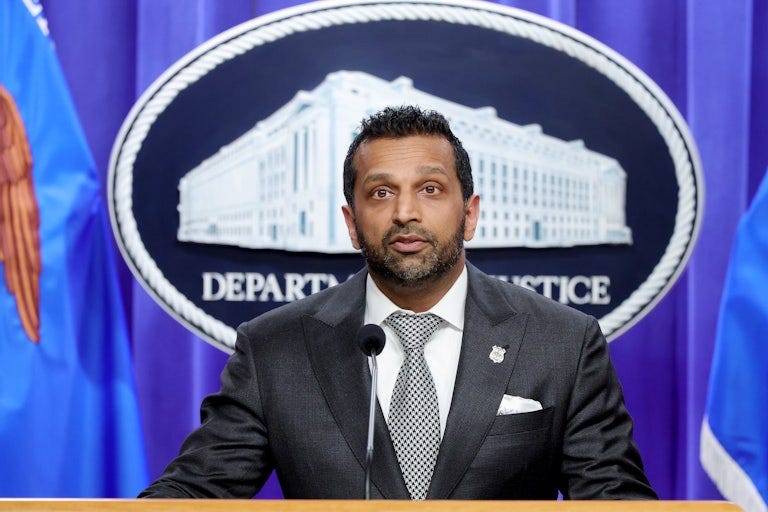
A few days ago, Politico reported that FBI Director Kash Patel is expected to travel to Moscow and St. Petersburg on October 14–15. According to a U.S. official familiar with the travel plans, Patel’s host is expected to be the FSB, the successor to the KGB. Had someone shown me that headline several years ago, I would have assumed it was a joke. But we have reached the point where even the FBI Director traveling to Russia, while it wages a genocidal war against Ukraine and remains under sweeping Western sanctions, barely qualifies as a news story. If the reporting is accurate, Patel would become the first FBI director to visit Russia since Robert Mueller traveled there in 2013, before Russia launched its war against Ukraine in 2014.
Comments
Nothing yet. Say the first thing.
Sign in to join the conversation.