
I noticed a pattern recently.
I come up with a problem. I chat with Claude for two hours trying to solve this problem — unsuccessfully. I get frustrated, shut down my laptop, switch to doing something else. And then one of the two things happens:
The solution I was looking for suddenly pops in my head — at the most random time.
I realize that I was solving the wrong problem, the real problem reveals itself, and I solve it — quickly.
Either way, I unexpectedly break through the barrier that seemed impenetrable a few hours ago.
***
This pattern shows itself in other places, too.
If you live in the United States, you’ve likely heard of — or maybe even play every day — the game called Wordle.
The rules are simple: you have six tries to guess a five-letter word. Each time you make a guess, if you found a correct letter in the correct spot, it shows as green. If you found a correct letter but it’s in a wrong spot, it shows as yellow. With every guess, you gain more information — until you correctly guess the word or run out of tries.
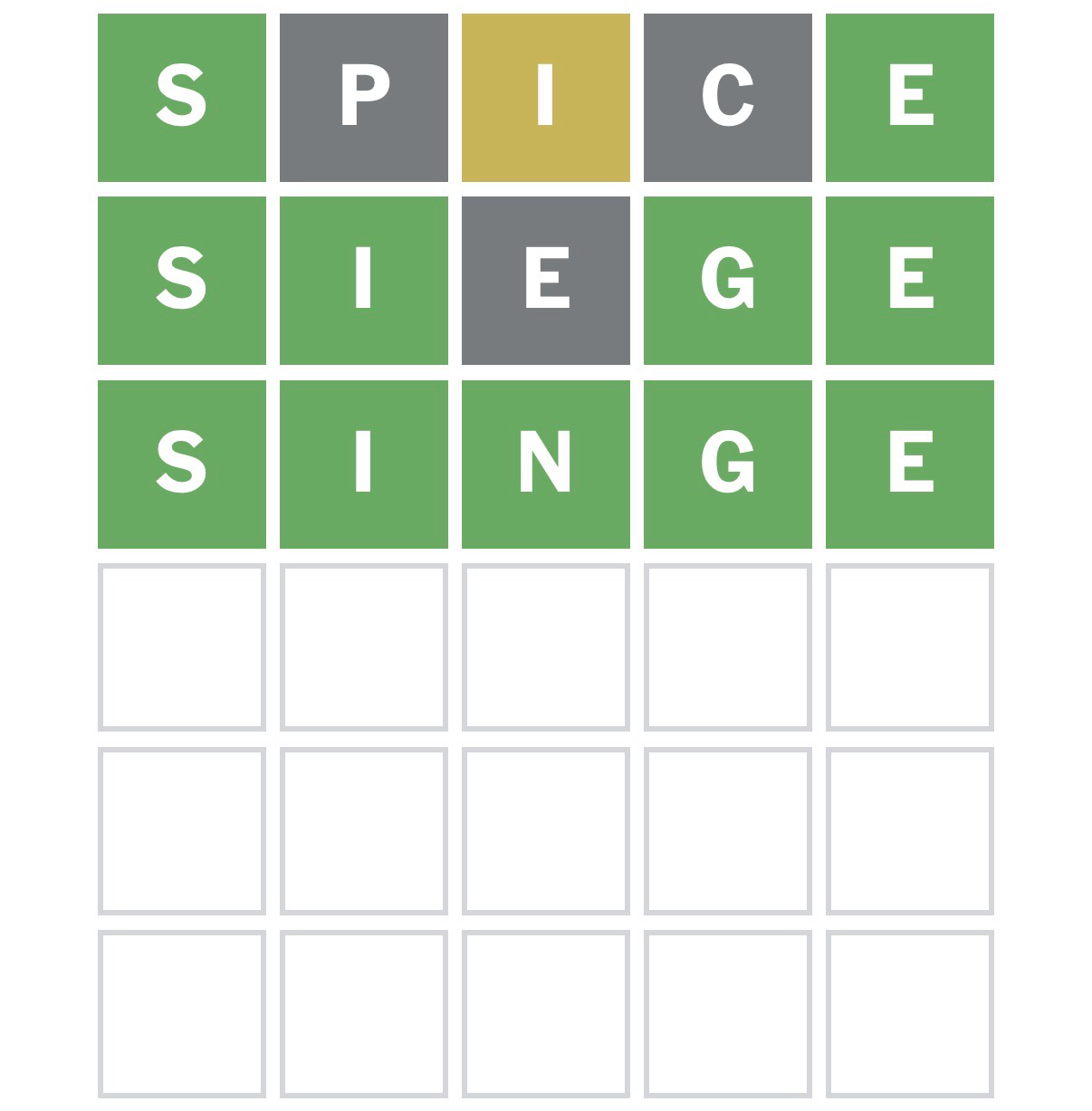
A few weeks ago, I was having a hard time with my Wordle. I had already used four guesses, not many letters were left, I was staring at my phone trying to figure out what the heck the word was — and couldn’t. Nothing was coming to mind.
It was time to get dressed and drive my daughter to school. Wordle had to wait.
Forty minutes later, I came back home and opened my Wordle — to give it another try. As soon as I did, the solution popped in my head. Instantly, it was obvious what the word was. I typed it in, and voilà — Wordle solved.
I could not believe how much I’d struggled just under an hour ago — and how effortlessly the solution surfaced when it did.
But this experience was not accidental. This is exactly how unconventional problems get solved with insight.
The story of the great Greek mathematician Archimedes running naked through the streets of Syracuse screaming “I have found it!” is undeniably the most famous example of an a-ha moment, or an insight.
The solution Archimedes had been looking for — that the volume of King Hiero II’s crown could be measured by putting it in the water and seeing how much water was displaced — didn’t come to him while he was actively trying to solve the problem. It arrived when he was about to take a bath.
This tells us several things:
Insights are sudden — they emerge out of nowhere, at an unexpected time, and come fully formed and complete.
Insights evoke a significant emotional response — with the immensely satisfying feelings of joy and surprise. (Archimedes was so excited he forgot to put his clothes on!)
Insights unlock fundamentally new understanding — and this is their most valuable quality.
Insights reveal something you didn’t know before. A problem you didn’t know how to solve. A question you didn’t know how to answer. Now you do.
Insights drive human evolution. They are the quantum leaps of knowledge. They sit at the foundation of every creative or technological breakthrough.
And AI can help you have more of them.
Let’s take a trip to Ancient Greece (you loved the Greeks so much here I had to bring them back).
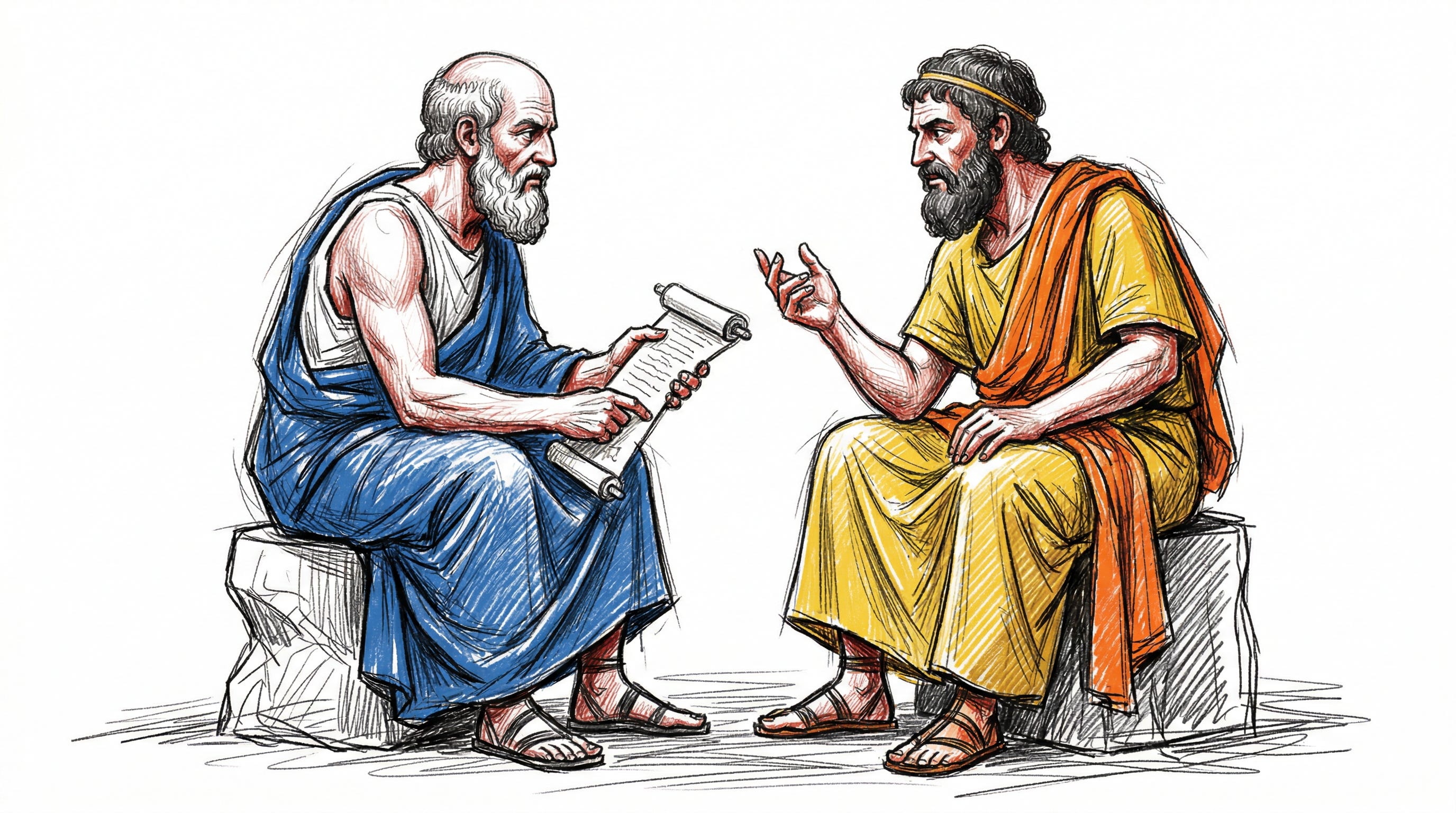
Socrates, one of the greatest Greek philosophers, was famous for his teaching method which is known today as the Socratic method.
Instead of lecturing students, the Socratic method was based on an argumentative dialogue — relentless probing questions were used to stimulate critical thinking, expose underlying assumptions, and ultimately uncover truth.
But although the goal of the Socratic method was to move people from superficial knowledge to a deeper understanding, what was particularly celebrated in Ancient Greece was not winning an argument or proving one’s point.
It was something called aporia — a state of genuine puzzlement.
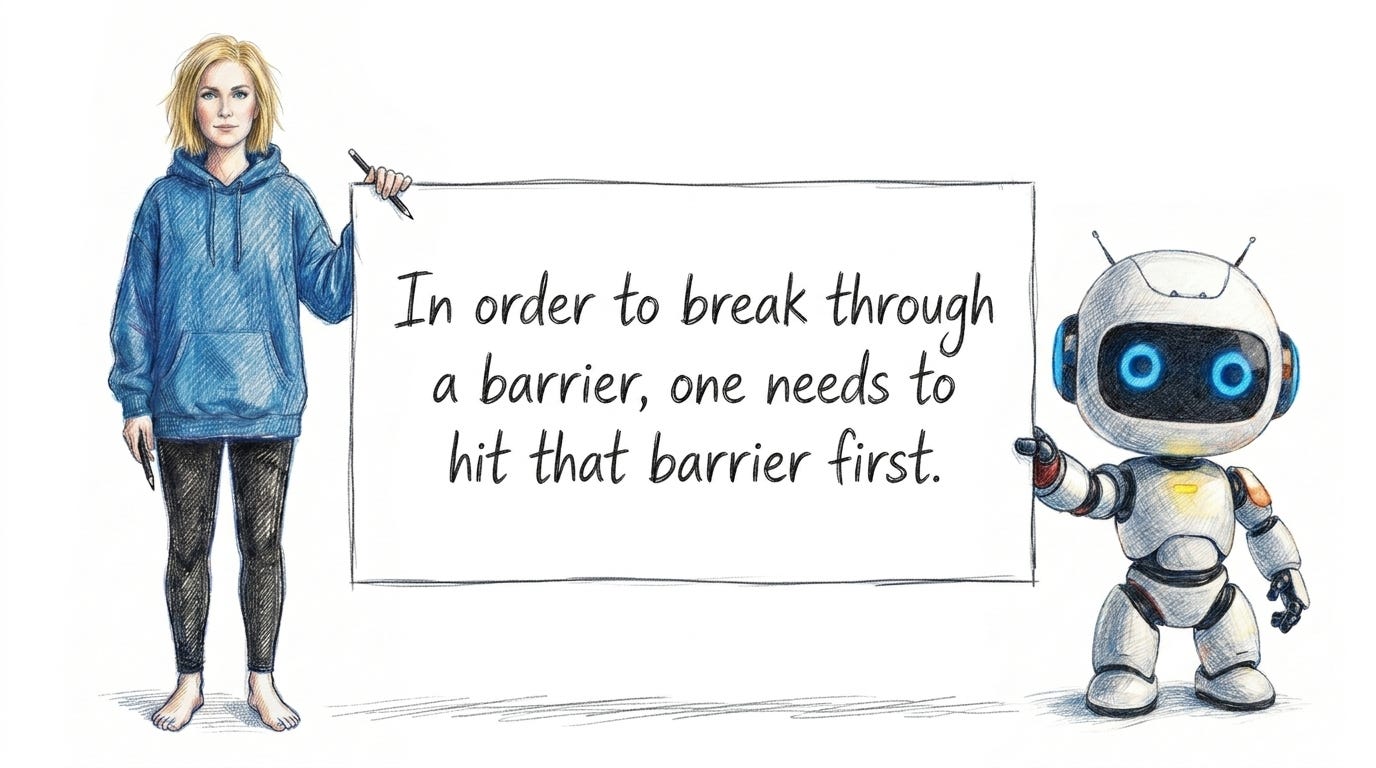
Socrates and his followers believed that in order for a person to reach a deeper understanding, they first need to get puzzled, or stuck.
In order to break through a barrier, one needs to hit that barrier first.
This remarkably resembles the state known to the researchers of insight as a state of an impasse.
How do insights occur?
You’ve likely experienced it before: you have a problem, you spend a significant amount of time trying to solve it, eventually you get stuck, give up, go for a walk, and during that walk the solution pops in your head — out of the blue.
The solution popping up — that’s the insight.
The period when you were away from your desk doing other things because you got tired of solving the problem is called an incubation period.
And the moment when you hit the roadblock and couldn’t make any more progress — the moment when you decided to step away — that’s an impasse.
***
Before we understand the value of an impasse state — as well as discover how we can leverage AI to induce this state — we first need to learn what happens during an incubation period.
Unlike what some people want to believe (and gosh would that be great if it were true), no current scientific evidence supports the claim that there is a separate “unconscious” mind that keeps chewing on the problem while your “conscious” mind is busy doing something else.
So, if taking a break from solving a problem really means taking a break, how does it help?
Reason #1:
When you are actively thinking about the problem, certain neural pathways in your brain become highly activated — they get “hot.” These “hot” pathways represent the most obvious ways to think about the problem, and obviously they don’t work — otherwise you would’ve solved your problem already.
When activated, “hot” pathways make your brain blind to “cold” pathways — looser, less activated, more remotely connected ones. All your brain can see is the “hot” pathways — you don’t see the forest for the trees.
When you step away and take your mind off the problem you are trying to solve, these “hot” pathways cool down, and the “cold” ones (aka more unexpected solutions) get a chance to be spotted by your brain.
Reason #2:
When you take a break from solving a problem, you are likely switching to another activity, or changing your environment, or both. You expose yourself to a whole lot of new stimuli.
While stimuli might seem unrelated to your problem, one of them, when processed by your brain, might give one of the “cold” pathways just enough juice for your brain to register it.
This is exactly what happened to Andrew Stanton of Pixar Animations in the early 2000s.
***
Stanton had already co-written and directed Finding Nemo, and he was now working on WALL-E — a film that would later win him the Academy Award for the Best Animated Feature.
One of the problems Stanton was struggling with was the design of WALL-E’s face. WALL-E was a robot, but in order for it to deliver the emotional message of the movie, it needed to feel human.
One day, Stanton went to a baseball game. He had a bad seat, and someone handed him a pair of binoculars. Stanton started turning the binoculars around, flipping them upside down, and making them look sad and happy. He missed the whole inning doing that but he didn’t care. He finally solved his problem: an entire character and soul was right there, in a pair of binoculars.

Now we know that an incubation period creates space for an insight to surface — but only if before stepping away you acquired enough raw material for this insight to form.
If a solution to the problem is hiding in one of the loosely coupled neural pathways, it means that these pathways — or at least the nodes that would form them — are already in your brain.
Your brain can’t magically invent new pieces of the puzzle — it can only put them together.
Which means that your chances of solving a problem with insight increase the more information you gather about the problem before taking a break.
The more raw material you give to your brain, the more diverse it is, the higher the chances are that you will encounter something during a break that will spark the insight.
How do you know when you’ve given your brain enough raw material?
By hitting a state of genuine puzzlement.
Millennia ago, Socrates gave us the recipe for how to reach the state of puzzlement — through a thought-provoking dialogue. And today, AI is offering us a way to replicate this recipe any time we want.
Last week, I analyzed the sessions I had with Claude Code in March — twenty total. I wanted to see if any particular collaboration patterns would emerge.
I wasn’t surprised that in most sessions, except for the purely operational ones, Claude did these three things:
It asked me probing questions — to challenge my thinking and uncover hidden beliefs and assumptions I was holding.
It mirrored back to me what I was saying — so I could see it more clearly and refine it.
It offered me perspectives and opinions — to give me something to react to and to test my own arguments.
If this sounds similar to what a debate in Ancient Greece could look like, it is.
And it’s intentional.
Ever since I started using AI regularly, I have been purposefully training Claude to follow the combination of the Socratic method and other coaching and communication skills I have acquired over the years.
And I’m not the only one doing that. Many people — you might well be among them — have also discovered the value of AI as a thinking partner rather than advice giver or solution provider.
And now you also know why AI as a thinking partner is valuable: it allows you to get a broader understanding of the problem which in turn increases your chances of solving this problem — deliberately or with insight.
But then a scary question arises:
If AI is so good at replicating human debate, is there value in debating with humans?
And the answer is: yes, there is great value in collaborating with other humans. Because AI cannot replicate everything.
***
You might’ve heard that words account for only 7% of all communication — with 93% of it being nonverbal.
Well, this statement is wrong. Even Professor Albert Mehrabian himself — the author of the two studies that this urban legend is based on — has complained that his work was misquoted.
But while the numbers are incorrect, the main premise stands:
Communication does have a nonverbal component — and part of the message is conveyed using this component.
How big this part is depends on the type of message. The more factual the message the less importance the nonverbal component carries. And vice versa: the more emotionally rich the message the more critical this component becomes.
***
Now let’s think about AI.
LLMs are language models, meaning they are optimized to work with and recognize patterns in text — written or spoken.
This gives LLMs an unquestionable advantage over humans.
LLMs don’t forget what you said — you can ask them three days later, “What did I tell you on Wednesday?”, and they will remember (no human has that good of a memory).
LLMs behave predictably regardless of the time of day or whether it’s sunny or raining outside — unlike humans whose mood and therefore ability to communicate is impacted by the weather, how well they slept, how crappy the political situation in their country is, and a million other things that affect each one of us daily.
LLMs are the perfect thinking partner — except they aren’t.
They can’t read your emotions (they might guess them based on the words but it’s not the same).
They can’t read your facial expressions or body language either.
They have access to words — and they are pretty damn good at processing those — but don’t have access to any nonverbal signals you are sending. And another human would instantly pick up on those signals.
This might change in the future, possibly in the very near future. But until it does, don’t give up on your book club, group brainstorming sessions at work, or loving argument with a spouse.
As long as the goal remains the same — unlocking new knowledge through reaching a state of genuine puzzlement — thinking with AI and thinking with other humans are both valuable. They each have their unique advantages. And you don’t need to choose one over the other.
You have a rare opportunity to benefit from both — use it.
Now that you have reached this point, you might be wondering,
“Okay, I understand it in theory, but how can I practically determine when I’ve hit the puzzled state when talking to my AI? Is there a clue?”
Yes, there is.
Last week, when I was chatting with Claude, I caught myself thinking,
“Ugh, this isn’t working. We are getting nowhere. I should probably start a new chat and try again.”
This is it. Frustration is the clue.
Last week, I refused the urge to start a new chat when I felt this frustration. I closed my laptop and went for a run instead. And I got an insight.
It worked. Because it always does.
So, next time you catch yourself iterating through something with AI and getting frustrated because it isn’t working, remember that it is the sign that it is working — just as designed. And then take a break.
No posts
Comments
Nothing yet. Say the first thing.
Sign in to join the conversation.