
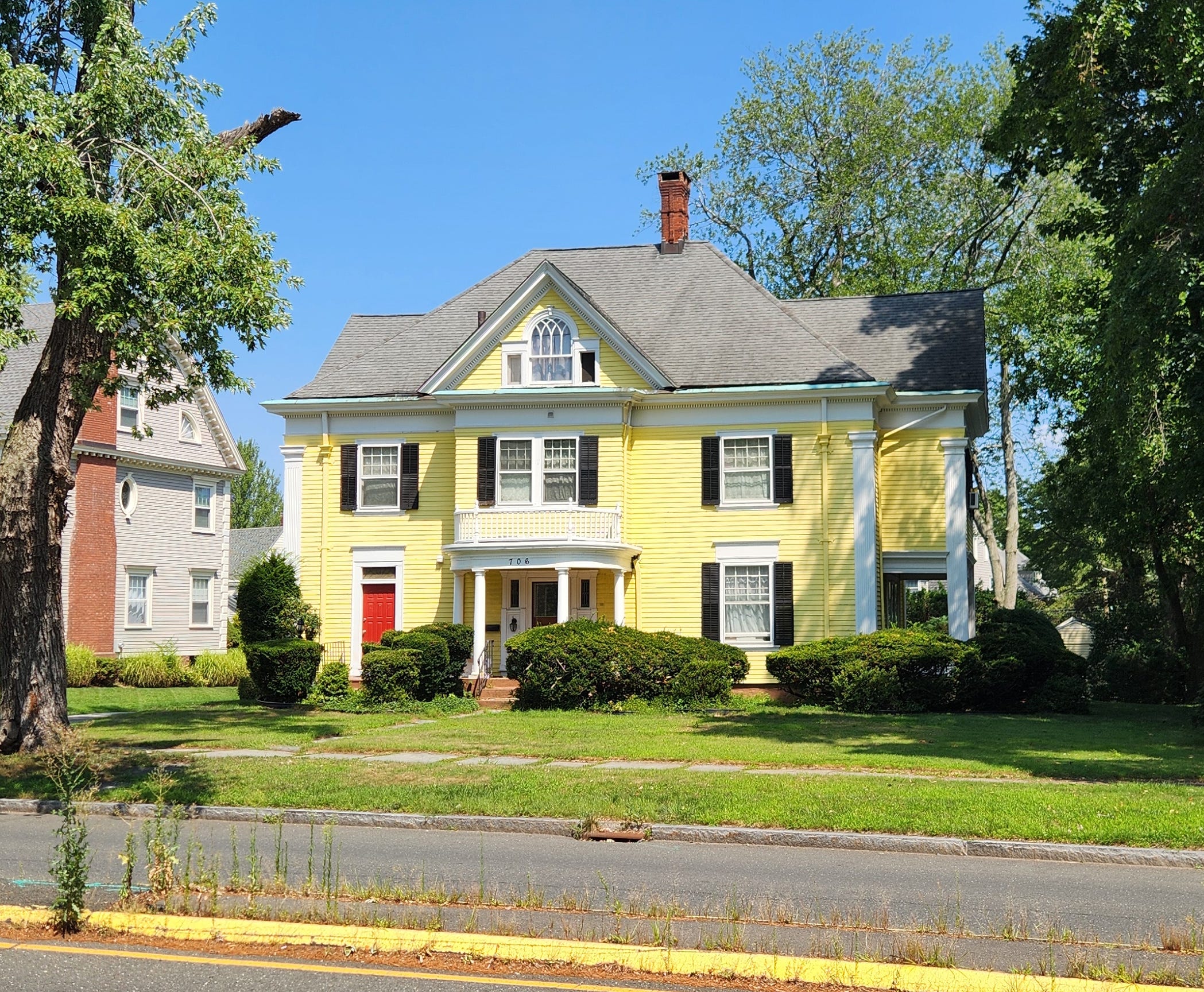
Last year, I made a video about mansions on Prospect Avenue in Hartford. Someone recently asked me if I had any information about the history of the house at 706 Prospect Avenue, which was not one of the ones that I had featured in the video. There’s not a lot of information about the house available online or in published sources, but after digging through the digital archives of the Hartford Courant I was able to find the names of the house’s architects and builders and its original residents. I also came across the story of a dramatic event which destroyed the home’s kitchen in 1919!
On July 24, 1895, the Hartford Courant reported (in a story entitled “Mr. Chapman’s Cottage”) that “Thomas B. Chapman of Marshall street has just had completed a new house on the east side of Prospect avenue which he has rented to William H. Post. Mr. Post will take possession about August 1.” This is almost certainly the house at 709 Prospect Avenue. The article further relates that, “The house was built from plans prepared by W. F. Becker, Edward O'Neil was the contractor, Olds & Whipple did the plumbing and Walter F. Blake did the decorating. The house cost about $9,000.”1 What the article doesn’t reveal is that Chapman was Post’s son-in-law. Thomas Brownell Chapman (1859-1904) was the son of former Hartford mayor Charles R. Chapman (in office 1866-1872). His mother was Harriet Putnam Brownell Chapman, a daughter of the Episcopal Bishop Thomas Church Brownell (hence her son’s given name and the fact that Thomas B. Chapman was educated at Trinity College, which his grandfather had founded). As his obituary in the Courant (March 10, 1904) noted, Chapman “had been in a number of enterprises, being last New England agent for Holmes, Booth & Haydens of Waterbury,” manufacturers of brass and copper goods, as well as photographic plates.
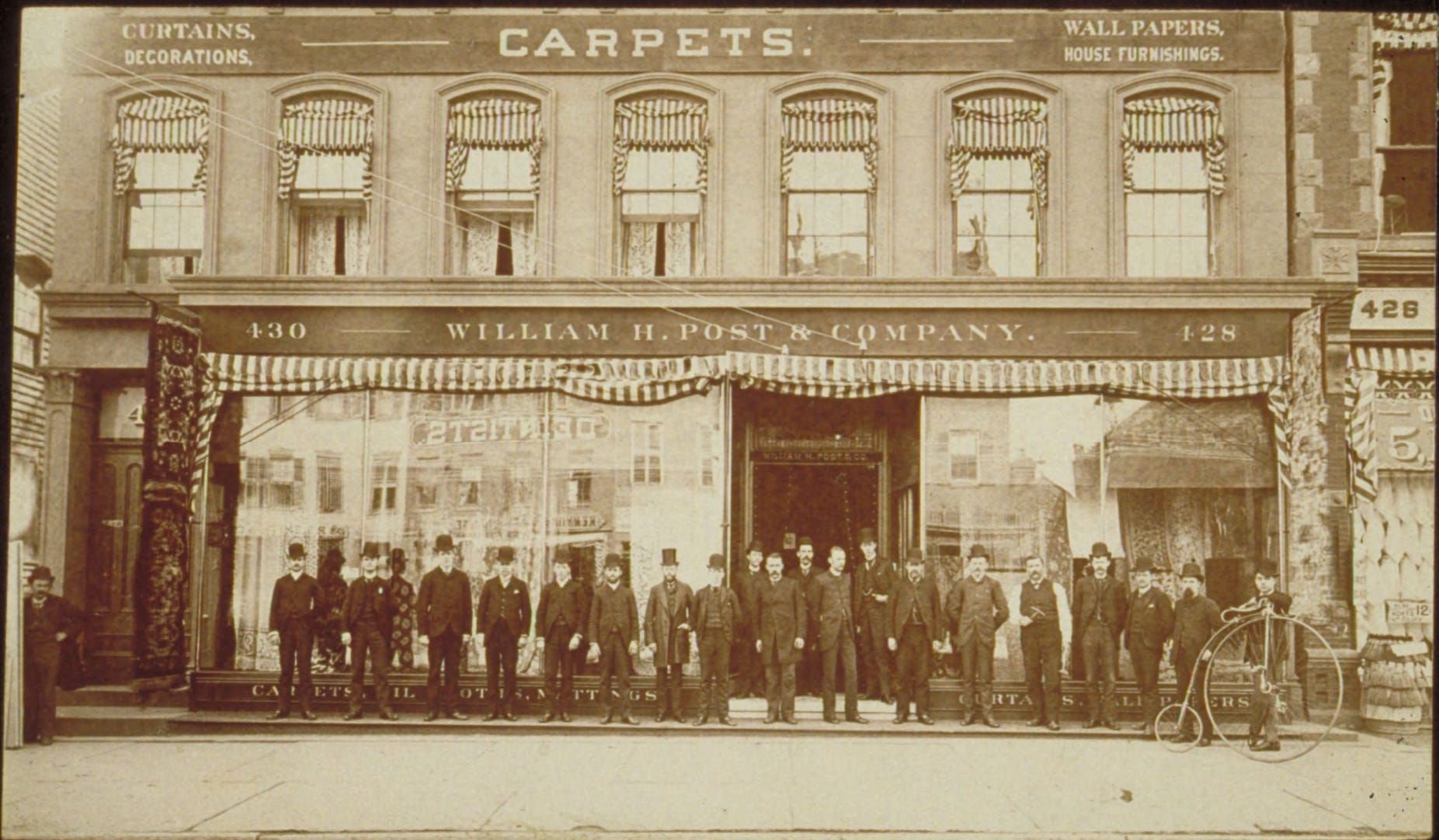
Chapman’s father-in-law, William Henry Post (1833-1899), was one of Hartford’s most notable merchants. From the mid-1850s until 1881, Post and his partner Caleb L. Talcott, operated one of the city’s most prominent dry goods and carpet stores, Talcott & Post, which was located at the corner of Main and Pratt Streets. In 1881, the partnership was dissolved and Post moved further up Main Street to start a new business, William H. Post & Co., which sold carpets, drapes, and wallpaper. The business operated in a building that was located where the former G. Fox & Company Building stands today. Unfortunately, Post’s business went bankrupt in 1892. Undeterred by this setback, he started a new carpet store, located at the corner of Asylum and Haynes Streets, in 1894, the year before he moved into his son-in-law’s house. Post passed away in 1899 and his daughter and son-in-law were soon residing in the house (or they may have already been living there before his death). Sadly, Thomas B. Chapman died in 1904, but his widow, Helen Louise Post Chapman (1860-1941) continued to occupy the home into the 1920s. During those years, she was quite active in supporting social and political causes, opening her house for such occasions as a 1908 sale of towels made by “needy women, who are assisted through the Union for Home Work,” a 1913 lecture on Women’s suffrage by the wife of Yale professor Arnold Gesell, a 1916 “illustrated lecture” by Loyal Sewell, who described first hand his seven months’ work on the front lines in Europe with the American Red Cross, and a 1917 meeting of “28 prominent society women” who organized a Hartford branch of the National Child Labor Committee and started planning a child labor exhibit to be held in the Old State House.2
While Mrs. Chapman’s house was the scene of a number of active gatherings, perhaps the most dramatic incident to ever take place there was described by the Courant on April 28, 1919:
A terrific explosion last night in the kitchen range at the home of Mrs. Thomas B. Chapman at No. 706 Prospect avenue shattered the range to atoms, as Mrs. Chapman expressed it to a reporter for “The Courant,” the force of the explosion being such that the lids of the range were embedded in the ceiling of the kitchen. There was nobody in the room at the time. Investigation by members of the police and fire departments late last night did not disclose the exact nature of the cause of the explosion, but it is believed to have resulted from some dynamite that was in the coal when it came here from the mines.
The first intimation of the occurrence came when Mrs. Chapman telephoned to police headquarters, gave the details of the explosion and asked that a policeman be sent to the house to make an investigation. Policeman W. J. Fitzgerald was reached, by means of the signal system and he hastened to the house. Before he reached the house, however, Third Deputy Fire Chief R. H. Ramsden, who jumped out of bed as a result of Mrs. Chapman's appeal when she telephoned to Engine Company No. 5's house on Sigourney street, where the chief's quarters are, hurried to the Chapman home and had made an inspection of the wrecked kitchen.
The theory of the Chapman household was that an accumulation of coal gas in the fire place of the range had caused the explosion, but this the two departments discount as it was pointed out there was not sufficient coal in the range to allow for such an accumulation of gas. It was said that in all probability a portion of a stick of dynamite which had managed to get in with a shipment of coal from the mines was in the hod of coal which was placed in the range.
It was learned that a servant in the house had filled the range with a hod of coal, opened the damper and had retired to her room before [banking ?] the kitchen range for the night. In less than ten minutes after this operation, it was said, there was a terrific explosion. The range was shattered, pots and pans which were on the range were hurled in all directions, but none of the live coals started a fire. The walls of the kitchen were dented and furniture in the kitchen was wrecked. Mrs. Chapman immediately notified police headquarters and Deputy Chief Ramsden. No still alarm was sent to the East Side fire company in West Hartford, a short distance away.
She seems to have left the house in the 1920s. She went on to write an account of her memories of Hartford in her youth entitled My Hartford in the Nineteenth Century, published in 1928.
The article goes on to describe the house in detail:
The house is of colonial design, 48x30 feet, with an ell on the northwest corner, 18x20 feet. The house is two stories high and leading from the front entrance is a large hallway running through the center of the house. On the right and south sides of the hall is a library, 18x20 feet, with a piazza on the south side of the house, 20 feet long. At the left of the hall is a reception room, 16x18 feet, and back of this the dining room, 16x20 feet. Each room opens into the hallway. In the hallway, dining room and library are large fire places.
A staircase at the rear of the hall leads to the second story. There are five chambers on the second floor with large closets, dressing rooms and a bath room. The staircase has an old-fashioned mahogany rail with polished balusters. The kitchen, pantry and refrigerator rooms are located in the ell on the first floor and the servants’ rooms are on the second floor. The circular porch at the front entrance of the house has a brick floor with stone steps. The house is painted a deep shade of yellow, with white trimmings. The interior of the main building is painted white and the ell is finished in natural pine. The floors are hard pine. The house will be lighted by gas and heated by steam. The plumbing is all open.
“Mrs. Sluyter’s Towel Sale,” Hartford Courant, May 25, 1908, “Woman and her Peculiar Needs,” Ibid., February 13, 1913; “Child Labor Campaign Planned,” Ibid., January 16, 1917; “To Tell of Red Cross Work on Battle Front,” Ibid., December 12, 1916.
No posts
Comments
Nothing yet. Say the first thing.
Sign in to join the conversation.