
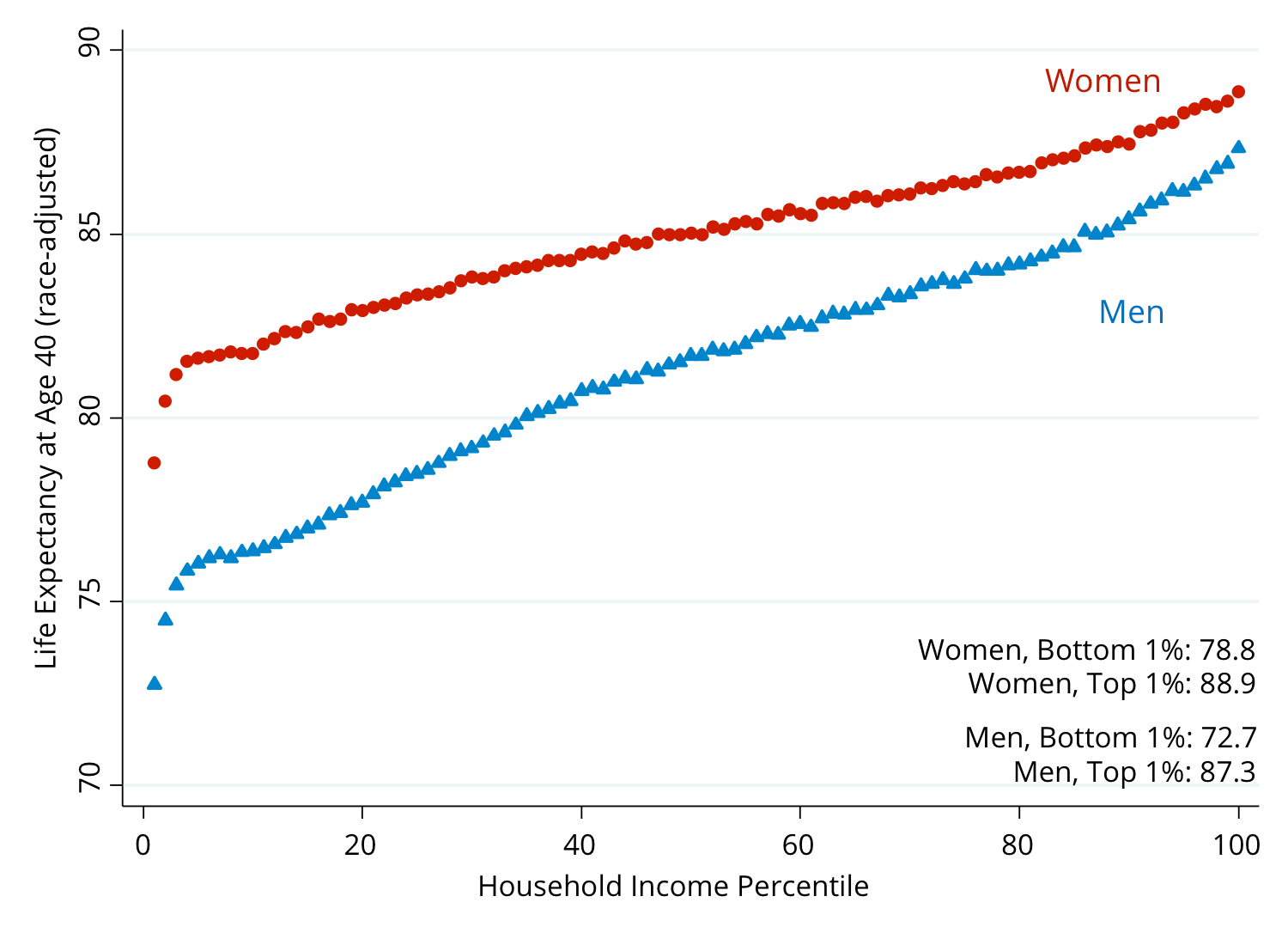
Recent studies have revealed the growing gap in life expectancy between lower-income and higher-income Americans and between Black Americans and those of other races.
In Boston, a report released by its Public Health Commission found a 23-year difference in life expectancy between census tracts in the Back Bay (91.6 years), an affluent neighborhood, and in Roxbury (68.8 years) which is predominantly African-American. Looking at all of the Back Bay, its average life expectancy of 83 years was 15 years longer than the average of 77 years, another largely African-American part of town.
In Chicago, average life expectancy can vary as much as 13 years from 84.5 in largely white neighborhoods on the North Side to as low as 71.5 years in largely African-American neighborhoods in the city’s South Side.
Princeton economists Anne Case and Angus Deaton’s well-known 2020 book, Deaths of Despair and the Future of Capitalism, describes how the economic hollowing out of formerly manufacturing towns in the midwest and other parts of the United States has affected the health and life expectancy of their mostly white residents.
This pattern is borne out in a study conducted by LeadingAge LTSS Center at UMass Boston and the National Council on Aging that found that on average older Americans in the lowest 20% of wealth die nine years earlier than those in the highest quintile.
Discrepancies in health between the rich and the poor have always been with us. In his seminal book, The Other America: Poverty in the United States, Michael Harrington wrote in 1962: “The lowest-income group among the aged (and it should be kept in mind that this comprises around half of their number, that is, some millions of people) had four times the number of serious limitations of activity that the highest-income group of the same age had. When it becomes a question of ‘chronic limitations of mobility,’ the really serious cases, the same pattern reasserts itself: 26 per cent of the top-income group have no chronic conditions; but only 17 per cent of the bottom group are in the same position.”
Not only is there a great difference in life expectancy and longevity between rich and poor Americans, but it has been growing over time. According to Dutch social scientist Jan Baars, writing in his book Long Lives Are for the Rich: Aging, the Life Course, and Social Justice while “the difference between the life expectancies of those with the lowest and highest socioeconomic status in 1982 was 3.7 years, this had almost doubled to 7.2 years in 2019.”
He adds that “the most disadvantaged have a much shorter healthy life expectancy: the number of years they can be expected to live without a burdening disease or disability.”
Both Baars and Boston University sociologist Deborah Carr attribute the discrepancy in life and health span to the effects of poverty over the life course. Writing in her book, Golden Years? Social Inequality in Later Life, Carr cites the work of “the sociologist John Robert Warren [who] revisited the [Wisconsin Longitudinal Study] data to explore how these early experiences mattered for the later-life health of of the study participants, now in their seventies. He found strong and consistent patterns: the now-retirement-age adults from less-advantaged backgrounds had poorer mental health, poorer self-rated health, and worse musculoskeletal health than their more-pivileged classmates, and these patterns were largely explained by the study participants’ own socioeconomic resources.”
She succinctly describes the life-course analysis as follows: “The main arguments is that advantage begets further advantage, and disadvantage begets further disadvantage, such that relatively modest inequities in early life amplify over time.”
This explains why lower-income seniors fare worse than more affluent older folk even though they all receive health care coverage through Medicare, which did not exist when Harrington was writing. Medicare’s universal health coverage beginning at age 65 can do little to even the playing field when poorer health care, increased stress, poorer diets, and less exercise have already left their marks on the human body over a lifetime.
As Baars explains, “for most of the disadvantaged, the middle years will already be hard as chronic disease and material problems begin to accumulate. Age-related arrangements for those who make it into ‘old age,’ such as Social Security and Medicare will give them much needed support but are simply too late to prevent the accumulation of bodily and mental insults that lead many of them into early chronic disease and early death. In contrast, age based entitlements, pensions and (healthy) life expectancies tend to be more favorable for those who enjoyed advantaged positions all along.”
Baars attributes this growing inequality in longevity and healthspan in the United States to the neoliberal policies adopted by the Reagan administration and perpetuated ever since. These policies have also caused the United States fallen behind other developed nations in terms of longevity due to how poorly non-wealthy Americans do.
Life expectancy in the United States was 74 years in 1980, 77 years in 2000 and 79 years in 2020, as compared to 74, 79 and 83 years, for the same years in France, by way of example. In other words, while the typical American and French person had the same life expectancy in 1980, Americans today can expect to live four fewer years than their French counterparts.
Going back to Baars, to “avoid the impression that the US is framed negatively by comparing it only with the best performing country [Japan in his example], it should be noted that the US has been the only OECD country that has experienced a decrease in healthy life expectancy over the decade since 2010: from 66.7 to 66.1 years. Only two undeveloped countries demonstrated such a decrease: Yemen and Venezuela.”
Why is this? Baars argues that it’s due to the increasing inequality and lack of social supports in the United States: “These developments are neither inevitable nor do they happen accidentally: as can be plausibly demonstrated health inequalities are mainly caused by social inequalities that are reproduced over the life course. In spite of the enormous wealth that has been piled up in the US for a tiny percentage of the population, there has been growing public indifference about the needs of those in jobs with low pay and high stress, who live in ill maintained houses and neighborhoods, unable to afford marketed services in early childcare, education or health care.”
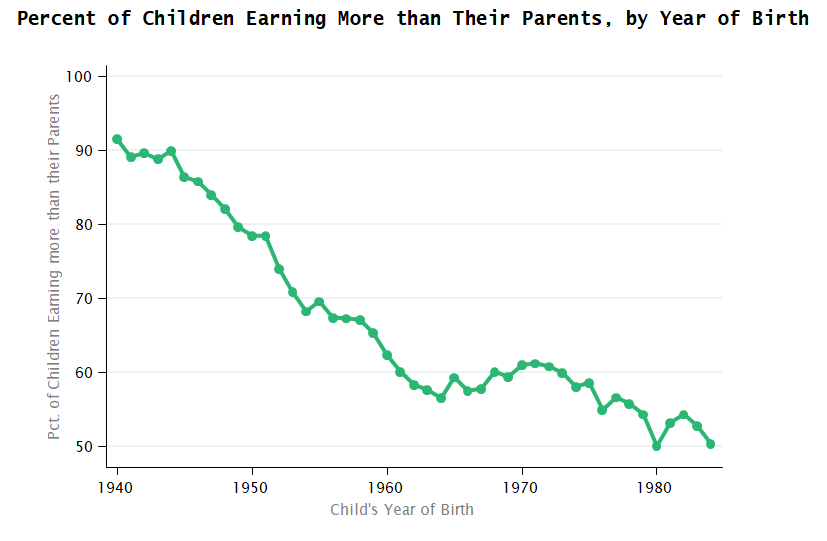
At the same time, it has become much more difficult for those with fewer socioeconomic resources to change their social class. Research led by Harvard economist Raj Chetty has found that while 90% of American children born in the 1940s grew up to earn more than their parents (in constant dollars), this was only true for half of those born in 1980.
At the same time, that more income and wealth has been flowing to richest Americans, and they have increasingly locked in their financial status, according to Baars like other Americans they’re living shorter lives than their counterparts in Europe and many countries in Asia. This is ironic given the investments many of the richest Americans are making in the longevity industry — trying to live forever.
I’m not sure why the wealthy in the United States do not live as long as the rich in comparable countries but perhaps because life in this country is so much more stressful. Perhaps if the rich helped improve the lives of their fellow citizens, they might live longer as well.
No posts
Comments
Nothing yet. Say the first thing.
Sign in to join the conversation.