
In this update:
The risk of a prolonged war and energy crisis remains high
Oil shortages kicking in around the world, prices could go far higher
Latin American oil producers are far from the Middle East, and thus are beneficiaries of the disruption
Two stock summaries: one high-growth, one high-income (for paid subscribers)
A market anomaly offers a discounted share in one company
It’s been quite a few weeks of developments regarding the war between the US/Israel and Iran. It began on 28 February, or a month and a half ago, with joint US-Israeli missile strikes on Iran. It seems that the ferocity of Iran’s response caught many by surprise.
The official US policy focus now appears to have shifted to preventing Iran from ever having nuclear weapons. This is a laudable aim. The only question is how that is achieved. Or even whether it can be achieved.
Originally there was talk of the need for regime change in Iran. To an extent, that has been achieved, as previous leaders have been bumped off. Unfortunately, many regional experts have concluded that the new leaders are even more radical than the old ones, with more power handed to the IRGC (Islamic Revolutionary Guard Corps).
This does not bode well for a quick peace.
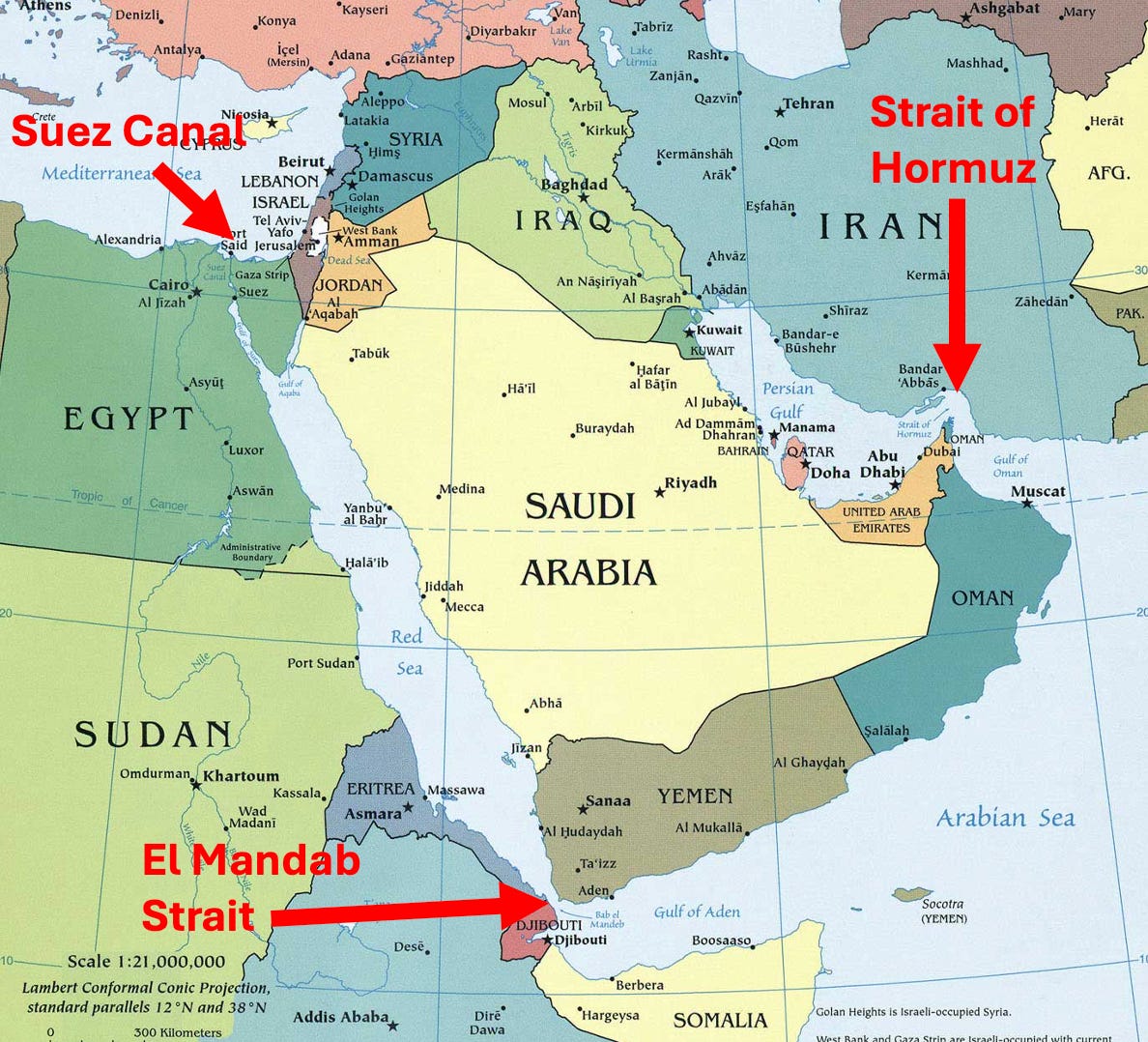
There were the initial strikes. Then the Iranian counter-strikes. Then a pause. Then threats of escalation. Then another pause, and brief peace negotiations. After those quickly ended over the weekend, now the US has started a blockade of the Strait of Hormuz, which appears to be aimed at preventing all Iranian ship traffic from transiting.
It’s very difficult to guess which way this goes. Will Iran capitulate? Or will the war escalate further?
This is one of those times when it pays to gather news from wider sources than normal, in order to gain a better understanding of what’s going on. For example, I’ve been keeping an eye on the live news feeds from Al Jazeera, a news organisation based in Qatar. (And partly funded by the Qatari government, which is worth bearing in mind.)
It’s not about whether the content is more or less biased or truthful than Western media outlets. It about getting different perspectives, with the aim of building a fuller picture overall. It’s at times like these - especially as investors - that it’s more important than ever to avoid confirmation bias.
(For more information about the investor biases that we need to contain see Chapter 6 of my book: The inner monkey: our dangerous, in-built psychological biases. It focuses on the five main biases that can be detrimental to investors, as well as some practical steps to tame them.)
The potential outcomes in Iran seem fairly binary. Sudden peace or major escalation. (The Israel / Lebanon conflict is a separate issue, but with far less impact on the world as a whole.)
It’s a hard call, but I’m still leaning towards further escalation as my base case. I’ll give a quick resolution (say, within a month) a 30% chance and major escalation a 70% chance. And maybe even that’s being optimistic.
For example, what happens if Iran manages to strike, or even sink, a US Navy ship that’s patrolling the Strait of Hormuz or surrounding waters? Potentially, this could be achieved with a missile, a swarm of drones, or a mini-attack submarine.
Of course, US Navy fleets are extremely well protected. But no defensive systems are perfect.
In such a scenario, it seems unlikely that the US fleet would just sail away to a safe distance and call it a day. More likely would be new waves of heavy bombing of Iran, and perhaps a US land invasion to secure the Iranian side of the strait.
There are many moving parts, and we can only speculate. But it’s hard to see how this just fizzles out quickly. Both sides have their pride at stake, and irreconcilable demands, for now at least.
Here’s a recent map that shows when the bulk of the pre-war oil shipments from the Persian Gulf were or are due to arrive at their destinations, from investment bank J.P. Morgan. This is when the last pre-war tankers arrive, after which almost all new deliveries stop.
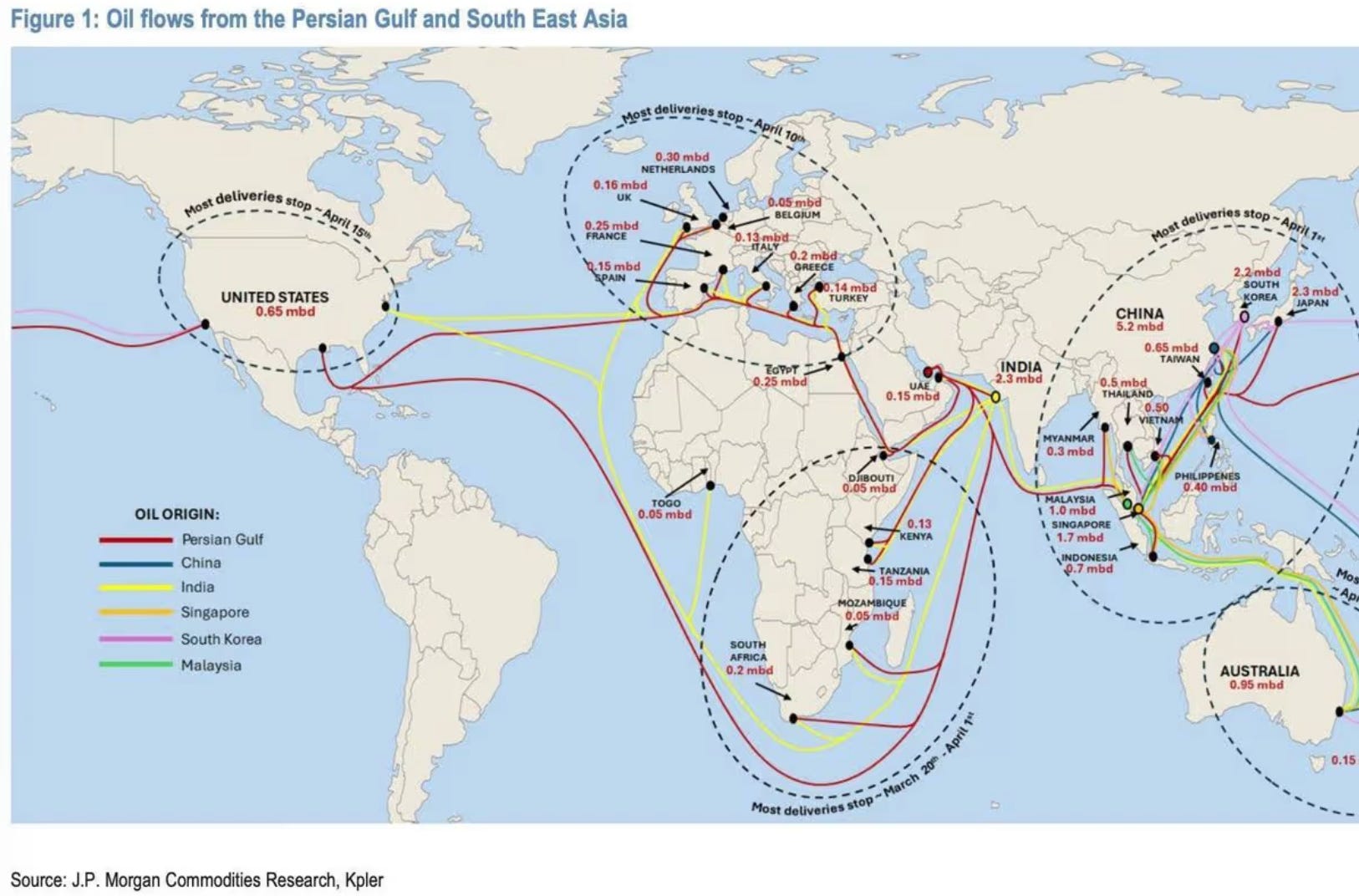
Eastern & Southern Africa: March 20th to April 1st
Asia: April 1st
Europe: April 10th
United States: April 15th
Australia & New Zealand: April 20th
Clearly, most of those dates have already passed, or are about to pass. Even if mass new shipments started TODAY - which is, of course, not going to happen - there would still be a gap of a month or two before the new ship cargoes reached their destinations.
The implication is that we’re already on the cusp of widespread shortages in many places around the world. There are still stocks of oil, refined fuel, natural gas and fertilisers in most places that need them. But, at this rate, they will be drained and run out in most places pretty soon.
Governments may take steps to suppress prices, such as those of petrol / gasoline and diesel. Achieved by one or more of the following: cutting tax levies on fuel, capping prices combined with subsidies for fuel retailers, or even imposing hard price caps with no subsidies.
But none of that will resolve supply issues. Meanwhile, lower prices prop up demand artificially. Thus, outright shortages are a distinct possibility in many countries.
In fact, they are already happening in parts of Africa and Asia Pacific. If I lived in an affected country - such as the United Kingdom - then I’d want to keep my tank pretty full at all times. It’s not a question of “hoarding” or “panic buying”. It’s a question of being prepared.
The world has many oil price benchmarks (e.g. see here for a list of live quotes). The most important and commonly quoted international price benchmark is Brent Crude, which is priced at $100.00 per barrel at the time of writing. That’s up from a low of $58.67 in mid-December (+70%) and $72.87 on 27 February (+37%), just before the war started.
But the Brent benchmark is based on cash-settled futures prices. This means that it represents prices for notional future deliveries of crude oil, a month or two ahead, but that actual physical delivery rarely takes place. Instead, the contracts are settled for cash.
This is different to the “spot” price for immediate purchase of physical oil for delivery. Reports suggest (e.g. see here) that North Sea Forties crude oil for prompt physical delivery is now trading around $150 per barrel, or 50% above the Brent futures benchmark. That’s what buyers are actually paying in the market today for immediate delivery.
Is this a sign of things to come across the wider oil supply chain? We’ll find out soon enough.
Put another way, the building energy crisis could be short or prolonged. And there’s no way of knowing which is on the cards. But it makes sense to be prepared.
For investors, that means being cautious as things play out. In my book, that indicates holding higher cash allocations than usual (or near cash, such as treasury bills), a slug of gold, oil & gas stocks, and diversified general stocks with an emphasis on quality, value, and healthy dividend yields.
Also with one eye on moving away from energy-intensive industries, especially those that are mostly based in geographies that rely heavily on oil and gas imports (which in practice means much of Europe and Asia). But not totally out of stocks, as that would mean missing any sharp rally if things calm down. Whilst owning stocks of oil & gas producers provides a hedge in case things get a lot worse.
But it’s no good if those producers have a lot of their operations stranded within the Persian Gulf. They can’t get the product out, and their infrastructure assets are sitting ducks for further Iranian missile or drone strikes (or have already been damaged).
Also, high gasoline prices are a political hot potato in the US, especially with mid-term elections coming up later in the year. So it’s not beyond the realm of possibility that the Trump administration takes steps to suppress fuel prices. This could take the form of fuel price caps or even export restrictions, with the aim of flooding the domestic market and lowering prices.
It may sound outlandish. But it fits the “America First” agenda. So I wouldn’t rule it out.
Given all this, one part of the world stands out. And that’s Latin America. It’s a long way from the Strait of Hormuz. For that matter, it’s a long way from all of the world’s current or potential geopolitical hotspots (Ukraine, Iran / Middle East, Taiwan, etc.).
Okay, not Venezuela obviously. The socialist dictatorship remains firmly in place, just under new leadership. But there are other options in a vast continent.
I’ll give a brief outline of two very different Latin American oil companies.
In one case there’s a special class of share which can be bought at a discount, due to an anomaly in the markets.
The following is for educational and informational purposes only, and is not a recommendation to buy or sell shares. When buying or selling shares, investors should do their own research and seek independent financial advice if necessary.
Both stocks that I’ll look at trade as ADRs in the US (NYSE).
The two companies in question are:
Comments
Nothing yet. Say the first thing.
Sign in to join the conversation.