

The following is for educational and informational purposes only, and is not a recommendation to buy or sell shares. When buying or selling shares, investors should do their own research and seek independent financial advice if necessary.
Clearly there are ongoing reasons to worry about the potential impact of the closure of the Strait of Hormuz, especially if it stays closed for a prolonged period. Global supplies of oil, natural gas, petrochemicals, fertiliser, helium and more have been severely impacted, or are about to be.
Although oil prices aren’t particularly high in historical terms, especially once adjusted for inflation (i.e. currency debasement), the speed of the price increase has potential to cause a jump in consumer price inflation rates. It could also tip already weak economies into recession, not least by hitting discretionary consumer spending.
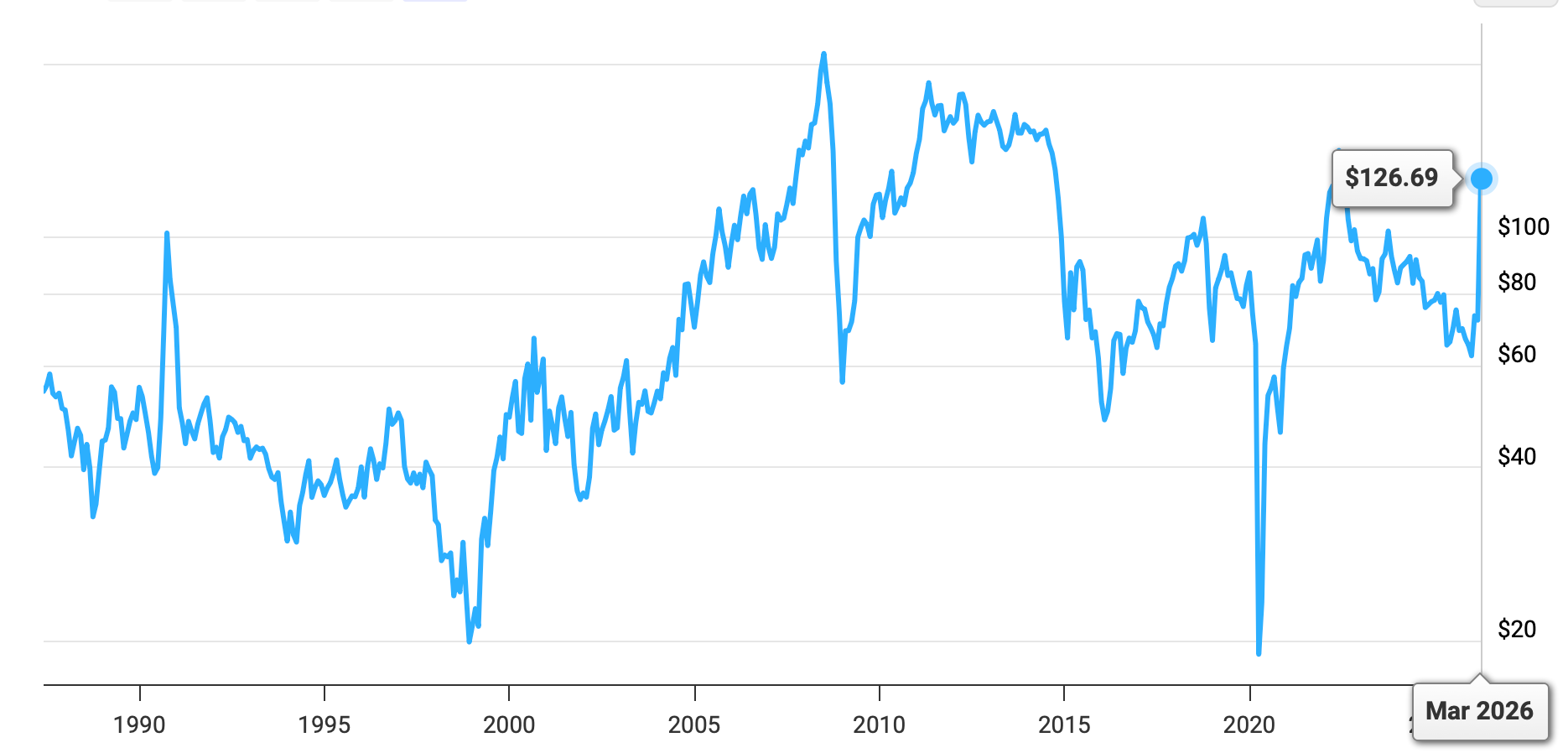
You can see in the chart below that Brent crude’s real price is up sharply, but lower than the 2010 to mid-2014 period (typically in the $150-185 per barrel range, inflation-adjusted). It’s also well below the record inflation-adjusted monthly price of $209 per barrel reached in June 2008.
Inflation-adjusted Brent crude oil price (May 1987 to March 2026, log scale)
Source: Macrotrends
What’s more, the hit to different countries will vary widely. For example, here’s a table showing the twenty countries with the largest percentage increases in petrol / gasoline prices between 23 February (just before the Iran war started) and 13 April.
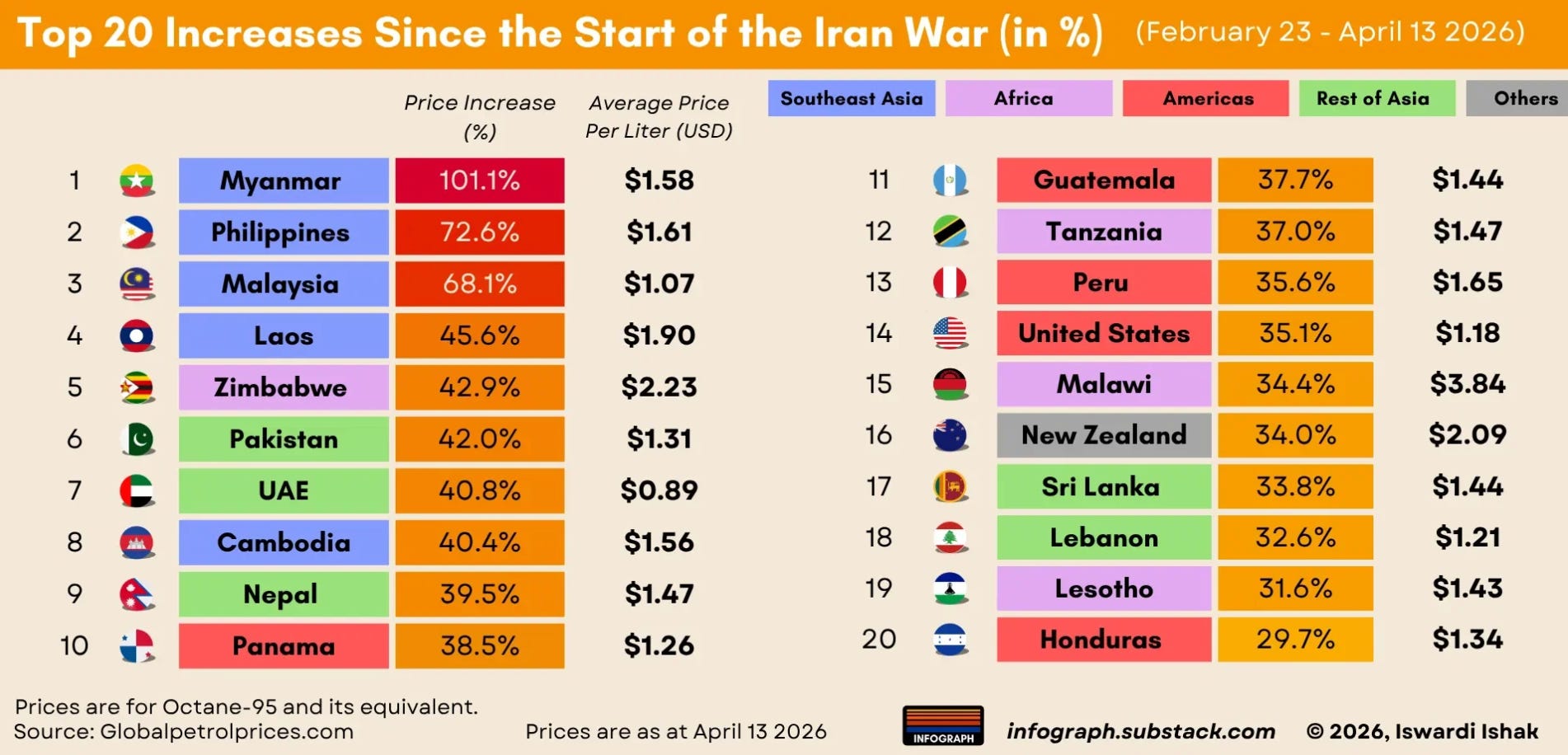
Eighteen of those are low income countries in Asia, Africa and Latin America. This kind of change is particularly painful in such places. Only two on the list are high-income countries: being the USA and New Zealand. (Although US fuel prices remain third lowest of the twenty shown.)
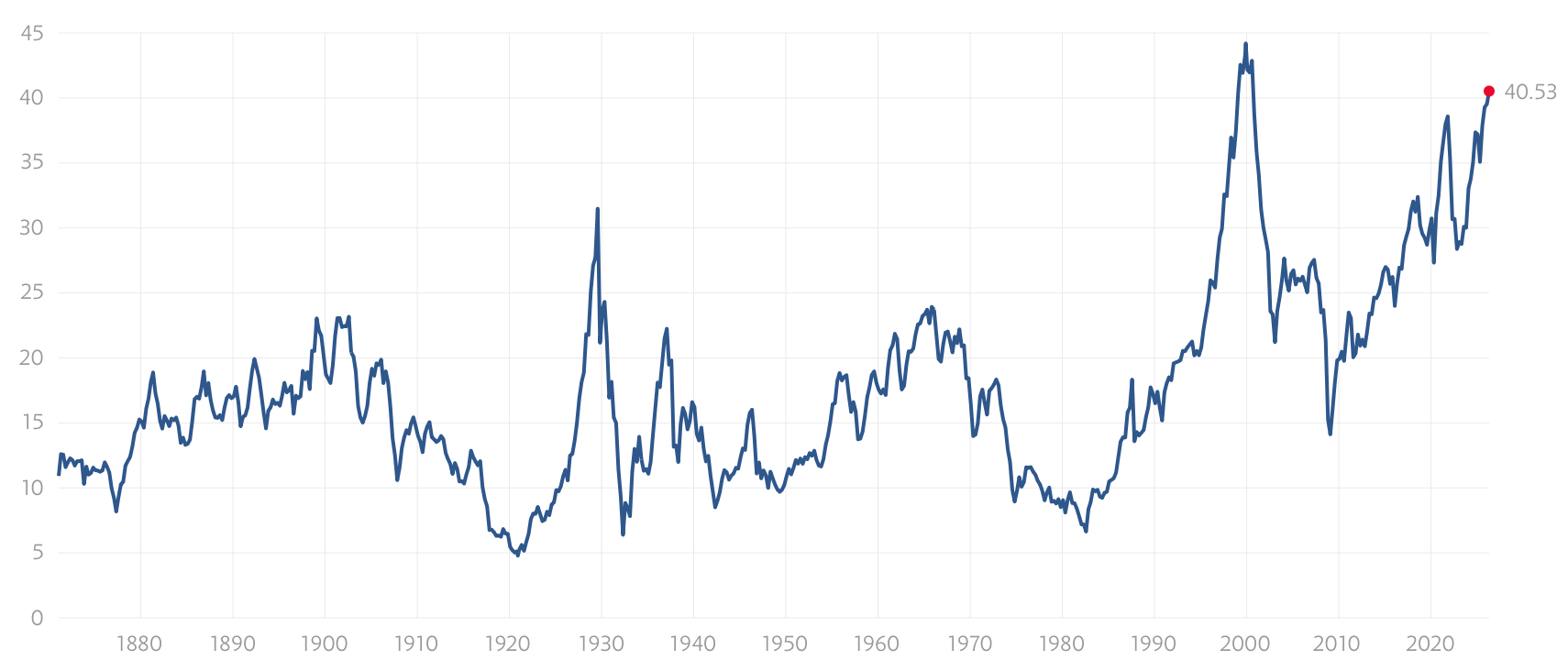
Meanwhile, the US stock market has shrugged off the economic risks, and continues to rise. It’s now trading at the second highest valuation in its history. At least, as measured by the Cyclically-Adjusted Price-to-Earnings ratio (CAPE), also known as the Shiller P/E. The CAPE is one of my favourite measures for gauging whether a market is relatively cheap or expensive.
(Incidentally, other valuation measures such as the trailing price-to-earnings ratio, price-to-sales, and price-to-book value are also all at very high levels.)
US stock market CAPE ratio since 1871 (S&P 500 index or predecessors)
Source: multpl
This points to a very high level of investor optimism. History suggests that such optimism is unlikely to be rewarded: see the Great Crash of 1929-1932, or the post-tech bubble crash of 2000-2002.
Opinions vary. But I believe that the US stock market is in bubble territory once again.
For that reason, personally I have only modest exposure to a handful of US stocks. Even then, that’s only when I believe that the specific stocks are downright cheap, taking account of individual company fundamentals (such as growth rates, where in the world they actually generate sales and profits, and so forth). I certainly wouldn’t want to own the US index at this level.
Meanwhile, the stocks that I’ve analysed on these pages in the past have performed pretty well so far, with an average profit of 57%. The top performer is up 249%, including 24% from dividend income, over about two and a half years. If only they could all work out like that...
But there’s one company that’s in a turnaround situation where the stock has performed poorly so far. It looks like it will take a year or two more than initially expected to get fully back on track.
Meanwhile there are two high-growth companies where the stock prices have been surprisingly weak: one in moderate profit, and one in moderate loss. I give my thoughts on the potential reasons below. But if the companies continue to grow their underlying businesses at anything like recent rates then both stocks look very cheap to me.
I haven’t done a new stock analysis for a little while (since July), but I have a shortlist of potential candidates. I set a high bar for stocks, but it’s likely that some new analyses will come out fairly soon. Although I want to get a new chapter or two of my book out first.
Other than that, it’s my birthday this Friday, 1st May. That brings me up to 54 years of survival.
It also means that it’s been nearly 33 years since I first set foot in the offices of a leading investment bank in the City of London, as a fresh-faced young graduate trainee. Little did I know, at the time, how interesting the investment world can be, and how there’s never a lack of something new going on.
Anyway, below are the stock updates for seven companies. Please send me your comments or questions to the usual email address (shown at the end). I will reply!
Comments
Nothing yet. Say the first thing.
Sign in to join the conversation.