
In case it has somehow escaped your notice, Christopher Nolan's star-studded film version of The Odyssey will be released next month. There has been much heated discussion of its choices re: casting, costume, and diction.
I won't add to that discord. I'll just use it as an excuse to share two of my Odyssey-influenced poems—one silly, one somber.
• • •
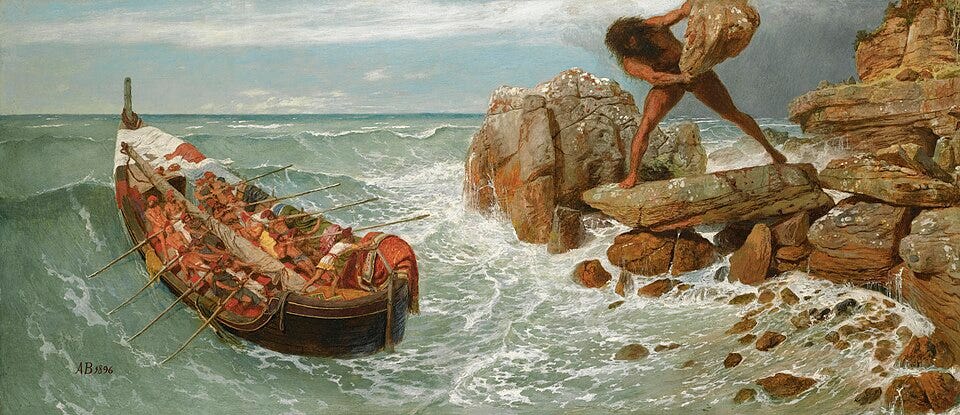
“Moon landing goes sideways: Odysseus mission will be cut short after craft tipped over” —USA Today, February 2024
“Active recalls affecting the Honda Odyssey: 67” —Cars.com, March 2024
“Cruise passengers who spent up to £680,000 on three-year trip stranded in Belfast for three months: The ship, ‘Odyssey’, had planned to depart for the three-year voyage on 30 May” —The Independent, August 2024
Text within this block will maintain its original spacing when published
Will treks you bless
be hiccup-free,
or choke? I’d guess,
from past debris,
their destiny.
(Asphyxia’s.)
But don’t mind me,
Odysseus.
You traveled, yes,
from A to B,
but hurry-less
and haltingly.
I’m Odyssey-
susp-yssey-ous.
But few agree,
Odysseus.
It’s S.O.S.,
not V.I.P.,
that should impress
in your C.V.
Yet your I.D.
can tizzy us
with travel glee,
Odysseus:
“What shipwreck spree?
Awe-dizzy us,
Ship Rex (i.e.,
Odysseus)!”
September 2024, Light (“Poems of the Week”)
NOTES
• • •
• • •
Text within this block will maintain its original spacing when published
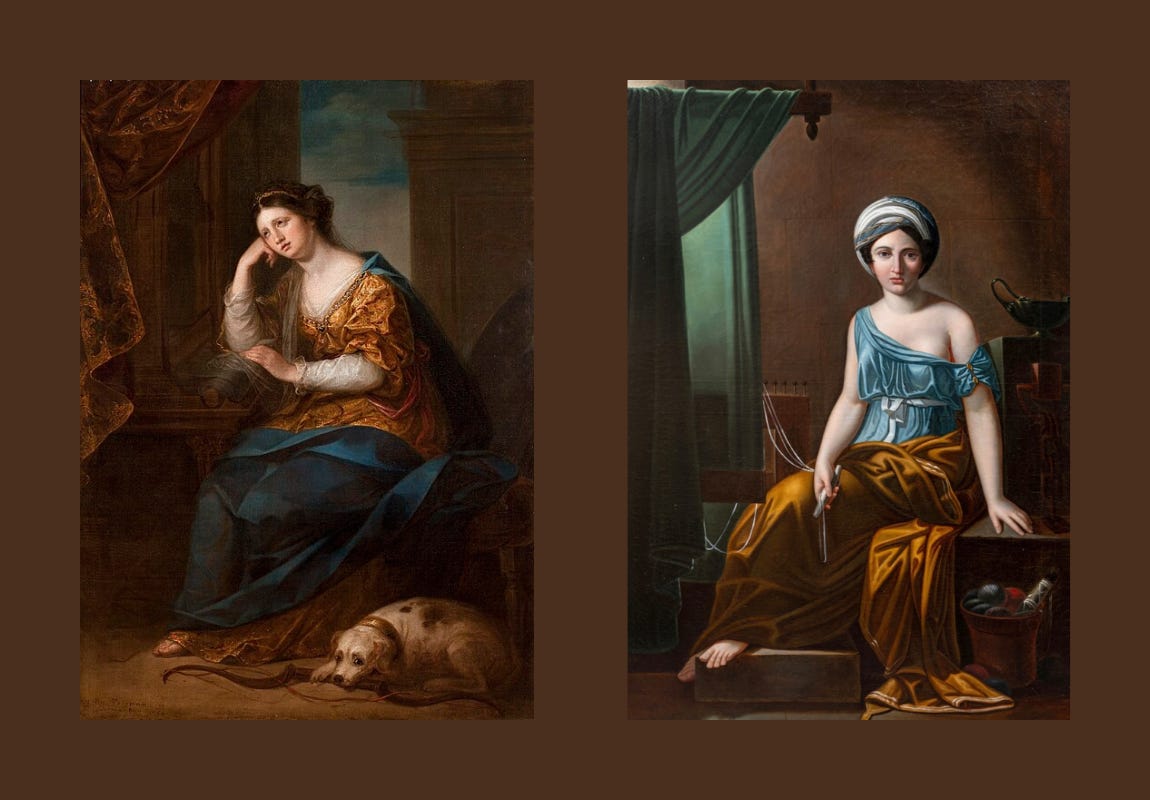
Pity poor Penelope
          husband      facing     hostile     sea
Pity Helen even more
          facing     hostile     husband     shore
Pity poor Penelope
          weaving     4     unweaving     3
Pity Helen even more
          looming     husband     keeping     score
Pity poor Penelope
         given     grief     by     revelry
Pity Helen even more
         guests     aggrieved     nepenthe     pour
Pity poor Penelope
          testing     husband     bedroom     tree
Pity Helen even more
          husband     testing     bedroom     door
Pity poor Penelope
          metaphor     fidelity
Pity Helen even more
          trophy     object     metaphor
September 2011, Tipping the Sacred Cow:
Overturning Myths, Fairytales, and Legends: A Fortunate Childe Anthology
NOTES
• • •
"Women in The Odyssey” was an essay topic option in three different classes in my first year at the University of California at Berkeley (1986–1987). I always chose a different topic, but I did ponder the private implications of Menelaus's public putdown of Helen in Odyssey Book IV, as evidenced by this doodle of a poem.
After two years as a comparative literature major, I noticed that the graduate students teaching my prerequisite classes were miserable—except for the instructors on loan from the Classics department, who always loved what they were doing and couldn't wait to get into it with us during class time. I decided to go where the happy people were. I changed my major to classical languages and added a double major in independent studies. This would allow me to keep studying Spanish and French literature without being forced to regard it primarily as a dismal social document (as required at that time by the comp lit department).
My favorite class of all my undergraduate years (five of them, plus two summers) was studying The Odyssey with only seven other students, under the gentle, joyful guidance of Professor Donald Mastronarde. His specialty was Greek drama, so he emphasized the entertainment aspect of Homer’s epic. Before we translated any assigned passage in class, we had to participate in a dramatic reading of it in Greek, with various students assigned to the narrator and character roles.
The goal of dazzling Professor Mastronarde and our fellow students with our nuanced performances became our primary motivation for poring over the Greek vocabulary and grammar between classes. Since good grades were simply a byproduct of that meticulous prep work, everyone earned an A or A+. And I do mean earned.
I'm looking forward to seeing Christopher Nolan's take on the story. Whether I like or dislike particular choices he's made, I'll enjoy seeing this rich work of literature from a different angle.
One of my recently published poems below (“Homeric,” in Snakeskin Issue 339) is also Odyssey-influenced, although I'm not yet ready to discuss that one. The context of the other short repeating forms with which it's published there is helpful for making sense of its modern scenario.
Julie
My publications since May 1:
“In Short”(a biolet), “Homeric” (a tritina), and “Being the Bad Guy” (a triolet) appeared May 4, 2026, in Snakeskin 339 (Short Forms Special Issue).
“Bouguereau’s Les Oréades (1902)” (a brief monorhymed nonce form) appeared May 14, 2026, in The Asses of Parnassus. (Here’s a link to the painting, too.)
“Two Weeks in Review” (a terzanelle) appeared May 18, 2026, in Light’s “Poems of the Week” feature.
“On Her Portrait (Sonnet 145)” (a sonnet translated from the Spanish of Sor Juana de la Cruz) appeared May 30, 2026, in The Ekphrastic Review.
“Curryelle” (a kyrielle) appeared June 1, 2026, in Lighten Up Online.
“Rondelet-ed Reaction” (a rondelet, of course) and “Cassandra at the Open Mic” appeared June 15, 2026, in Light.
Forthcoming:
Two epigrams on Michelangelo's sculpture Night (translated from the Italian of Strozzi and Michelangelo, respectively, and answered with an epigram of my own) will appear in The Ekphrastic Review on June 30.
I've reviewed galley proofs for my translation of the alexandrine sonnet “The Death of the Cicada” (from the French of Maurice-Louis Faure) for Issue 25 of Stanford University's Mantis: A Journal of Poetry, Criticism, and Translation, but it's not yet available.
Elsewhere: A Journal of Place has accepted two of my sonnets for its upcoming “End of the World” issue.
Blue Unicorn has accepted two of my triolets.
Comments
Nothing yet. Say the first thing.
Sign in to join the conversation.