
This time of year, Southern California's warm desert air passes over cold ocean currents sent from Alaska by the North Pacific Gyre. This temperature inversion keeps coastal areas wrapped in the “marine layer” of stratus clouds referred to as May Gray and June Gloom.
Jacaranda trees, introduced here from Brazil in the late 1800s, brighten up May and June considerably with their own clouds of neon purple blossoms. I took these photos in my neighborhood this month.
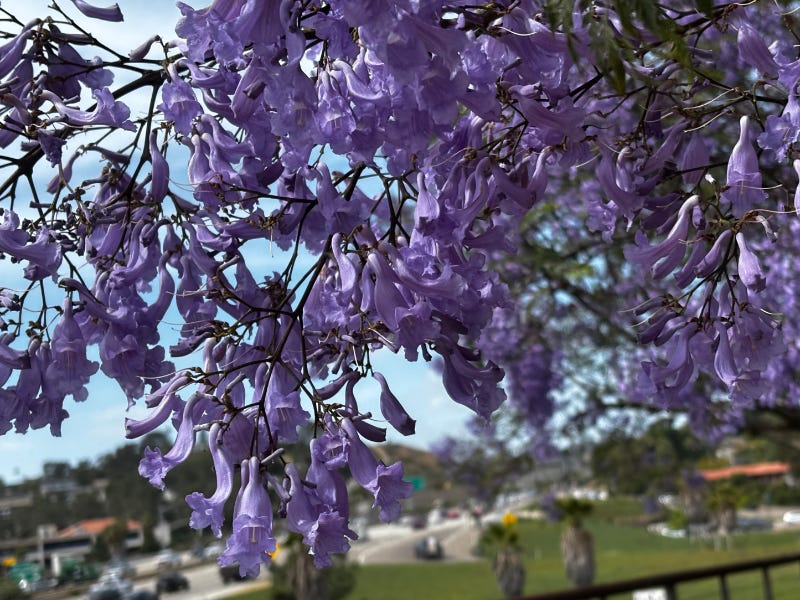
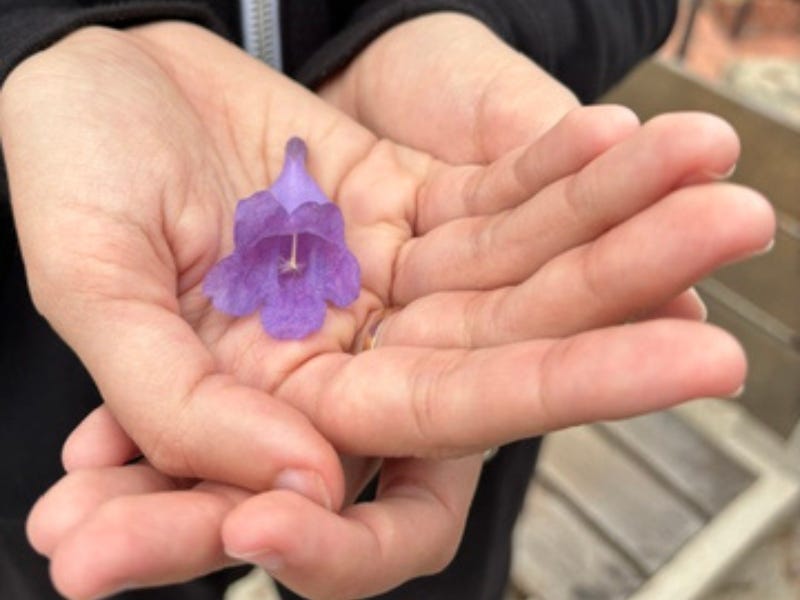
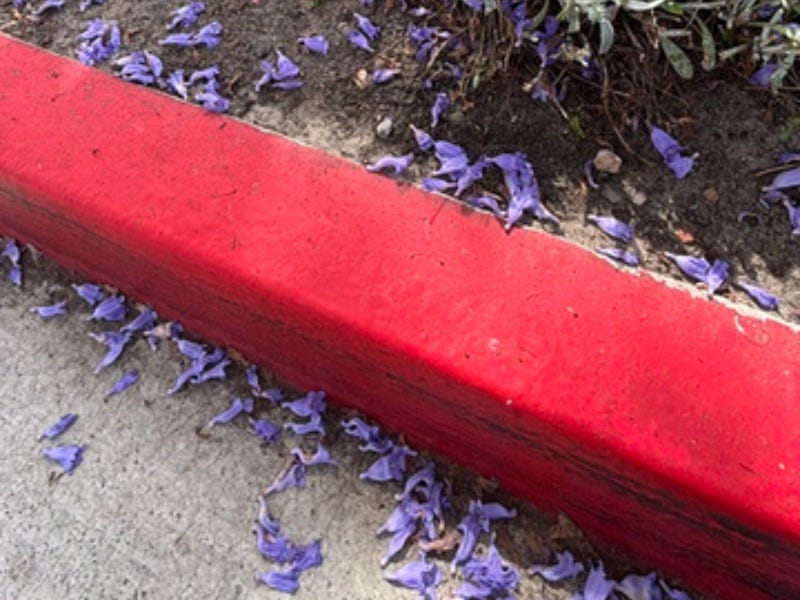
These two-inch long, saxophone-shaped blossoms keep dropping throughout the jacarandas’ two-month blooming period.
In keeping with my triolet “Manifesto,” here's what my muse did with all this loveliness.
Written June 7, 2013, during live news coverage
of the Santa Monica College shootings
Text within this block will maintain its original spacing when published
Four crime scenes. In the backgrounds of them all,
shell-shocked Angelenos mill like sheep.
Live coverage, as cone-shaped flowers fall
continuously. Even as we leap
from lens to lens, the blossoms seem to keep
in sync. We’re told a gunman has been downed.
Meanwhile, jacarandas gently weep
their giant purple teardrops on the ground.
A shaken student tells about her crawl
to safety, as my scalp begins to creep.
She can't describe the shooter: she stayed small
and low, behind a desk, and didn't peep.
The newsman's eyes go hard at that, and sweep
the crowd: less useless witnesses abound.
Meanwhile, jacarandas gently weep
their giant purple teardrops on the ground.
Rumors. Ruminations. Doubts. Banal
summaries “if you've just joined us.” Cheap
speculation. (Mine: Expect 'The Call'?
One victim's died in surgery. The sleep
of brain death? Hope erupts from somewhere deep.
My daughter needs a heart. I feel mine pound.)
Mean, while jacarandas gently weep
their giant purple teardrops on the ground.
I didn't sow this, Prince, but hope to reap.
Your song's I never meants, once un-profound,
mean, while jacarandas gently weep
their giant purple teardrops on the ground.
First published November 2014 in The Rotary Dial
• • •
Of course this poem had to be a ballade. The 1984 hit “Purple Rain” was by Prince and the Revolution, and the beginning of a ballade's final half-stanza (the envoi) is traditionally addressed to a prince or lord.
My first draft came together in about two hours, mainly because I deviated from the standard ballade recipe in two time-saving ways.
First, I expanded the usual iambic tetrameter into iambic pentameter, which gave me 1.25 times the room to maneuver. (Your experience may vary, but I find that lines shorter than IP take far more time and effort.)
Second, instead of repeating only the last line of each stanza, I decided to repeat the last two lines of each stanza. With capital letters representing repeated lines, this changed the challenge of finding 14 unique b rhymes (ababbcbC ababbcbC ababbcbC bcbC) to the easier task of finding 11 unique b rhymes, since I could use one of them four times (ababbcBC ababbcBC ababbcBC bcBC).
These cheats may not sound like huge advantages, but trust me, they were. And I wanted to get everything down quickly in case The Call did come, although I knew it was very unlikely that this situation would result in transplantable organs.
Soon after our elder daughter's birth in 1996—when she was given an Apgar score of 1 out of 10, and a 50% chance of survival to the next day—my husband and I were informed that a heart transplant was the only way to fix her very rare restrictive cardiomyopathy. However, it was not until September 2011, when she was 14 years old, that her condition deteriorated to the point that her San Diego cardiology team said it was time to put her on the transplant waiting list.
At that time, there were only four facilities in the multi-state western region of the United States performing pediatric heart transplants. San Diego Children's Hospital was not one of them.
We felt lucky that Mattel Children's Hospital (part of the Ronald Reagan Medical Center at the University of California at Los Angeles) was only a 2.5 hour drive from our San Diego home. However, one of the terms one must agree to when listed for a heart transplant is a commitment to remain within a two-hour drive of the transplant facility. Our daughter's UCLA team agreed to bend the rules a bit, and delayed requiring us to move closer for another year.
In Fall 2012, we rented an apartment in Westwood, close enough to the UCLA campus to allow me to push our then-16-year-old daughter's wheelchair to the hospital in about ten minutes. From February to October 2013, she and I relocated to Westwood full-time, while my husband remained in San Diego with our younger daughter (then thirteen) to keep his employer's very generous health insurance going. Our family connected via Skype or Facetime nightly, and the San Diego half reunited with us on weekends.
About noon on June 7, 2013, a police helicopter passed over our apartment, blaring that everyone should go inside and shelter in place, since there might be an active shooter at large. Even before we turned on the television and learned that there were four crime scenes being investigated, my daughter and I began hearing the sirens of multiple ambulances bringing shooting victims to the UCLA Medical Center. A gunman had already been fatally shot by police in the library at Santa Monica College, seven miles away, but the authorities were not yet certain that he had acted alone, and the number of crime scenes kept growing, eventually reaching nine. (The fact that President Obama and Vice-President Biden had a fundraiser scheduled in Santa Monica later that evening didn't seem coincidental at the time, though it eventually turned out to be.)
The need to process evidence means that deaths in forensic situations generally do not result in organ donations. I knew this. But by then I was starting to feel desperate that a donor organ would not arrive in time to save my daughter's life, and I couldn't help thinking, Maybe this tragedy is our miracle….
It wasn't. It was not until September 4, 2013—on my 45th birthday, and one week before the two-year anniversary of our daughter’s two-year prognosis—that a heart of the right size and blood type finally became available, through the generosity of an 23-year-old female donor whose family wished for her to remain anonymous.
Both our daughters are now doing fine as they approach their 30th and 27th birthdays, and they will be visiting us in their old stomping grounds for the next week.
It is still difficult for me to see jacaranda blossoms without thinking of the hundreds, if not thousands, of latex gloves used by my elder daughter's doctors, phlebotomists, nurses, etc, over the years. Those gloves were usually that exact shade of translucent purple, and as floppy when discarded.
Five fingers, five petals….
Julie
PS—Want more? Check out the Index to My Poems with Repetends, or one of the other indices at Off-Piste on Mount Parnassus.
My publications since May 1:
“In Short”(a biolet), “Homeric” (a tritina), and "Being the Bad Guy” (a triolet) appeared May 4, 2026, in Snakeskin 339 (Short Forms Special Issue).
“Bouguereau's Les Oréades (1902)” (a brief nonce form) appeared May 14, 2026, in The Asses of Parnassus. (Here's a link to the painting, too.)
"Two Weeks in Review” (a terzanelle) appeared May 18, 2026, in Light’s Poems of the Week feature.
“On Her Portrait (Sonnet 145)” (a sonnet translated from the Spanish of Sor Juana de la Cruz) appeared May 30, 2026, in The Ekphrastic Review.
“Curryelle” (a kyrielle) appeared June 1, 2026, in Lighten Up Online.
Comments
Nothing yet. Say the first thing.
Sign in to join the conversation.