
Neighbors,
Only nine spots left for this month’s event!
Next Thursday, join fellow artists, filmmakers, and friends from around the neighborhood for a night of board games (and an exclusive, secret premiere). You can RSVP here.
Onto this week’s review. Plus: four new headlines that took us offline.
— NGL
P.S. Last letter, we shared five thoughts on OpenAI’s niche podcast acquisition—and what Ye’s return means. You can read it here.

Runtime: 15m 9s
Review by: Nate Graber-Lipperman
Roughly five-and-a-half minutes into the alternative rock band Geese’s Tiny Desk Concert at NPR headquarters in Washington, D.C., lead singer Cameron Winter—sporting a brown flop and a devilish grin—turns to his audience, which is sitting out of sight.
“Is this a ticketed thing?” he asks them, half-serious. “I thought it was just NPR staffers here and friends…[but] NPR staffers don’t have this many friends.”
By the end of 2025, Geese—a four-member band hailing from Brooklyn—had shot up the charts, with their fourth studio record “Getting Killed” named album of the year by Stereogum and The New Yorker alike (the latter described Geese as “art for an artless era”). SNL and Coachella appearances followed shortly thereafter, and Winter has become the muse of filmmakers Paul Thomas Anderson and Benny Safdie (the frontman even sparked dating rumors with Olivia Rodrigo just this week).
In other words, Geese’s ascension from indie sleaze favorite to the next big thing felt stratospheric. Almost too stratospheric.
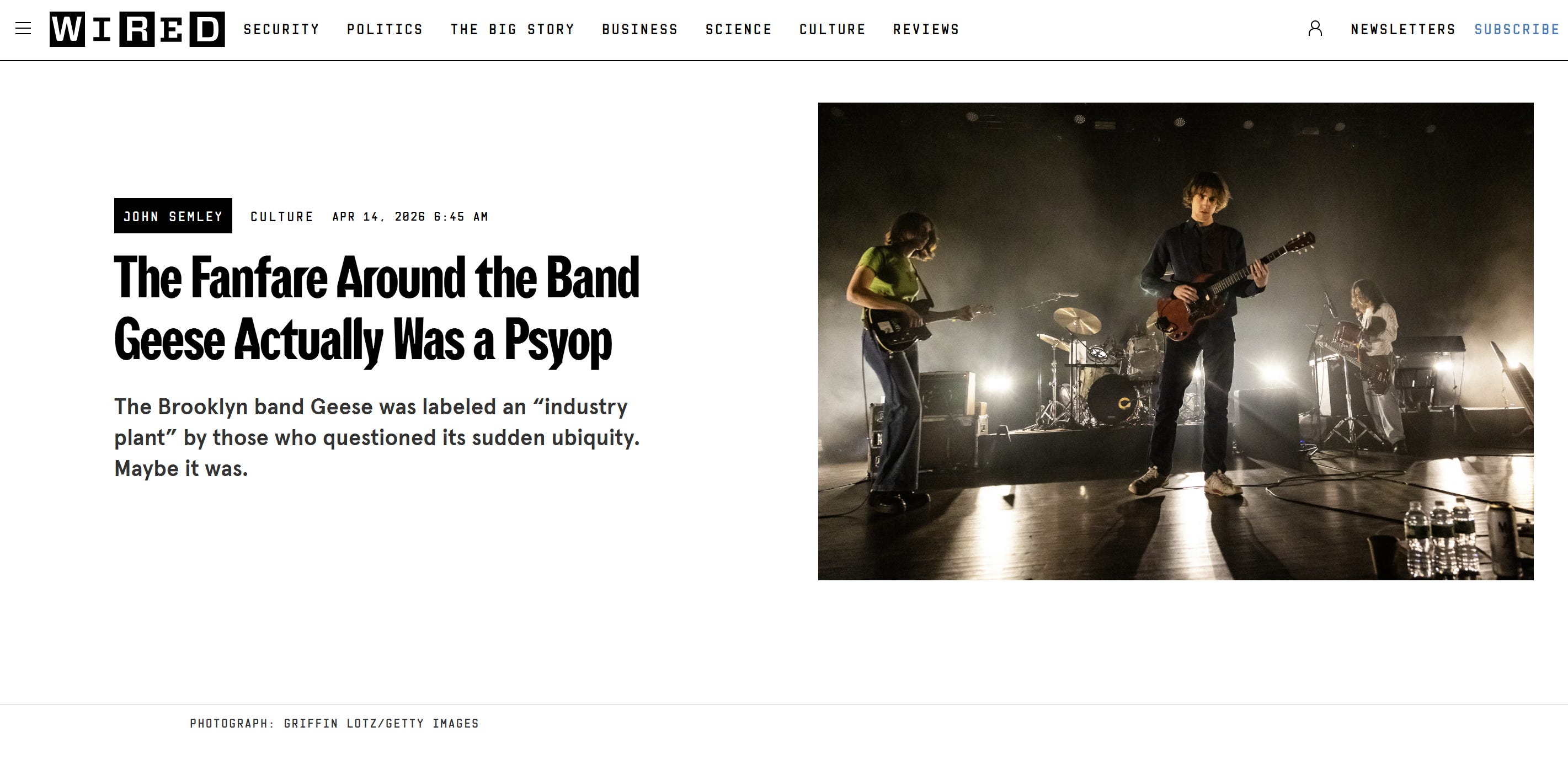
Enter: Wired. On Tuesday, the storied tech magazine ran a piece with a salacious headline—“The Fanfare Around the Band Geese Was a Psyop.” The content was much more informative than the packaging would lead a casual scroller to believe, highlighting Geese’s work with the digital “narrative” company Chaotic Good Projects.
The main gist:
“The firm creates networks of social media pages (typically on TikTok) and uses them to drive the band’s music into the recommendation algorithm. Songs are dropped into the backgrounds of videos. Live clips are shared. Sometimes, burner accounts, comments, and whole ecosystems of interactions can be fabricated out of digital cloth, stoking—and in some cases, completely manufacturing—discourse around an artist.
The accounts driving the discourse are, in a sense, ‘genuine’—bespoke, engineered, and overseen directly by the in-house PR team, working from their smartphones.”
The Chaotic Good founders defended their practices to Wired, explaining that “narrative campaigns mostly consist of consulting on digital PR strategy.” In a different interview they gave Billboard last year, they summed up their defense more succinctly: “Everything on the Internet is fake.”
Which begs the question—in the age of algorithm-manipulated taste, what’s fair game?
And what should be considered suspect, if not illegal outright?
Since the Wired piece ran, this debate has played out across the music world. Some argue that Geese had already proven its indie bona fides across three previous albums. And besides, labels used to curry radio DJs’ favor via backstage passes and free cocaine, anyway. The music industry has always been just that—an industry, a game to be won. Was this really that different?
Others feel it’s fairly cut-and-dry. “Advertising should be marked as advertising, this shouldn’t be controversial” one comment reads under a video by music critic Anthony Fantano.
If a consensus has emerged, it’s this: Chaotic Good is right, and our taste is formed by outside forces more than we’d like to believe. “If Geese are a psy-op, so is everything else,” Dazed claimed. “What I’ve found is that every person agrees with general ideas like ‘don’t believe everything you read’ or ‘lots of internet comments are fake,’ but only in the abstract. When it actually comes up in real-life situations, most people just don’t consider that,” one Reddit user wrote.
This consensus evokes a certain laissez-faire approach towards cultural consumption that’s lazy at best, and sinister at worst. As I wrote in November, who we pay attention to impacts our wallets, our elections, and, well, our attention. With the rise of bot networks and clipping disguised as “organic” marketing, the only “real” thing left may be the people and conversations we foster in-person.
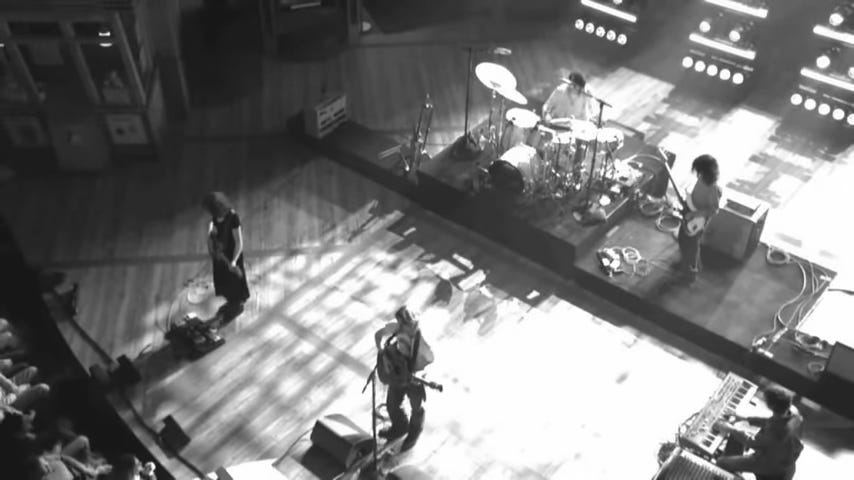
Through following all this discourse around Geese, I realized something about the band. I’d never actually heard one of their songs.1 So I opened up their Tiny Desk Concert, as I felt NPR’s beloved, stripped-down production would offer the closest thing to experiencing their live show, and pressed play.
Listening through the set list (of “Husbands,” “Cobra,” and “Real”), I was instantly met with the signature “warble” Winter has become known for. The group’s sound feels like you’re all sitting around your friend’s garage, together. Making music, shooting the shit, turning nothing into something (it makes sense; the band began practicing as high schoolers in drummer Max Bassin’s Fort Greene basement). They’re a throwback to a simpler time, speaking to a nostalgia Zoomers have only previously felt through viral clips of life before social media.
By the time I’d finished their catalogue, I felt like I understood the Geese hype. Though I’d stop short of any “voice of a generation” labels, it felt safe to claim that they genuinely had the goods. The band feels like they’ll be hanging around for a long time.
Nevertheless, do the means justify the ends, in an age where it’s become abundantly clear that “breaking through” requires some degree of social media manipulation?
After all, even if those NPR staffers Winter ribbed down in D.C. only have so many friends, at least they are real.
Nate’s Score: 4 / 5 🪿
Highlighting the week’s online stories and phenomena that inspired us—and took us offline.
🪄 The “largest magic venue in the world” opens in Chicago this weekend. For male patrons of The Hand & The Eye, collared shirts and jackets are required (though suits and tuxedos are encouraged).
📻 Wait wait…tell me more! NPR receives two gifts worth a combined one hundred and thirteen million dollars, the largest private gift in the organization’s history. The donations come after Congress halted all federal funding of public media in 2025.
🌳 America’s largest rainforest says no to loggers. Tongass National Forest counts bald eagles, sperm whales, and Chinook salmon among its protected species. Thanks to an Alaska district court judge, it’s saws down for the logging industry.
🦷 Is toothpaste a scam? Answer in Progress has got you covered with their latest deep dive.

We’re looking for submissions for the first print issue of OFFLINE with the theme ‘NEIGHBORS.’
Whether it be writing, art, photography, a game, collage, or anything in between, pitch your neighborly stories to us! (And don’t be shy—share the link with a friend who should pitch something, too.)
Thanks for reading! Shoot us a reply, comment, or DM if anything resonated with you in particular—we respond to them all.
Maybe that was the point.
No posts
Comments
Nothing yet. Say the first thing.
Sign in to join the conversation.