

Hello, and welcome to Offcuts: a weekly newsletter about AI and commerce. Written for the people running consumer brands. Brought to you by the team at ROIROI - engineering, design, performance marketing and AI for consumer brands.
I am writing this to you from Stockholm as we have taken Offcuts on the road. I will be interviewing Erik (CTO at Stellar Equipment) and Ola (ex-Acne Studios) for a special live podcast direct from Centra HQ, with the Dema guys supporting. More on this in the next couple of weeks.
So, what’s been going on?
Google I/O dropped a slate of commerce announcements last week. The same week, Shopify opened the Universal Commerce Protocol to every developer. They are separate developments with their own implications, but they are pointing at the same shift. External AI, which is the discovery & conversion experience, had started to feel like a slow burn. It’s moving again.
Let’s talk about it.
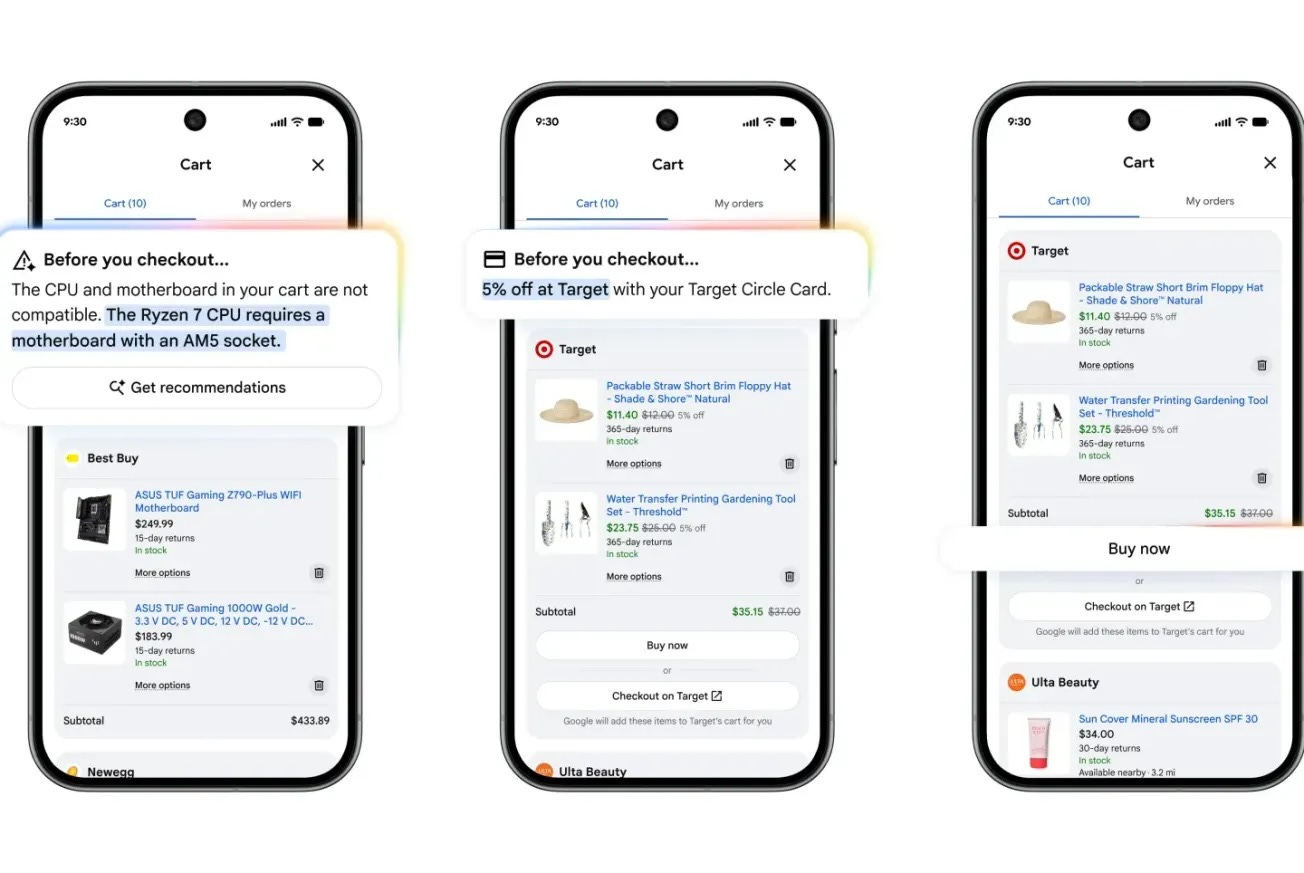
Google I/O had a lot in it. A lot. In fact, there was a 100x increase in AI grifters creating content with hooks claiming ‘Google I/O just killed - insert some legacy tool’. On the AI side: Gemini Pro updates, Project Astra moving into early access, NotebookLM getting audio features, and a new AI filmmaking tool called Flow. On the commerce side: AI Mode shopping, which surfaces product recommendations inside Google’s generative search interface rather than a list of links; virtual try-on for apparel, letting users upload a photo and see how a listed product looks on them; and agentic checkout, where a user sets a target price on a product and Google’s AI monitors and completes the purchase when the conditions are met.
The one I want to focus on is the Universal Cart.
Universal Cart is a persistent shopping cart that works in the background across Search, Gemini, YouTube, and Gmail simultaneously. A user can add items from multiple merchants while going about their normal Google activity, have the cart automatically scan for deals and loyalty discounts, and complete the purchase through Google Pay without visiting a single brand’s website. It is rolling out in the US this summer with Nike, Sephora, Target, Ulta Beauty, Walmart, and Shopify merchants including Fenty and Steve Madden as launch partners.
Google’s VP of Ads and Commerce noted that its Shopping Graph covers over 60 billion product listings and that people shop across Google more than a billion times a day. Universal Cart is not a new feature sitting on top of that. It is a structural change to how that existing scale converts.
OpenAI tried something adjacent earlier this year and pulled back, having underestimated the payments infrastructure complexity and, probably, the gap between users researching in ChatGPT and users completing a transaction there (maybe a combination of the two). A Bain study found only 24% of consumers would be comfortable making a purchase through an AI chat interface. Google is in a materially different position. It already owns Google Pay, has two decades of merchant relationships through Google Shopping, and sits at the start of more purchase journeys than any other platform. In other words, Google owns the consumer.
The thing that strikes me about Universal Cart is not the technology. It is the surface area. Google is not building a new place to shop. It is making shopping happen inside the places people already spend their time, without asking them to change their behaviour at all. That is a different kind of problem for brands than a new channel to optimise for. I am also surprised people wrote Google off when ChatGPT exploded in 2022. They have proved they were and are the dominant consumer AI company.
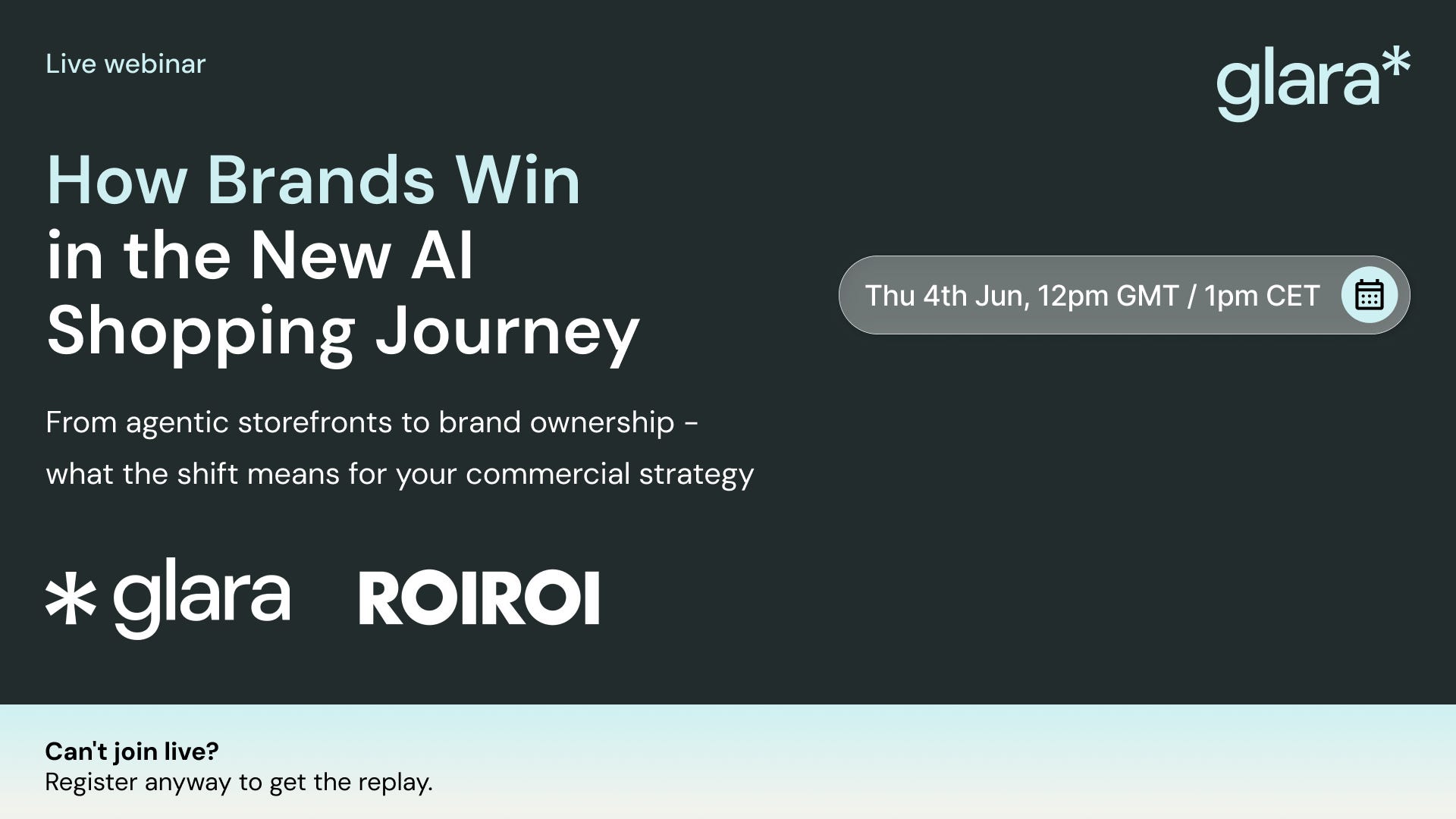
We’re joining Glara on June 4 for a live discussion on what the shift to agentic shopping means for your commercial strategy - where the funnel is moving, what brands now have to own and why the PDP’s job is changing faster than most teams realise. With myself and Chris Kilin (Glara CEO). 12pm UK / 1pm CEST.
If you lead ecommerce, marketing or commercial strategy and want a clear-eyed view of what the AI shift actually demands from brands in 2026 - this one’s for you.
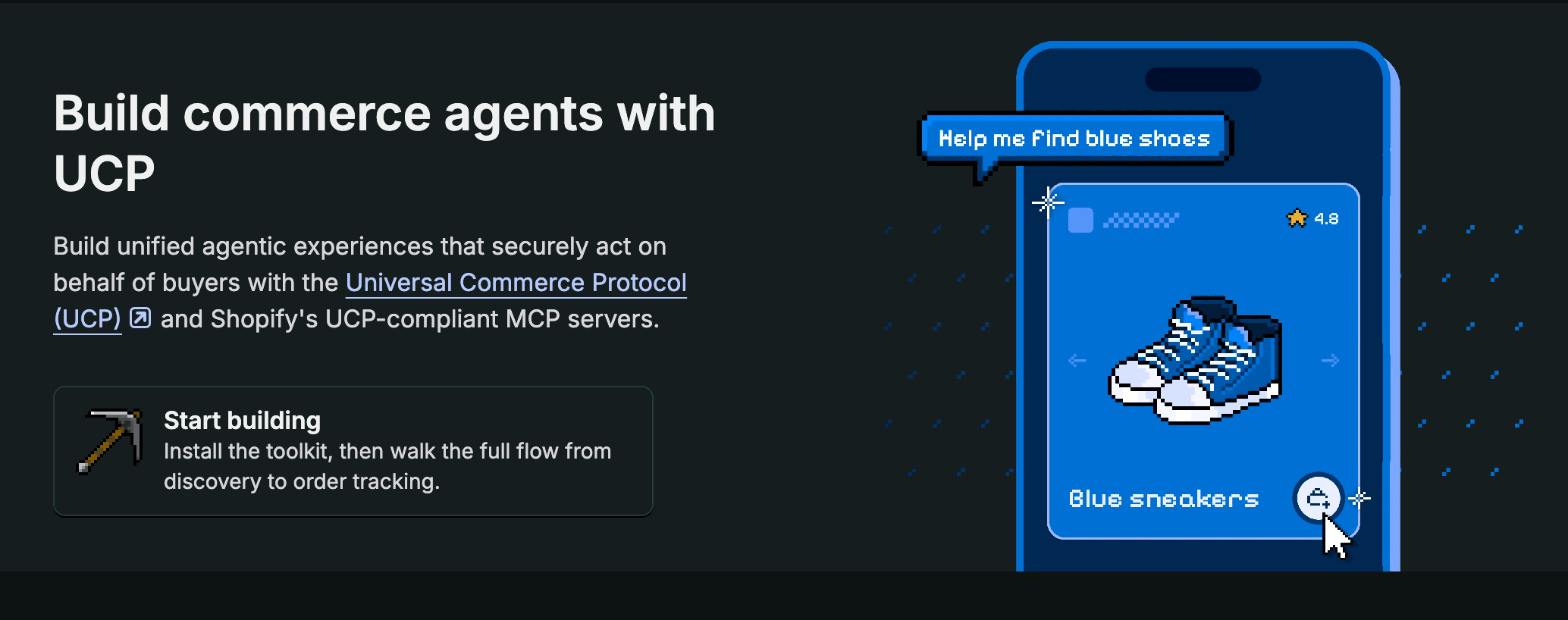
UCP has been live since January, when Shopify announced it alongside a set of major AI platforms already running on it. This week they opened it to every developer.
The protocol was co-developed with Google, Booking.com, Expedia, Marriott, Uber Eats, DoorDash, and others. The idea is a standardised language between AI agents and commerce infrastructure covering discovery, cart building, checkout, and post-purchase management. Any mobile app, content platform, or AI agent can now access Shopify’s full catalogue through it.
If you are on Shopify, your catalogue is already accessible through UCP. But the agent experiences that surface and sell your products still need to be built on top of it. What Shopify has done is open the infrastructure to any developer who wants to build them. The pipes are standardised. The experiences are not yet ubiquitous.
As part of the same release, Shopify redirected every store’s llms.txt file to a new file called agents.md. llms.txt was about discoverability: here is what we sell, here is how to find it. agents.md is about operability: here is exactly how to buy from this store.
There is a gap in the default setup. Shopify’s agents.md gives an AI the checkout mechanics. It tells the agent nothing about the brand, which products to prioritise, or why it should recommend this store over a competitor. The transactional layer is handled. The reputational layer is not.
The agents.md gap is super interesting to me. Shopify has solved the plumbing. A customer can now find and buy from your store without touching your website. But the model deciding whether to recommend you at all is making that call based on signals you are probably not actively managing. The transaction is automated. The recommendation is not. At the same time, one is still handing over their brand experience to a technology company. Which I suspect will worry many Creative Directors out there.
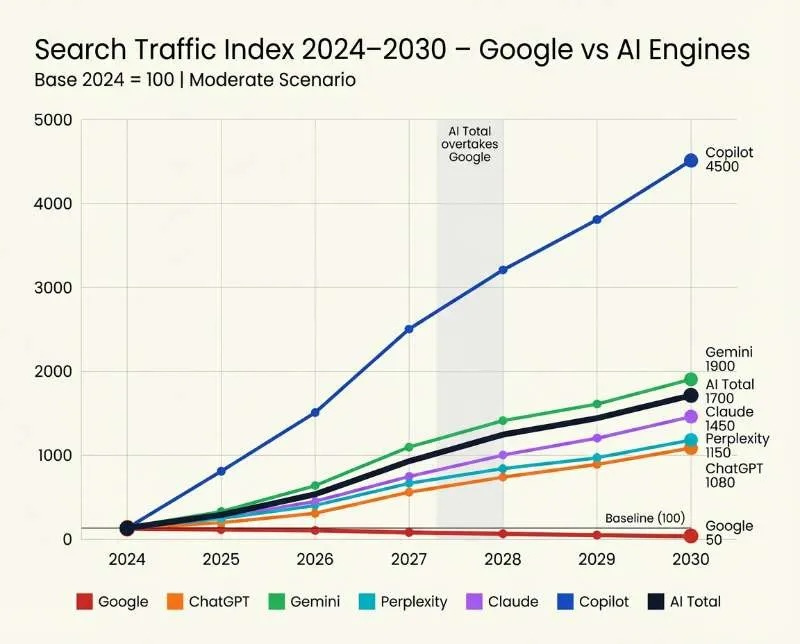
A year ago there was a lot of noise about AI changing the discovery layer for commerce. AI Overviews in Google search, ChatGPT shopping integrations, conversational product recommendations. It got traction, then it went quiet. OpenAI’s retreat from checkout was part of it. Perplexity’s commerce features did not land with the urgency people expected. The third layer of external AI, agentic shopping, felt like something to monitor rather than act on.
UCP and Universal Cart change that. UCP is a production protocol with major platform co-signatories and developer tooling that is live today. Universal Cart is rolling out to hundreds of millions of Google users this summer. These are not announcements about what is coming. They are announcements about what is now available.
For a brand operator making the case internally for where to invest, external AI has always had one advantage over internal AI: it is a topline story. Internal AI is about efficiency, cost reduction, and operational leverage. External AI is about new revenue and new discovery channels. That is an easier conversation to have with a CFO or an investor, and the infrastructure to support it is now in place.
The topline argument is also the one that gets brands into trouble. External AI is easy to sell internally precisely because it sounds like a channel play, something you can bolt on without changing how the organisation works. The brands that get the most out of it will be the ones that treat it as a data and positioning problem first, and a distribution problem second.
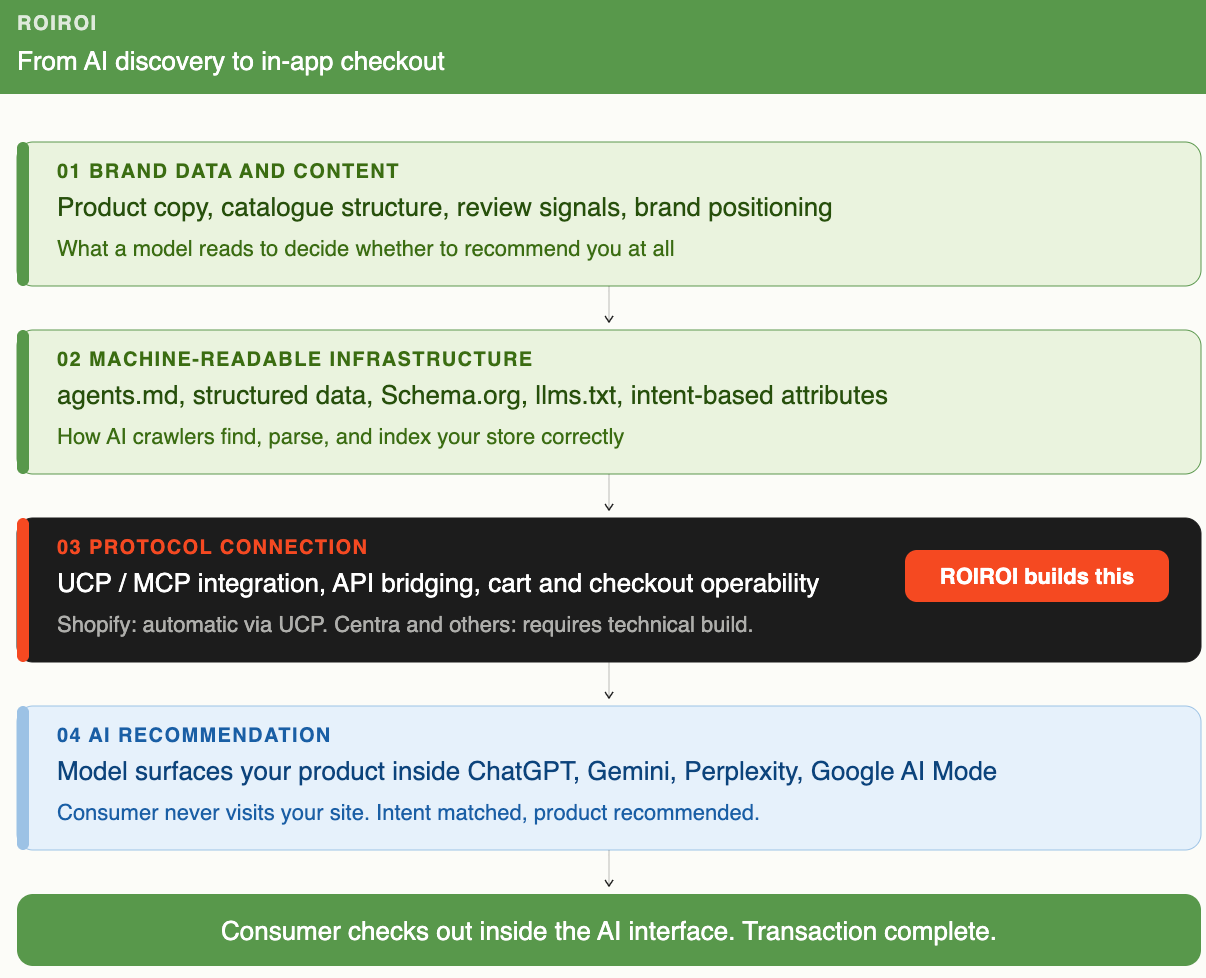
Being in Shopify’s catalogue and being reachable through Google Shopping does not mean being recommended. A model deciding what to surface to a user is working from everything it has access to: product descriptions, review data, brand signals, structured data quality, and what authoritative sources say. If your product copy is thin or your catalogue structure is inconsistent, you are reachable but not prioritised.
At ROIROI, we're building the scaffolding to get brands surfaced and convertible inside LLM interfaces (note, EU availability is a blocker at the moment in some cases). The work involves auditing and improving the data a model uses to make a recommendation, structuring product information in ways that are legible to an agent, and building the technical bridge between a brand's catalogue and the protocols that allow an AI to complete a transaction on a customer's behalf. Being discoverable is the first problem. Being transactable is the one most brands have not started solving yet.
For Shopify merchants, UCP makes the transaction layer straightforward. For brands on platforms like Centra, it requires more technical depth to bridge the gap, but it is achievable.
The brands investing exclusively in external AI right now are making a partial bet. Discovery and conversion through AI agents matters, but an organisation that has not done the internal work, building the data infrastructure, the operational workflows, and the knowledge layer that AI can reason from, will struggle to scale what external AI delivers. External AI brings customers in. Internal AI determines whether the organisation can service them efficiently and learn from the interaction.
I do not think most brands are more than six months away from this mattering in their numbers. Not because agentic shopping will be the majority of transactions by then, but because the gap between brands that are prepared and brands that are not will start to be visible in discovery metrics and conversion rates. The window to get ahead of it is becoming narrower by the day.
So, what do I see when I look into my crystal ball?
External AI becomes a bigger part of the conversation in the second half of this year. The infrastructure is in place. The commercial narrative is easier to sell internally. And the gap between brands that have prepared their data and positioning for this environment and those that have not is going to start showing up in results.
Layer one, AI search and discovery, is Google’s default behaviour for over a billion searches a month. Layer two, AI personalisation, is increasingly happening on Google and other surfaces before a customer reaches your site. Layer three, agentic shopping, is live and accelerating. The website is still important. It is just no longer where the journey begins (and potentially not where it ends).
If you want to map where your business actually sits on this, our AI Readiness Assessment is built for exactly that conversation. One structured day, a clear picture of what you have, what you are missing, and what to build first.
“We brought ROIROI in to run an AI consulting project across the business. In a week they had spoken to every team, mapped our friction points, and produced a roadmap with real commercial impact. They did not try to sell us technology for the sake of it. They told us what we needed to hear, identified a significant saving, and gave us a foundation to build from.”
Gemma Stevenson, Chief Commercial Officer, Skin Rocks

Hi, I’m Tim. I’m the CEO of ROIROI, a technology and marketing agency. We connect engineering, design, paid media and AI for consumer brands. I also host Offcuts, a weekly podcast and newsletter exploring the same themes. Outside of work, I’m usually cycling, swimming, running or in a sauna-cold-plunge trying to recover from all three.
No posts
Comments
Nothing yet. Say the first thing.
Sign in to join the conversation.