
For most of Malik’s* life, he hasn’t been understood by almost anyone.
His one consistent word—signed, vocalized, tapped on his AAC device—is a catch-all for anything he wants: “more”. Even that was a breakthrough: we understand you, we know that you want something, yes, we want to help you. But it doesn’t go very far, and it can’t go very abstract. The thing you want “more” of has to be in sight or in grab-your-hand-and-show-you distance or else it’s a guess. The people who love Malik do their absolute best to guess. Malik does his absolute best to let them know. And still, it’s so, so hard.
During OT sessions, Malik always wants to have his mum’s phone playing YouTube videos. Sometimes his favorite music. Sometimes clips of, or whole episodes of, children’s shows. His mum asked me early on if that was okay with me. I said yes. Without it, he was in immense distress. With it, we had some kids’ music in the background, and sometimes he could zone out and watch some videos to take a moment to himself. That seemed totally fine to me.
During a couple of sessions, I began to wonder if Malik might be choosing the videos that he was choosing, not solely out of enjoyment or preference, but also to communicate. I didn’t know for sure. I was going based off of stories I’ve read of young nonspeakers, and Gestalt language processors, and the way that their brains connect whole phrases, or whole songs, or whole videos, as a unit of meaning—like the way that a word or a sentence is a unit of meaning in typical spoken language.
Some of my guesses were things like: he’s spinning and spinning on the swing, and the title sequence of this show has spinning shapes on it. Or, he’s throwing the ball upward, and there are planes and helicopters up in the air on the show. Maybe he’s pretending or relating those two things.
I described this to Malik’s caregivers. I said, “I’m going to work under the assumption that he’s connecting more dots than we’re able to tell. That he’s choosing videos for a reason. I don’t know if we’ll figure out the reason or not, but I’m going to do my best to react like he’s telling me something and I just can’t hear it yet.”
But then, in one session, he was swinging on the swing and very clearly and very deliberately chose an episode of Bluey where Bandit (the dad) is pushing Bluey and Bingo on the swing. “Let’s play come here go away!” says Bluey, and then Bandit playfully pretends to try to talk to them while they’re on the swing and then yells “hey! Come here!” when they swing away. Then they switch to him yelling “hey, go away. I said go away!” as he pretends to get mad that the swing keeps returning to him.
The whole clip of Bluey takes about thirty seconds. Malik selected this particular episode from all of YouTube. Then he scrubbed forward in the video to this particular few seconds. When it got to the end, he repeated it again. And again. The message couldn’t have been clearer.
While I pushed him, I took the role of Bandit— “come here! Hey! I said come here!” And then, “go away! Hey, I said go away!” As he repeated it over and over, I tried hard to make my exact words, timing, cadence, inflection match Bandit’s. Malik kept looking at me and giggling and smiling. We did it over and over and over again.
Briefly, he experimented with another one. He found the episode, scrubbed to the part, and played a clip of Bluey caught between her dad and her sister as they each tug on one of her arms, as if she’s the rope in tug-of-war. With the video clip playing, he handed me our scrunchy, bungee, tug-of-war rope. Again, I loudly affirmed and described what he was doing and tried to repeat the words along with the video as I tugged the rope with him. That one only lasted a few seconds, then we were back to “go away!” with the swing.
I had also worked on creating a page in my own AAC app on my own therapy iPad that was specific to the room we were in, with verbs and pictures of the room equipment. Malik was mildly interested in the therapy page but was massively interested in the “feelings” page, because when I hadn’t had a symbol to represent a particular feeling, I had found a picture of Bluey feeling that way. Over and over again he pressed “happy, mad, sad, calm, excited, do it together, silly” because those were all the Bluey-related buttons.
So, between sessions, I set to work at making a Bluey page with words, phrases, or sentences from Bluey that I thought were either good Gestalts (like “let’s play….”, something Bluey says all the time and can be used in many different contexts) or were memorable play scenes from Bluey for which I could recreate the available materials. Bluey plays Butterflies in a fabric swing; I hung up our fabric swing. Bluey plays Freeze/Unfreeze with a xylophone; I added freeze and unfreeze buttons and a xylophone to the room. Bluey plays Keepy Uppy with a balloon. I had to finagle the app to get it to pronounce it right but I added a “keepy up e” button and a balloon to the room, too.
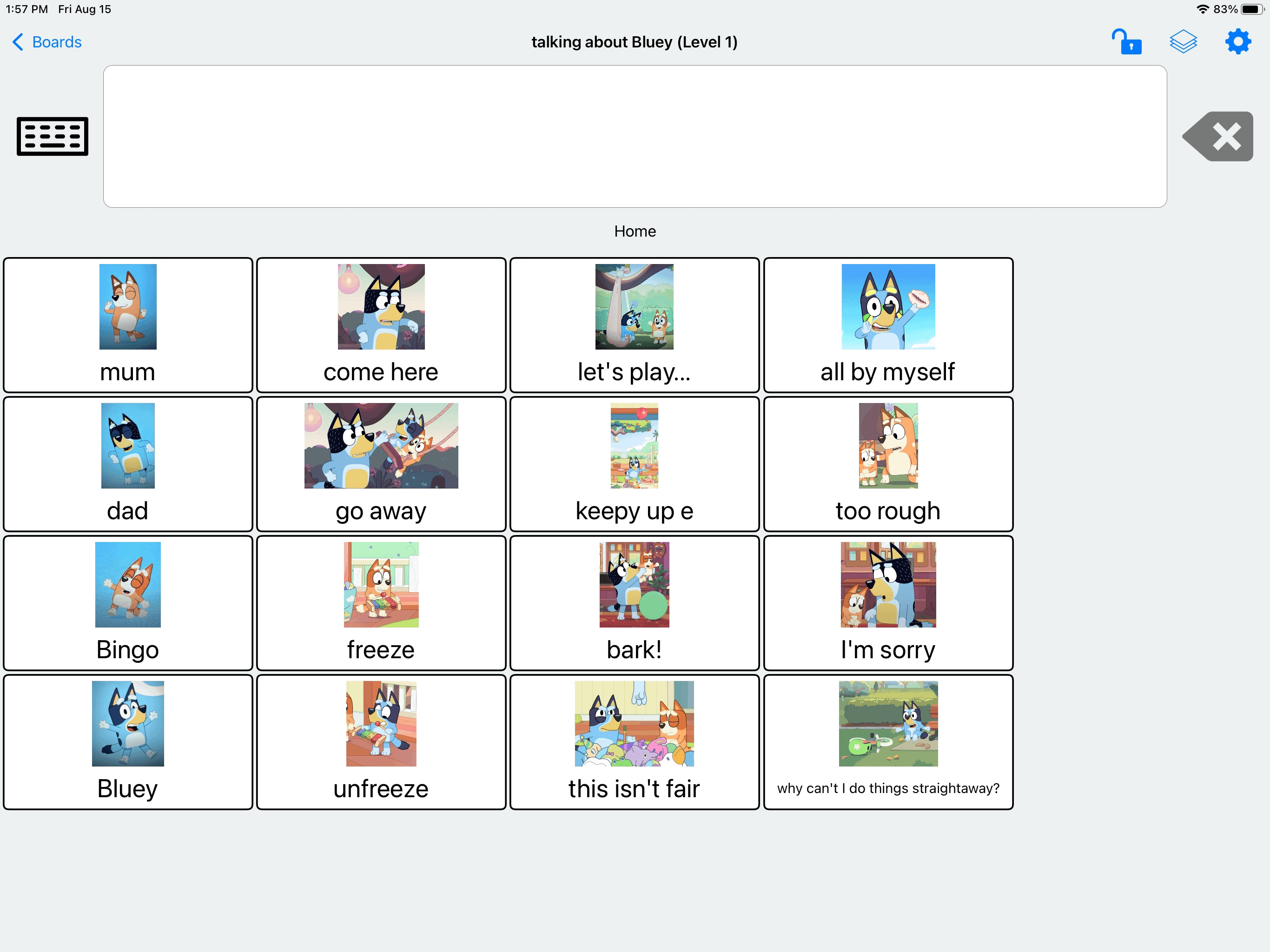
And, of course, of course, “come here” and “go away” buttons.
Every button I added had exact lines from Bluey, and exact pictures from that specific moment in the show.
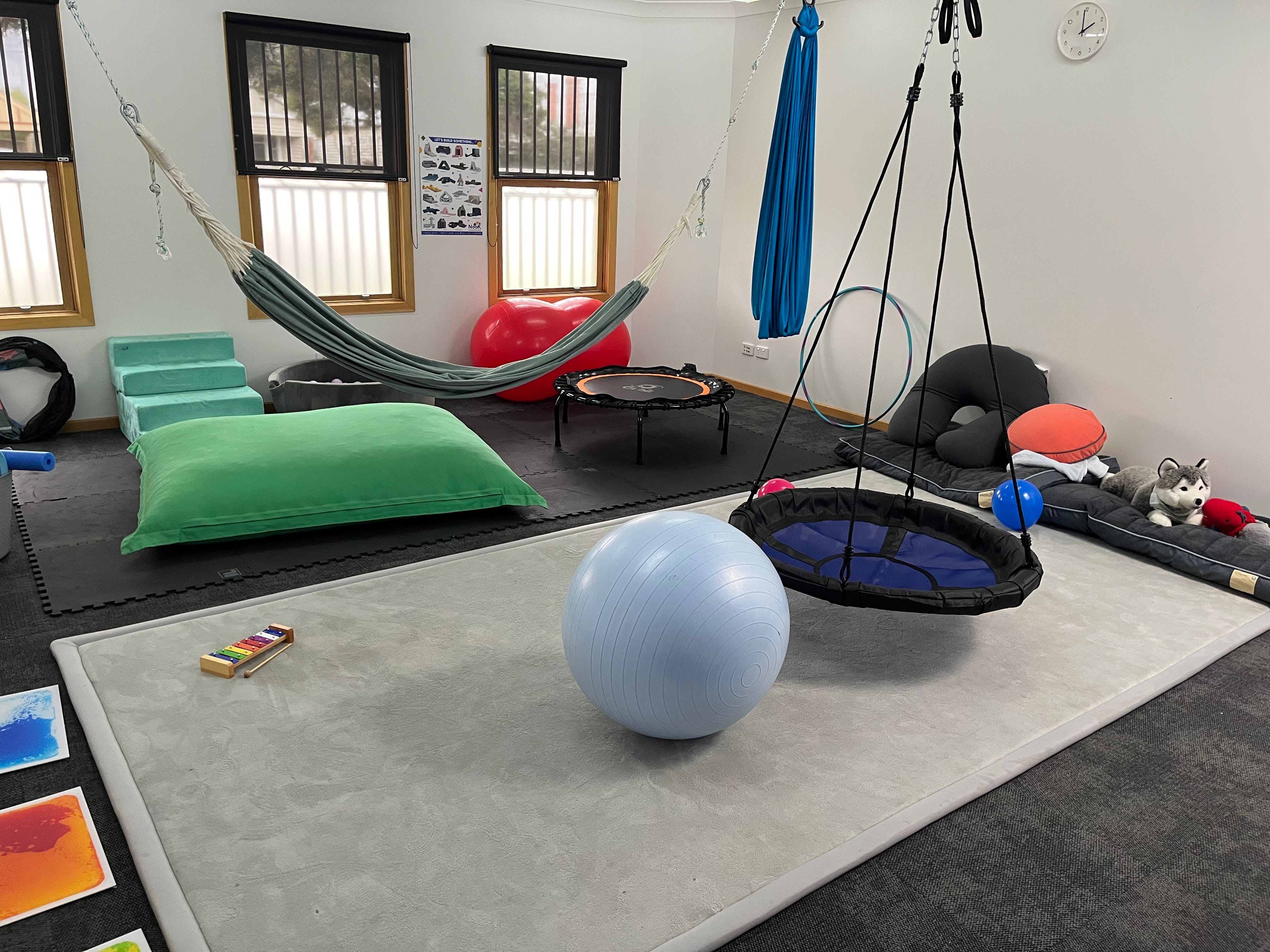
When Malik showed up next time he was absolutely delighted by the Bluey page. “Why can’t I do things straightaway,” he tapped immediately, and then “come here! Go away!” and we were jumping right back into our swing game. I alternated between tapping on the app myself, saying it with my own mouth, and talking with additional words—“I’m pushing you on the swing like Bluey’s dad. Bluey’s dad says go away!”
I tossed a ball pit ball—the soft plastic kind—onto the swing with Malik and it accidentally bonked off his head. He didn’t look hurt but I immediately apologized with my mouth and with the AAC app. I had a button for “I’m sorry”, funnily enough from a time when Bluey and Bingo’s dad is playing too rough and apologizes to Bingo for roughhousing too hard. I said “I’m sorry! I didn’t know it would hit your head!” I tapped “I’m sorry!”
Malik was grinning and climbed out of the swing. He tapped “I’m sorry!” and then he tapped “too rough!” — a button from the same scene, with a different picture, that happens later in the scene.
Importantly, he hadn’t even heard this button said yet. He derived what it was—or he read it! If he read it, that would be a surprising skill that nobody yet knows he has, but I would not count it out yet. Many Autistic people are also hyperlexic and read very early (me too as a kid).
I was delighted and astounded. “I’m sorry! Too rough!” I echoed, both with my mouth and with the app. “It was too rough, I’m sorry Malik.”
In response, he grabbed my face with both hands and put his forehead to my forehead, squeezing us together like he was trying to impart something essential to me. He looked joyous. He squeezed, and then let go.
“I know. I know,” I said. I wasn’t a hundred percent sure we were feeling the exact same. But it felt so profound.
“Why can’t I do things straightaway,” he tapped, and grinned, and got back on the swing.
We played more come here/go away. Then he used the phone to find one where Bluey and Dad are playing “follow the leader”. “Great idea, I’ll add that for next time,” I told him.
Malik’s mum asked me about an episode of Bluey where the kids are getting takeaway food with their dad. Bingo eats spicy food and then spits it out on the ground. She told me that at home he keeps playing those few seconds and then spitting his food on the ground and grinning at them, like he’s pretending it. He’ll do it with any kind of food. I told her that going through a spitting phase is very common for kids, too, and maybe he both is in this phase *and* wants to convey that it could be meaningful. She agreed. “Ever since that session with you and the swing, I really think he’s telling everyone in his life that he can talk to them with videos, and he expects them to understand that he’s understanding.”
(As Malik’s mum told me some stories about his birthday party, Malik in the background pulled up a Bluey episode where they’re talking about presents, and then a Bananas in Pyjamas episode about “mystery boxes”…which also sounded an awful lot like presents to me.)
Then he started branching out from Bluey and using an array of videos. Most of them were Australian kids’ shows that I’m not familiar with yet. As he played them, I wasn’t sure exactly what each one meant. I did my best to respond by affirming out loud how much I knew he was communicating with me, and then making guesses: “oh, they’re in a race. You’re zooming fast in this swing. I wonder if it’s like a race?” (I still don’t know for sure, but I wonder if I might’ve gotten that one close, because there’s a hammock across the room and he later dove across it right as the racers passed the finish line!) “Oh wow, they’re in space. A rocket! Rocketships…hmm, I loved space when I was a kid. Malik, I wonder if you love space?”
After all, not everything everybody communicates in a day is all, 100%, just making requests, nor is it all just commenting on exactly what we’re doing. Sometimes people talk about or think about abstract stuff, or stuff they like that isn’t immediately present. I don’t want it to sound like I think I 100% understood, or could pin down, every single thing he said. But I think Malik knows I believe there’s a lot he’s thinking about and telling people and that I’m gonna listen as hard as I can.
The final surprise of the day: Malik found an episode of some show I didn’t know where they were using a balloon to float away. He handed me one of the tied-off balloons. At first I tried holding it above the swing and pretending it was floating away. I also tried pushing the “keepy uppy” button on the iPad. He didn’t want either of those things. Finally he got close enough to insert the balloon physically into my mouth. Ohh, okay. But this balloon was tied off. “Let me see if I can untie it,” I said and finally managed.
“He wants you to let it go,” his mum told me, so I did and it zoomed around the room and he was ecstatic. He replayed the clip—the little guy says, “we could go by balloon!” and then blows up the balloon in five loud puffs. I repeated the words and tried to time my balloon blows with the guy. Then, as the characters floated away, I let go the balloon again to shrieks of delight. We repeated it over and over, Malik laughing so hard he had tears in his eyes.
Then, once we’d both gotten the hang of the timing, I repeated the balloon words, blew up the balloon, and as the characters said “up and away!”, Malik leaped into the swing and soared up into the air. His mum pointed out, “look. You’re the balloon, and he’s the up and away!”
And so he is. And so I am.
And so we’re soaring together.
*As always, name and details are changed. (This one in particular, I asked caregiver permission to write and then to share, too, because I felt it might be impossible for me to make it vague enough to be *any* kid, since the delight is in some of the specifics. 🥰)
[image descriptions:
The first image is the AAC app with the Bluey icons that I made. The icons are:
Mum
Dad
Bingo
Bluey
Come here
Go away, both of these are from the swinging game
Freeze
Unfreeze, both of these are from Magic Xylophone
Let’s play…
Keepy up e, with a balloon
Bark!, which is Bingo using her “big girl bark” to convey that Bandit played too rough
This isn’t fair, with Bluey mad as her dad tries to teach her that claw machines are unfair
All by myself, with Bluey on the beach walking to her mum by herself
Too rough
I’m sorry, both of these also from Bingo and her dad playing too rough
Why can’t I do things straightaway?, while Bluey tries to ride a bike and other kids also struggle with other physical challenges in the episode
The other image is of the room we’re in. In addition to usual things like a hammock, crash mat, mini trampoline, I’ve hung up a fabric swing to be like “let’s play…”, brought a xylophone to go with unfreeze/freeze, brought balloons for keepy uppy, and brought a yoga ball because in the “too rough” episode they play with a yoga ball.
End description.]
No posts
Comments
Nothing yet. Say the first thing.
Sign in to join the conversation.