
Thank you for reading Observing Japan. Japan Daily Briefing is a feature for paid subscribers. My goal is to publish this briefing every weekday and once over the weekend.
If you are looking for timely, forward-looking analysis of the stories in Japans’s politics and policymaking that move markets, I have launched a service through my business, Japan Foresight LLC. For 2026, I am preparing a new pricing tier for public institutions. For more information about Japan Foresight’s services or for information on how to sign up for a trial or schedule a briefing, please visit our website or reach out to me.
The government’s support continued to drop in new polls conducted over the weekend. Prime Minister Takaichi Sanae faced questions about the recently concluded Diet session in a recess meeting of the lower house budget committee and a press conference marking the end of the session. The prime minister is also nearing a decision on a consumption tax cut as the National Conference on Social Security remains deadlocked on whether to recommend a tax cut.
The end of the Diet session was followed by another round of poor polling for Prime Minister Takaichi Sanae’s government. In three new polls conducted over the weekend by Kyodo News, the Yomiuri Shimbun, and the Nikkei Shimbun, the government’s net approval fell by an average of 17.63 points, including -20 in Nikkei and -25 in Yomiuri. The latter have been among the most favorable polls for the government, so while both polls remain the greatest outliers in the government’s favor – 58% and 57% approval respectively – these polls show an overall downward convergence for the government’s support. The Mainichi Shimbun poll that recorded a 41% approval rate for the government, which had a significantly larger sample than any other major pollster, could prove to be closer to capturing the true level of support than some of the small sample, low response polls still relying on random digit dialing.
With the entrance of these polls into my ten-day moving average, the government’s favorability actually rose slightly, with approval rising to 52% from 47% (to 53% from 51% when adjusted for house effects), though disapproval was largely unchanged, shifting from 37% to 36.6% (36% to 35% when adjusted for house effects). As a look at my chart shows, this is a familiar pattern of bounces following dips; the steady decline on the whole remains more important than local variations as polls enter and exit the average.
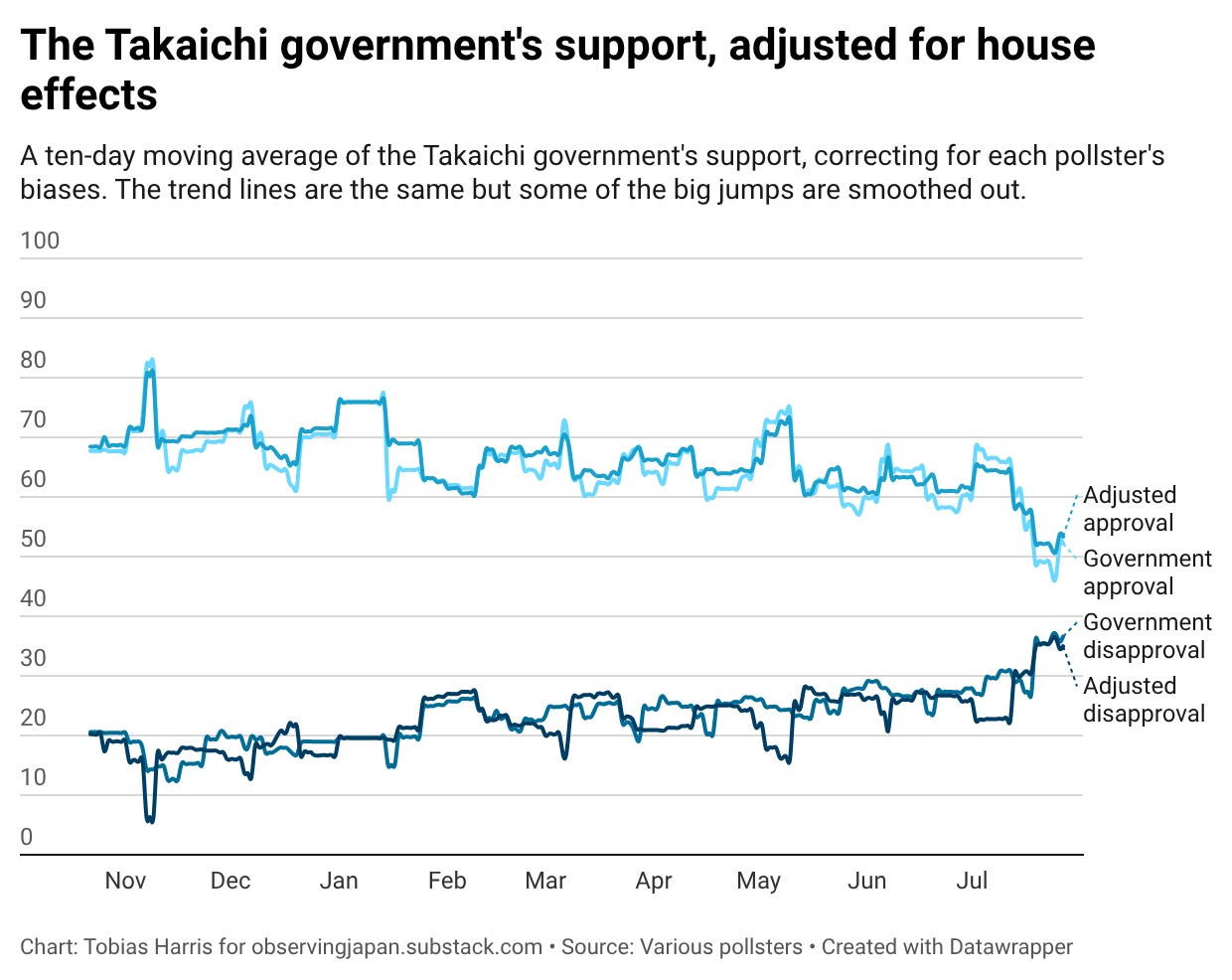
The Yomiuri poll may provide the clearest look at the factors contributing to the government’s falling support. The poll found that only 21% approve of the government’s response to high inflation, while 71% disapprove. Meanwhile, only 29% agreed that the prime minister had sufficiently explained major pieces of legislation in Diet deliberations, while 62% thought she had not done so. In general, the Yomiuri poll also found only slight majorities in favor of the government’s favored provisions regarding the adoption of the sons of former cadet branches into the Imperial Household but significant majorities in support of the provision allowing women to remain members of the household after marriage and near-universal support (85% in Yomiuri, for example) in favor of revising the Imperial Household law to permit women to ascend to the throne. Finally, while pluralities continue to favor cutting the consumption tax on foodstuffs, the margins are considerably smaller than in the immediate aftermath of the general election. In Nikkei, only 48% approve while 44% disapprove; in Yomiuri, it is favored by a 48-41 margin. The best way to read the government’s falling approval continues to be some kind of combination between disappointment over sins of omission (insufficient action against inflation) and commission (the government’s handling of the Imperial Household law and its general approach to the Diet), plus the prime minister’s defamatory video issue (Kyodo found 58.6% said that Takaichi’s explanations have been insufficient), plus regression to the mean for Japan’s prime ministers.
Comments
Nothing yet. Say the first thing.
Sign in to join the conversation.