
Most copywriters and ghostwriters reading this are worse than the machine.
Not all.
But most.
And if you want to know who they are, pay attention to what they write about.
They are often the loudest about how AI will never replace human creativity, which is exactly the kind of whimper a man makes right before he gets replaced.
The stealthier ones did something different, however. They changed their job title. Which makes them much harder to find. But looking for signs of that changed job title is a good place to start.
I know that that's one hell of a way to open a newsletter.
But if you give me twenty minutes of your time, I will not only show you the receipts (because I used to be one of them), but I will also explain why I think there is still hope for you to be whatever it was you were before Pre-A.I. As a matter of fact, I will show you why, if you were good at it, there has never been a better time.
Sometime in the last two years, I stopped calling myself a copywriter, and I would like very much to tell you it was a strategic decision.
But that would be a lie because it was really fear.
When it became apparent that the machines could now produce serviceable sentences, the copywriters and ghostwriters of the world did not, on the whole, lose their jobs.
But they did lose their nerve.
And the first thing a frightened professional does, before he retrains, or retools, or does one single useful thing, is “reposition,” that is, he or she changes the name of what it is he or she does. I know this because I changed mine. It started innocent enough as becoming a ghostwriter, then a personal brand manager. Then I became, in my own mind, a publicist (but not a PR publicist, of course- an old-school Hollywood stunt-type publicist).
My reasoning was simple: A publicist gets people into rooms by getting people to do things, and a machine can’t walk into a room or do things.
Nobody made me do this. There was no client revolt, no invoice returned, no phone that stopped ringing. I did it in the privacy of my own skull, which is where all the really thorough cowardice gets done.
What changed in 2023 is that a free tool started producing competent, structurally sound, entirely adequate copy in four seconds, which meant that suddenly every client on earth had a reference point for what adequate copy looks like.
But at the end of the day, that’s all that happened.
There was no copywriting AIpocalypse.
All that really happened was that somebody flipped a switch, and we all got a look at the room. And the room was full of people charging money for adequate copy. And for a lot of people, that adequate copy was good enough because even before AI, adequate copy sometimes was all someone needed.
Until it wasn’t.
So I was not afraid the machine would write better copy than me. Nobody who has read the machine’s copy closely is afraid of that. Great copywriters will always be great copywriters for reasons that I hope to discuss in the future. But for now, what I was afraid of was that the market would stop being able to tell the difference and that people would settle for adequate and that the clients that are already good writers would think it was the machine that did it, which is when put together a different fear altogether, and, when you think about it, a considerably more insulting one. Insulting not to the machine or myself but to the client. Because it assumes that people are fools. And the moment you privately conclude that your buyer is a fool, you will start doing foolish things, like go looking for a title they cannot price, because a title he cannot price is a title he cannot compare, and a title he cannot compare is a place to hide.
So I did the only thing frightened people ever do. I changed my name
OberThinking:: Fear renames. It never builds.
And I wasn’t the only one who did this.
I know copywriters who became conversion strategists. And I know conversion strategists who became brand architects. And I know the brand architects who became AI-enabled growth partners (which is four words doing the work of zero). Everybody started sprinting sideways. Or as a copywriter might put it, everybody started bolting on a modifier. Nobody, with very few exceptions, sat down and committed to going all in on who they already were.
I am not sure how that worked for other people.
But for me, it meant that most of my posts stopped working, and for roughly a year I published into total silence and diagnosed it as a hook problem, or a cadence problem, or a reach problem, or a the-platform-hates-me-personally problem. Which led to two years of frantic rebranding that did not improve my net income one penny.
Sorry.
I get properly heated about this one. Some of that heat is aimed at a guy I used to be.
So I think it’s important to point out that this did not mean I wasn’t making more money. But what it did mean is that I wasn’t making more money for the reason I thought I was. Which means, of course, that it was costing me money.
It took a workshop with the former AI-Guru Tasleem Ahmad Fateh (Taz) to wake me up. And not because he handed me a tactic. He did the opposite, actually. He kept asking what I actually do for the people who pay me. At first, every answer I gave was a noun invented to avoid the answer. And the word I was avoiding was the one on my first business card. I write things that make people buy things or pay attention to people. And, as any decent copywriter will tell you, there is no version of that sentence that improves by being made vaguer.
Every single person who has ever hired me, hired me to write.
Not for the publicity stuff or the strategy or the personal brand architecture or whatever I was calling it that quarter (though they would get that later, and for many that is why they stick with me). They came with a problem, I went away, and I wrote something, and that is the service. It has always been the service. The work never changed once.
Which explained the silence.
Because I think the algorithm knew. I think it knew exactly how that sounds. But whatever runs inside that thing could smell that I was talking about everything except the one thing I do, and more to the point, so could the people.
OberThinking: The algorithm isn’t measuring your hook. It’s measuring your honesty.
A man who believes his copy makes money does not need a new noun.
He needs better clients.
I’m not a millionaire.
I’ve never sold you a laptop on a beach, and I’m not going to start. My primary business right now involves ghostwriting for high-net-worth clients. And I still limit myself to one traditional copywriting project at a time, because I’m not built to run six and I’d rather admit that than fake a bigger operation.
So here’s the ridiculous thing I’m announcing. I do not plan to just become a copywriter again. I intend to make an even more embarrassing claim than that:
I intend to become the first copywriting guru of the post-AI era.
I know how that sounds. But I have decided I would rather say it out loud and be measured against it than say something smaller and be safe, and if that irritates a few people, that is fine with me.
There's a hole in this market the size of a house. Every copywriter in the space is still teaching a pre-AI game of tips and tricks, which do not go away, but need to be repagaged. So here is how I am repagaging copywriting.
Copy Hunter. Copy Hunting is the pre-writing and post-writing system I use to make sure people read every word I write. I originally created it before AI. I then abandoned it after AI. But I am now bringing it back for reasons I have already discussed above. Objectively, it is a course about hunting. What to hunt for before you write and what to hunt for in what has already been written. The Copy Hunting part is the latter. And it consists of 52 Hunts that will, if you follow the direction, take anything you (or AI) writes and make it better than something even the best copywriters will write. It is not, however, a course about prompts because prompts are the cheapest part of this trade now, which is precisely why the best copywriters have become expensive. [LINK]
A Sprint Toward Premium Clients with Tasleem, for copywriters and ghostwriters, on how to market yourself in the post-AI era, specifically, how to go after high-net-worth individuals and outrageously profitable businesses and nobody else. The problem with most copywriters is not their copy. It is their address book. I spent years working out how to get in front of people who do not flinch at a number, and I used it on my own behalf, and it worked, and it is teachable. There is no Link for this yet. But if you reply to this email and tell me you are interested, I will personally make sure you are one of the first to know when it is.
The Daily Copy Hunter: A New Daily Newsletter about Copywriting. Why Daily? Because that’s what copywriters do. And because it helps keep my newsletter list honest. It will consist of nothing but craft, mechanics, tips, and the small ugly tricks that the best copywriters use to create very different results than average copy, but all packaged up to address the ten-ton AIlephant in the room. It is not fully up and running yet. But the list is open, and if you want it, get on it now while the archive is still short enough to read. [LINK to Subscribe]
*
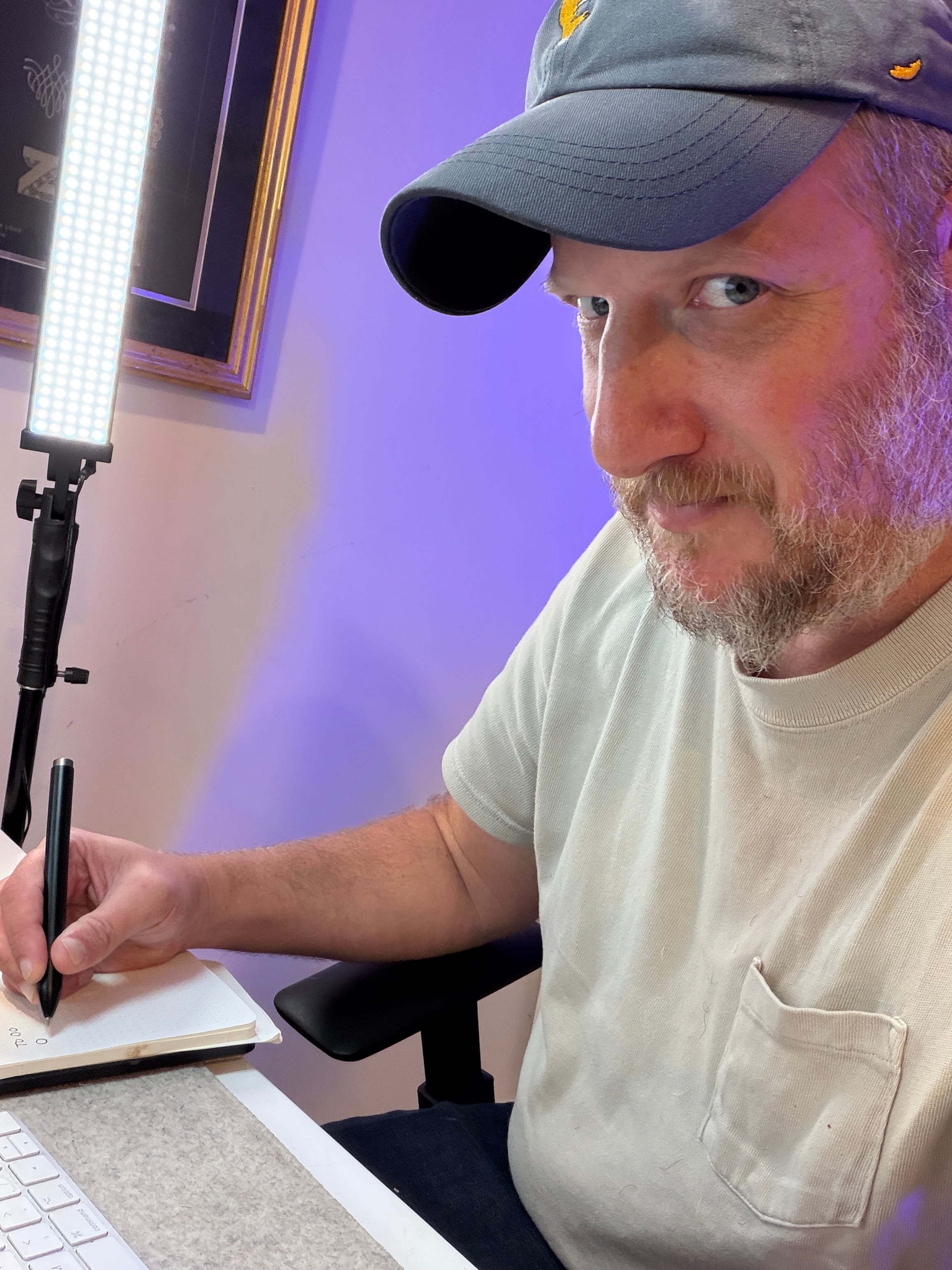
Don’t worry. OberThinking is not going anywhere. It's just going upstairs. This newsletter will lean harder into the philosophical end of things: human nature, self-deception, the seamy side, why we buy what we buy, and why we lie about it afterward. It will also continue to offer people unique ways to use AI to think more creatively and solve life problems. Plus, it will serve as my own personal evidence because every issue of this thing is a demonstration that the advice in other places works: you subscribed to it, you opened it, and you have read this far into a newsletter with only one picture in it.
*
As for the work itself: I have started taking direct response again, and website copy, and there is a short branded film underway, with a brand campaign starting soon after. I am still holding it to one copywriting project at a time, because the bulk of my hours belong to ghostwriting for high-net-worth individuals, many of whom, it turns out, have been quietly tapping me for copy all along.
They never once asked whether I called myself a publicist.
The clients were never confused about what I do. Only I was.
More about what I mean by that next week.
In the meantime, it is good to be myself again, even if myself is out of style.
— Justin Oberman
Comments
Nothing yet. Say the first thing.
Sign in to join the conversation.