
Every week, someone asks me the same question.
How do I get AI to write in my voice?
And every week I have to resist the urge to tell them the hard truth directly, because the hard truth is not what they are asking for, because the hard truth is that a voice is not a thing you can capture.
I talk about this in greater detail in my monthly free Idea Hunter Workshop, but to sum it up:
What most people are talking about when they talk about AI copying their writing is AI copying their style, not their voice.
Your style is the surface of your writing. It’s the way you arrange words on a page. It’s whether you use long sentences or short ones, whether you start with a question or a statement, or whether you write in paragraphs or punchy line breaks. In other words, style is a teachable and fixable technique.
Your voice, on the other hand, is something else entirely.
Your voice is the thing attached to your actual thinking. It’s the specific way you notice what’s around you. It’s your tastes, your suspicions, your private opinions about the people you work with, the books you love, the things that genuinely make you angry. More importantly, your voice is what you would say if nobody were watching. In other words, it’s your filter. And a filter cannot be captured because it is not a word pattern.
OBERTHOUGHT: Your voice is a filter, not a style.
Now…
I am talking about voice and style as if they are two separate things, and in one sense they are. But in another sense, when it comes to the writers who actually matter, they are completely inseparable.
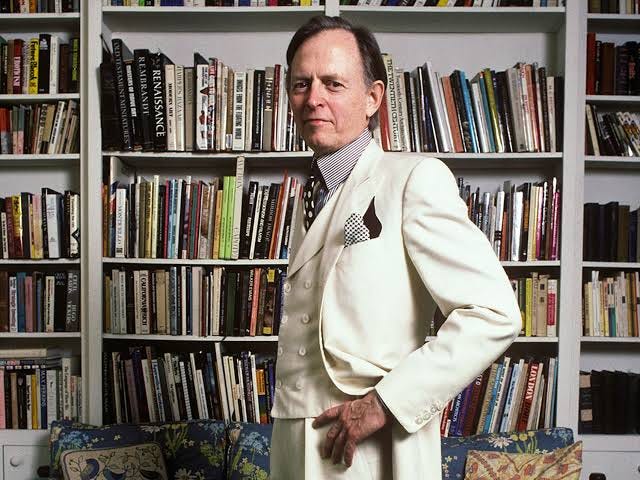
Whenever I think of someone with a very unique voice and style, I think about the non-fiction and fiction writer Tom Wolfe.
Tom Wolfe had both a voice so singular it could not be mistaken for anyone else’s and a style so distinctive it announced itself from the first sentence of the first paragraph before you even knew what he was writing about.
He used exclamation points the way other writers use periods. He invented compound words mid-sentence when the existing vocabulary was not sufficient for what he was trying to say. He wrote in long, electric, accumulating rushes that felt like someone had grabbed you by the collar and refused to let you slow down. He also borrowed the techniques of fiction, scene, dialogue, point of view, status detail, and applied them to journalism at a time when nobody in journalism thought that was allowed.
But underneath it all was something no amount of technical description or course or even AI training about Tom Wolfe’s style could capture. And that is simply the fact that Wolfe had a specific way of seeing American life, its status rituals, social performance, and desperate and hilarious hunger for prestige, that belonged entirely to him. He could walk into any room in America with his all-white suit and immediately identify its social architecture, who was performing for whom and what everyone was pretending not to want.
Most LinkedIn or even Substack Newsletter writing (hell, even marketing writing of any sort nowadays) avoids any and all of those things.
And even when the perspective is interesting, most of it gets written in a style that makes it seem like it’s trying to be immediately forgotten.
In the 60s and 70s, there were a few copywriters (Ogilvy, Gossage, Bernbach, Halbert, Schwartz) who were known for their voice and style. But nowadays, very few of us actually have a voice (which is a huge mistake when it comes to selling your services as a copywriter, which I will discuss in more detail in my upcoming bootcamp to teach copywriters how to get high-end clients).
To be clear, this isn’t because copywriters are bad writers. It’s mostly because having a voice is not a writing skill. Having a voice is a thinking skill built from years of paying genuine attention to the world around you, forming actual opinions about what you see, and being willing to say what you actually think rather than what the situation permits.
Hemingway had it. His voice came from a specific relationship to violence, to masculinity, to the way men behave when they are afraid, and from a writing discipline so severe it bordered on pathology.
Faulkner had it. His voice came from a specific grief about a specific place, the American South, its beauty and its rot, that he could not stop thinking about, no matter what he was officially writing about.
Bill Bernbach had it. His voice came from growing up a poor Jewish kid from the Bronx in a Non-Jewish world.
Howard Gossage had it. His voice came from a background in promotions and a love-hate relationship with advertising itself.
Tom Wolfe had it too.
And what they all shared was not a technique but a preoccupation, a way of looking at the world they could not stop seeing wherever they looked. In other words, a filter that was so particular to them that the writing it produced could not have come from anyone else.
Even if someone were to copy their style
And I am sorry to say this, but most people writing on LinkedIn or Substack do not have that kind of voice yet.
When you read someone whose writing stops you, it is almost never because of the style. It is because something in the writing reveals a way of seeing you have never encountered in exactly that way. And that could be for a lot of reasons.
It could be because of a specific observation, a particular angle, or a connection between two things that had no reason to be in the same sentence until this person put them there.
Let me show you what I mean with Wolfe specifically.
The title of his first book is: There Goes (Varoom! Varoom!) That Kandy-Kolored (Thphhhhhh!) Tangerine-Flake Streamline Baby (Rahghhhh!) Around the Bend (Brummmmmmmmmmmm).
And this is the opening of Radical Chic, his 1970 New York Magazine piece about a fundraiser Leonard Bernstein threw for the Black Panthers at his Park Avenue duplex. Wolfe was not invited. So he reconstructed the evening from interviews and his own observations of the social world it came from.
At 2 or 3 or 4 a.m., somewhere along in there, on August 25, 1966, his 48th birthday, in fact, Leonard Bernstein woke up in the dark in a state of wild alarm.”
When talking about the event itself, Wolfe describes Bernstein's appearance into the room as if Bernstein was having a vision — seeing himself walk onstage with a guitar.
And then: A guitar! One of those half-witted instruments, like the accordion, that are made for the Learn-To-Play-in-Eight-Days E-Z-Diagram 110-IQ 14-year-olds of Levittown!
The exclamation point after A guitar! Nobody does that. The compound word Learn-To-Play-in-Eight-Days, Wolfe invented it on the spot because no existing word was sufficient to convey the specific contempt he felt for the instrument. The E-Z-Diagram 110-IQ 14-year-olds of Levittown, that is not a description. That is a social class being skewered with surgical precision using nothing but made-up hyphenated words and a zip code.
And all of this is in the first two paragraphs before he tells you anything about the party, the Black Panthers, or any of the famous people who showed up.
He also invents words when existing ones aren’t sufficient, uses exclamation points the way other writers use periods, and writes in long, electric, accumulating rushes that feel like someone has grabbed you by the collar and refuses to let you slow down. He liked to spell out sounds of engines and crowds and laughter because, as he once put it in an interview, “if something sounded a certain way, the writing should sound that way too.”
In The Right Stuff, Wolfe is describes the unspoken caste system among test pilots, the invisible hierarchy that nobody acknowledges out loud but that every single person at Edwards Air Force Base understands completely. But he does not do this by explaining the hierarchy. Nor does he summarize it. What he does is put you inside the social performance of it And then at the very last moment, in the position of maximum emphasis, he names the thing that gives the whole passage its charge: the quality has no name and nobody talks about it:
“A young man might go into military flight training believing that he was entering some sort of technical school in which he was simply going to acquire a certain set of skills. Instead, he found himself all at once enclosed in a fraternity. And in this fraternity, even though it was military, men were not rated by their outward rank as ensigns, lieutenants, commanders, or whatever. No, herein the world was divided into those who had it and those who did not. This quality, this it, was never named, however, nor was it talked about in any way.”
In other words, Tom Wolfe did the thing only he could do: identify the social performance of a room, the gap between what people believe they are doing and what they are actually doing, and put it into a language that makes you laugh and wince at the same time.
That is a voice.
Everything else, the exclamation points, the compound words, the italics, the ellipses, and all the other surface tricks Wolfe fans and critics have cataloged for fifty years are his style.
But a style that belonged to his voice. Because without his voice underneath it, the style is costume. Like his all-white suit.
To illustrate this here is the same scene from Radical Chic written without that filter:
“Leonard Bernstein held a fundraiser for the Black Panthers at his Park Avenue home in January 1970. The event brought together wealthy New York socialites and members of the Black Panther Party. It was considered unusual at the time for people of Bernstein’s social standing to support such a controversial political organization.”
That is what AI produces when you have not given it a mind to replicate.
But if a voice is a pattern of thought, and a thought expressed in language comes out as a certain style, then there must be something in the language that encodes the thinking, something more specific than word choice and sentence length, something that carries the logic of a mind rather than just its surface texture. Something, in other words, that can be copied.
There is.
But before I can tell you what it is, it is very important for me to tell you what it isn’t.
Brook Landon, in Building Great Sentences, makes an argument about language that most people trying to improve their writing will find crazy.
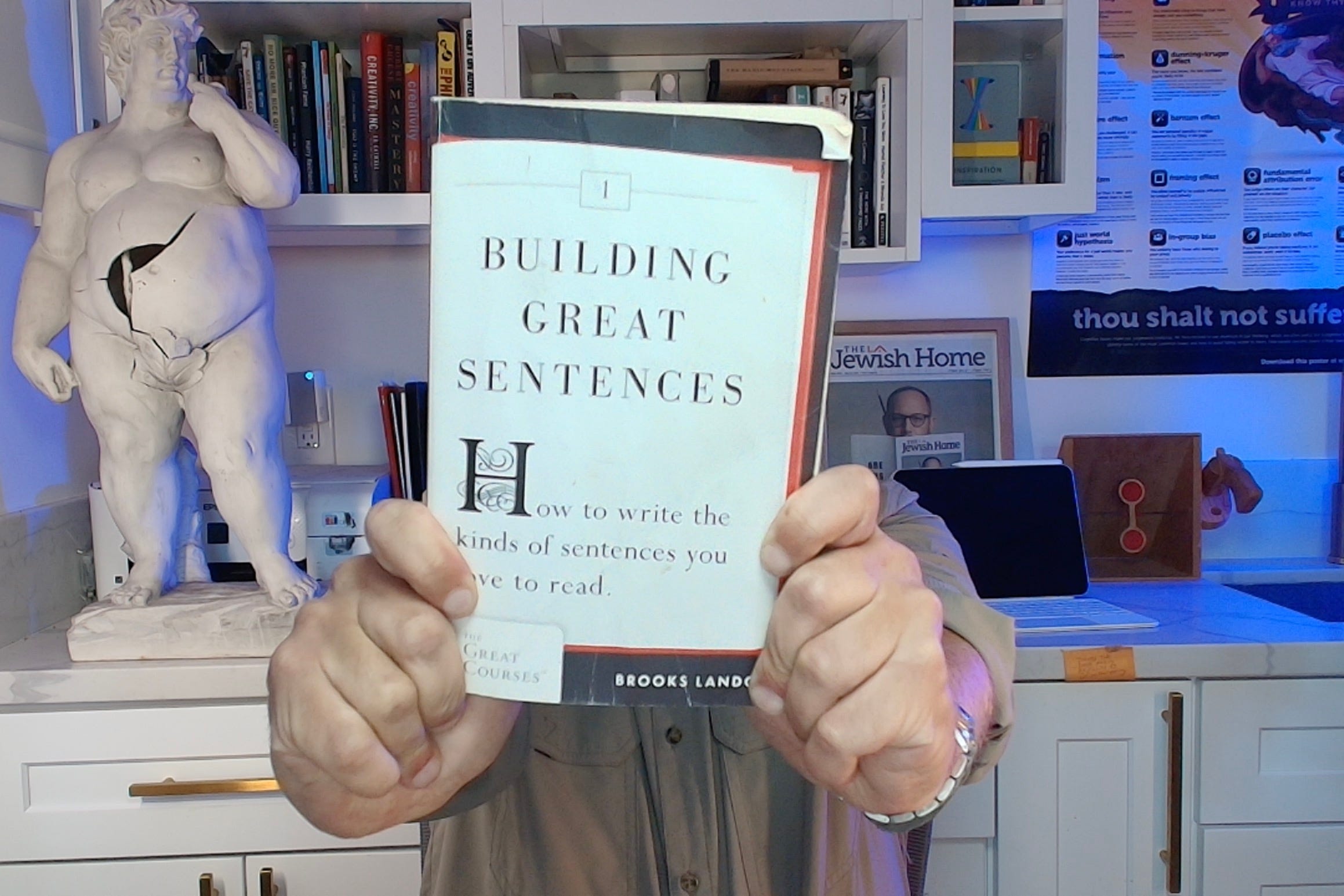
But that is because most people are trained to believe that the basic units of writing are words and sentences.
AI, as a Large Language Model, is trained to think this as well.
But Landon argues that this is not the case at all.
For Landon, the basic unit underlying all writing is not words and sentences, but philosophy, or, to put it, propositions.
For Landon, a proposition is the underlying claim or claims a sentence makes about the world.
These do not need to be complex.
For example, take the sentance:
“After fifteen years in marketing, watching campaigns come and go, sitting in rooms where everyone agreed and nothing changed, I finally understood that the problem was never the strategy.”
That is not one proposition. It is six. The writer spent fifteen years in marketing. Campaigns came and went. They sat in rooms. Everyone agreed. Nothing changed. The problem was never the strategy.
But what I want you to pay extra attention to is what the writer of that sentance chose to put last.
“I finally understood that the problem was never the strategy.”
The whole sentence is a setup for that final proposition, which only lands because the five propositions before it built the room the reader is sitting in when it arrives.
If you move that last proposition to the front, you have a completely different sentance that sounds like a completely different writer. One who, for an infinite number of reasons, has the inclination to announce their conclusion and then explain it.
The propositions are the same. But a sentance that puts that proposition first comes across very differently. It feels different. And the reason it feels different is that it was written in a different style by someone with a different voice. In this case, a voice that comes across as more preachy.
So while one’s style is affected by the way one arranges and chooses the words one puts on a page, it is most affected by the arrangement of propositions that a writer claims, in what order, and with what emphasis.
It is also affected by which propositions they choose to make apparent and which ones they choose to make invisible.
For example, Landon talks about the famous grammatical sentence:
“An invisible G-d created the visible world.”
If I asked you to count the number of propositions in that sentence, you would probably say that there are three.
1. An invisible G-d
2. An invisible G-d that can create
3. A visible world
But one could also say that there were five because the proposition “invisible G-d” assumes that G-d exists. The proposition about a “visible world” also, philosophically speaking, assumes that the visible world exists as well.
You may think I am overreaching here, but this matters a lot if and when I bring these propositions to the surface.
For example:
“There is a G-d! An invisible G-d. That created a visible world.”
Same facts. Same propositions. But a totally different feeling sentence. And all I did was bring one proposition that was assumed to the surface. “There is a G-d.”
The difference between the two sentences is not about vocabulary, grammar, sentence length, or the use of italics or exclamation points.
It is the order and selection of propositions.
It is, in the Tom Wolfe example from The Right Stuff, what Wolfe chose to show you first, what he chose to save for last, what he trusted you to infer, what he named and what he left unnamed.
That is what the protocol below is designed to teach AI to replicate.
Not Wolfe’s voice. Because that cannot be replicated.
But the propositional logic of a specific mind, how it moves, what it foregrounds, what it trusts the reader to supply, and where it places its weight.
And it is the closest thing to a voice that AI can currently produce.
Because the only way to train AI to copy your style (assuming you actually have one) or anyone’s style is to get the AI to look beyond word choice and word arrangements and pay closer attention to the way a person arranges and chooses propositions.
Which brings me to the paid part of this Paid Subscriber newsletter:
The protocol behind the paywall below this week is a Proposition Analysis System.
You feed it ten examples of writing from the person whose style you want to replicate. This could be yourself, a client, or a writer you admire. After each example, the protocol dissects the underlying propositions: what claims were made, in what order, what was foregrounded, what was left implicit, what that pattern reveals about how that mind works, and tells you what it has found. This is very important because with AI, there is no input without output. It is also very important for you to review these outputs, as this is not easy for AI to do. It can do it well enough, but it can also sometimes misunderstand or skip propositions. And if you catch that, you need to fix it right away. Otherwise, it will throw the whole thing off.
After you input the ten examples, it synthesizes everything it has learned into a detailed instruction set, detailed enough for you to paste into a Claude Project or a ChatGPT custom GPT and actually produce writing that carries the logical style of the original mind.
It is the closest you can get AI to write in a person’s voice. But I want to be very clear about this…
What it captures is not a person’s voice. Because nothing can capture a person’s voice. All it does is capture the logic and style influenced by that voice.
And that is a very important distinction for you to understand. Because if you copy someone’s style but you don’t actually think in the same way that person does, or provide it with the same kind of detail or ways of thinking that the writer does, the outputs are going to come out sounding very weird.
But when done right, it produces results that are 90% more accurate than everything else people are doing when they try to train AI on someone’s writing.
I have personally used it to create a Claude Project that writes in the style of Tom Wolfe, which (using another one of my protocols that guides me on the information Tom Wolfe needs to write the way he does, plus a little editing afterward) has fooled one or two Tom Wolfe fans and scholars.
I have also used it to create projects for various LinkedIn personalities with unique styles, all of whom, after I showed it to them, asked me for it.
The proticol comes in two parts.
Part 1 tells you exactly what this is and how to use it.
Part 2 is the complete prompt, everything you copy and paste.
PART 1: HOW TO USE THIS
What it is: A ten-example analysis system that dissects writing samples at the level of propositions, the underlying claims each piece of writing makes, and synthesizes those patterns into a detailed style instruction for any AI platform.
What it produces: A complete, deployable system prompt you paste into a Claude Project, ChatGPT Custom GPT, or Gemini Gem, one that instructs AI to replicate not the surface texture of someone’s writing but the propositional logic underneath it.
When to use it: Any time you need AI to write consistently in a specific style coming from a unique voice- your own, a client’s, or a writer you’re studying. Run the analysis once. Use the output indefinitely.
How long does it take: Twenty to thirty minutes for the ten examples. Five minutes to deploy the output.
What you need before you start:
Ten writing samples from the person whose style you want to replicate. They do not all have to be in the same format; a mix of posts, paragraphs, and emails often produces a richer analysis than ten of the same thing. Each sample should be at least fifty words. Longer is better. The more the writer has to actually move through an argument or tell a story, the more propositions there are to analyze.
All that matters is that you keep the medium the writing will appear on the same.
If you want the project to write LinkedIn posts, make it 10 LinkedIn posts. For newsletters make it 10 newsletters.
You also want to choose posts that performed well. And by performing well, I don’t just mean from your perspective, but from theirs. You want to find the top 10 examples that performed better than everything else they have ever written. In other words, you want to find the outliers.
To help me find the outliers I use DAN KOE’s platform Eden.

Among many other amazing things (like giving me a place to store all the content I find online that I find useful or want to refrence, it also allows me to look up anyone with a social media account and, with a click of a button, see their outlier posts. Eden is an essential part of my stack. I have no idea how anyone creating content can create content without it. Check Eden out here.
O.K, back to Proposition Analysis Protocol
What to do:
Open a new AI Claude Project, Gemini Gem, or GPTs
Copy everything in the box in Part 2 below. The entire box. Nothing outside it.
Paste it and hit send.
When the system asks for the first sample, paste it in.
After each sample, the system will give you its propositional analysis and ask for the next one. Respond with the next sample.
After the tenth sample, the system will synthesize everything it has learned into a complete instruction set.
Copy that instruction set. Open a new Claude Project, ChatGPT Custom GPT, or Gemini Gem. Paste it as the system instructions.
The system you have just created will write in the propositional logic of the person you analyzed. Not perfectly, because no system is built entirely on using language as algebra does. But closer than anything else you have tried.
So the output will be good. Possibly surprisingly good. It will produce writing that carries the logic of the original in a way that surface style analysis never does. But it will still be filled with AI patterns (just styled differently). It will also overemphasize the patterns it was trained to pick up on. It will overemphasize and over-embellish the use of propositions and rhetorical devices, so you will still need to edit it to make it sound more human.
Which is exactly what my Copy Hunter Field Guide for Writing Like A Human in the Age of AI is designed for. It consists of 52 things to hunt for, words, phrases, straw man arguments, big words, etc., to either change or kill.
The first 17 hunts have already been released. When all 52 hunts are made, the price of the Field Guide will be $200. But if you join while we build it, it can be yours for only $75. Just use the word PRESALE at checkout. Here’s the link
And, as I keep reminding you, it will not capture your voice.
Your voice is what you would say if nobody were watching. Voice is the filter. Voice is built from a specific Cabinet of Curiosity, a specific set of lived experiences, a specific way of seeing the world that belongs to exactly one person.
The proposition analysis captures how that person’s mind moves when it writes.
Which is valuable. I think it is genuinely more valuable than anything else I have seen for training AI on a specific writer.
But it is not the same as the voice itself.
A voice can only come from a human being. All the protocol below can do is just make sure that when AI writes on your behalf, it thinks in your direction rather than in the direction of the average.
That is not a small thing.
But it is not everything.
Everything is still you.
PART 2: THE PROMPT
Copy everything inside the box. Paste it into a new AI conversation. Do not copy anything outside the box.
Comments
Nothing yet. Say the first thing.
Sign in to join the conversation.