
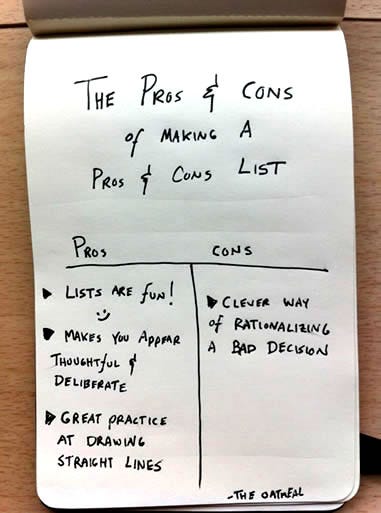
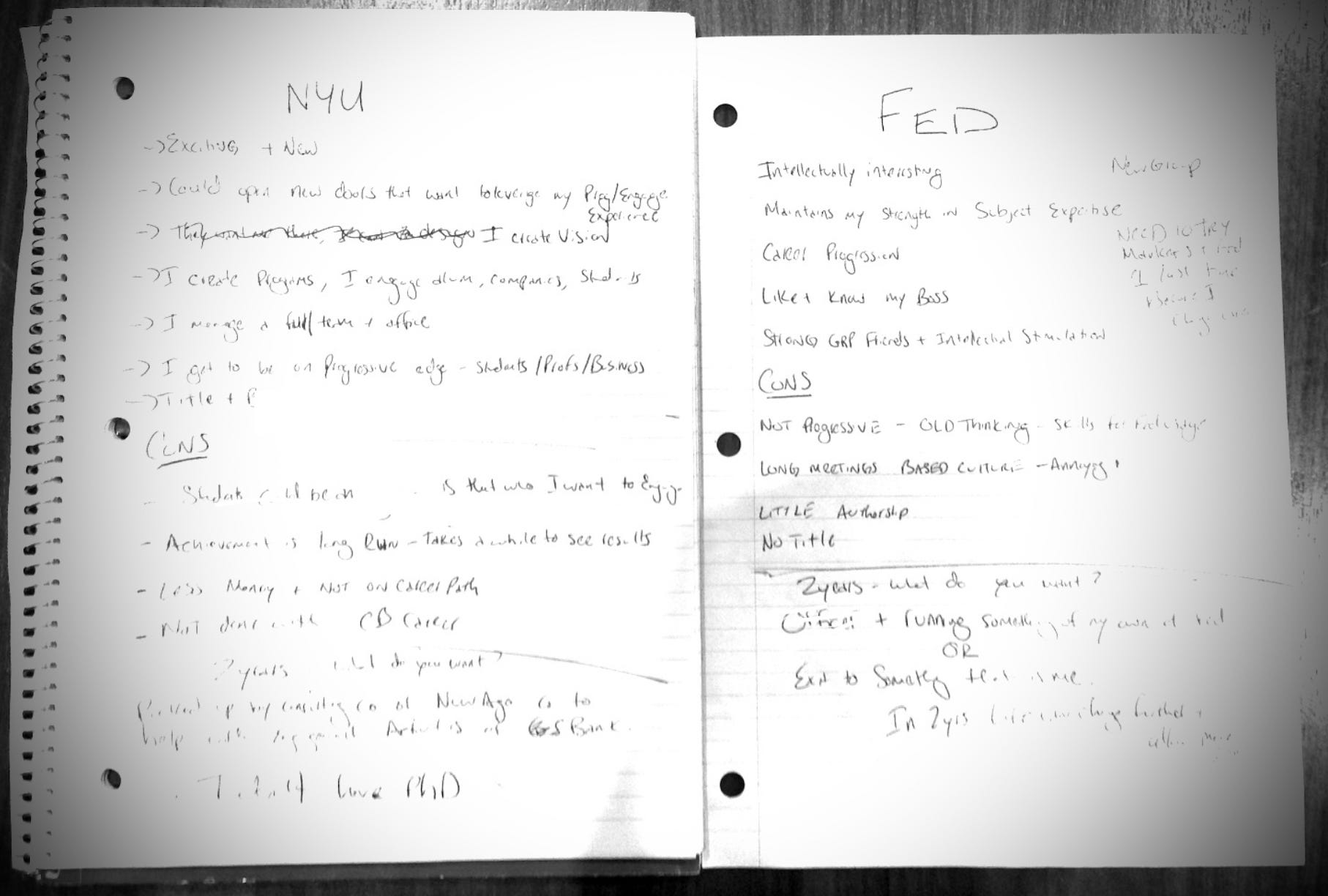
Eleven years ago, I made a careful pro/con list to decide between returning to my previous desk at the Fed or to take a leap to NYU. On paper, the Fed won. But I chose NYU and I haven’t looked back since.
My solution didn’t come from my pro/con list, but rather from something I caught myself saying out loud.
We like to believe our decisions are rational, that if we just list the pros and cons, the “right” answer will reveal itself. But in reality, your most important decisions aren’t made by logic alone. They’re shaped by what you value, and even more importantly, what future you’re ready to create.
Cost-benefit lists don’t work.
They give you a false sense of certainty and control that doesn’t exist. The problem is that when you write a pro/con list, every item is treated equally. “Good boss” sits next to “long commute” as if they carry the same weight. The result is that you can end up choosing a path that looks better on paper but feels wrong in reality, and you won’t know why until you’re already on it.
The trap of a pro/con list is that in trying to be careful in capturing all the factors, we forgot instead to consider the weight of what matters most. In math we may think of this as a coefficient in an equation. Each variable is not equal in weight, so stop looking at them as if they are. And some variables are too difficult to categorize at all.
In 2015, my list said the Fed was the obvious choice. I wrote that it was intellectually stimulating, provided a strong career progression, and had a boss I respected. (To my Fed friends, I still think foundly on my time there!). Furthermore, on my NYU “cons” list I reinforced that I was “Not done with central bank career.”
The pro/con list was capturing my fear of changing careers, my inertia actually lived on both sides of the ledger! The problem was that the list couldn’t help me see what I actually valued in the moment.
AI tools like ChatGPT or Claude will often give you the wrong answer to big decisions for the same reason your pro/con list does. They optimize based on surface-level inputs, not your internal value system. They don’t know what you prioritize unless you explicitly define it. Yes, they have some memory, but they aren’t capturing your motivations, desires, and psychological needs. If you outsource your thinking without clarifying your values, you risk making decisions that feel coherent but that are uninspired and not aligned with your goals.
When we look around at others that seem to make decisions easier, it’s easier to think they are just risk takers. That’s what many people believe about entrepreneurs, that they love risk. But the reality is very different. They just value what they are pursuing more. And that can range from seeking autonomy, to building a big idea, to leading a team. Arthur Brooks has been talking about this recently, and would probably say they are using their right hemisphere of their brain and tapping into excitement alongside of fear.
So what are we suppose to do? Before evaluating options on a tally sheet, define what is more important to you right now: stability or growth? mastery or exploration? past identity or future potential? Better analysis from AI tools won’t “solve” what we haven’t clarified and thought through ourselves. Actually the risk is that it accelerates our analysis paralysis loop, leaving us even more confused.
The word decide comes from the latin word decidere, which means “to cut off” or “to kill” an alternative. I learned about this surprising etymology history when I read Oliver Burkeman’s incredible book 4,000 Weeks. It’s shocking because killing off alternatives is exactly why it’s so hard to make a decision. We don’t want kill off our options.
But what I’ve found, whether it’s for yourself or for an organization, deciding when uncertainty is extremely high, is much more about revealing who you want to become.

The choice that wins isn’t the one with the most pros. It’s the one that aligns with the identity you’re ready to step into. If you ignore that signal, you stay stuck optimizing a life you’ve already outgrown. For a business, you become stuck in your past success, ready to be disrupted by the next new competitor.
Instead of asking “Which option is better?”, ask: “Which future am I ready to enter?” What pulled me to NYU wasn’t logic, it was observing my own language at the time. I wrote that it would be “exciting and new,” that I’d be “on the progressive edge,” working with students, professors, and businesses. I wanted authorship, responsibility, and a different kind of impact. And most of all I remember telling then NYU Stern Dean Geeta Menon,
“I want to be the person that takes this job.”
After you observe yourself saying something like that, you can’t turn back. At that moment I didn’t realize it but I had made a decision to end one career path and enter another, I stopped weighing options and chose a future.
No posts
Comments
Nothing yet. Say the first thing.
Sign in to join the conversation.