
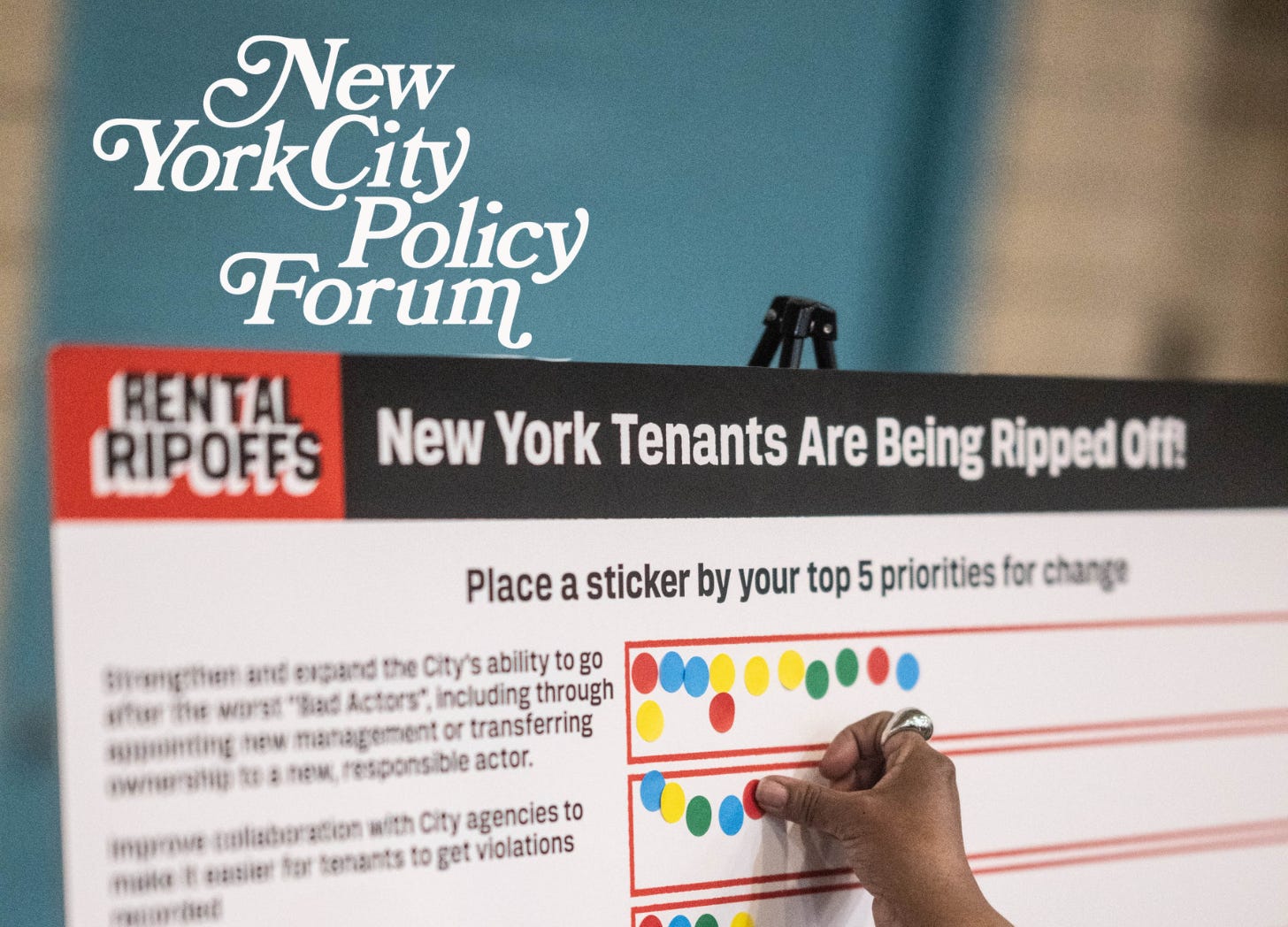
One of the major ambitions of the Mamdani mayoralty is to increase engagement in the city’s governing institutions. “We won because we insisted that no longer would politics be something that is done to us,” he declared in his victory speech. “Now, it is something that we do.” One of Mamdani’s first actions was to organize “rental ripoff hearings” at which tenants could share their struggles and demand changes. He then created a new Office of Mass Engagement to “reach New Yorkers where they are, organize them, and build long-term participation” in governing institutions. Recently, that office formed Organize NYC to run mobilization efforts.
In attempting to achieve mass participation in governing institutions, the Mamdani administration builds on a long and motley tradition of experimentation and struggle. To help understand what we can learn from these past efforts, law professor Luke Herrine spoke with two leading scholars on the topic, Michael Sant’Ambrogio and Glen Staszewski. Among other work, Sant’Ambrogio and Staszewski conducted a massive study examining decades of federal agency experiments with expanding mass engagement in rulemaking—the process by which agencies establish the regulations necessary to implement the broad goals set out in legislation. In the following interview, they discuss the value of public participation, what kind of reforms enable greater participation, and what lessons cities can take from these experiments in federal rulemaking.
Luke Herrine: To get us oriented: What is the point of making rulemaking more participatory?
Glen Staszewski: From a theoretical standpoint, public participation promotes legitimate and effective democratic governance by helping to ensure that public officials consider all the relevant information and views and provide reasoned justifications for their decisions.
First, public officials don’t know everything. They’re not omniscient. They need to hear from other people to be fully up to speed on the issues and make quality, effective decisions. Public participation performs that role, thereby improving the effectiveness of government.
There’s also the question of legitimacy. When government exercises coercive authority, they should hear from everyone who’s going to be affected by their decisions, take their views into account, and make decisions that could be or should be acceptable to the people who are affected by those decisions. That doesn’t mean that members of the public are necessarily going to agree with the decisions, but they can at least understand them and accept them.
Michael Sant’Ambrogio: I’d add that in a republican form of government, the business of government is the people’s business, so the government should be accountable to the people, the public. And accountability requires more than just electoral feedback. It requires an ongoing relationship between the public and the government. The government owes a duty to render an account for what it is doing in ways that are understandable by the public and in which the public can engage. This duty might even be heightened for regulatory agencies, because they are run by people who are not elected.
LH: A similar notion—the idea that unelected bureaucrats are making illegitimate decisions at a remove from the people—has been a core part of this most recent wave of MAGA, and especially the MAHA insurgency. Robert F. Kennedy Jr. and others portray themselves as reclaiming administrative agencies from corrupted experts and putting it in the hands of the people. How do you think about your own views on participatory rulemaking in relation to these movements?
MS: Some of our proposed reforms can help to close the gap between experts and the public. One of the barriers to public participation is the divide between what experts are addressing and what the public sees and knows about a problem. I think that the public is much more likely to have a healthy respect for expertise, if not always agreeing with the position of the experts, if they understand the issues that they’re grappling with.
GS: Your question relates to the interplay between legitimacy and effectiveness. I think of expertise as going to the effectiveness of the decision-making process, whereas the political preferences and perspectives of ordinary citizens are relevant to legitimacy. It’s important to take both into account. Experts should understand how their decisions are going to affect people, and what those affected want and think about these things. But they can also explain to the public what approach they’re taking and why they chose it over alternatives.
This is part of the reason we believe in more deliberative democracy, as opposed to direct democracy. There is real value to having agencies—including people with expertise—making these decisions. They’re more inclined to make effective decisions, taking into account different views and interests, than someone who doesn’t know what they’re doing and doesn’t have access to all the information and facts.
MS: To emphasize the point, we’re not electing autocrats. The ongoing relationship between our political leaders and the public requires dialogue. Certainly, when we’re electing people, we’re electing them to exercise discretion. But we create many guardrails on that discretion—constitutional, statutory, and otherwise—and we think that one more should be that their appointees should still be accountable in some ongoing way to the people as they make decisions.
LH: Would you go so far as to say that public participation in ongoing governance might actually make people more informed and engaged when election time comes around?
GS: There’s social science literature that suggests that people who participate in government decision-making become more civically active in other ways as well, including by paying more attention to politics and being more informed voters. In some of our work, Michael and I argue that one of the values of public engagement with policymaking is that it helps create an infrastructure of civic engagement, where you have more people who are interested in and engaged with what’s going on across the board.
LH: Okay, assuming that we want more participation in regulation, let’s shift gears and explore what that might look like in practice. One core institution of federal regulation is what’s called “notice and comment rulemaking.” How does notice and comment make agencies more responsive to the public? And what are some of the limitations to this practice?
MS: Notice and comment rulemaking, which was codified in the Administrative Procedure Act of 1946, has often been described as one of the greatest inventions of modern government. Formally, it is quite open and participatory. It gives any interested member of the public the opportunity to comment with views, data, and arguments about proposals made by a federal government agency to regulate some particular area. The agency must consider and respond to the public’s views in a reasoned fashion, typically once the agency issues the final rule. If you understand this process, and you have the interest and capacity to participate effectively, it works very well.
But most people don’t have the capacity to participate effectively. While notice-and-comment rulemaking is formally quite open, it tends to favor well-resourced interests that are aware of and motivated to participate in the rulemaking.
Everyday people, who stand to benefit from agency regulation, are typically absent from notice and comment rulemaking, especially when compared to the regulated entities, which have a very strong financial interest in participating. Also excluded, to a lesser degree, are smaller regulated entities, who may not have the same resources as larger businesses or industry associations. State, local, and tribal governments also participate much less frequently than regulated entities. Unaffiliated experts, such as scholars, participate sometimes, as do well-resourced public interest groups, but each less frequently than the large, regulated industries.
One of the challenges that we and many others have tried to address is how to reach traditionally absent stakeholders, unaffiliated experts, and members of the general public when they have important information that could help agencies to make a more effective, legitimate decision.
GS: I’d add that one of the advantages of notice and comment rulemaking is that it’s not a “plebiscite.” It’s not like we’re counting votes, how many people favor this proposal versus how many oppose it. A minority group or an individual can thus have a big impact on the process if they submit significant comments, data, views, or arguments—those have to be taken into account regardless of whether the position is widely shared. The system doesn’t have to be fully balanced for a less powerful person or constituency to have an impact.
LH: What are some of the major initiatives to make regulation more participatory?
MS: At the beginning of the twenty-first century, there was a big move to put notice and comment rulemaking online, both as a way for the public to more easily participate and as a way for the agency to respond to those comments when issuing final rules. Many people thought that “e-rulemaking” would really make rulemaking much more open than it had been before, and certainly, in some ways, it did. You no longer had to go to the library to get the Federal Register and the Notice of Proposed Rulemaking. You no longer had to go to a reading room in Washington, DC, to get the rulemaking record or all the comments that had been submitted.
But it didn’t really fundamentally shift the dynamic of traditional stakeholders dominating the process. And even with the mass comments now possible in certain rulemakings with heightened public salience and interest, the comments have ended up being largely duplicative and not particularly effective at answering the kinds of questions that agencies need answered.
Social media is also a great tool, if used well, to communicate and engage with traditionally absent stakeholders. But fundamentally, notices of proposed rulemaking are very difficult documents for most members of the general public to engage with. They’re long, they’re written in a lot of legalese, they tend to be pitched to a college-educated audience. And the very detailed descriptions make it very hard to figure out what pieces you can engage with as a member of the public. Most people will not have the interest or situated knowledge to engage with the entire rule, which is often very technical and complex. We’ve been working on ways to break rules down into digestible parts and make them more accessible.
GS: One thing that Michael didn’t mention is that during the Obama administration there was this Regulation Room project run by Cynthia Farina at Cornell University, along with a number of collaborators. She worked with several federal agencies, including the Department of Transportation and CFPB, on a couple of rulemaking proposals. Basically, they set up an online and interactive portal in which folks could learn about and comment on the proposed rule. They did a lot of outreach to get folks to participate. The portal described what was going on in these rulemaking proceedings in ways that were understandable to an ordinary person. And it broke the rulemaking down into much more specific and discrete topics, where they asked very specific questions. People could then click on the things that they were interested in and submit comments. They had people trained in mediation respond to comments and elicit follow-ups. At the end of this process, Cynthia Farina herself, I believe, went through and summarized the commentary and provided it as a single comment to the agency. For example, ‘the Department of Transportation is doing this rule on the trucking industry, and here is what the truck drivers we’ve spoken with think about it.’
MS: It was a great model for rulemakings when there is important, situated knowledge held by members of the public that can contribute to a more effective rule.
GS: It’s probably clear from our description that it’s very resource-intensive. You can only do this for a relatively small number of important projects.
During the Biden administration, there was a big emphasis on planning for public engagement. Each agency was required to have a general plan for engaging with the public, and specific plans about what types of public engagement make sense in any particular rulemaking or decision. Another area of emphasis was on targeted outreach to what the Biden administration termed “underserved communities” and other missing stakeholders. They asked, who would be affected by this? Who would be interested in this? Who doesn’t normally participate? How do we reach them and encourage them to participate? Also, the Biden administration made concerted efforts to facilitate public participation in agenda setting and rule development. These early stages are often the points in the rulemaking process where public input be more impactful, because the agency’s views and plans aren’t already set in stone. Issues tend to be more “value-oriented” and about setting priorities at this stage— public input maybe has more value here. When you get into the technical details of implementation, you’re generally going to rely more heavily on technical expertise.
LH: What are the best practices, as you see them, for democratizing rule development?
MS: Let’s start with some simple things. I mentioned how a lot of these notices of proposed rulemaking are written in very technical, complex language. Unsophisticated stakeholders can participate in a meaningful way if you use plain language to explain the information they need about what the agency is proposing and the major questions under consideration need. That could include visuals in addition to a written statement. Public communication on the regulation can be broken down into discrete, manageable, digestible subparts, so that people can focus on particular areas that might be relevant to them, and where they might have an opportunity to participate meaningfully.
Another good practice is spreading the word to people where they are: social media, bus stops. One of the agencies we spoke with in a recent study talked about doing outreach in barbershops, because that’s where the stakeholders they wanted to reach were
It’s easier to do all of this if an agency has plans for public participation and each particular rulemaking, especially where there is important information to be gained from traditionally excluded voices.
Where it’s particularly important to expand input, agencies need to think about the educational aspect, so that the desired audience has the capacity to participate meaningfully. Regulation Room developed short videos about the notice and comment rulemaking process, and how to contribute comments that are persuasive to agencies.
City governments should take care to have well-structured public meetings. If you just put up a microphone, you will get a long line of people stating their positions, up or down, but not providing information that can actually change how agency officials are thinking about the issues. One agency we talked to would have one-on-one conversations with interested members of the public, so they didn’t need to be comfortable speaking in front of a giant room. The back-and-forth dialogue helped the agency elicit meaningful information and perspective from the participants.
GS: A couple things to add. First, it’s important to let people know that their participation matters. That requires follow-up at the end of the process—at the very least, thanking people for participating, but ideally also addressing their concerns in the decision-making process.
Second, use of advisory committees, composed of a balanced group of interested stakeholders can help balance out these “self-selective” forms of participation, which do not necessarily reflect all the relevant interests or views.
Local agencies could also form citizen advisory committees—groups of ordinary citizens that are kind of representative of the public in various demographic ways. In Michigan, for example, a low-income energy policy board made up of a representative group of ordinary citizens has been influential in some policymaking related to energy issues.
The Holy Grail of best practice, if you want to put it that way,is establishing and involving “mini publics” in policy decision-making. Citizen advisory committees are one way of doing this. Citizen assemblies, like the ones that have been used in British Columbia, or deliberative polls along the lines that James Fishkin has established, are more elaborate than the citizen advisory committees. The basic idea is to gather a representative group of stakeholders, give them background information about the decision that needs to be made and the competing arguments,views, and data, have them engage in discussions with one another and give them an opportunity to ask questions of agency officials and other experts.Then they can provide advice about what should be done. Mini publics can give you a sense of what the general public would think about an issue if it had the time to learn about it and give it careful thought. You can’t do deliberative polling all the time, but for really important decisions where a variety of perspectives could be useful, these are worth trying and could have a big payoff.
LH: What institutional reforms can an agency make to create more enduring and routine participatory processes?
MS: One possibility is to have dedicated offices of public participation—a group that’s focused on ensuring meaningful public engagement and skilled at identifying that across different types of proceeding. They can also help think about whether enhanced participation is appropriate in a given circumstance, how much engagement would be worthwhile, and what tools would be most effective. It’s difficult for agencies with a variety of priorities to always be thinking about public participation. An Office of Public Engagement could be part of the team that collaborates with other agency officials to make sure that the public is involved at an appropriate level whenever the agency makes policy decisions to implement its substantive mission. We’ve seen some of that in some federal agencies, and perhaps the Office of Mass Engagement could play that role in New York City.
We’ve also seen that it can be beneficial to have cross-pollination across different decisions, both within agencies and across governmental agencies. Can an agency working on a rulemaking learn from its enforcement cases, and vice versa? Maintaining that flow of information can make public participation take a variety of forms and inform multiple regulatory actions.
LH: Your research has mostly focused on the federal government, though you’ve given some examples from states and municipalities. What is different about the municipal level, and what lessons can cities take from your work?
GS: Resource limitations are a major challenge. But at the same time, a municipal government might be closer to the affected public, and may know them or be able to find out more easily whom to talk to. To the extent that municipal bodies deal in bread-and-butter issues, they may find it easier in many cases to explain the issues and problems to people within the community.
Another advantage of public participation at the local level is that there’s more of an opportunity for experimentation. This is partly related to having fewer legal constraints. Let’s try having a deliberative poll. Let’s set up a citizen advisory group. Let’s do a Regulation Room–type project or exercise. And then let’s see what works well and build on that. One of the most important things in the public engagement field is the need for greater experimentation and learning, and doing this at the local level is exciting, partly for that reason.
MS: I’ll throw out a caveat. At the local level, entrenched interests and traditionally present stakeholders—whether that’s the real estate industry, unions, or whoever it might be—can be even more entrenched, and it can be harder in some ways for people to evolve in their thinking about issues they’ve been engaging in a certain way for a long time.
Another caveat: At the federal level, most rulemaking is not going to have a significant political impact on the President. I’m not sure that’s true at the local level. The mayor might be more sensitive to the politics of a lot of these issues, because mayors rely on less dispersed publics for their support.
In terms of the motivation to be involved, there are certainly fewer local barriers for a lot of issues. If you think about Waymo taxis, Hudson Yards, or congestion pricing—people really are prepared to participate in those types of issues.
LH: Wonderful, thanks so much for your time.
Luke Herrine is a Visiting Assistant Professor of Law at Brooklyn Law School and an Assistant Professor of Law at Alabama Law.
Michael Sant’Ambrogio is the Dean of Michigan State University College of Law.
Glen Staszewski is a Professor of Law & The A.J. Thomas Faculty Scholar at Michigan State University College of Law.
No posts
Comments
Nothing yet. Say the first thing.
Sign in to join the conversation.