
I’m probably not the first person to say this, but I’ve been experiencing it more frequently: the joy of making and fixing software is gone. And I miss that feeling.
I was lucky to get into college before ChatGPT was a thing. And when ChatGPT started becoming a thing, it still wasn’t good enough to solve my school assignments.
Last semester at NUS, I took an advanced database course. We spent most of the semester learning how PostgreSQL works internally.
One of the assignments was to modify the way Postgres’s buffer manager manages its free list. Technically, a database engine tries to keep some data in memory for fast lookups. But since memory is limited, it occasionally needs to choose chunks of data to write back to disk, i.e., maintaining a list of free memory slots. And it was freaking hard.
We worked in pairs. The professor encouraged everyone to discuss the assignment, as long as we didn’t copy each other’s work. Perhaps he knew how complex it was.
Some of my friends also took that course in the same semester. After the first week, most of us had gotten - or at least thought we had gotten - the first half of the assignment done. But the real challenge was in the second part.
At NUS, we have something called recess week. There are no classes for the whole week before the midterm exams. That semester, we spent most of recess week working on the second half of the assignment.
We spent nights trying out a bunch of things and taking turns writing code. It was a cycle: someone came up with an idea, others implemented it, the tests ran, something crashed, and then everyone did it again and again.
It was painful, but in the moments between a new idea coming up and the test almost finishing, we felt the adrenaline. And after each iteration, we learned something new. Perhaps the most important lesson was to stay humble.
Eventually, most of us got it right. It was hacky, but it was beautiful. And we no longer cared about midterms. We were tired, but satisfied.
I went through that kind of emotion many more times, both in school and at work, both by myself and with friends and colleagues.
That was the joy of coming up with new ideas, perhaps thinking you were smarter than other people - and smarter than yourself five minutes ago - then realizing you were wrong. That was the joy of debating each other’s opinions. The joy of figuring things out. And, the joy of getting things done.
Looking back, I haven’t experienced that in a few months.
People have been talking a lot about the Opus 4.5 inflection point, where coding agents transitioned from sometimes working to working most of the time.
I have benefited greatly from that transition and enjoy it a lot. I can now build things faster, and more importantly, build things I would never have built by myself without AI.
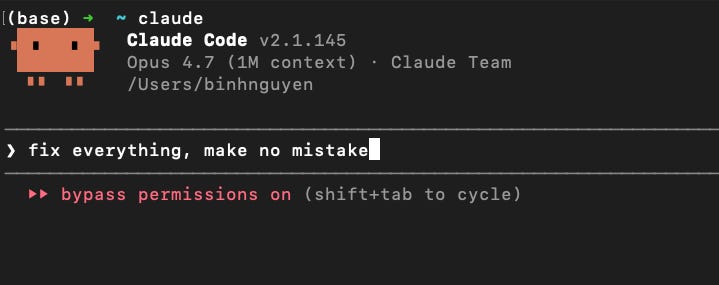
But now, whenever I need to build a new feature, fix a bug, or investigate an alert, the first thing I do is throw it to Claude. And it doesn’t make sense not to.
Even if I can sometimes solve a problem faster than Claude because of my knowledge of the system, letting Claude do it is still better overall, since it frees me to do something else during that time. Sometimes that “something else” is just browsing X or LinkedIn. Furthermore, humans are cognitively lazy by default.
At the end of the day, engineers are paid to build software that delivers business impact. Collapsing the time it takes to build new things and fix issues is good overall, and the old way of writing code may someday disappear.
But that old way of writing code was how I learned to become who I am today. And it was fun. And I miss it.
Comments
Nothing yet. Say the first thing.
Sign in to join the conversation.