

When businesses talk about finding “the right person”, they tend to focus on experience, past titles, or the mythical ability to “hit the ground running”. Yet when you pull back the curtain on most hiring failures, the issue rarely starts with the candidate.
It starts with the role.
Overlooked, under-designed, or stitched together from old templates, many roles have no meaningful connection to the organisation’s long-term direction. They describe tasks, not impact, and responsibilities, not the thinking needed to drive the business forward.
This creates an unspoken disconnect where companies say they want capability and judgement, but they advertise skill lists and tick-box criteria instead. It’s no wonder the recruitment process becomes a lottery... and an increasingly biased one at that.
We often tell ourselves the problem is the talent market, or “people today”, or a lack of applicants with the right background.
Too old.
Too Young.
Wrong type of work experience.... yadi-yadi-yada...
Traditional recruitment practices weren’t built for the modern landscape of fast-paced tech, hybrid cultures, and ever-shifting strategic horizons. They’re relics of a time when the world moved slowly, roles stayed static, and experience genuinely predicted future performance.
So now we know the problem, what can we do about it?
Decades of research support what many leaders already already know... experience is a poor predictor of how someone will actually perform in a new environment.
Hunter-Schmidt ’s landmark meta-analysis demonstrated the low correlation between years of experience and job success. More recent analysis hasn’t improved the picture. LinkedIn ’s 2023 Future of Recruiting report shows skills-based assessments outperform experience and interview performance by a large margin. And GitLab ’s 2022 Talent Index found that hiring managers consistently overestimated the value of experience... despite repeated evidence that context, culture, and decision-making matter far more.
If anything, relying on experience alone is becoming riskier.
Fast-growth environments are defined by ambiguity, emerging priorities, rapid change, and the need for sound judgement. Someone who has spent ten years in a rigid structure may struggle to adapt; meanwhile, someone with less experience but greater alignment and decision-making clarity may thrive.
Traditional recruitment filters the latter out long before they ever get a chance to demonstrate this.
There are many incredibly capable, deeply experienced individuals are often rejected with vague, dismissive feedback like “too senior”, “overqualified”, or “didn’t meet the essential criteria”.
On the surface these seem legitimate. Beneath the surface, they reflect something else entirely.
“Too senior” often means:
You’ll ask for clarity we haven’t built yet.
“Overqualified” often means:
You’ll question things we’re not ready to address.
“Too experienced” often means:
You’ll spot gaps we’ve grown used to tolerating.
Many organisations aren’t afraid of experience... they’re afraid of what experience will reveal.
This pattern shows up most visibly in tech companies between £1M and £30M turnover, where growth outpaces structure.
Leaders are stretched, responsibilities blur, and roles evolve faster than they can be documented. In these environments, hiring someone with depth isn’t always seen as an asset. It’s seen as pressure.
What looks like “caution” is often avoidance.
What looks like “culture fit” is preference bias.
What looks like “agility” is a lack of clarity.
The CIPD notes that nearly half of all job descriptions are recycled from old roles, and over 60 per cent have no real alignment with business strategy. This leads to an odd paradox... organisations want strategic clarity from candidates while giving them none in return.
The result?
Roles stay undefined.
Onboarding becomes chaotic.
People drown in ambiguity.
Turnover rises.
Leadership wonders why nothing sticks.
Traditional recruitment tools... CVs, competency lists, AI screening... or even new video versions of these old methods amplify the disconnect. They reward:
Polish, not potential.
Confidence, not competence.
Familiarity, not alignment.
They fail to engage both parties to assess alignment, instead they offer new ways to cement further biases.
Companies end up hiring people who look right, sound right, and interview well, has a polished video CV and story... but still cannot operate in the environment they’re entering.
Unstructured interviews have a predictive validity of just 0.14. Structured interviews improve to 0.44, but still fall short for complex roles. CVs fare even worse!
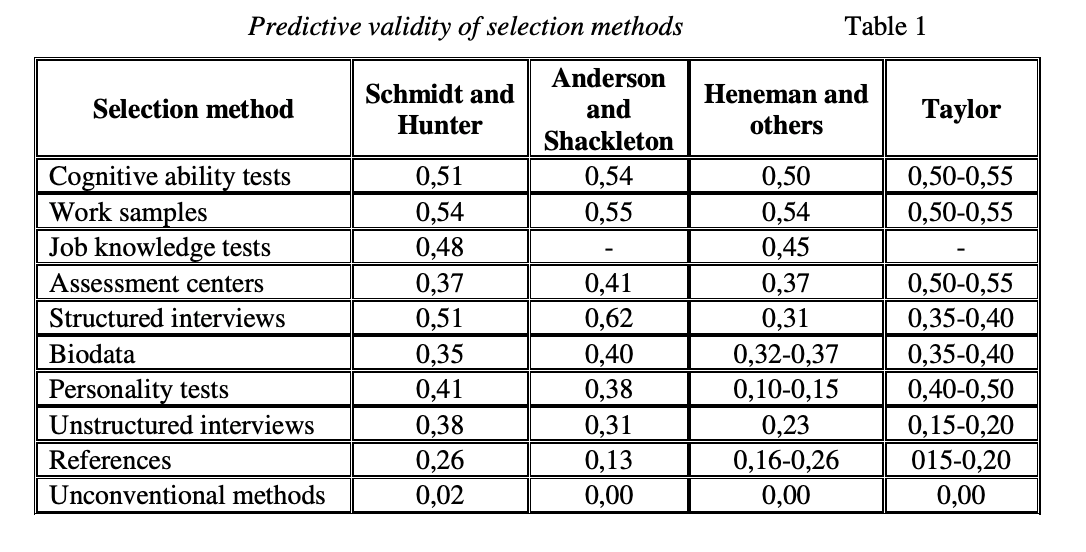
These methods survive not because they work, but because they’re familiar.
And now, as automated screening tools become the norm, we’ve taken an ineffective system and made it more exclusionary. Harvard Business School ’s 2023 study shows digital screening rejects millions of qualified candidates every year, disproportionately excluding returners, neurodivergent talent, older workers, and those with non-linear paths.
Tech isn’t solving bias.
It’s industrialising it.
Behavioural science is clear... real-world performance is best predicted by what people do, not what they say they’ve done.
Top predictors include:
scenario-based judgement
cognitive adaptability
work-sample tests
values-led behavioural assessment
decision-making patterns
judgement under uncertainty
observable behaviours in context
These aren’t “nice to have” qualities... they’re the difference between someone who thrives and someone who gets pulled underwater.
Yet these qualities are almost never assessed before a CV - in whatever fancy form - is reviewed.
This is the root of the problem.
Most organisations treat scenarios as a later-stage exercise. But by the time scenarios appear, most of the potential talent has already been screened out by keyword matching or unexamined bias.
This is why a scenario-first approach matters.
Many organisations have embraced scenario assessments, but they place them inside the existing recruitment process... after CV screening, after AI filtering, after the applicant pool has already been narrowed.
By then, most of the damage is done.
The people who think differently, who could thrive in ambiguity, who lean into values-led decision making... many never even reach the scenario stage.
These organisations aren’t selecting for capability.
They’re selecting for paperwork.
Scenario-first hiring changes that entirely.
Instead of starting with:
job titles
years of experience
keyword scoring
conventional career paths
You start with:
How do you think?
How do you decide?
How do you respond to the real scenarios this role will demand?
Do your values align with how we operate now and where we are going?
This shift transforms recruitment from a filtering process into a selection process.
It reveals capability before bias can take root.
You measure thought process, judgement, values alignment... not polish, confidence, privilege, or career neatness.
It opens the door to hidden or non-traditional talent.
People with atypical paths often excel when given a scenario, even if they’d be screened out by a CV.
It forces the business to define “what good looks like” before hiring begins.
You cannot design high-quality scenarios without clarifying:
your real values
your long-term direction
the decisions the role will actually face
what judgement looks like in your environment
how this role supports the broader organisational vision
This level of clarity strengthens leadership, alignment, onboarding, and culture before a candidate ever walks through the door.
Scenario-based hiring inside the pipeline is evolutionary.
Scenario-first hiring is revolutionary.
Fast-growth tech environments are defined by ambiguity.
Priorities shift weekly.
Teams grow and reconfigure.
Leaders make decisions under pressure.
Projects demand adaptability, judgement, cross-functional collaboration, and the ability to operate with incomplete information.
Traditional hiring can’t spot these traits early. Scenario-first hiring can.
Candidates who excel in scenario-based pre-vetting tend to:
navigate uncertainty without panic
handle conflict without ego
prioritise intelligently
communicate clearly
adapt without losing momentum
reflect the organisation’s values in real decisions
reduce management burden rather than add to it
Roles in these environments demand more than experience. They demand the ability to operate within a living, evolving ecosystem. Scenarios first recruiting surfaces that ability instantly.
Perhaps the greatest benefit of scenario-first hiring is its unavoidable by-products: Clarity and Alignment
To build a scenario, leaders must articulate:
the business’s actual direction
the values that guide behaviour
the non-negotiables of the culture
the challenges the role will face
the decisions the role will regularly make
the responsibilities that actually matter
Roles shift from being task-based to strategically grounded.
Teams gain shared understanding.
Managers gain alignment.
Candidates gain transparency.
And the organisation avoids the chaos of hiring someone into a role no one truly understood.
Scenario-first forces the business to write the real job description... the one that describes reality, not recycled expectations.
Most companies hire by asking:
“Who has played a similar game before?”
Scenario-first hiring asks:
“Who can play our game (with our rules... in our world) and help us win the future we are building?”
It’s the difference between selecting a character based on their costume versus choosing the one whose skillset is actually built for the quest ahead.
It replaces guesswork with behaviour.
Assumptions with evidence.
Scenario-first hiring isn’t a tweak.
It’s a redesign.
And for organisations serious about long-term success, it’s the only model that makes sense.
If reading this has highlighted that your hiring model is built on outdated assumptions - or that your roles don’t yet reflect the reality of the future you’re trying to build - this is where nuutology can help.
Let’s find your wavelength and let others tune in.
Before you can hire the right people, you need the right alignment. At nuutology, we support organisations to
:
uncover their unwavering values and translate them into observable behaviours
clarify their long-term vision story so every role aligns with where the business is truly heading
articulate responsibility architecture grounded in strategy, not recycled templates
design scenario-based pre-vetting simulations that reveal real capability
facilitate alignment workshops to ensure leaders know what “good” actually looks like
embed a hiring approach where decision-making, judgement, and values matter more than keyword-matching
If you’re ready to move from hiring history to hiring capability
...if you want to choose players who can actually win in your world
...then it’s time to redesign the game.
Start your next hire with clarity, alignment, and a better strategy. Let’s build a system that finds the right people.
Comments
Nothing yet. Say the first thing.
Sign in to join the conversation.