
Here is Maria Gutschi’s article:
After spending two or more hours writing extensive comments, I found that her article has no place for comments. Here they are, with some illustrations and graphs.
(*) After I published this article, Maria Gutschi turned comments on, so I wrote one there, linking to here. She later commented most appreciatvely, mentioning that she supplements 100 mg (4000 IU) vitamin D3 a day and that her circulating 25-hydroxyvitamin D level is 100 ng/mL. She had considered writing about vitamin D as well. In her comment she also mentions using multiple doses of 1 gram oral liposomal vitamin C (ascorbic acid) to help treat infections, both bacterial and viral, along the lines of Dr Paul Marik’s vitamin C infusion treatment, with thiamine and hydrocortisone, for sepsis: 2019-07-03 video: www.youtube.com/watch?v=OOmd2R9LM84.
I put the vitamin D comments last here, because many Nutrition Matters readers will already be familiar with what I wrote, except for my hypothesis about why the Coimbra high 25-hydroxyvitamin D protocol suppresses much the same set of inflammatory conditions as helminthic therapy - the introduction of relatively benign intestinal worm infestations.
The following comments start with notes on an article about the need for urgent antibiotic treatment in sepsis, and about tea tree oil and its use for antibiotic resistant bacteria.
Thanks very much for this treatise on bacteria and antibiotics. Many illnesses were more common, horrific and deadly before antibiotics became widely available.
At a pinch, tea tree oil can be employed. Toxicity seems only to be a problem for very high oral overdoses, as a CNS suppressant onlinelibrary.wiley.com/doi/full/10.1002/ptr.7687, and topically as a cause of allergic contact dermatitis: www.consultant360.com/content/allergic-contact-dermatitis-tea-tree-oil. There are concerns about it being an endocrine disruptor, activating estrogenic receptors: academic.oup.com/jcem/article/104/11/5393/5544509 which are not supported - but I think not disproven - by pmc.ncbi.nlm.nih.gov/articles/PMC10769481/, doi.org/10.17925/EE.2023.19.2.9 and www.sciencedirect.com/science/article/abs/pii/S0965229919316760.
An incompetent dentist placed crowns on two of my teeth without root canal treatment, despite me querying her about the wisdom of doing so. They both become infected and mobile to the point where they would have fallen out within a few weeks. A competent dentist gave me an oral antibiotic, which helped, but I switched to crushing the tablets and applying small fractions of a tablet’s worth directly on the tooth and adjacent gums, which worked very well. When these tablets ran out, with months to go before having the crowns removed and proper root canal fillings, I used topical tea tree oil - on a cotton bud AKA Q-tip - to suppress the infection. The teeth survived, with little mobility, until this treatment - and I still have them 25 years later.
More recently I had a sudden mild fever and a mid-lower-back ache on one side. I had no idea of the cause, which turned out to be a kidney infection caused by one or more relatively small kidney stones. I applied several drops of tea-tree oil transdermally, I forget where - it wasn’t at that site. The fever and soreness subsided in an hour or two and this told me that it that the cause of both symptoms was most likely a bacterial infection. After a trip to my doctor and an ultrasound I fully understood what had happened.
I wonder to what extent tea tree oil might be effective against the various strains of bacteria, with their resistance-conferring plasmids (academic.oup.com/ismej/article/18/1/wrad032/7513094), which are resistant to conventional antibiotics. As with vitamin D3, there’s no strong economic impetus to research tea tree oil, since it is cheap and unpatentable.
A quick Google Scholar search for MRSA “tea tree oil” turns up research from the late 1990s onwards. It would be a lot of work to find the most significant articles in this field. Picking a recent article almost at random - from an Iranian pediatric team - jpc.tums.ac.ir/index.php/jpc/article/view/577, topical chlorhexidine and tea tree oil was compared in an open-label trial for suppressing Methicillin-resistant Staphylococcus Aureus (MRSA) colonization in non-intact skin of hospitalized patients:
The mean ± SD of the growth inhibition zone against MRSA was 19.20 ± 3.73 and 33.41 ± 9.53 for chlorhexidine and TTO, respectively. Conclusion: TTO body wash proved to be more effective than chlorhexidine in MRSA decolonization in hospitalized children. Implementation of such decolonization can improve patients’ outcomes and prevent MRSA transmission.
[Maria Gutschi lamented that an important article on the need for very rapid antibiotic treatment of sepsis was behind a paywall. She reproduced one graph from the article. Here is another. It refers to the time after the onset of hypotension - dangerously low blood pressure - in septic shock.]
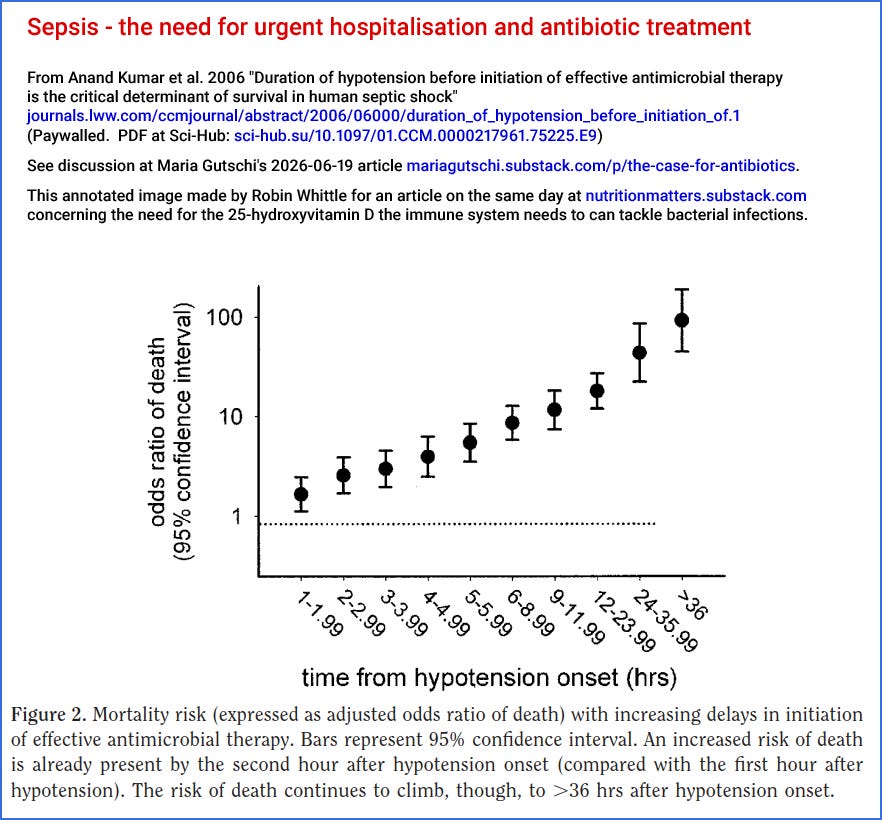
The PDF of Anand Kumar et al. 2006 “Duration of hypotension before initiation of effective antimicrobial therapy is the critical determinant of survival in human septic shock” journals.lww.com/ccmjournal/abstract/2006/06000/duration_of_hypotension_before_initiation_of.1.aspx is available at Alexandra Elbakyn’s Sci-Hub: sci-hub.su/10.1097/01.CCM.0000217961.75225.E9.
Sepsis mortality or at least hospital stay time can be reduced by rapid increase in 25-hydroxyvitamin D levels from the typical very low levels such as 10 ng/mL to at least 50 ng/mL. 12.5 mg (500,000 IU) vitamin D3 over several days can do this, but it takes a few days to be hydroxylated in the liver: Han et al. 2016 https://www.sciencedirect.com/science/article/pii/S2214623716300084 discussed at: aminotheory.com/cv19/#2016-Han.
A much better approach is recommended by New Jersey based Professor of Medicine Sunil Wimalawansa: a single oral dose of about 0.014 mg calcifediol (which is 25-hydroxyvitamin D), and so about 1 mg for average weight adults. This is more easily absorbed than vitamin D3, due to having two rather than one hydroxyl groups. It goes straight into circulation, so there is no multi-day delay due to 25-hydroxylation in the liver. See: https://vitamindstopscovid.info/00-evi/#4.7. At least 50 ng/mL circulating 25-hydroxyvitamin D can be attained, even from very low baseline levels, in 4 hours or less.
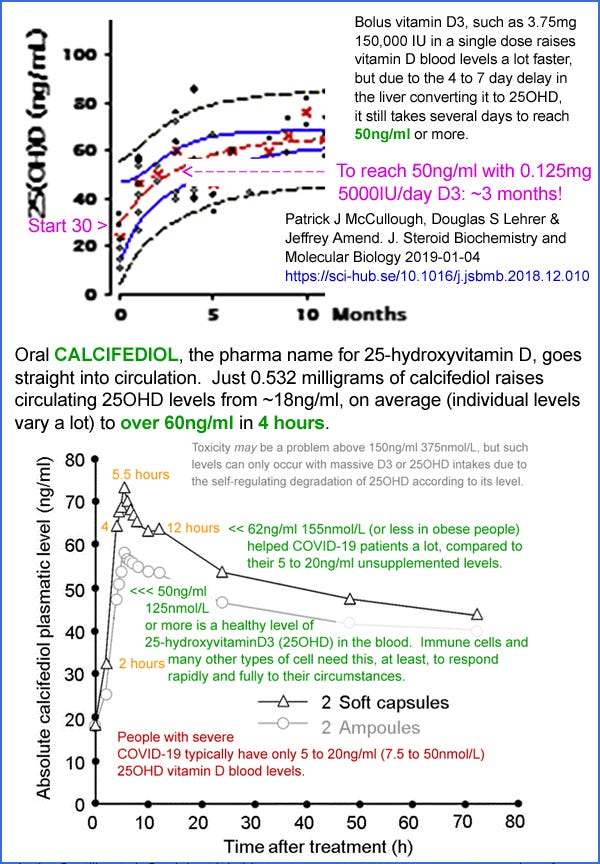
(The top graph is from sci-hub.su/10.1016/j.jsbmb.2018.12.010. The bottom graph is from patents.google.com/patent/WO2016124724A1/.)
See also an RCT of 0.532 mg of calcifediol on day 1, with half this days 3 and 7 for hospitalized COVID-19 patients, which should have alerted the entire world to the importance of suppressing transmission with supplemental vitamin D3 and treating acute disease with calcifediol: Castillo et al. 2020 www.sciencedirect.com/science/article/pii/S0960076020302764. See discussion and a preprint regarding the imperfectly randomized control group: vitamindstopscovid.info/00-evi/#castillo.
I wrote recently about sepsis and early treatment with calcifediol - as well as the risk of it developing surely being lower with higher baseline 25-hydroxyvitamin D levels: nutritionmatters.substack.com/p/032-sepsis-prevention-and-treatment. I am not in medicine - I am an electronic technician and computer programmer - but I wanted to convey the urgency of getting people to hospital if they are going downhill rapidly.
Sepsis killed ca. 11 million people worldwide in 2017: https://www.thelancet.com/journals/lancet/article/PIIS0140-6736(19)32989-7/. From all I have read, even the best clinicians cannot reliably spot it in time - since there are so many ways a patient can present, which are much like other conditions - but the person is rapidly developing sepsis which can kill them in hours.
Regarding immune competence, seasonality and immunoscenescence in the elderly, it is not widely enough known that the immune system can only work properly - at least regarding suppressing largely bacterial post-operative infections - if there is at least 50 ng/mL circulating 25-hydroxyvitamin D.
Many types of immune cell needs this as a raw material to be used in their 25-hydroxyvitamin D to calcitriol (1,25-dihydroxyvitamin D) intracrine and paracrine signaling systems. These are crucial to the ability of each cell to alter its behaviour according to its changing circumstances.
Intracrine signaling occurs entirely within an individual cell. Paracrine signaling detects a condition in one or more cells of a particular type, which produce sufficient calcitriol to diffuse to nearby cells (likely of different types, as far as I know) which change their behavior accordingly. The diffusion is at a local level well above the very low level of kidney-produced calcitriol, ca. 0.05 to 0.1 ng/mL, which functions as a hormone so the kidneys can control the behaviour of several types of cell in distant parts of the body which are concerned with calcium-phosphate-bone metabolism.
These two signaling systems are unrelated to hormonal (endocrine) signaling. Few otherwise vitamin D aware clinicians and researchers, and very few immunologists, understand these signaling systems, because they were only discovered in recent years and because there is not yet, as far as I know, a tutorial in the peer reviewed literature. I wrote a non-peer-reviewed tutorial in 2020: vitamindstopscovid.info/02-intracrine/. A simpler version is: vitamindstopscovid.info/00-evi/#02-compounds.
The most precise evidence for the need for at least 50 ng/ml is from researchers at Massachusetts General Hospital who report that the risk of post-operative infections with pre-operative 25-hydroxyvitamin D at or above 50 ng/mL (125 nmol/L = 1 part in 20,000,000 by mass) is about 2.5% for, separately, surgical site infections and hospital acquired infections. At lower levels, the risk rises dramatically. At 20 ng/mL, which is a normal level for many people (and some have 5 ng/mL or less), the risk of each of these two types of post operative infection is about 25%. Quraishi et al. 2014 jamanetwork.com/journals/jamasurgery/fullarticle/1782085 PDF at: https://www.researchgate.net/publication/258957847_Association_Between_Preoperative_25-Hydroxyvitamin_D_Level_and_Hospital-Acquired_Infections_Following_Roux-en-Y_Gastric_Bypass_Surgery. Discussion and the two graphs combined: vitamindstopscovid.info/00-evi/#00-50ngmL:
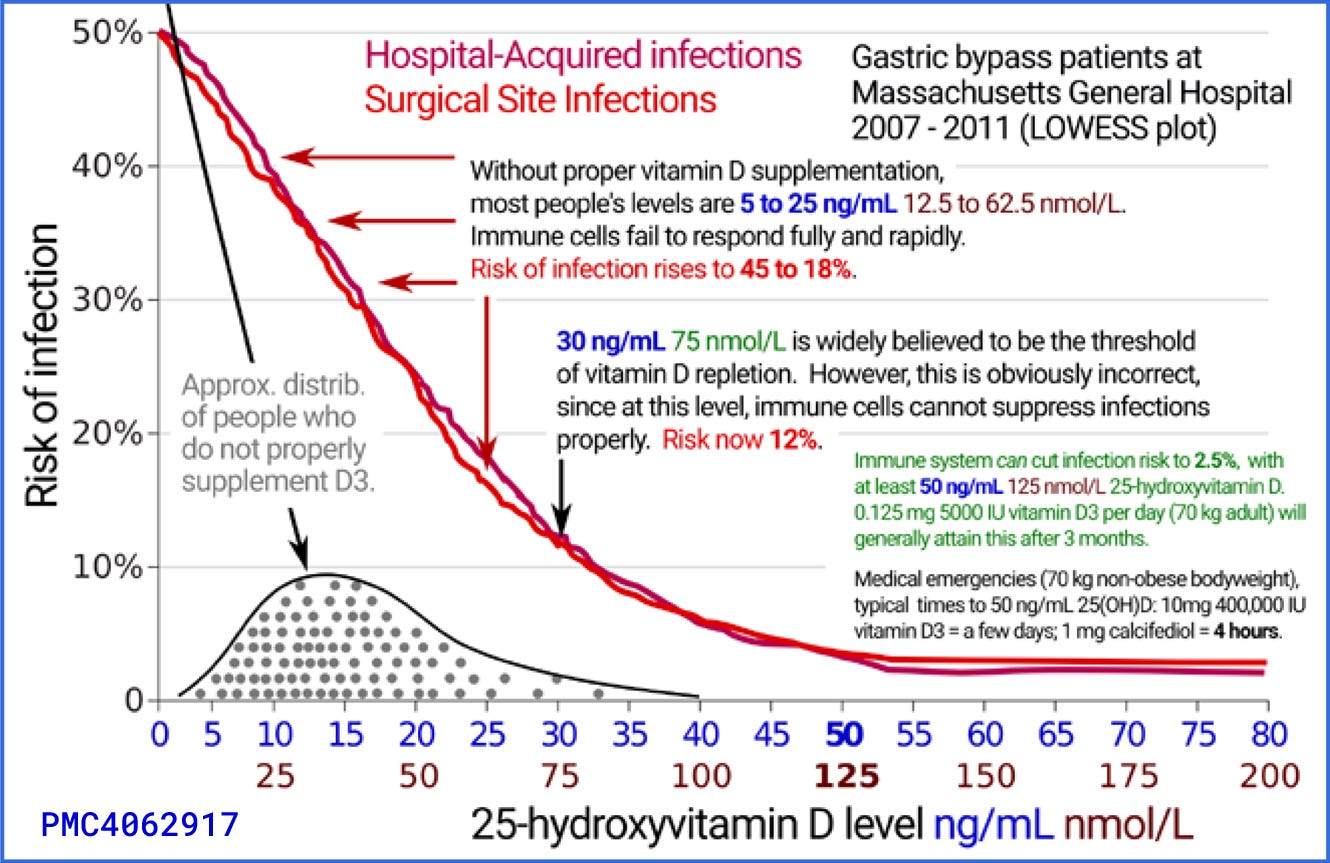
The patients were all suffering from what is now called obesity III and had the same Roux-en-Y gastric bypass surgery for weight loss. There’s no reason to believe that people suffering from obesity need significantly higher 25-hydroxyvitamin D levels to run their immune systems, so these observations can be generalized to all people.
At https://vitamindstopscovid.info/00-evi/#02-compounds you can read the recommendations of Prof. Wimalawansa - as he has written in several peer-reviewed articles and provided in an FLCCC/IMA webinar - on how much vitamin D3 to supplement, on average, per day, in order to maintain at least the 50 ng/mL level of circulating 25-hydroxyvitamin D the immune system needs, without the need for blood tests or medical monitoring.
For 70 kg (154 lb) body weight, without obesity, 125 micrograms (5000 IU) is a good amount. The actual amount depends on body weight and obesity status, since by two mechanisms at least (https://vitamindstopscovid.info/00-evi/#obesity-deficit), obesity reduces the body’s ability to maintain a good level of circulating 25-hydroxyvitamin D.
25-hydroxyvitamin D to calcitriol intracrine signaling is sometimes referred to as “autocrine” signaling. I made this mistake at first, as did the researchers who elucidated this signaling system in greatest detail, in Th1 regulatory lymphocytes from the lungs of hospitalized COVID-19 patients: Chauss et a. 2021: www.nature.com/articles/s41590-021-01080-3. PDF at: sci-hub.su/10.1038/s41590-021-01080-3.
In intracrine signaling, a cell-type-specific condition is detected by a single cell, which results in the intracellular production of ligand. (In these Th1 cells, a high level of a complement protein triggers the intracellular production of both the 1-hydroxylase enzyme and the “vitamin D receptor”, really the calcitriol receptor. The enzyme turns 25-hydroxyvitamin D into calcitriol, which is the ligand.) The ligand binds to a receptor inside the cell and this results in changes in cellular behavior. (In this case, the calcitriol binds to the VDR molecules and the bound pair find their way to the nucleus where they further bind to retinol X. The triple complex causes cell-type specific up- and down-regulation of gene transcription to mRNA, for dozens to hundreds of genes, thereby altering protein synthesis and so the cell’s behaviour in a cell-type specific manner. For these Th1 cells, the change is to switch from a pro-inflammatory mode of producing a pro- and an an anti-inflammatory cytokines to an anti-inflammatory mode.)
Autocrine signaling is similar, but the ligand leaves the cell and binds to receptors of the same cell which are displayed on the outside of the plasma membrane. This does not occur in Th1 cells, or any other cells using 25-hydroxyvitamin D to calcitriol signaling, as far as I know.
This is a dense article - see my summary at: https://aminotheory.com/cv19/icu/#2021-Chauss.
This intracine signaling system did not work in these Th1 cells, so the inflammatory immune responses continued indefinitely. These were the primary cause of death from COVID-19: destruction of the pulmonary endothelium inducing hypoxia and this damage triggering hypercoagulative blood which caused micro-embolisms and larger clots to damage the lungs, CNS, liver, heart and other organs.
Chauss et al. did not have data on the patients’ level of circulating 25-hydroxyvitamin D, but it is well known that low levels cause more severe COVID-19 symptoms. If these people had had a good, 50 ng/mL or more, level of circulating 25-hydroxyvitamin D, they would generally have been able to suppress the viral infection before it reached the lungs, and so would not have been hospitalized.
Chauss et al. concluded that the reason for the failure of this (intracrine) signaling system to operate successfully was largely or entirely due to inadequate levels of 25-hydroxyvitamin D in the cytosol of the Th1 cells.
This is relevant to many conditions, including, I think, as you wrote about Rheumatic Heart Disease in Boston children in the 1920s and 1930s:
This is the crazy part of ARF. It is an immune response to the bacteria.
The prevalence of numerous inflammatory diseases and chronic conditions is likely due partly to low 25-hydroxyvitamin D (Boston is far from the equator) and, more fundamentally, due to lack of helminths: vitamindstopscovid.info/06-adv/#02-helminths.
A brief account of this is that the innate and adaptive immune responses, including antibodies and macrophages, which work on single-cell organisms and viruses are no use against multicellular parasites, which evolve thick protective layers. Consequently, vertebrates (at least) developed indiscriminate cytotoxic immune responses - often referred to as inflammatory responses - such as those mediated by eosinophils, the suicide bombers of the immune system. They arrive on the scene and disintegrate, with the enzymes from their vacuoles destroying DNA, RNA and protein of all cells in the area, as well as of any viruses.
Multicellular parasites, such as helminths (intestinal worms) long ago evolved to exude compounds which down-modulate these inflammatory immune responses which target them. In response, the hosts (our mammalian ancestors and so humans today) evolved overly-strong inflammatory responses in order to counteract this down-modulation from helminth infections which were typically ubiquitous until the early 20th century or so.
Now we have all been dewormed, our inflammatory indiscriminate cytotoxic immune responses are at a generally unhealthily high, likely self-destructive, level, with considerable variation between individuals due to genetic differences.
Low 25-hydroxyvitamin D would allow greater growth of the original pharyngitis bacteria and poorer regulation of the excessive inflammatory responses which may be triggered by this infecting the heart tissue.
A curious relationship has, as far as I know, yet to be explored properly by researchers. Two totally different treatments reliably suppress much the same set of chronic inflammatory disorders, including multiple sclerosis and psoriasis: Firstly, introducing relatively benign helminth infections: helminthictherapywiki.org. Secondly, the Coimbra and similar very high 25-hydroxyvitamin D protocols: vitamindstopscovid.info/06-adv/#01-higher which achieve circulating 25-hydroxyvitamin D levels in the 100 to 200+ ng/mL range, with care to avoid hypercalcemia.
I am yet to update the above page with the following hypothesis about why the Coimbra protocols works. Since 25-hydroxyvitamin D has a smaller, but still significant, affinity to bind with VDR than does calcitriol, if the intracellular level of 25-hydroxyvitamin D in Th1 lymphocytes is high enough, then (assuming some VDR is present in the cells without the intracrine signaling system being triggers, which I think is realistic) then there is sufficient binding between VDR molecules and 25-hydroxyvitamin D to cause the newly constituted Th1 cell to never fully behave according to its pro-inflammatory startup program (see Chauss et al.), as if the intracrine signaling system has already switched the cell to its anti-inflammatory shutdown program.
The Coimbra physicians seem not to be aware of 25-hydroxyvitamin D to calcitriol intracrine and paracrine signaling.
Early to mid-20th century TB treatments in Switzerland and other countries took patients up to mountain elevations and exposed them to lots of UV-B light, which breaks a carbon ring in 7-dehydrocholesterol so the molecule becomes vitamin D3 cholecalciferol. This is hydroxylated, mainly in the liver to the 25-hydroxyvitamin D the immune system needs.
In this 2017 article “Sanatoria revisited: sunlight and health” journals.sagepub.com/doi/10.4997/jrcpe.2017.314 PDF: sci-hub.su/10.4997/jrcpe.2017.314 Greenhaigh and Butler suggest, referring to antibiotics as “chemotherapy” that
. . . heliotherapy was more successful in treating tuberculosis than was appreciated once chemotherapy became available
through the actions of vitamin D and nitric oxide.
There’s lots of research on low 25-hydroxyvitamin D being a risk factor for TB: scholar.google.com.au/scholar?hl=en&as_sdt=0%2C5&q=TB+%22vitamin+D%22&btnG=.
Searching for images of these high altitude sanatoriums, with people basking in the sun, I found one far more spectacular than those I had seen before:

Comments
Nothing yet. Say the first thing.
Sign in to join the conversation.